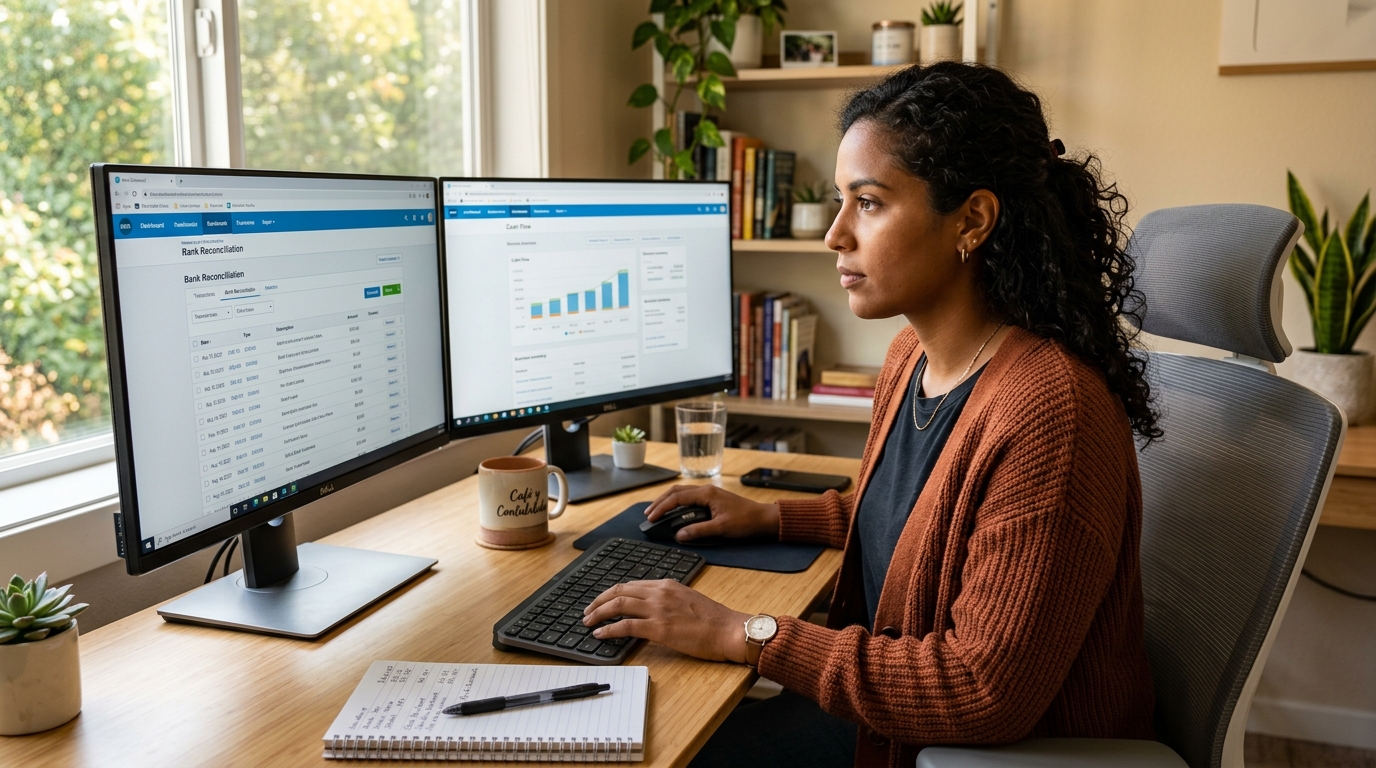
Nearshore Xero virtual bookkeepers are one of the fastest-growing hires in small business finance right now — and for good reason. Latin America-based bookkeeping professionals who work US business hours, speak fluent English, and live inside Xero all day give you something offshore teams in the Philippines or India simply cannot: real-time collaboration that feels like an in-house hire. This guide covers everything — how Xero stacks up against the competition, what a virtual bookkeeper actually costs, how to transition your books to the cloud, and how to make sure you hire the right person the first time.
According to the U.S. Bureau of Labor Statistics (2024), the median annual wage for bookkeeping and accounting clerks is $47,440 — meaning a full-time in-house hire costs most small businesses well north of $55,000 once you add payroll taxes, benefits, and recruiting. A fully managed nearshore virtual bookkeeper at $2,500/month comes in at $30,000/year all-in. The math is not subtle.
What Is a Xero Virtual Bookkeeper, Exactly?
A Xero virtual bookkeeper is a remote accounting professional whose primary working environment is Xero's cloud accounting platform. They reconcile bank transactions, manage accounts payable and receivable, generate financial reports, handle invoicing, and keep your books audit-ready — all without sitting in your office. The "virtual" label simply means they work remotely, typically over a secure cloud connection directly into your Xero organization.
What separates a good Xero virtual bookkeeper from a mediocre one is depth of platform knowledge. Xero has hundreds of features — bank rules, tracking categories, purchase orders, multi-currency, Xero HQ for practice management — and a bookkeeper who knows them cold will save you hours every week that a generalist will waste clicking around menus.

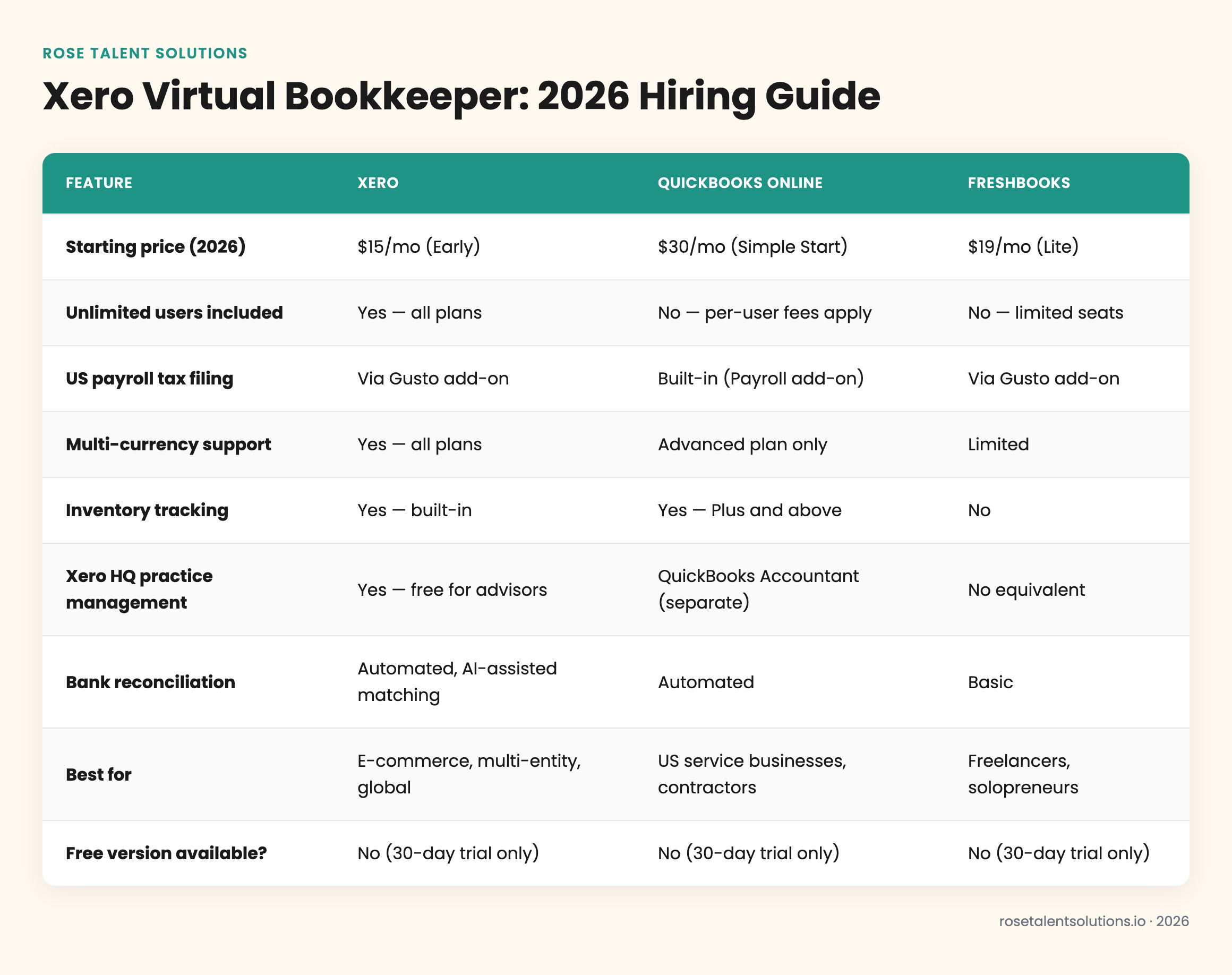
Is Xero as Good as QuickBooks in 2026? An Honest Comparison
This is the question every small business owner asks before committing to a platform. The honest answer: it depends on your business model. Xero tends to win for product-based businesses, e-commerce operators, and multi-entity structures. QuickBooks Online still dominates for US-based service businesses, especially those with existing accountants already in the QBO ecosystem. Neither is universally superior — but knowing the difference before you hire a virtual bookkeeper matters, because switching platforms mid-stream is painful.
FreshBooks is worth mentioning for solo consultants and freelancers who need clean invoicing more than deep accounting. Wave is technically free but lacks the integrations and reporting depth that growing businesses need. If you want a deeper look at what a QuickBooks virtual bookkeeper costs compared to Xero, Rose has a full breakdown in a companion post.
| Platform | Monthly Cost (Base) | Best For | US Tax Forms | Payroll Integration | VA Availability |
|---|---|---|---|---|---|
| Xero | $15–$78/mo | Multi-entity, e-commerce, global | Partial (1099 via partners) | Gusto, Rippling | High — growing fast |
| QuickBooks Online | $35–$235/mo | US service businesses, contractors | Full (1099, W-2 native) | QBO Payroll native | Very high — dominant |
| FreshBooks | $19–$55/mo | Freelancers, solo consultants | Limited | Gusto (add-on) | Moderate |
| Wave | Free (paid add-ons) | Micro-businesses, side hustles | Limited | Wave Payroll ($40+/mo) | Low |
Is Xero Free for Bookkeepers? Pricing Reality in 2026
Xero is not free for bookkeepers or their clients. Xero's current US pricing runs from $15/month (Early plan, limited invoices) up to $78/month (Ultimate plan with full payroll and project tracking). For most small businesses, the Established plan at $47/month is the practical starting point.
Xero does offer discounted partner pricing through its Xero HQ practice management portal. Xero HQ is a free hub for accounting and bookkeeping practices — it lets bookkeepers manage multiple client organizations, track deadlines, and collaborate across their client book from a single dashboard. If you're hiring a bookkeeper who manages your Xero file as part of a broader practice, they may be able to pass partner discounts to you. That said, Xero's "accounting software free download with crack" searches you see online are dangerous territory — pirated or cracked versions of cloud software don't exist in any functional sense (Xero is browser-based), and sites offering them are almost universally malware vectors. Stick to the official platform.
One thing worth knowing: Xero offers a 30-day free trial directly on their website for new business accounts. This is Xero's own promotion — it has nothing to do with hiring a bookkeeper. Your bookkeeper will need to be invited as a user or advisor into your organization once your trial ends and you're on a paid plan.
"The total cost of bookkeeping isn't the software subscription — it's the hours your team spends doing work that should be automated or delegated. Most businesses are paying twice: once for the tool and once for the inefficiency." — Kenji Kuramoto, Founder & CEO at Acuity (2023)
How to Transition From Spreadsheets to Xero Bookkeeping Software in 2026
Moving from spreadsheets — or from a desktop accounting tool like QuickBooks Desktop — to Xero is one of the highest-leverage operational upgrades a small business can make. McKinsey's research on business automation (2023) consistently shows that finance and accounting functions are among the highest-ROI targets for workflow digitization, with up to 60% of finance tasks automatable using current tools. Xero's bank feed, rules engine, and app marketplace are built exactly for this shift.
The biggest mistake businesses make when switching to Xero is treating it as a data migration project instead of a process redesign. A trained Xero virtual bookkeeper doesn't just move your old spreadsheet rows into new columns — they rebuild your chart of accounts, set up automated bank rules, and connect your payroll and e-commerce integrations from day one.
If you're also weighing whether to bring bookkeeping fully in-house versus outsourcing it, this guide on outsourcing bookkeeping for small businesses walks through the decision framework in detail — including when outsourcing makes sense and when it doesn't.
Audit Your Current Books
Before migrating anything, reconcile your most recent fiscal year in your current system. Migrating clean data into Xero is fast; migrating messy data creates a clean-looking mess.
Set Up Your Chart of Accounts
Xero's default chart of accounts is a starting point, not a finish line. Your bookkeeper should customize it to match your industry, entity type, and reporting needs before a single transaction is entered.
Connect Your Bank Feeds
Link every bank account and credit card. Xero's live bank feed pulls transactions automatically — this alone eliminates hours of manual data entry every month.
Configure Automated Bank Rules
Bank rules tell Xero how to categorize recurring transactions automatically. A trained bookkeeper sets these up in the first week, so 70–80% of your reconciliation runs on autopilot.
Integrate Your Stack
Connect payroll (Gusto, Rippling), e-commerce (Shopify, WooCommerce), and CRM tools through Xero's app marketplace. Your bookkeeper manages the sync so your reports are always current.
Is Virtual Bookkeeping Worth It? The Real ROI in 2026
Virtual bookkeeping is worth it for the vast majority of small and mid-sized businesses — but the quality gap between providers is enormous. A generalist freelancer found on a gig platform and a fully vetted, platform-trained nearshore professional are not the same product. The difference shows up not in whether your bank accounts reconcile, but in whether your books are actually decision-ready — giving you the P&L clarity to know which service line to double down on and which to cut.
According to SHRM's research on cost-per-hire (2023), the average cost to recruit and onboard a single employee in the US is $4,700 — and that's before their first paycheck. For a bookkeeping role, add 3–6 months of ramp time before they're operating independently. A nearshore virtual bookkeeper through Rose is placed within days, arrives Xero-trained, and comes with a role-specific AI copilot already calibrated to their software stack. If the placement isn't the right fit, Rose replaces them at no additional cost — that's the risk reversal that makes the decision straightforward.
For accounting firms specifically, the calculus is even clearer. Practices that outsource junior bookkeeping work free up senior staff for advisory and tax strategy — the work that actually commands premium fees. Rose's post on accounting firm practice strategy and outsourcing covers how forward-thinking CPA and bookkeeping practices are restructuring their service delivery around nearshore talent.
Nearshore vs. Offshore Xero Bookkeepers: Why Location Still Matters in 2026
The nearshore vs. offshore debate often gets framed as a pricing conversation. It's actually a workflow conversation. A bookkeeper in the Philippines or India who works a 9-hour time-shifted schedule will batch your questions, process your reconciliations overnight, and deliver answers the next morning. That's fine for month-end closes — it's a friction tax on everything else. Every urgent vendor dispute, every same-day wire question, every "what's our cash position right now" moment hits a wall when your bookkeeper is asleep.
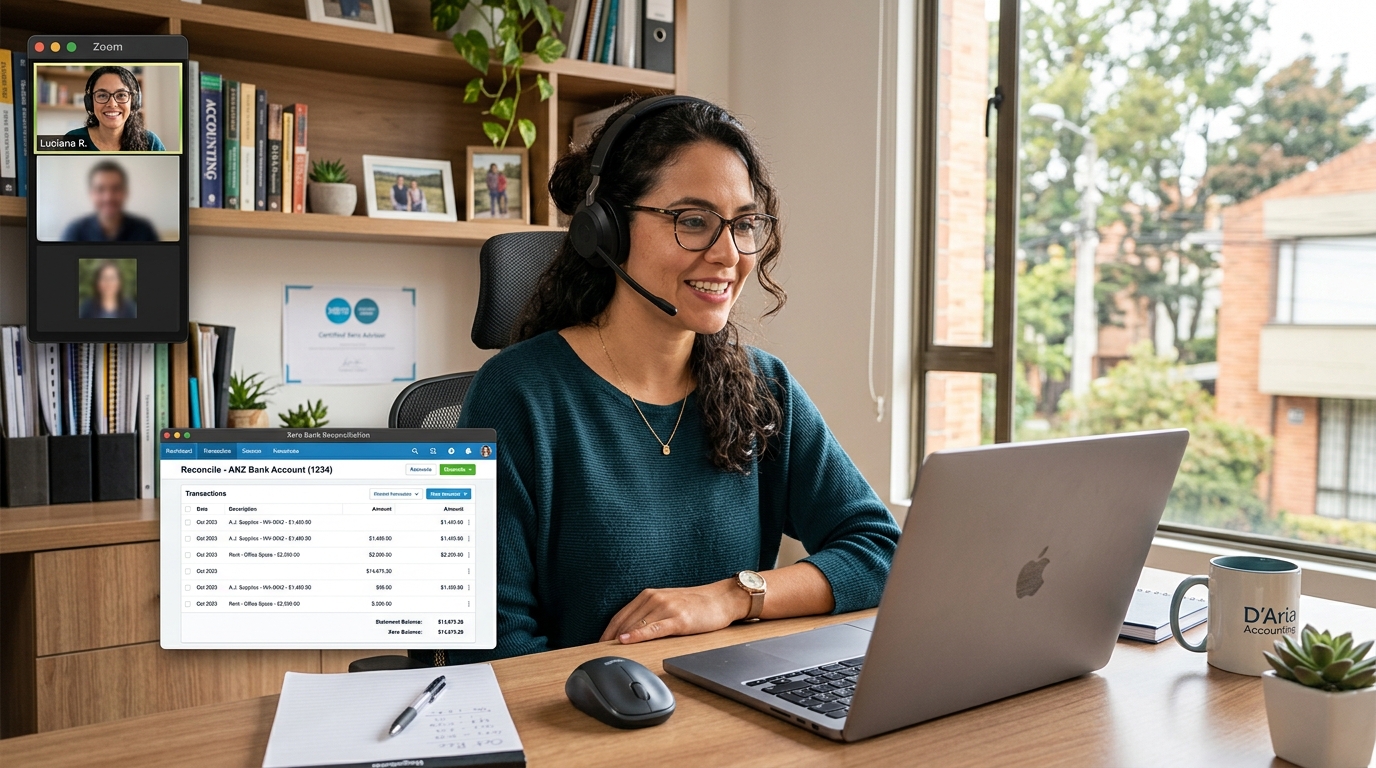
Nearshore team members — based in Colombia, Mexico, Argentina, Costa Rica, and across Latin America — work the same hours you do. They're on Slack at 9am Eastern. They're on a Zoom call by 9:15 if something needs explaining. According to Gallup's State of the American Workplace research, collaboration quality and real-time responsiveness are among the top drivers of knowledge worker productivity. Time zone alignment is not a nice-to-have — it's a force multiplier.
Rose's bookkeeping and accounting virtual staff are recruited specifically for Xero and QuickBooks proficiency, screened at 8/10+ English fluency, and placed on a no long-term contract, month-to-month basis. You're not locked in. If you want to understand the full pricing picture alongside QuickBooks options, the QuickBooks virtual bookkeeper cost guide covers both platforms side by side.
Nearshore Xero VA (Latin America)
- Same US business hours — real-time collaboration
- English fluency at 8/10+ screened bar
- 1–3 hour time zone difference maximum
- Cultural alignment with US business norms
- Xero and QuickBooks platform-trained on hire
- Flat $2,500/month — recruiting, HR, payroll included
Offshore Xero VA (Philippines / India)
- 9–12 hour time zone gap creates overnight delays
- Variable English proficiency — no standardized bar
- Async-only workflow for most real-time questions
- Platform training often self-reported, unverified
- Hidden coordination costs (extra PM overhead)
- Pricing may appear lower but TCO is often comparable