
What Is Accounting Firm Practice Strategy — and Why Does It Matter in 2026?
Practice strategy is the operating blueprint that connects your firm's day-to-day decisions to its long-term growth targets. It covers who you serve, how you price, how work flows through your team, and which roles you hire — or outsource — to fill capacity gaps. Without it, most accounting firms grow reactively: they add clients until the team breaks, then scramble to hire.
Rose Talent Solutions is a nearshore virtual staffing agency — every team member is based in Latin America and works US business hours alongside your staff. That distinction matters enormously for accounting firms, where real-time client communication and same-day turnaround are baseline expectations. Latin America's time zones align directly with US business hours, which is a structural advantage no offshore arrangement can replicate.
A formal accounting firm practice strategy answers three questions: Where are we going? (firm growth targets, niche positioning), How do we get there? (service mix, pricing model, technology stack), and Who does the work? (internal team structure plus nearshore virtual staff). That third question is where outsourcing enters the picture — and where most firms leave significant margin on the table.
Capacity is a strategy problem, not just a hiring problem. Firms that treat it purely as headcount often over-hire senior staff for tasks that a well-trained virtual bookkeeper or accounting virtual assistant could handle at a fraction of the cost. That misallocation quietly erodes profit margins year after year, according to AICPA-CIMA's PCPS Top Issues Survey (2023).
How to Build a Practice Development Framework That Actually Scales in 2026
Practice development is the ongoing process of improving firm performance across client acquisition, service delivery, and team capability. The firms growing fastest in 2026 treat it as a structured discipline, not a vague aspiration. A workable framework has four layers.
Layer 1 — Positioning: Define the niche you serve best (real estate investors, e-commerce brands, law firms, etc.) and price your services to reflect specialized value. Generalist accounting firms compete on price; specialist firms compete on expertise. Layer 2 — Delivery systems: Document every repeatable workflow — monthly close, payroll processing, tax prep — so any trained team member can execute it consistently. Layer 3 — Technology stack: Standardize on two or three platforms (QuickBooks Online, Xero, or industry-specific tools) and build your team's proficiency around them. Layer 4 — Capacity planning: Model headcount needs 90 days ahead so you're never hiring in a panic at the worst possible time.

Technology adoption is the layer where most firms stall. The Journal of Accountancy's 2023 Technology Survey found that fewer than 40% of small and mid-size accounting firms have fully standardized their client-facing software stack — meaning the other 60% are losing time every week to tool-switching, duplicate data entry, and inconsistent outputs. That inefficiency compounds quickly as the firm grows.
This is precisely where AI-equipped nearshore staff create an outsized return. Rose Talent Solutions equips every team member with a role-specific AI copilot trained on their assigned software — QuickBooks, Xero, Karbon, or whatever your firm runs. They arrive ready to work in your tools from day one, not after a three-month learning curve.
KPIs Every Accounting Firm Should Track to Measure Practice Quality in 2026
You cannot improve what you do not measure. Accounting firm management requires a short list of leading and lagging indicators reviewed at least monthly. The firms with the clearest practice strategies are usually the ones with the tightest KPI dashboards — and they use those dashboards to make staffing decisions, not just financial reports.
Here are the seven KPIs worth tracking consistently:
- Realization rate — billable hours collected vs. billable hours worked. Target: 85%+.
- Average revenue per client — total revenue divided by active client count. Tracks pricing discipline over time.
- Client retention rate — percentage of clients retained year over year. Industry benchmark is 85–90%, according to CPA.com Research (2023).
- Staff utilization rate — billable hours per staff member per week vs. capacity. Signals over- or under-staffing before it becomes a crisis.
- Turnaround time per engagement — days from engagement start to deliverable. Client satisfaction correlates strongly with this metric.
- Net Promoter Score (NPS) — a standardized client satisfaction benchmark. Bain & Company's NPS research shows that accounting firms with NPS above 50 grow referral revenue at 2x the rate of firms below 30.
- Cost per billable hour — total staff cost divided by billable hours delivered. This is the number outsourcing directly improves.
Cost per billable hour is the KPI where nearshore outsourcing has the most immediate impact. A full-time nearshore bookkeeper or accounting support specialist through Rose costs $2,500 per month flat — that's $625 per week of dedicated 40-hour capacity, all-in. Compare that to the fully loaded cost of a US-based junior accountant, which the Bureau of Labor Statistics (2024) pegs at a median salary of $79,880 annually — before benefits, taxes, and overhead.
How Nearshore Outsourcing Compares to Offshore and Onshore for Accounting Firms in 2026
Not all outsourcing is the same. The word "outsourcing" in accounting circles often triggers memories of offshore arrangements that promised cost savings and delivered communication nightmares. Nearshore is a structurally different model — and the differences are measurable.
Nearshore virtual staff are professionals based in Latin American countries such as Colombia, Mexico, and Argentina. They work standard US business hours, hold 8/10+ English proficiency scores on standardized screens, and collaborate in real time via Slack, Zoom, and your practice management software. This is categorically different from offshore staffing, which typically means staff based in regions like Southeast Asia with a 10–12 hour time difference that batches every response overnight.
| Staffing Model | Typical Monthly Cost (Full-Time) | Timezone Overlap with US | English Proficiency | Avg. Ramp Time |
|---|---|---|---|---|
| Onshore (US-based) | $4,500 – $7,000+ | Full overlap | Native | 4 – 8 weeks |
| Offshore (non-Americas) | $1,200 – $1,800 | 0 – 4 hrs overlap | Varies (4–7/10 avg) | 6 – 12 weeks |
| Nearshore — Rose Talent Solutions (Latin America) | $2,500 flat | Full US business hours | 8/10+ screened floor | 3 – 5 weeks |
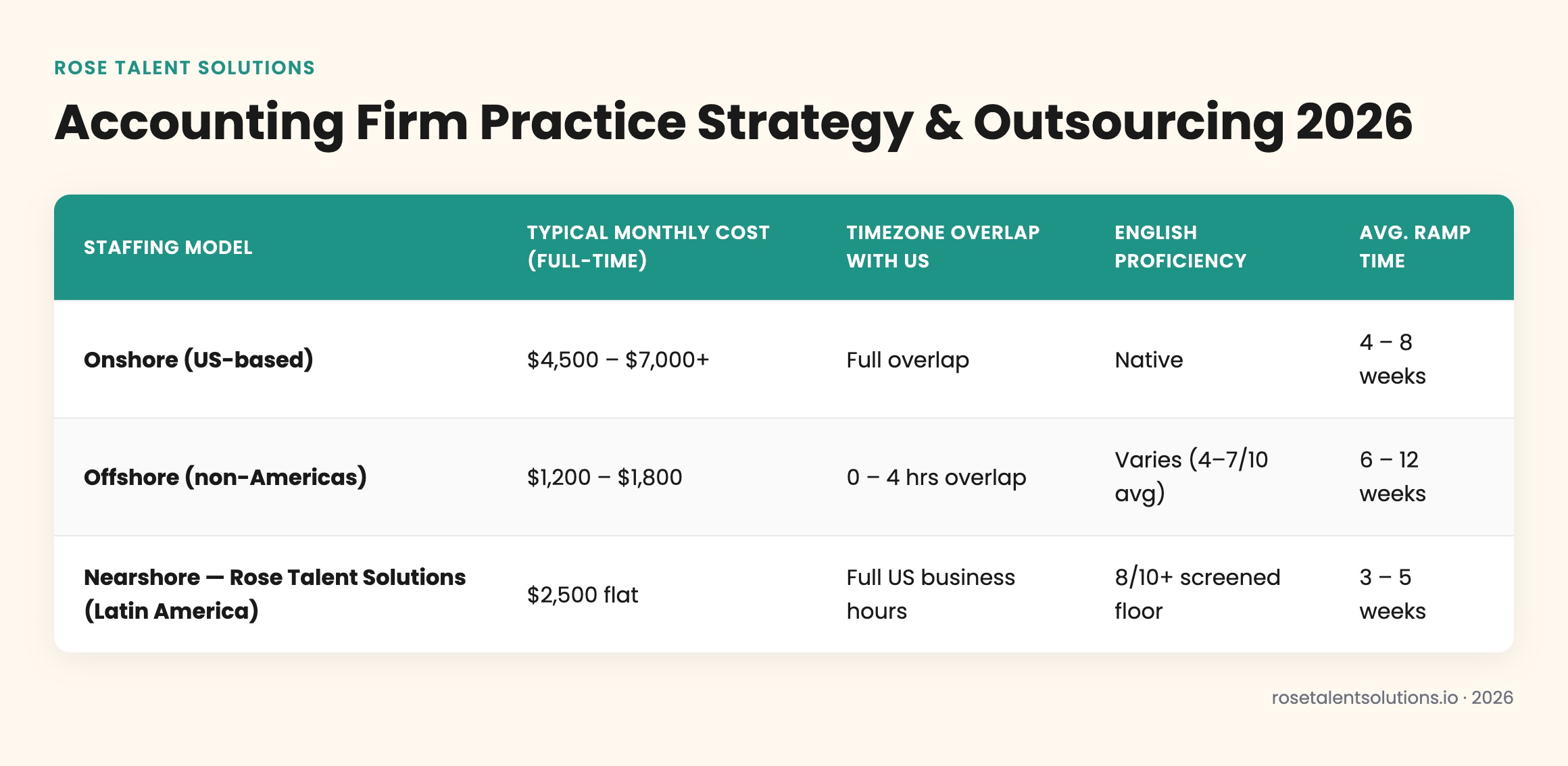
The timezone gap is the hidden cost of offshore models that rarely shows up in the initial pitch. When a client emails at 10am EST with a payroll question and your offshore support team won't see it until their next morning, that's a 12-hour delay — and potentially a lost client. Nearshore staff at Rose work your business hours, answer Slack messages in real time, and join your Monday morning standups live.
The real cost of offshore accounting support isn't the hourly rate — it's the compounding delay in every client touchpoint. A 10-hour timezone gap doesn't just slow responses; it erodes the client trust that drives referrals and retention, which are the two highest-ROI growth levers for any accounting firm.
English proficiency matters more in accounting than in almost any other outsourced function. Miscommunication about a tax deadline or a bank reconciliation discrepancy isn't a minor inconvenience — it creates liability. Rose's published proficiency floor is 8/10 on standardized English screens, which is why accounting firms consistently report that their nearshore team members communicate at a level indistinguishable from a domestic hire.
What Roles Can Accounting Firms Outsource to Nearshore Virtual Staff?
The scope of what's outsourceable has expanded significantly in the past three years, driven by cloud-based accounting software and AI-assisted workflows. Accounting firm management teams that outsourced only data entry a decade ago are now outsourcing entire service lines to trained nearshore professionals based in Latin America.

Common roles accounting firms outsource through Rose include:
- Bookkeeping and monthly close support — bank reconciliations, categorization, GL maintenance. See our dedicated bookkeeping-accounting service page for scope details.
- Accounts payable and receivable processing — invoice coding, vendor payments, collections follow-up.
- Payroll administration — data entry, payroll runs, employee record updates.
- Tax season support — document collection, organizer prep, return assembly, client communication.
- Client onboarding coordination — engagement letter tracking, software access setup, data migration.
- Practice management admin — Karbon or Jetpack Workflow task management, deadline tracking, reporting.
Each of these roles benefits from the AI copilot advantage Rose builds into every placement. A nearshore bookkeeper trained on QuickBooks Online with an AI layer reviewing their reconciliations catches errors faster and closes books more consistently than a generalist hire working the same hours without that tooling. According to Intuit's Accountant Trends Report (2023), firms that deploy AI-assisted workflows in their bookkeeping process reduce average close time by up to 30%.
How to Integrate Outsourcing Into Your Business Strategy for Accountants Without Disrupting the Firm
The single biggest concern accounting firm owners raise about outsourcing is disruption — to workflows, to client relationships, to quality control. That concern is valid. Poorly managed outsourcing does disrupt firms. Well-managed nearshore staffing, with the right onboarding structure, integrates seamlessly into an existing practice.
Audit Your Capacity Gaps First
Before placing anyone, map which tasks consume disproportionate time from your highest-cost staff. That gap list becomes the job description for your first nearshore hire.
Define Workflows Before Handing Them Off
Document the process — even a simple Loom video walkthrough — before the team member starts. Nearshore staff learn fast, but they learn fastest from clear, repeatable instructions.
Start With One Role, Prove the Model
Resist the urge to outsource five functions simultaneously. Prove the model with one bookkeeper or admin coordinator, measure the impact on your KPIs, then expand.
Integrate Into Your Daily Communication Stack
Add the nearshore team member to your Slack workspace, your practice management software, and your weekly team standup. Treat them as a core team member — because they are one.
Review KPIs at 60 and 90 Days
Measure realization rate, turnaround time, and cost per billable hour before and after the placement. Those numbers tell you whether to scale the model or adjust the role scope.
Rose's model is designed to reduce integration risk at every step. Recruiting, vetting, payroll, HR, and ongoing management are all handled — you manage the work, not the employment relationship. Pricing is $2,500 per month, flat, with no long-term contract and a free replacement if the team member isn't a fit for your firm. See how this same model applies to property management firms for a parallel use case that illustrates the integration process in a different industry context.
Staff retention inside your nearshore team also feeds back into your broader firm growth strategy. SHRM's Employee Job Satisfaction and Engagement research (2023) consistently shows that clarity of role and quality of management tools — not compensation alone — drive retention. Nearshore team members based in Latin America who have well-documented workflows, the right software access, and regular feedback stay longer and perform better, which reduces your true cost of staffing over time.
Nearshore Outsourcing Pros for Accounting Firms
- Full US business hours — real-time collaboration with your team and clients
- Flat $2,500/month all-in pricing eliminates unpredictable staffing costs
- AI-trained on your specific software from day one
- No long-term contract — month-to-month with 30 days written notice to cancel
- Free replacement if the team member isn't the right fit
- 8/10+ English proficiency floor — client-safe communication
Considerations to Plan For
- Requires documented workflows upfront — poorly documented processes slow onboarding regardless of model
- Not a substitute for licensed CPA judgment on complex tax or advisory work
- Initial role scoping takes time — the clearer your brief, the faster the match
The firms that get the most from nearshore outsourcing are the ones that treat it as a strategic capacity lever, not a cost-cutting afterthought. When you embed a nearshore bookkeeper or practice management coordinator — based in Latin America, working your hours — into your business strategy for accountants from the planning stage, the ROI compounds. You reclaim senior-level hours for advisory work, improve client turnaround times, and build a more resilient delivery model that doesn't collapse every tax season.