
Nearshore virtual bookkeeping has quietly become the most cost-effective move a small business owner can make in 2026. While your competitors are still posting local job listings at $55,000+ per year for a part-time bookkeeper, you can staff a full-time, software-trained financial professional from Latin America — working your exact US business hours — for a flat monthly rate that's less than most owners spend on software subscriptions combined. This guide covers everything you need to make that decision confidently: real pricing, red flags to avoid, how to vet a provider, and when outsourcing is actually the wrong call.
Why Are More Small Businesses Outsourcing Bookkeeping in 2026?
The bookkeeping labor market broke before most owners noticed. The U.S. Bureau of Labor Statistics (2024) projects a 6% decline in bookkeeping and accounting clerk employment through 2032 — meaning qualified candidates are becoming structurally scarcer, not just temporarily hard to find. That decline is being driven by two forces: automation handling routine data entry, and experienced bookkeepers retiring faster than new ones enter the workforce.
For small business owners, that talent crunch translates directly into salary inflation and longer hiring timelines. According to Salary.com (2025), the median annual salary for a full-time in-house bookkeeper in the United States sits at roughly $47,000 — and that's before payroll taxes, benefits, PTO, and software licensing. The fully loaded cost of a domestic bookkeeper frequently exceeds $65,000 per year for a small business. Outsourcing to a nearshore specialist collapses that number immediately.
A second driver is software complexity. Modern accounting workflows run on QuickBooks Online, Xero, FreshBooks, and industry-specific platforms like AppFolio or Buildium. Finding a local hire who is already fluent in your exact stack is increasingly rare. Nearshore bookkeeping and accounting VAs hired through a specialized agency arrive pre-vetted for the specific software your business uses — often with an AI copilot trained on that platform layered on top.

How Much Does It Cost to Outsource Bookkeeping in 2026?
Pricing in the outsourced bookkeeping market is genuinely confusing because three completely different models coexist — and they're rarely apples-to-apples when providers quote them.
Hourly freelance bookkeepers are the most flexible but the hardest to budget. According to Intuit's resource library (2024), self-employed bookkeepers in the U.S. typically charge between $25 and $75 per hour depending on specialization and location. If your business needs 20 hours per month of work, that's $500–$1,500 — reasonable. But as your transaction volume grows, hours grow unpredictably, and your monthly bill becomes hard to forecast.
Tiered monthly plans from bookkeeping services package work by transaction volume — usually starting around $300–$500/month for very light books and climbing to $2,000+ for busier businesses. These services use a mix of software automation and human review, which works well for simple books but can miss the industry-specific nuance that a dedicated, full-time bookkeeper catches.
Flat-rate dedicated VA models — like what Rose Talent Solutions offers through its outsourced bookkeeping service — give you one full-time professional (40 hours per week) for $2,500/month, all-in. Recruiting, vetting, payroll, HR, and ongoing management are included in that number. You get the output of a full-time employee without the overhead of being an employer. There's no long-term contract, and if your assigned bookkeeper isn't the right fit, they're replaced at no additional cost.
How Does Nearshore Compare to Other Bookkeeping Options in 2026?
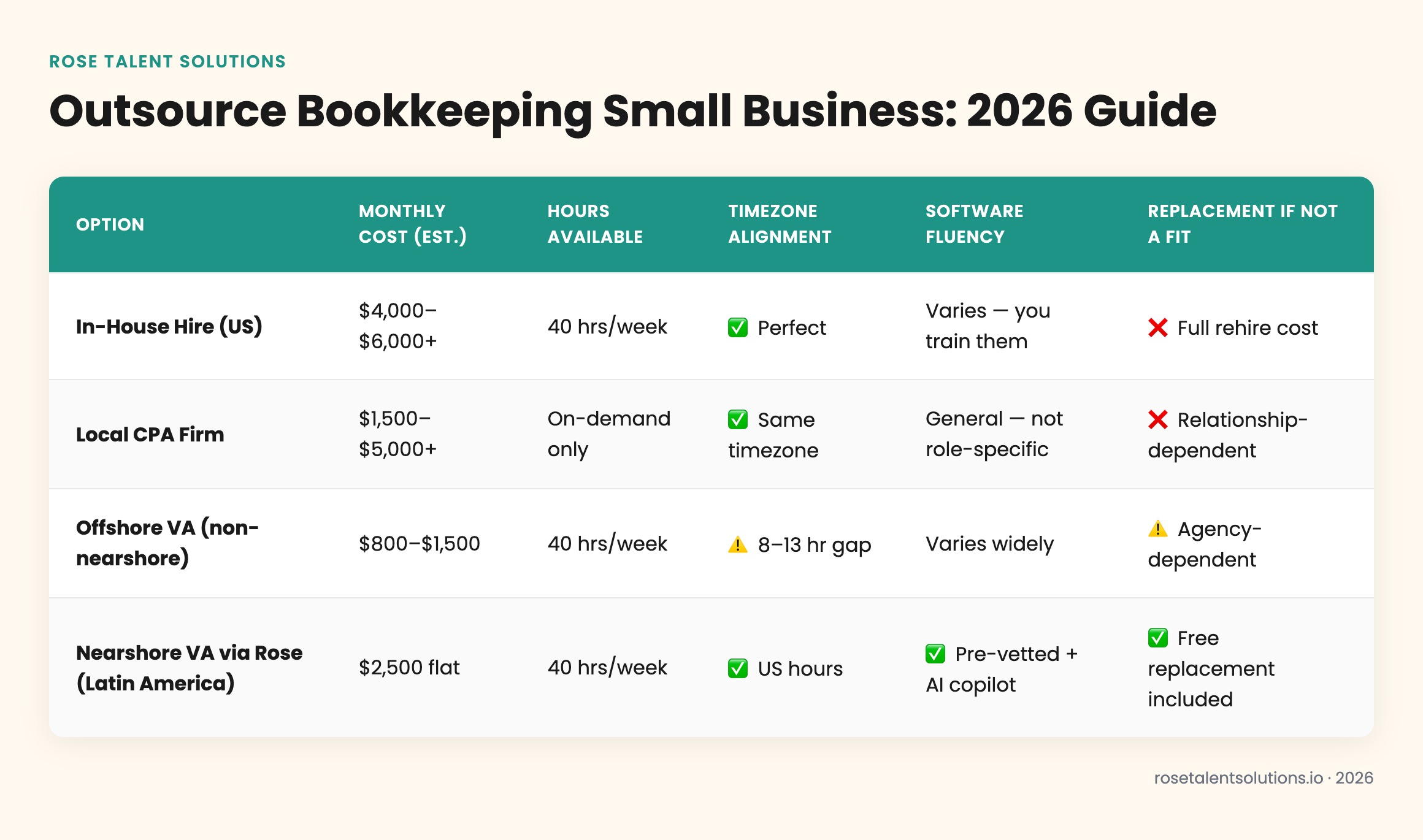
Before you sign with any provider, it helps to see the options mapped side by side. The table below compares the four most common bookkeeping arrangements for small businesses across the dimensions that actually affect your day-to-day operations.
| Option | Monthly Cost (Est.) | Hours Available | Timezone Alignment | Software Fluency | Replacement if Not a Fit |
|---|---|---|---|---|---|
| In-House Hire (US) | $4,000–$6,000+ | 40 hrs/week | ✅ Perfect | Varies — you train them | ❌ Full rehire cost |
| Local CPA Firm | $1,500–$5,000+ | On-demand only | ✅ Same timezone | General — not role-specific | ❌ Relationship-dependent |
| Offshore VA (non-nearshore) | $800–$1,500 | 40 hrs/week | ⚠️ 8–13 hr gap | Varies widely | ⚠️ Agency-dependent |
| Nearshore VA via Rose (Latin America) | $2,500 flat | 40 hrs/week | ✅ US hours | ✅ Pre-vetted + AI copilot | ✅ Free replacement included |
How to Vet an Outsourced Bookkeeping Provider (Red Flags Included)
The outsourced bookkeeping market has no universal licensing requirement, which means quality varies enormously. Knowing what questions to ask before you sign is the difference between a smooth transition and a bookkeeping disaster.
The most common red flag in outsourced bookkeeping proposals is vague pricing — specifically, hourly rates without a monthly hour cap. An uncapped hourly engagement will always cost more than the estimate once your transaction volume picks up in a busy quarter.
Questions to ask every provider before hiring:
- What accounting software does your team work in, and can you show certifications?
- Is pricing fixed monthly or variable by transaction volume — and where exactly does the price increase?
- What happens if my assigned bookkeeper leaves or isn't a fit — what's the replacement process and cost?
- Who owns my financial data if I cancel, and how is it returned to me?
- What data security protocols are in place — encryption, access controls, NDA requirements?
- Are your bookkeepers full-time on my account, or shared across multiple clients simultaneously?
Credentials to verify: Look for QuickBooks ProAdvisor certification, Xero certification, or platform-specific credentials relevant to your industry — AppFolio or Buildium certification for property managers, for example. An agency that pre-screens for these credentials and requires an English proficiency score of 8/10 or above reduces your vetting burden significantly.
Data security minimum standards: Any legitimate outsourced bookkeeping provider should have signed NDAs with all team members, use role-based access controls in your accounting software, and transmit data over encrypted channels. Ask specifically whether your bookkeeper will be given admin-level access or limited permissions — limited is almost always the right answer to start.
What Does the 2026 Onboarding Process Look Like?
One of the biggest fears small business owners have about switching from in-house to outsourced bookkeeping is the transition itself — what happens to historical data, how long the handoff takes, and whether the new person will understand how your business works. A well-run agency makes this predictable.
Intake & Matching (Days 1–3)
You share your software stack, transaction volume, industry, and any specific accounting requirements. The agency matches candidates based on those specs — not just general bookkeeping experience.
Candidate Review & Interview (Days 3–5)
You review shortlisted profiles and interview your top pick — ideally with a live software walk-through to verify fluency. Rose clients typically review 2–3 candidates before selecting.
Access & System Setup (Days 5–7)
Your new bookkeeper receives limited-permission access to QuickBooks, Xero, or your platform of choice. NDAs are signed. Communication channels — Slack, email, or your preferred tool — are established.
Historical Data Review (Week 1–2)
Your bookkeeper audits your current chart of accounts, reconciles any open periods, and flags discrepancies before taking over live entries. This is where a strong bookkeeper earns trust fast.
Live Operations Begin (Week 2 Onward)
Daily and weekly bookkeeping tasks run on your schedule. You get regular reporting check-ins — weekly or monthly depending on your preference — and a direct line to your bookkeeper during US business hours.
The full transition from signed to fully operational typically runs 7–14 days with an organized agency. That timeline assumes you can provide read-only access to your current books and a brief call to explain your reporting preferences. According to SCORE (2024), the most common onboarding delay is on the client side — specifically, delayed access to accounting software and incomplete bank feed connections.
When Should You NOT Outsource Your Bookkeeping?
Outsourcing is the right call for most small businesses with more than $200K in annual revenue and consistent monthly transaction volume. But it's not the right call for everyone, and intellectual honesty matters here.
Outsource When…
- You're spending more than 10 hours per month on bookkeeping yourself
- Your books are consistently behind or unreconciled
- You're scaling fast and can't predict how much bookkeeping capacity you'll need
- A local hire would cost $50K+ and you don't have the physical office space to justify it
- Your industry uses specialized software — AppFolio, Buildium, Jobber — where fluency matters
Keep It In-House When…
- Your business has fewer than 50 transactions per month and a single bank account
- You're pre-revenue and a simple spreadsheet genuinely covers your needs
- Your industry has extremely unusual compliance requirements that need on-site presence
- You have an existing employee who does accurate bookkeeping as part of a broader role
DIY bookkeeping software like QuickBooks Self-Employed or Wave is genuinely adequate for solopreneurs with simple, low-volume books. The tipping point is usually when tax prep becomes painful — when your CPA is spending billable hours cleaning up your books before they can file, you've already passed the point where outsourced bookkeeping would have paid for itself.
According to QuickBooks/Intuit research (2024), small business owners spend an average of 10 hours per month on bookkeeping and financial admin. At a conservative $100/hour opportunity cost for an owner's time, that's $1,000/month in lost productive hours — which reframes the cost of outsourcing entirely.
Industry-Specific Bookkeeping Considerations for 2026
Generic bookkeeping experience is not the same as industry fluency. The chart of accounts, revenue recognition rules, and compliance requirements differ meaningfully across verticals — and hiring a bookkeeper without that context creates real risk.
Real estate and property management: Requires trust accounting, security deposit tracking, CAM reconciliations, and fluency in platforms like AppFolio or Buildium. A bookkeeper unfamiliar with these can create serious compliance exposure. Rose's property management VA service specifically screens for this background, so you're not training someone from scratch on industry-critical workflows.
E-commerce: Multi-channel revenue reconciliation across Shopify, Amazon, and Etsy, plus sales tax nexus tracking across states, COGS management, and returns accounting are non-trivial. A bookkeeper who only knows service business accounting will struggle immediately with these workflows.
Construction and trades: Job costing, WIP (work-in-progress) accounting, lien waivers, and contractor payment compliance — specifically 1099 tracking — require specialized knowledge. Ask any candidate to walk through a job-costing workflow before you hire them.
Restaurants and hospitality: Daily sales reconciliation against POS systems, tip reporting, food and labor cost tracking, and vendor payment cadences require a bookkeeper who has done this before — not one learning on your live books.
When you evaluate any outsourced bookkeeping provider, ask for specific experience in your industry and request a brief explanation of how they'd handle one of your most common accounting scenarios. Vague answers are a hard stop. Explore Rose's AI advantage for industry-specific roles to see how software-trained copilots — built on the exact platforms your business uses — accelerate ramp time and reduce errors from day one.