
Why QuickBooks Virtual Bookkeeper Pricing Is Confusing in 2026
Nearshore bookkeeping has quietly become the most cost-competitive option for US small businesses — but most owners comparing prices never look past the first two Google results. They see a QuickBooks Live ad, get a quote from a local CPA firm, and stop there. That's a mistake that can cost you $10,000 or more per year.
The virtual bookkeeper pricing landscape in 2026 spans at least four distinct models — and each one has a different effective cost once you account for hours covered, software expertise, hidden fees, and time-zone friction. This breakdown covers all four, including the costs competitors rarely mention: catch-up fees, per-transaction surcharges, and the silent tax of back-and-forth delays when your bookkeeper is 12 time zones away.
According to the U.S. Bureau of Labor Statistics (2024), the median annual wage for bookkeeping clerks in the United States is $47,440 — or roughly $22.80/hour before benefits, payroll taxes, and overhead. That number sets the floor for what a domestic hire truly costs.
The 4 Main Options for Outsourcing QuickBooks Bookkeeping in 2026
Before you can compare virtual bookkeeper pricing fairly, you need to understand what each model actually delivers. Here is an honest look at all four paths a small business owner typically considers when they decide to outsource QuickBooks bookkeeping.
QuickBooks Live is Intuit's managed bookkeeping add-on. Plans start around $200/month for very low transaction volumes and scale to $700–$800/month for active businesses. A bookkeeper reviews your books monthly — but they are not dedicated to your account, they do not handle AP/AR workflows, and they cannot take on custom tasks outside Intuit's defined scope. You're paying for light oversight, not a full-time operator.
Freelance bookkeepers on Upwork typically charge $25–$40/hour for QuickBooks-trained talent. At 40 hours per month — the minimum a growing business usually needs — that's $1,000–$1,600/month. Scale to 80 hours and you're at $2,000–$3,200. You also manage recruiting, vetting, onboarding, and replacing them yourself when they go dark (and they do). According to Upwork's Freelance Forward report (2023), 59% of hiring managers say finding qualified freelancers takes longer than expected — that search time has a real dollar cost.
Domestic bookkeeping firms charge $1,500–$3,000/month for small business packages. Some bill hourly at $60–$100/hour for senior bookkeepers. These firms offer reliability and US-based service but rarely provide a dedicated contact — your books rotate among staff. Tax filing, catch-up work, and software migrations are almost always billed separately.
Nearshore dedicated bookkeepers — like those placed by Rose Talent Solutions — sit in a different category entirely. You get one full-time person (40 hrs/week), working your US business hours, fluent in English, pre-vetted for QuickBooks proficiency, and shipped with an AI copilot trained on your specific software stack. The Rose Talent Solutions flat rate is $2,500/month, all-in.

How Hidden Fees Inflate Your Real Remote Bookkeeper Monthly Cost
The sticker price for any bookkeeping service is rarely the real price. Here are the five hidden costs that inflate what businesses actually pay — and that competitors almost never mention in their pricing pages.
Catch-up fees. Most bookkeeping services charge extra to bring disorganized or behind books current. Rates range from $150–$400 per month of catch-up. If your books are six months behind when you onboard, add $900–$2,400 before your first real month begins.
Tax filing add-ons. QuickBooks Live and most virtual bookkeeping subscriptions explicitly exclude tax return preparation. You'll pay a separate CPA $500–$2,500+ annually on top of your monthly bookkeeping fee.
Software seat costs. QuickBooks Online plans run $35–$235/month depending on tier. If the firm or platform requires you to upgrade to access their service, that's a real cost. Some domestic firms pass through software costs as a line item.
Transaction volume surcharges. Many services tier their pricing by transaction count — 150 transactions/month in one bracket, 500 in another. A growing business can find itself repriced mid-year. According to the U.S. Small Business Administration, nearly 82% of small businesses that fail cite cash flow problems — often a symptom of books that aren't being maintained in real time.
Replacement and re-onboarding costs. When a freelancer disappears or a firm rotates your contact, you absorb the cost of bringing someone new up to speed — your time, your documentation, your frustration. With a managed nearshore model, replacement is handled for you at no additional cost.
The advertised monthly price for a QuickBooks bookkeeping service almost never includes catch-up fees, tax prep, software upgrades, or re-onboarding after turnover. A flat-rate, fully managed model eliminates most of these surprise line items before they appear on your invoice.
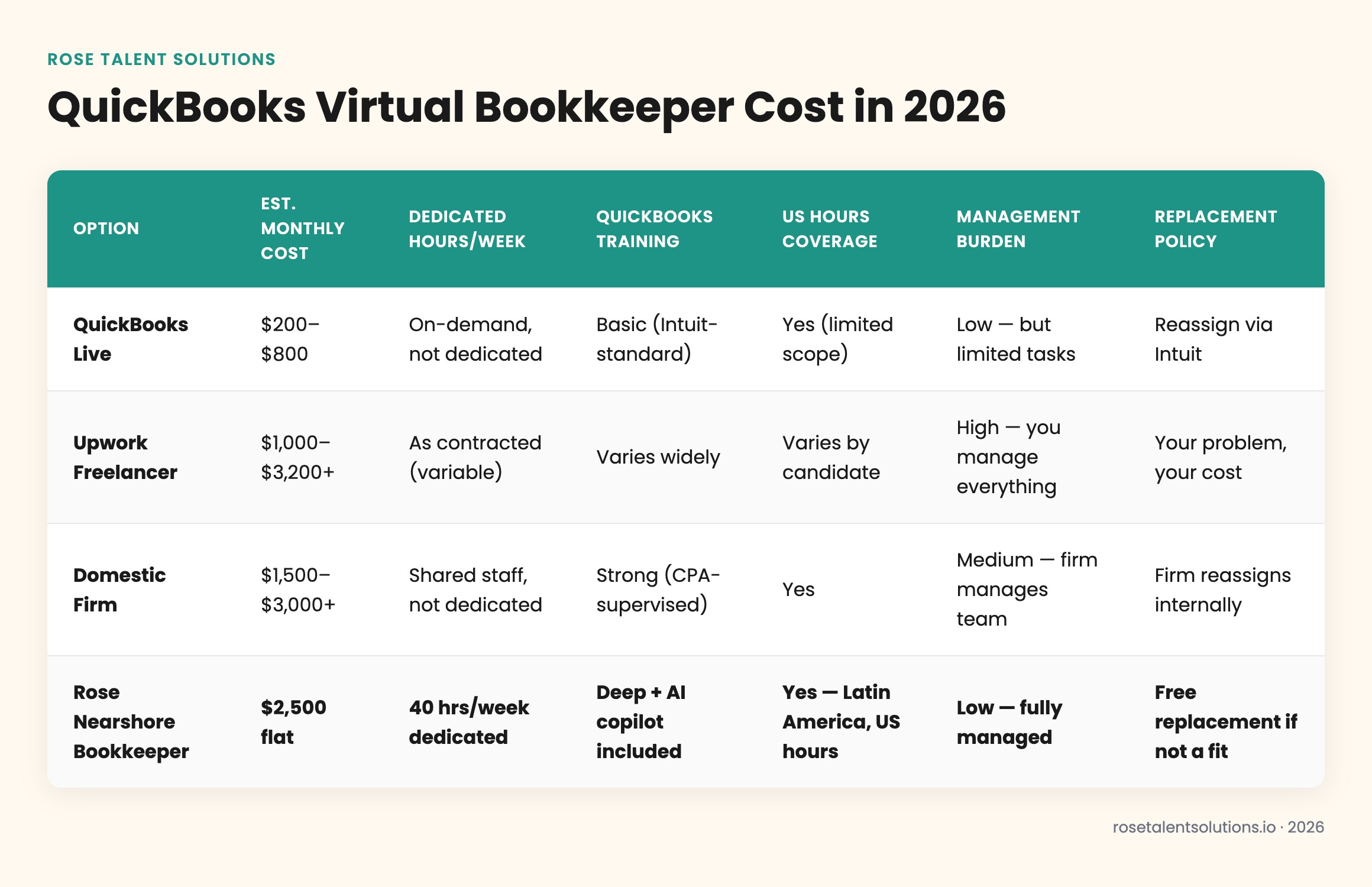
QuickBooks Bookkeeping Cost Comparison Table 2026
The table below compares the four primary options on the dimensions that matter most to a small business owner: true monthly cost, dedicated hours, software training depth, time-zone alignment, and who absorbs the management burden.
| Option | Est. Monthly Cost | Dedicated Hours/Week | QuickBooks Training | US Hours Coverage | Management Burden | Replacement Policy |
|---|---|---|---|---|---|---|
| QuickBooks Live | $200–$800 | On-demand, not dedicated | Basic (Intuit-standard) | Yes (limited scope) | Low — but limited tasks | Reassign via Intuit |
| Upwork Freelancer | $1,000–$3,200+ | As contracted (variable) | Varies widely | Varies by candidate | High — you manage everything | Your problem, your cost |
| Domestic Firm | $1,500–$3,000+ | Shared staff, not dedicated | Strong (CPA-supervised) | Yes | Medium — firm manages team | Firm reassigns internally |
| Rose Nearshore Bookkeeper | $2,500 flat | 40 hrs/week dedicated | Deep + AI copilot included | Yes — Latin America, US hours | Low — fully managed | Free replacement if not a fit |
How Business Size and Transaction Volume Affect QuickBooks Bookkeeping Pricing
Not every business needs the same bookkeeping capacity. A $500K/year service business with 200 monthly transactions has very different needs from a $3M e-commerce operation processing 2,000+ SKUs across multiple sales channels. Virtual bookkeeper pricing should reflect that — but many services don't price this honestly upfront.
For businesses in the $500K–$5M revenue range, the economics tilt strongly toward a dedicated model. At this scale, you're managing payroll integrations, vendor payments, sales tax across states, and monthly closes that require continuity of knowledge. Rotating staff at a domestic firm or a part-time Upwork freelancer creates gaps that compound over quarters.
Transaction volume is the hidden lever most pricing pages bury. Services that charge by transaction tier will reprice you automatically as you grow. According to U.S. Census Bureau Small Business data (2022), there are over 5.4 million employer businesses with fewer than 20 employees — the majority of which reach transaction volumes that push them into higher pricing tiers within 12–18 months of signing up for entry-level bookkeeping plans.
Industry also matters. Real estate investors and property managers using QuickBooks alongside AppFolio or Buildium need a bookkeeper who understands trust accounting, owner distributions, and reconciliation across platforms — not just basic P&L entry. E-commerce owners need someone fluent in Shopify-to-QuickBooks sync and COGS accounting. These specializations cost more on a freelance or firm model. With a dedicated nearshore hire, you select for exactly the skill set you need from day one.

How to Vet a QuickBooks Bookkeeping Assistant Before You Hire
Red flags in bookkeeper candidates are consistent regardless of the hiring channel. Knowing what to screen for saves you months of wasted onboarding and the pain of reconstructing books after a bad hire.
Green Flags to Look For
- Can walk you through a bank reconciliation process step-by-step without prompting
- Familiar with your specific QuickBooks version (Online vs. Desktop vs. Enterprise) and has worked in your industry
- Asks clarifying questions about your chart of accounts before making assumptions
- Proactively flags discrepancies — doesn't wait to be asked
- References can speak to the accuracy and timeliness of their closes
Red Flags to Avoid
- Claims full QuickBooks expertise but can't describe the difference between accrual and cash basis accounting
- No verifiable work history on the specific platform your business uses
- Unwilling to do a paid skills assessment or provide sample work product
- Pricing is dramatically below market — usually signals limited hours, shared attention, or offshore batching
- No process for catching errors — "I just enter what I'm given" is not a bookkeeping methodology
Rose's vetting process screens candidates on English proficiency (8/10+ minimum), live QuickBooks task simulations, and a structured interview that surfaces how candidates handle real errors — because every bookkeeper will eventually face one. Learn more about how the AI copilot advantage is built into every placement to extend your bookkeeper's capability beyond what a standalone hire can offer.
How the Rose Nearshore Bookkeeper Onboarding Process Works in 2026
One of the most common concerns business owners raise is ramp time — how long before a new bookkeeper is actually useful? The answer depends heavily on the process behind the placement. Here's how a managed nearshore engagement works from intake to first close.
Role scoping call
Rose's team maps your QuickBooks version, transaction volume, software stack (e.g., Gusto, Shopify, Stripe), and the specific tasks you need handled — payroll entries, bank rec, AP/AR, reporting, or all of the above.
Candidate matching
Rose surfaces 1–3 pre-vetted candidates matched to your industry and software. You review their profiles and conduct a final interview — no resume-sorting, no cold outreach, no skills guessing.
AI copilot configuration
Before day one, your bookkeeper's role-specific AI copilot is configured for your software stack — QuickBooks, plus any connected platforms. This cuts ramp time significantly compared to a cold freelance hire.
First-week orientation
Your bookkeeper logs on during your US business hours, gets oriented to your accounts and workflows, and begins executing — not shadowing, not training in isolation, but working inside your actual books.
Ongoing management and quality checks
Rose handles HR, payroll, and performance management. If something isn't working, you flag it and Rose handles the resolution — including a free replacement if the team member isn't the right fit.
Is the ROI of a Dedicated QuickBooks Bookkeeper Worth $2,500/Month?
The ROI calculation for a full-time virtual bookkeeper comes down to two numbers: what you're currently spending (in dollars and hours) to maintain your books, and what accurate, current financials are worth to your decisions.
Most small business owners who handle their own books spend 8–15 hours per month on QuickBooks tasks — entering transactions, reconciling accounts, chasing receipts, and running reports. At an opportunity cost of $100–$250/hour for a founder's time, that's $800–$3,750/month in lost productivity. According to a SCORE Foundation survey, 40% of small business owners say bookkeeping and taxes are the most challenging part of running a business — time they would rather spend on growth.
The downstream cost of inaccurate books is harder to quantify but consistently larger: missed tax deductions, incorrect cash flow projections, failed loan applications, and late payroll reconciliations. The IRS requires businesses to maintain accurate records — errors don't just cost money in corrections, they can cost money in penalties.
A flat $2,500/month for a dedicated, software-trained bookkeeper working 40 hours per week — with no long-term contract and a free replacement guarantee — is not an expense. It's one of the most defensible line items a $1M+ business can carry. Explore the full scope of what a nearshore bookkeeping and accounting assistant can own inside your business.