
How Much Does a QuickBooks Virtual Bookkeeper Actually Cost in 2026?
The honest answer: it depends heavily on which model you choose. QuickBooks virtual bookkeeper cost in 2026 spans roughly $200/mo to $3,000+/mo depending on whether you're using Intuit's own QuickBooks Live service, hiring a freelancer on Upwork, contracting a domestic bookkeeping firm, or bringing on a dedicated nearshore bookkeeper. Each has a completely different cost structure, capacity, and hidden-fee profile.
This guide breaks down every option with real numbers — including the costs competitors don't talk about. If you run a business between $500K and $5M in revenue and you're trying to figure out whether QuickBooks Live, a freelancer, or a dedicated virtual bookkeeper makes more financial sense, you're in the right place. Rose Talent Solutions places nearshore bookkeepers — based in Latin America, working your US business hours — at a flat $2,500/mo.
According to the U.S. Bureau of Labor Statistics (2024), the median annual wage for a bookkeeping clerk in the United States is $47,440 — roughly $22.80/hr. That's before you factor in payroll taxes, benefits, recruiting costs, and software seats. The fully-loaded cost of a domestic in-house bookkeeper routinely exceeds $65,000/year.
What Does QuickBooks Live Bookkeeping Cost in 2026?
Intuit offers two QuickBooks Live tiers: Assisted and Full-Service. QuickBooks Live Assisted starts at approximately $200–$400/mo and gives you access to a bookkeeper who reviews your books and coaches you — but you still do much of the data entry yourself. QuickBooks Live Full-Service starts around $500/mo and scales upward based on your average monthly expenses, and Intuit handles categorization, reconciliation, and monthly closes.
The catch? QuickBooks Live bookkeepers are shared resources. You get a team, not a dedicated person. Response times can stretch to 1–3 business days. And if your business has payroll, contractor payments, inventory, or complex job costing, you may be quoted a higher tier — or told it's out of scope entirely.
QuickBooks Online itself carries its own subscription cost: Simple Start runs ~$35/mo, Plus ~$90/mo, and Advanced ~$235/mo as of 2026 — and those fees stack on top of any Live bookkeeping plan. Dedicated virtual bookkeepers from Rose work inside your existing QBO subscription, so there's no seat upcharge from us.
How Freelance Bookkeeper Costs Compare to Dedicated Nearshore in 2026
Reddit threads on "QuickBooks virtual bookkeeper cost" tend to surface freelancers quoting $25–$40/hr for basic bookkeeping and $50–$75/hr for cleanup or catch-up work. On Upwork, you can find QuickBooks-proficient bookkeepers across a wide range — but the real variable is consistency. Freelancers juggle multiple clients, disappear during tax season, and rarely come pre-vetted on your specific software stack.
Run the math on a mid-range freelancer at $35/hr for a committed 40 hours per week. That's $5,600/mo — more than double what Rose charges — with zero recruiting support, no HR backstop, no replacement guarantee, and no AI copilot trained on your tools. Even at 20 hours/week, you're at $2,800/mo for a part-time person with no redundancy.
According to Statista (2023), over 64 million Americans performed freelance work in the past year — meaning the freelance bookkeeping market is liquid but noisy. Vetting for QuickBooks proficiency, English fluency, and reliability on your own takes 10–20 hours of founder time per hire.
The Real Cost Comparison: Total Cost of Ownership in 2026
The subscription line item is never the whole story. QuickBooks Online add-ons — payroll, contractor payments, time tracking, advanced reporting — stack up fast. QuickBooks Payroll Core runs ~$45/mo plus $6/employee. QuickBooks Online Payments charges 2.9% + $0.25 per card transaction. If you're evaluating total cost, you need to look at the full stack, not just the base plan.
Here's every major option mapped out side by side:
| Option | Monthly Cost | Hours/Week | Dedicated Person? | Recruiting/HR Included? | AI Copilot? | Replacement Guarantee? |
|---|---|---|---|---|---|---|
| QuickBooks Live Assisted | $200–$400 | Shared pool | No | N/A | No | No |
| QuickBooks Live Full-Service | $500–$700+ | Shared pool | No | N/A | No | No |
| Upwork Freelancer | $2,800–$5,600 | 20–40 hrs | Yes (unvetted) | No | Rarely | No |
| Domestic Bookkeeping Firm | $1,500–$3,000 | Varies | Sometimes | No | Rarely | No |
| Rose Nearshore (Latin America) | $2,500 flat | 40 hrs | Yes | Yes | Yes | Yes — free replacement |
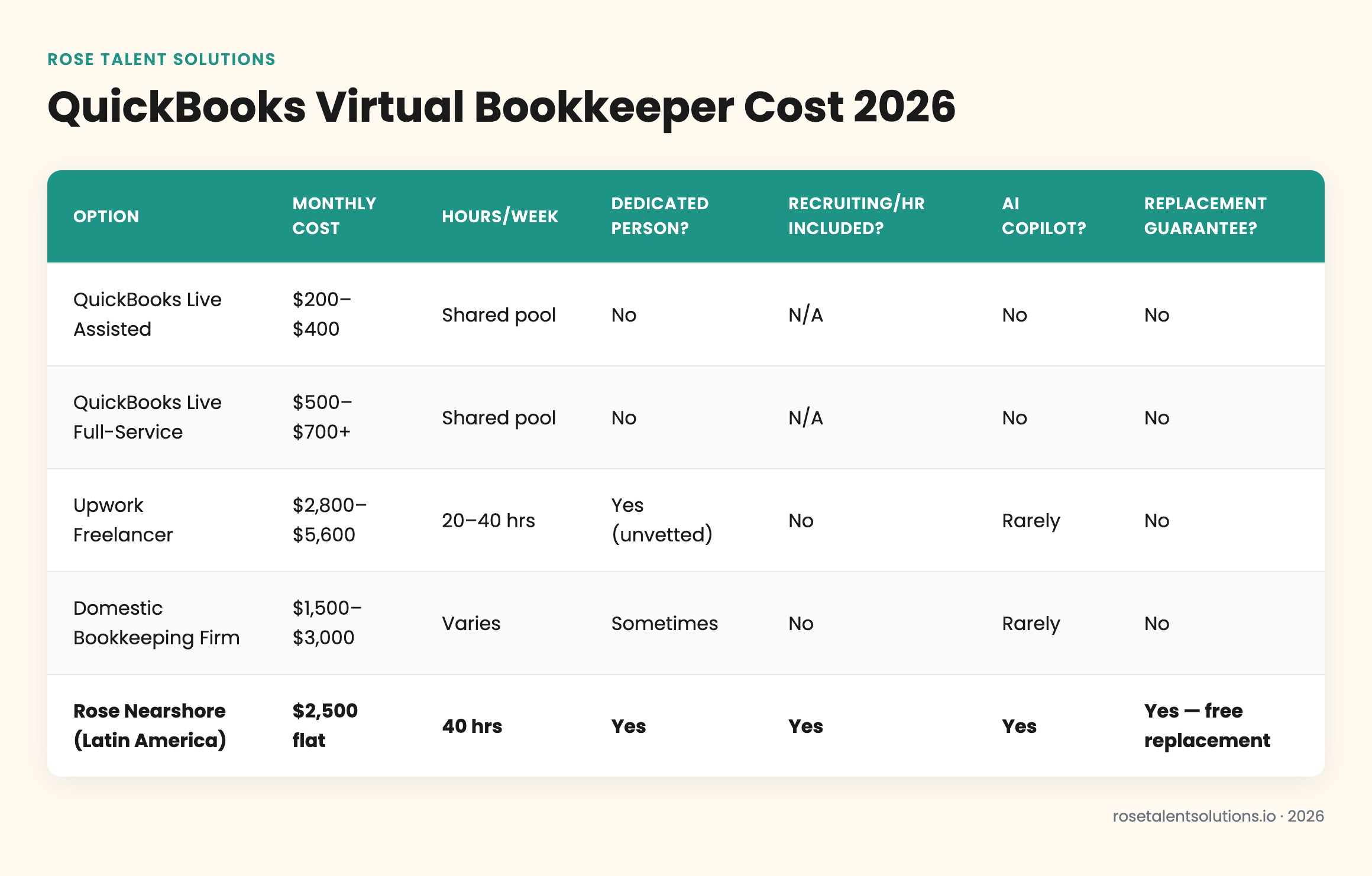
What the table makes clear: QuickBooks Live is cheapest by the line item, but it's not a dedicated resource. A domestic firm is the closest equivalent to Rose but costs the same or more without the AI advantage or replacement guarantee. Freelancers cost more per hour and carry the most execution risk.
Is QuickBooks Desktop Going Away in 2026?
Yes — and this affects your bookkeeper cost calculation directly. Intuit discontinued new QuickBooks Desktop sales for most products in 2024 and has been migrating users to QuickBooks Online. By 2026, most small businesses are running QBO exclusively. If your current bookkeeper only knows Desktop and you haven't migrated yet, expect a transition cost — both in time and potential cleanup work.
A nearshore bookkeeper placed by Rose arrives already fluent in QuickBooks Online, trained on the specific workflows your business uses — accounts payable, bank reconciliation, chart of accounts setup, job costing, or class tracking. Every Rose team member ships with a role-specific AI copilot trained on their software stack, so QBO-to-QBO transitions are handled without a learning curve on your dime.
QuickBooks Desktop's end-of-life migration isn't just a software switch — it's a workflow audit. Business owners who use this moment to upgrade from a patchwork freelancer setup to a dedicated nearshore bookkeeper often cut total bookkeeping costs by 30–40% while gaining more hours and better coverage.

How Business Complexity Drives Your Real Bookkeeping Cost
Here's a gap almost no competitor covers: transaction volume and industry complexity change what you actually need — and therefore what you should actually pay. A SaaS company doing 200 transactions per month in a single currency has completely different bookkeeping demands than a 15-unit residential property management company tracking security deposits, maintenance invoices, and owner distributions across multiple entities.
According to the IRS (2024), adequate recordkeeping is legally required for all business tax filings — and "adequate" scales with complexity. Property managers, contractors, and product-based businesses almost always need more bookkeeping hours than service businesses with simple invoicing cycles. Fitting that workload into a shared QuickBooks Live pool almost never works well past $1M in revenue.
Rose's bookkeeping virtual assistants are matched to your industry vertical — not just your software. If you're in property management, your bookkeeper already knows how to handle owner ledgers, trust accounting considerations, and maintenance expense categorization before day one. That industry depth is what prevents the expensive cleanups that generic bookkeeping services generate.
One more cost most people miss: bookkeeping software and bookkeeper fees are generally tax-deductible as ordinary business expenses under IRS Section 162. That means your $2,500/mo investment may effectively cost $1,750–$1,875/mo after federal tax savings at a 25–35% effective rate. Consult your CPA, but this deductibility meaningfully narrows the gap between Rose and a cheaper, lower-capacity option.
How Rose Talent Solutions Places Your QuickBooks Bookkeeper
The process from first conversation to your bookkeeper handling live transactions is designed to take under two weeks. Every Rose team member is based in Latin America, works your US business hours, and clears an 8/10+ English proficiency screen before they ever reach you. There's no long-term contract — cancel with 30 days written notice. And if a placement isn't the right fit, we replace them at no additional cost.
Intake Call
We learn your software stack, transaction volume, industry, and the specific bookkeeping workflows you need covered — QBO reconciliation, AP/AR, payroll support, reporting, or all of the above.
Candidate Matching
Rose sources from our pre-vetted Latin America talent pool and surfaces 1–3 candidates who are already fluent in your tools — not candidates who'll learn on your clock.
Interview & Selection
You interview, ask QuickBooks-specific workflow questions, and choose. We handle the offer, paperwork, and onboarding logistics.
AI Copilot Activation
Your bookkeeper's role-specific AI copilot is configured for your software — QBO, payroll platform, expense tools — so they're productive from day one, not week three.
Ongoing Management
Rose handles HR, payroll, compliance, and performance oversight. You manage the day-to-day work. We handle everything behind the curtain at no additional charge.
Red Flags to Watch When Evaluating QuickBooks Bookkeeping Pricing in 2026
Not all bookkeeping services price transparently. Before you sign anything, ask these questions: Does the monthly rate include cleanup of prior periods, or is that billed separately? Are there per-transaction fees once you exceed a volume threshold? Is the bookkeeper dedicated to your account or shared across 20 clients? What happens if the bookkeeper leaves — do you absorb the re-hiring cost?
According to SHRM (2024), the average cost per hire in the United States is $4,700 — and that doesn't include lost productivity during the open seat period. Freelance and domestic firm arrangements rarely include any replacement guarantee, meaning a bookkeeper departure becomes your emergency. Rose's flat $2,500/mo includes a free replacement if the placement isn't a fit — that's the risk reversal built into the price.
Why Dedicated Nearshore Beats QuickBooks Live for Growing Businesses
- 40 dedicated hours per week — no shared resource caps
- Responds in real time during your US business hours
- Industry-specific training (property management, construction, e-commerce)
- AI copilot trained on your exact software stack
- Free replacement if not a fit — zero re-hiring cost to you
- Flat pricing — no per-transaction or cleanup surcharges
Where QuickBooks Live Makes More Sense
- Your business does under $500K/year in revenue
- Transaction volume is very low (under 100/mo)
- You want light guidance and prefer doing most entry yourself
- You only need month-end review, not active daily support
The bottom line: QuickBooks Live is a coaching product with some cleanup support. A dedicated nearshore bookkeeper is a full-time team member who owns your books. Which one you need depends entirely on your revenue, complexity, and growth trajectory — and if you're reading this post, you're likely past the point where a shared resource pool covers you.