
Nearshore bookkeeping has quietly become the default choice for US small businesses that have done the math on in-house hiring — and the math is brutal. When you outsource bookkeeping instead of hiring in-house, you replace an $80,000–$90,000 fully loaded annual cost with a flat, predictable monthly rate that includes recruiting, HR, payroll, and software training. A full-time in-house bookkeeper in the United States costs between $52,000 and $68,000 in base salary alone, according to the U.S. Bureau of Labor Statistics (2024). Stack on payroll taxes, benefits, recruiting fees, and software licenses, and you're looking at a fully loaded annual cost north of $85,000 before that employee answers a single invoice. This post breaks down exactly why businesses that choose to outsource bookkeeping rather than hire in-house win on cost, speed, and quality in 2026.
What Does It Mean to Outsource Bookkeeping Instead of Hiring In-House in 2026?
Outsourced bookkeeping means hiring a trained financial professional — either through a staffing agency or a fractional firm — who handles your accounts payable, accounts receivable, bank reconciliations, payroll processing, and monthly close without sitting in your office. In 2026, the majority of businesses that outsource bookkeeping rather than hire in-house use cloud accounting platforms like QuickBooks Online, Xero, and FreshBooks to give remote specialists secure, real-time access.
A nearshore bookkeeper is a remote financial professional based in Latin America who works your US business hours, communicates in fluent English, and is trained on the exact software stack your business already uses. This is meaningfully different from offshore bookkeeping in India or the Philippines, where a 10–12 hour time zone gap means errors surface the next morning instead of the same afternoon. Rose Talent Solutions places nearshore bookkeepers from Latin America exclusively — every team member clears an 8/10+ English proficiency screen before placement.
If you want a deeper breakdown of platform-specific costs, our guide on QuickBooks virtual bookkeeper pricing in 2026 walks through exactly what you should expect to pay depending on business size and transaction volume.
How the True Cost of In-House Hiring Compares to Outsourcing in 2026
Most business owners anchor on base salary when they think about hiring a bookkeeper. That's the wrong number. The fully loaded cost of hiring in-house includes employer-side FICA taxes (7.65%), health insurance contributions averaging $6,584 per employee annually according to KFF's Employer Health Benefits Survey (2023), paid time off, 401(k) match, recruiting fees (typically 15–20% of first-year salary when you use an agency), onboarding time, and software licenses. Add it up and a $55,000-salary bookkeeper costs closer to $80,000–$90,000 all-in — which is exactly why so many operators choose to outsource bookkeeping instead of hiring in-house.
Then there's the hidden cost nobody budgets: turnover. The Society for Human Resource Management estimates that replacing an employee costs 50–200% of their annual salary, according to SHRM's Retaining Talent report (2022). Bookkeepers have a median tenure of under three years. If your $55,000 bookkeeper leaves after 18 months, you've absorbed a replacement cost of $27,000–$110,000 on top of the salary you already paid. That single variable makes the case to outsource bookkeeping rather than hire in-house almost by itself.
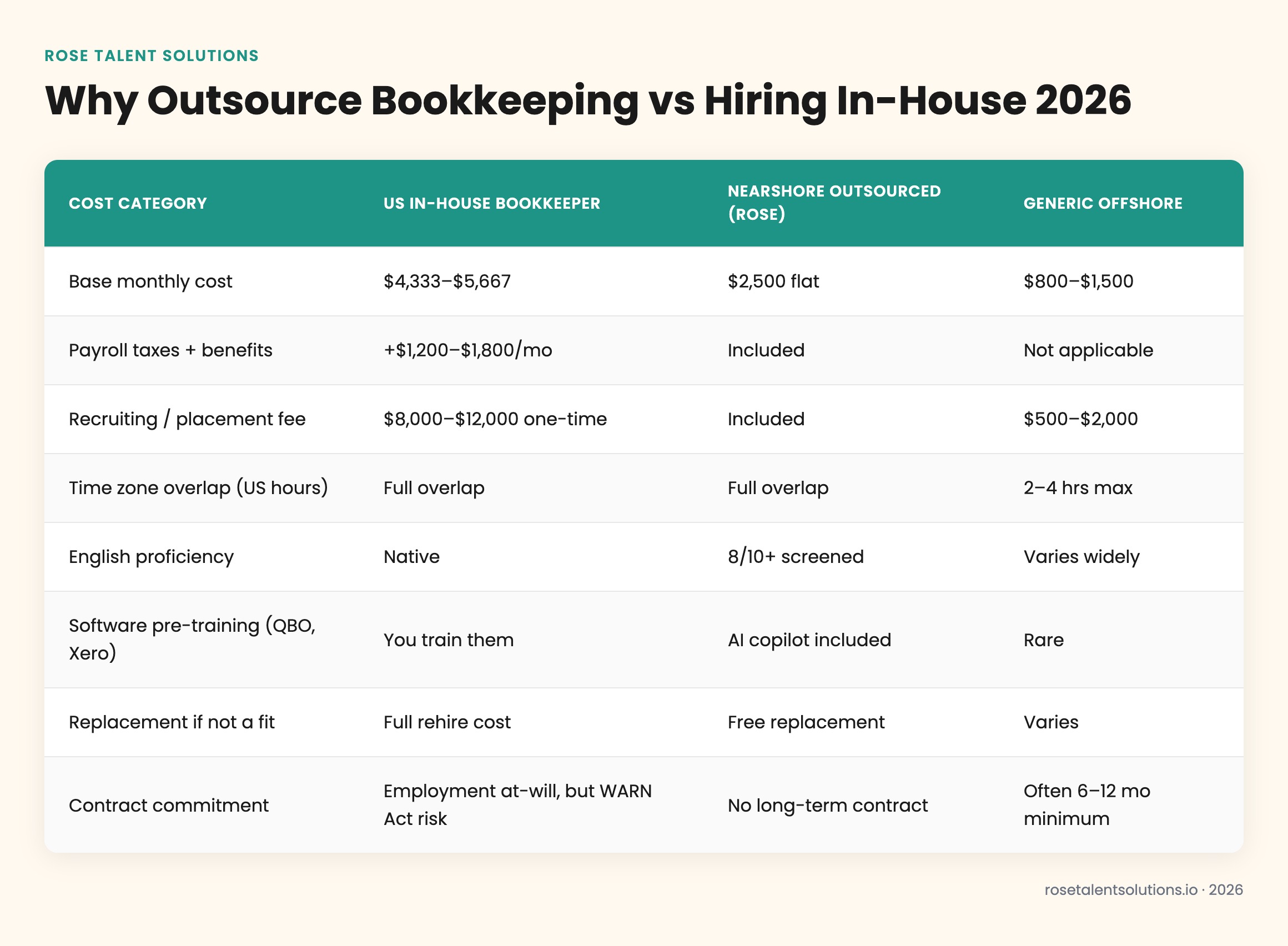
| Cost Category | US In-House Bookkeeper | Nearshore Outsourced (Rose) | Generic Offshore |
|---|---|---|---|
| Base monthly cost | $4,333–$5,667 | $2,500 flat | $800–$1,500 |
| Payroll taxes + benefits | +$1,200–$1,800/mo | Included | Not applicable |
| Recruiting / placement fee | $8,000–$12,000 one-time | Included | $500–$2,000 |
| Time zone overlap (US hours) | Full overlap | Full overlap | 2–4 hrs max |
| English proficiency | Native | 8/10+ screened | Varies widely |
| Software pre-training (QBO, Xero) | You train them | AI copilot included | Rare |
| Replacement if not a fit | Full rehire cost | Free replacement | Varies |
| Contract commitment | Employment at-will, but WARN Act risk | No long-term contract | Often 6–12 mo minimum |
How Nearshore Bookkeepers Ramp Faster Than In-House Hires in 2026
The average time-to-productivity for a new in-house bookkeeper is 60–90 days. That number comes from onboarding, software access provisioning, process documentation, and the simple reality that every business's chart of accounts, vendor relationships, and close process is slightly different. During those 60–90 days, you're paying full salary for partial output — yet another reason operators outsource bookkeeping instead of hiring in-house.
Nearshore bookkeepers placed through Rose arrive with an AI copilot trained on your specific software — QuickBooks Online, Xero, FreshBooks, Wave, or whatever platform you run. That copilot handles platform-specific edge cases in real time, which is why placement-to-productivity time compresses dramatically. If your business runs on Xero, our post on hiring a Xero virtual bookkeeper explains how pre-trained specialists approach the onboarding process differently than a generalist hire.
The hidden cost of offshore bookkeeping isn't the hourly rate — it's the 10–12 hour time zone gap that turns a 15-minute correction into a 24-hour delay. One missed reconciliation that sits overnight can cascade into a week of catch-up before month-end close.
According to Gallup's State of the American Workplace report, it takes new employees an average of 12 months to reach full performance. Remote roles with clear SOP documentation consistently outperform that benchmark — which is why structured nearshore placements with built-in AI support close the ramp gap faster than traditional in-house hiring cycles.
For businesses already outsourcing parts of their finance function, our breakdown of outsourcing bookkeeping for small businesses covers the process of transitioning from DIY or part-time bookkeeping to a dedicated remote specialist without losing continuity.

Why "Just Hire Part-Time" Is Usually the Worst Option When You Need to Outsource Bookkeeping in 2026
The middle-ground answer many business owners land on is a part-time in-house bookkeeper — someone for 20 hours a week at $22–$28 per hour. On the surface it looks cheaper. In practice, it creates three new problems: availability gaps when you need answers urgently, divided loyalty if they work for multiple employers, and the same recruiting, onboarding, and benefits overhead at half the output.
A 20-hour-per-week bookkeeper at $25/hour costs $26,000 annually in wages alone. Add employer taxes and you're at $29,000–$31,000 for half-time work. A full-time nearshore bookkeeper through Rose runs $30,000 per year ($2,500/month) — and that's all-in, including recruiting, HR, payroll management, and the AI copilot. You get 40 hours per week of dedicated attention for roughly the same price as 20 hours of fragmented part-time work. That is precisely why the decision to outsource bookkeeping instead of hiring in-house part-time is equally compelling.
Outsourced Nearshore Bookkeeping
- $2,500/month flat — no hidden add-ons
- Full-time 40 hrs/week dedicated to your business
- Pre-trained on QuickBooks, Xero, FreshBooks, Wave
- Works US business hours from Latin America
- Free replacement if not a fit
- No long-term contract — cancel with 30 days notice
- Recruiting, HR, and payroll managed for you
US In-House Hire
- $80,000–$90,000 fully loaded annual cost
- 3–6 month recruiting timeline on average
- You absorb full replacement cost if they leave
- Software training is your responsibility
- Benefits, PTO, payroll taxes all on you
- Employment law compliance overhead
- Median tenure under 3 years before rehire cycle restarts
How to Evaluate Whether You Should Outsource Bookkeeping Instead of Hiring In-House in 2026
Outsourcing bookkeeping works best when your transaction volume is predictable enough to support a consistent weekly workload, but not so complex that it requires a CPA-level strategic advisor on staff. For most businesses under $10M in annual revenue, a dedicated bookkeeper handles 90–95% of day-to-day financial operations — with a fractional CFO or your external CPA handling the strategic layer above that. If that profile describes your business, the question isn't whether to outsource bookkeeping instead of hiring in-house — it's when.
According to a McKinsey Global Institute report on workforce automation, 64% of accounting and bookkeeping tasks are highly automatable — but they still require a human to review outputs, handle exceptions, and communicate with vendors and clients. That's exactly the profile of a strong nearshore bookkeeper: they use AI tools to accelerate routine tasks while applying human judgment to the exceptions your business actually cares about.
Rose's AI advantage program ensures every placed bookkeeper ships with a role-specific copilot trained on your software stack — reducing the time spent on manual data entry and increasing the time available for reconciliation, reporting, and financial analysis that moves your business forward.
Discovery Call
Rose's team reviews your current bookkeeping setup, software stack, and transaction volume to define the exact role profile needed — usually a 30-minute call.
Candidate Matching
Within days, Rose surfaces 1–2 pre-vetted nearshore bookkeepers who have cleared English proficiency, skills assessments, and software-specific screening for your platform.
Interview and Selection
You interview the candidates directly and make the final call — Rose handles all the administrative back-end so you're evaluating fit, not paperwork.
Onboarding with AI Copilot
Your bookkeeper starts with a role-specific AI copilot already calibrated to your software, so they're contributing meaningfully within the first week — not the first quarter.
Ongoing Support
Rose manages HR, payroll, and performance check-ins on the back end. If the match isn't right, Rose replaces the team member at no additional cost.
If you're comparing specific service providers before making a decision, our detailed breakdown of QuickBooks virtual bookkeeper services compared cuts through the marketing language and shows you exactly what each option delivers for the price.
"Small business owners consistently underestimate the total cost of employment. When you factor in recruiting, training, benefits, and the productivity ramp, the first year of a new hire almost always costs twice what the salary line says." — Karen Kerrigan, President & CEO at Small Business & Entrepreneurship Council (2023)
The decision to outsource bookkeeping instead of hiring in-house ultimately comes down to one question: do you want to be in the business of employing and managing a bookkeeper, or do you want clean books? For most founders and operators, the answer is obvious once the full cost picture is on the table. Ready to stop overpaying for in-house overhead? Start the conversation with Rose — the intake process takes under ten minutes and placements typically move within a week.