
Nearshore QuickBooks virtual bookkeepers have quietly become the go-to back-office move for growth-stage US businesses in 2026. The options on the market look similar on paper—freelance platforms, domestic VA agencies, far-offshore outsourcing firms, and managed nearshore staffing from Latin America—but the real differences show up in timezone coverage, software depth, and total monthly cost once you do the math. This guide breaks all four models down so you can make a confident decision without wasting a billing cycle finding out the hard way.
What Is a QuickBooks Virtual Bookkeeper—and Why Does the Model Matter in 2026?
A QuickBooks virtual bookkeeper is a remote professional who manages your books inside QuickBooks Online or QuickBooks Desktop—handling tasks like transaction categorization, bank reconciliation, accounts payable, accounts receivable, payroll entries, and month-end close. The term covers a wide range of service models, and the model you choose determines your actual cost, quality floor, and day-to-day experience.
The model matters because QuickBooks proficiency is not uniform. A freelancer on a gig platform may know the software basics but have never managed a chart of accounts for a business with more than a handful of vendors. A managed nearshore VA, by contrast, arrives with role-specific training baked in—including the exact QuickBooks workflows relevant to your industry—and has a human support layer behind them if something goes wrong. According to Intuit QuickBooks (2024), more than 7 million businesses in the US use QuickBooks, which means the talent pool advertising "QuickBooks experience" is enormous—and enormously variable in actual skill level.
If you are also evaluating cloud accounting alternatives, our breakdown of Xero virtual bookkeeper options covers the same model comparison for Xero-based businesses.
How the Four QuickBooks Virtual Bookkeeper Service Models Compare in 2026
Before you hire anyone, understand that you are not just buying QuickBooks hours—you are buying a service delivery model. Each model bundles a different set of risks and trade-offs. Here is how the four main options stack up across the dimensions that matter most to a growing business.
| Service Model | Typical Monthly Cost | Hours per Week | Timezone | QuickBooks Training | Contract Flexibility |
|---|---|---|---|---|---|
| Freelance Platform (Upwork, Fiverr) | $800–$2,200 (variable) | 10–25 hrs (variable) | Varies widely | Self-reported only | Per-project; high turnover risk |
| Domestic VA Agency (US-based) | $3,500–$6,000+ | 20–40 hrs | US hours | Inconsistent | Often 3–6 month minimums |
| Far-Offshore Outsourcing (distant time zones) | $1,200–$2,000 | 40 hrs | 6–12 hr lag | Varies by firm | Often annual contracts |
| Managed Nearshore VA (Latin America) | $2,500 flat | 40 hrs | US business hours | Role-specific AI copilot included | Month-to-month, 30-day notice |
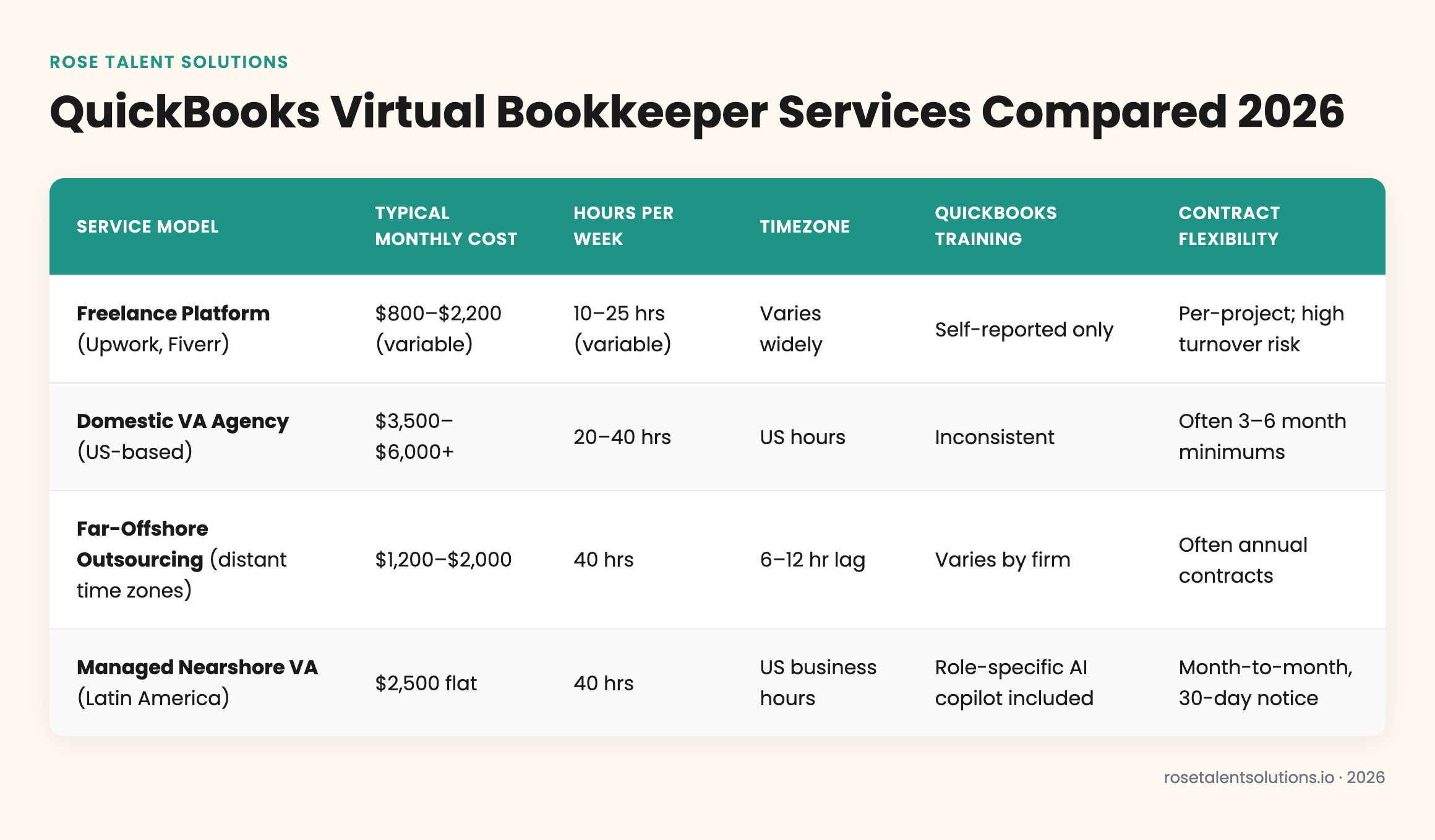
The nearshore model wins on the combination of full-time hours, real-time US timezone coverage, verified software training, and month-to-month flexibility—at a price point that undercuts domestic agencies by 40–60%. For a deeper look at how virtual bookkeepers handle one of the most time-sensitive QuickBooks workflows, see our guide on how virtual bookkeepers handle accounts payable.

How Nearshore VAs Outperform Far-Offshore Bookkeepers on QuickBooks Workflows in 2026
The timezone gap is the most underrated cost in far-offshore bookkeeping. When a vendor calls with a billing dispute at 2pm EST, a team operating across a 10–12 hour timezone difference won't respond until the next morning at the earliest. That lag compounds across every reconciliation cycle, every client invoice question, and every payroll entry that needs a correction. According to SHRM's Workforce Research (2024), real-time collaboration is consistently ranked among the top three factors in remote worker productivity—and it simply isn't achievable across a 10–12 hour timezone gap.
Nearshore VAs based in Latin America work on EST, CST, MST, or PST—your business hours, not a shifted overnight window. They take your Slack messages live. They join your weekly close meeting. They flag a duplicate transaction at 11am when your CFO is still in the office to approve a fix. Real-time availability isn't a luxury in bookkeeping—it's a quality control mechanism.
Rose Talent Solutions pairs every QuickBooks bookkeeper with a role-specific AI copilot trained on their software stack. That means your VA arrives knowing QuickBooks Online's bank feed rules, journal entry workflows, and report templates—not learning them on your clock. The AI copilot surfaces suggested categorizations, flags unusual transactions, and speeds up month-end close. This isn't a chatbot add-on; it's a purpose-built productivity layer trained on the exact software your business runs.
"Bookkeeping talent is abundant, but bookkeeping talent that shows up fluent in your software, your timezone, and your communication style on day one is genuinely rare." — Intuit Partner Network, Accountant Segment Research (2024)
Far-offshore bookkeepers often cost less per hour, but a 6–12 hour timezone gap means every same-day QuickBooks question gets batched overnight—slowing reconciliation cycles, delaying vendor payments, and adding hidden management overhead that erases the rate savings within two billing cycles.
What Does a Managed Nearshore QuickBooks Bookkeeper Actually Do Day-to-Day?
A full-time nearshore QuickBooks VA from Rose covers the complete bookkeeping cycle. Daily tasks include importing and categorizing bank and credit card transactions, matching receipts in QuickBooks's receipt capture tool, and processing vendor bills through the accounts payable queue. Weekly, they reconcile sub-accounts, follow up on outstanding AR, and prepare a cash position summary. At month-end, they close the books, generate the P&L, balance sheet, and cash flow statement, and flag any anomalies for your review.
Beyond core QuickBooks work, these VAs routinely handle payroll journal entries, 1099 vendor tracking, class and location tracking for multi-entity businesses, and integration management between QuickBooks and tools like Stripe, Shopify, or property management platforms. If your business also runs a parallel AP workflow, our detailed walkthrough of the best accounts payable virtual assistant services explains how a dedicated VA handles that layer separately or alongside your bookkeeper role.

According to the U.S. Bureau of Labor Statistics (2024), the median annual wage for a US-based bookkeeping clerk is $47,440—roughly $3,953 per month before benefits, payroll taxes, equipment, and management overhead. At $2,500 per month all-in, a managed nearshore bookkeeper costs 35–40% less than a domestic hire while delivering the same timezone coverage and software fluency.
One common question is how a nearshore VA integrates with QuickBooks Live, Intuit's own bookkeeping service. If you are weighing that option, our post on whether a virtual bookkeeper can use QuickBooks Live explains the key compatibility and ownership differences in plain English.
How Rose's Matching and Onboarding Process Works in 2026
Getting a QuickBooks VA placed and productive in under two weeks is achievable when the matching process is built around your specific software environment and workflow, not a generic bookkeeper resume pool. Here is how Rose handles it end to end:
Intake Call — Your QuickBooks Setup, Mapped
Rose's team documents your QuickBooks version (Online vs. Desktop), chart of accounts structure, connected integrations, and volume metrics (transactions per month, number of entities) before sourcing begins.
Sourcing and Vetting — Software-Specific Screening
Candidates are screened for QuickBooks proficiency (live skills test, not self-reported), English fluency at 8/10 or above, and prior experience in your industry vertical—whether that's real estate, e-commerce, or professional services.
AI Copilot Activation — Role-Specific Training Layer
Before your VA's first day, their AI copilot is configured for your specific QuickBooks environment—chart of accounts rules, vendor categories, report templates, and any custom workflows you use.
Placement — You Interview, You Decide
You meet your shortlisted candidate before any commitment. If the match isn't right, Rose re-sources at no additional cost—the free replacement guarantee covers both the initial placement and any future fit issues.
Ongoing Management — Rose Handles HR and Performance
Payroll, HR compliance, performance reviews, and team member management sit with Rose. You direct the work; Rose handles everything else.
According to Gallup's State of the Global Workplace Report (2023), employees who receive role-relevant onboarding and clear performance expectations are 2.6× more likely to stay engaged long-term. Rose's structured intake process is designed specifically to front-load that clarity before your VA's first login.
Nearshore vs. Far-Offshore QuickBooks Bookkeeping: Pros and Cons in 2026
The far-offshore vs. nearshore debate comes down to a simple trade-off: far-offshore firms offer the lowest nominal hourly rate; nearshore agencies based in Latin America offer real-time US-hours coverage at a still-competitive flat rate. For bookkeeping—a function where a single miscategorized transaction can cascade through a quarter's financials—the real-time oversight advantage is hard to overstate. According to McKinsey Global Institute (2021), knowledge-work roles with high collaboration requirements see a 20–30% productivity reduction when teams operate across time zones greater than 4 hours. Bookkeeping, with its daily transaction imports and frequent vendor questions, fits that high-collaboration profile exactly.
Nearshore (Latin America) — Pros
- Works US business hours in real time
- English fluency at a verified 8/10+ standard
- Cultural alignment with US business norms
- Month-to-month flexibility, no long-term contract
- Role-specific QuickBooks AI copilot included
- Flat $2,500/month all-in pricing, no hidden fees
Far-Offshore (distant time zones) — Cons
- 6–12 hour timezone gap creates overnight batching of urgent tasks
- Variable English proficiency without a verified screening floor
- Often requires annual contracts or long-term commitments
- Onboarding is slower without software-specific pre-training
- Management overhead falls on you, not a dedicated agency team
The bookkeeping and accounting VA services Rose provides are built specifically for this comparison point: nearshore Latin American talent at a price point that beats domestic hiring, with the real-time availability that far-offshore staffing cannot match. If you are ready to move forward, the fastest path is the start page—intake to first placement typically runs under two weeks.
According to Statista (2024), the global virtual assistant market is projected to exceed $25 billion by 2028, driven by demand from SMBs looking to replace expensive in-house admin and finance roles with flexible remote talent. The businesses winning in that shift are the ones that chose managed nearshore staffing early—before the talent pool tightened and rates reflected the demand spike.
The right QuickBooks virtual bookkeeper isn't the cheapest hourly rate you can find—it's the one who shows up at 9am your time, knows your chart of accounts, and closes your books without a three-email lag on every question. That is the practical standard a managed nearshore VA delivers, and it is the standard the freelance and far-offshore models consistently fall short of.