
Nearshore outsourced SDR programs — when built correctly — are one of the highest-leverage growth moves a B2B company can make. But most of them fail within 90 days, and the reasons are almost always the same. Bad incentive structures, SDRs splitting attention across five clients, zero integration with your CRM, and a 9-hour timezone gap that kills the feedback loop between sales and marketing. If your outsourced SDR program has stalled, this guide breaks down exactly why it broke and, more importantly, how to rebuild it so it produces pipeline in 2026.
According to Gartner (2024), more than 60% of B2B companies that outsource sales development report the program underperforms internal benchmarks within the first quarter. That's not a coincidence — it's a structural problem baked into how most outsourced SDR engagements are designed.
Why Do Outsourced SDR Programs Fail in 2026? The Root Causes
Understanding why outsourced SDR programs fail requires looking past the symptoms — low meeting volume, poor show rates, bad-fit demos — and diagnosing the actual structural failures underneath. There are five that appear consistently.
1. The Multi-Client Rep Problem
Most SDR agencies assign one rep to four, five, or even eight clients simultaneously. That rep learns your ICP shallowly, rotates to the next client's sequences by afternoon, and never develops the product depth required to handle a real objection. A rep who can't answer "how does your product handle X?" is not a rep — they're a dialer. The fix is straightforward: insist on dedicated, full-time SDRs who work exclusively in your pipeline. If you want to understand what a properly scoped engagement looks like, this breakdown of how to hire outsourced SDR services for SaaS companies covers exactly what "dedicated" should mean contractually and operationally.
2. Misaligned Incentives
Agency SDR programs are almost always incentivized on volume — dials, emails, meetings set. Your business is incentivized on revenue. Those two things are not the same, and when they diverge, you get SDRs booking demos with anyone who picks up the phone, inflating meeting counts while poisoning your AE's calendar with unqualified prospects. According to SHRM (2023), misaligned performance metrics are the leading cause of outsourced sales team underperformance. The fix: build shared qualification criteria into the SDR's KPIs — not just meetings booked, but meetings held and opportunities accepted by AEs.
3. Zero CRM Integration
Many outsourced SDR vendors operate in their own sequencing tools and deliver leads via a CSV export or a weekly Slack message. That means your AEs have no visibility into touch history, no call recordings to review, and no ability to coach the SDR based on real data. Pipeline built outside your CRM is pipeline you can't trust. The fix is mandatory, day-one CRM access — whether that's HubSpot, Salesforce, or any other system — with the SDR logging every activity natively.
4. Timezone and Communication Latency
Offshore SDR programs based in the Philippines or India operate 9–13 hours behind US business hours. That means when a prospect replies to an email at 10am EST expressing interest, the SDR may not see it until the following morning — and that lead has gone cold. Speed-to-lead matters more than ever: research from InsideSales.com (now XANT) (2023) found that responding to a lead within 5 minutes makes you 100× more likely to connect than waiting 30 minutes. Nearshore SDRs based in Latin America work fully overlapping US business hours, eliminating this lag entirely.
5. Weak Onboarding and ICP Documentation
Outsourced SDR programs fail when the hiring company hands the agency a one-page brief and expects results in week two. The SDR needs deep ICP documentation — who you sell to, the 3 biggest pain points, the top objections and responses, the competitive positioning, and real examples of won deals. Without this, even a talented SDR is guessing. Building that documentation is a one-time investment that compounds across every future hire.

How Nearshore vs. Offshore vs. In-House SDRs Compare in 2026
Not all outsourced SDR options are created equal. The difference between a nearshore model and an offshore agency model isn't just geography — it's timezone alignment, cultural fluency, and accountability structure. The table below breaks down the three primary hiring models side by side so you can see exactly where each one breaks down and where it wins.
| Factor | Nearshore Dedicated SDR (Latin America) | Offshore Agency SDR (Philippines / India) | Onshore In-House SDR (US) |
|---|---|---|---|
| Monthly cost | ~$2,500 all-in (dedicated) | $3,000–$8,000 (agency retainer, shared rep) | $6,500–$9,000+ (salary + benefits + tools) |
| Timezone overlap with US | Full overlap (EST/CST/PST) | Minimal — 9–13 hr gap | Full overlap |
| English proficiency | 8/10+ screened floor | Varies widely, often 6–7/10 | Native |
| Dedicated vs. shared | 100% dedicated to your pipeline | Usually shared across 4–8 clients | Dedicated |
| Ramp time | 7–14 days with AI copilot + ICP docs | 30–60 days (shallow onboarding) | 60–90 days |
| Recruiting / HR overhead | Zero — included in flat rate | None (but limited visibility) | High — job boards, interviews, onboarding |
| Risk reversal | Free replacement if not a fit | Contract exit penalties common | Severance / re-hire cost |
| Long-term contract required | No long-term contract — month-to-month | Typically 6–12 month minimums | At-will, but high switching cost |
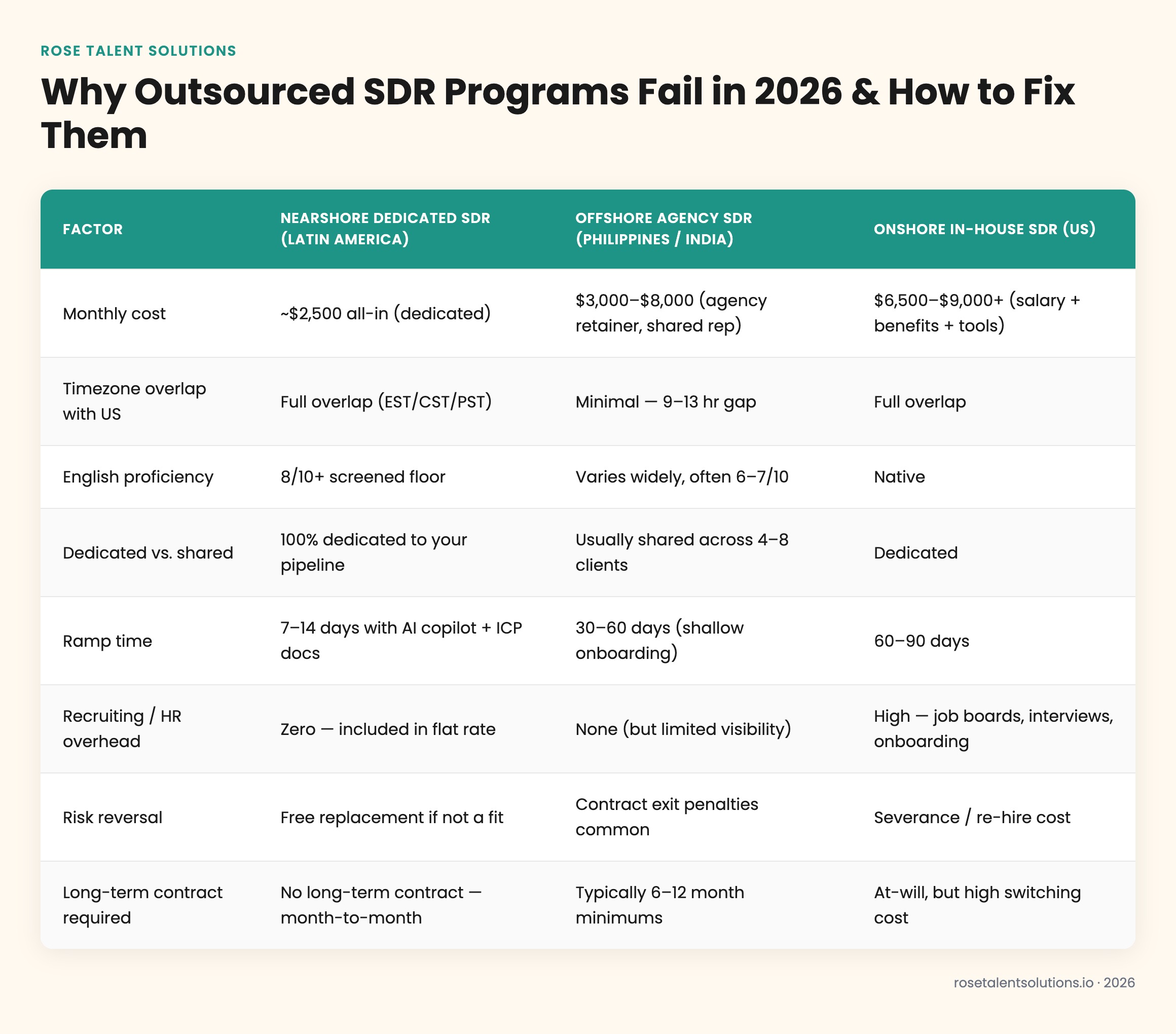
The cost difference between an offshore agency and a nearshore dedicated model is stark when you account for shared rep inefficiency. For a detailed breakdown of what these numbers look like across a full year, see this outsourced vs. in-house SDR ROI comparison that walks through total cost of ownership on both sides.
How to Fix a Failing Outsourced SDR Program: A 2026 Action Plan
Fixing a failing program doesn't require scrapping everything. In most cases, it requires changing three things: the rep model, the onboarding process, and the feedback loop between SDR activity and sales outcomes. Here's the sequence that works.
Audit Your Current Rep Structure
Find out how many clients your SDR is currently serving. If it's more than one, you have a structural problem that no amount of coaching will fix. Insist on a dedicated-only arrangement or switch providers.
Build a Real ICP Document
Write down your top 5 customer profiles, the 3 pain points each one has, the objections you hear most often, and the 2–3 reasons customers say they chose you over competitors. Give this to your SDR on day one.
Integrate the SDR into Your CRM on Day One
No exceptions. Every email sent, every call logged, every reply noted — directly in your CRM. This creates the data trail your AEs need to coach effectively and your leadership needs to measure ROI.
Run Weekly SDR-AE Syncs
A 30-minute weekly sync between the SDR and at least one AE closes the feedback loop faster than any KPI dashboard. AEs report which meetings were well-qualified; the SDR adjusts targeting and messaging in real time.
Add AI-Assisted Personalization to Outreach
Modern nearshore SDRs don't just send sequences — they use role-specific AI copilots to research prospects, personalize first lines, and prioritize intent signals. This is the single biggest differentiator between 2023-era outsourced SDR programs and what high-performing teams are doing in 2026.
According to McKinsey (2024), B2B companies that combine human SDR outreach with AI personalization tools see 2–3× higher meeting conversion rates than those using manual sequencing alone. That's not a marginal improvement — it's a structural advantage baked into the Rose model through role-specific AI copilots trained on each SDR's tools and target market.
"AI doesn't replace the SDR — it removes the research and personalization bottleneck so the SDR can spend 80% of their time on actual conversations instead of 20%." — Kyle Coleman, CMO at Copy.ai (2024)

How Cold Email Execution Exposes Structural Weaknesses in 2026
Cold email is where most failing outsourced SDR programs expose themselves fastest. When a rep is working six clients, their sequences are generic. They're copying templates, swapping out company names, and blasting at volume. Deliverability tanks. Reply rates crater. And the company assumes "cold email doesn't work anymore" — when the real problem is that the execution is broken, not the channel.
Cold email doesn't fail because the channel is dead — it fails because shared-rep agency models produce generic, low-personalization sequences that trigger spam filters and annoy prospects. A dedicated nearshore SDR who knows your ICP writes better first lines, maintains better sender hygiene, and gets 3–5× the reply rate of a shared agency rep running volume plays.
Deliverability is now a strategic asset. According to Statista (2024), approximately 45% of global email traffic is classified as spam. That means inbox placement is harder than ever, and sequences written by a rep who barely knows your product are almost guaranteed to underperform. For a deep look at how high-volume cold email actually works when it's done right, see how outsourced SDRs handle cold email at scale — including domain warm-up, sending infrastructure, and personalization frameworks.
The answer isn't less volume — it's smarter targeting combined with actual product knowledge. A nearshore SDR who works full-time in your pipeline, attends your weekly all-hands, and listens to your AEs' calls writes cold email that sounds like it came from someone who actually knows your business. Because it did.
What Does a Nearshore SDR Actually Cost in 2026?
One of the most common reasons companies don't fix their broken outsourced SDR programs is that they assume "dedicated" means expensive. It doesn't — at least not through a nearshore model. Rose Talent Solutions charges a flat $2,500/month for a full-time, 40-hour-per-week dedicated SDR based in Latin America. That rate includes recruiting, vetting, payroll, HR, and ongoing management. There's no long-term contract, and if the team member isn't a fit, they're replaced at no additional cost.
Compare that to the true cost of a US-based in-house SDR: base salary averaging $55,000–$65,000/year, plus benefits, payroll taxes, tools, and the 60–90 day ramp period where you're paying full cost for partial output. Or compare it to a typical offshore agency retainer of $3,000–$8,000/month for a shared rep you'll never actually manage. For a full cost breakdown across all three models, the complete guide to outsourced SDR pricing is the most thorough resource available on this topic.
According to the U.S. Bureau of Labor Statistics (2024), the median annual wage for sales representatives in professional services is $65,420 — and that's before benefits, recruiting costs, or tools. The nearshore model at $30,000/year all-in is not a compromise on quality; it's an arbitrage on geography with zero timezone penalty.
Nearshore Dedicated SDR: What Works
- Full US timezone overlap — no speed-to-lead lag
- 100% dedicated to your pipeline and your ICP
- English proficiency screened at 8/10+ minimum
- AI copilot reduces research time, increases personalization
- No long-term contract — month-to-month flexibility
- Free replacement if the hire isn't a fit
Typical Offshore Agency SDR: What Breaks
- 9–13 hour timezone gap kills lead response time
- Shared across 4–8 clients — shallow product knowledge
- Volume-based KPIs misaligned with your revenue goals
- Operates outside your CRM — no activity visibility
- 6–12 month contract minimums with exit penalties
- Onboarding is surface-level — no real ICP depth
If you're ready to move from a broken agency model to a dedicated nearshore SDR who works exclusively in your pipeline, you can get started with Rose Talent Solutions here — most placements are made within 7 days of kickoff.