
Nearshore SDRs have quietly become the engine behind some of the most efficient cold email programs running in 2026. When US and Canadian founders ask how outsourced SDRs handle cold email at scale, the honest answer isn't "they blast a list." It's a repeatable, infrastructure-heavy operation that combines domain warming, AI-assisted copy, tight segmentation, and human judgment — all running on your time zone, in fluent English, for a fraction of what an in-house hire costs. This post breaks down exactly how it works, what separates high-performing nearshore teams from offshore commodity shops, and what you should demand before signing anything.
What Does "Cold Email at Scale" Actually Mean in 2026?
Cold email at scale doesn't mean sending 10,000 emails from one Gmail account. That approach died years ago. In 2026, scale means building a system where a single SDR manages multiple sending domains, rotating inboxes, and persona-specific sequences — and still hits a 4–8% positive reply rate. The infrastructure is as important as the copy.
A well-run outsourced SDR program typically operates on a "sending cluster": 3–5 custom domains per rep, each with 2–3 warmed inboxes, rotating sends across all of them. Tools like Instantly and Smartlead automate the rotation and track deliverability scores per inbox. The rep's job is to manage the sequence logic, write and test subject lines, and handle replies — not to babysit spam scores manually.
According to McKinsey & Company (2024), B2B buyers receive an average of 121 emails per day, which means personalization and deliverability aren't nice-to-haves — they're table stakes for any reply rate worth reporting.
The definition matters because it changes what you should evaluate when vetting an outsourced SDR team. If a vendor talks about "volume" without mentioning domain health, inbox rotation, or reply-rate benchmarks, that's a red flag. If you're earlier in your research on what to look for when hiring outsourced SDR services for a SaaS or B2B business, that post covers the vetting checklist in detail.
How Outsourced SDRs Build and Segment Prospect Lists in 2026
List quality is the highest-leverage variable in any cold email program. A nearshore SDR who inherits a clean, tightly segmented ICP list will outperform an in-house rep working a bloated CSV every single time. Here's how the list-build workflow actually runs inside a high-output outsourced program.
The SDR starts with an ICP definition call — usually 30–60 minutes with you — to nail down firmographic filters: company size, industry vertical, tech stack (pulled from tools like BuiltWith or Clearbit), geography, and recent trigger events (new funding, leadership change, job postings). From there, they build lists inside Apollo.io or ZoomInfo, verify emails through a bounce-checker like Neverbounce, and segment by persona before a single send goes out.
Segmentation isn't just by industry. A high-performing outsourced SDR will split lists by pain point signal. A SaaS company targeting operations directors at logistics firms might have four separate sequences: one for companies using a legacy TMS they're known to outcompete, one for companies that just posted a "Director of Ops" role (indicating pain), one for companies that recently raised a Series A (budget available), and a fourth for warm re-engagement of contacts who opened a prior email but never replied.
According to Sales Hacker / Outreach (2023), personalized cold emails that reference a specific trigger event generate 3× the reply rate of generic template blasts. That multiplier is why list segmentation is treated as a core SDR skill, not a marketing task.
For businesses with fewer than 20 employees who are still figuring out their lead generation stack, our breakdown of the best B2B lead generation services for small teams is a practical starting point before standing up a full SDR function.
How Nearshore vs. Offshore vs. In-House SDRs Compare on Cold Email Operations
Not all outsourced SDR programs are the same. The delivery model — nearshore Latin America, offshore Philippines/India, or fully in-house — creates real differences in execution quality, especially for cold email work that requires judgment calls, fast iteration, and real-time communication with your sales team.
| Dimension | Nearshore (Latin America) | Offshore (Philippines / India) | In-House (US) |
|---|---|---|---|
| Monthly Cost | ~$2,500 all-in | $800–$1,500 | $5,000–$8,000+ (salary + benefits) |
| Timezone Alignment | Full US hours overlap | 0–2 hr overlap (EST); async-heavy | Perfect |
| English Proficiency | 8/10+ screened floor | Varies widely; 5–7/10 common | Native |
| Deliverability Ownership | SDR manages domains + rotation | Often relies on client setup | Depends on individual hire |
| Ramp Time | 7–14 days with AI copilot | 3–6 weeks typical | 4–8 weeks typical |
| Iteration Speed | Same-day feedback loops | 24–48 hr lag on changes | Same-day |
| Risk Reversal | Free replacement if not a fit | Varies by vendor | Full rehire cost (~$15K–$25K) |
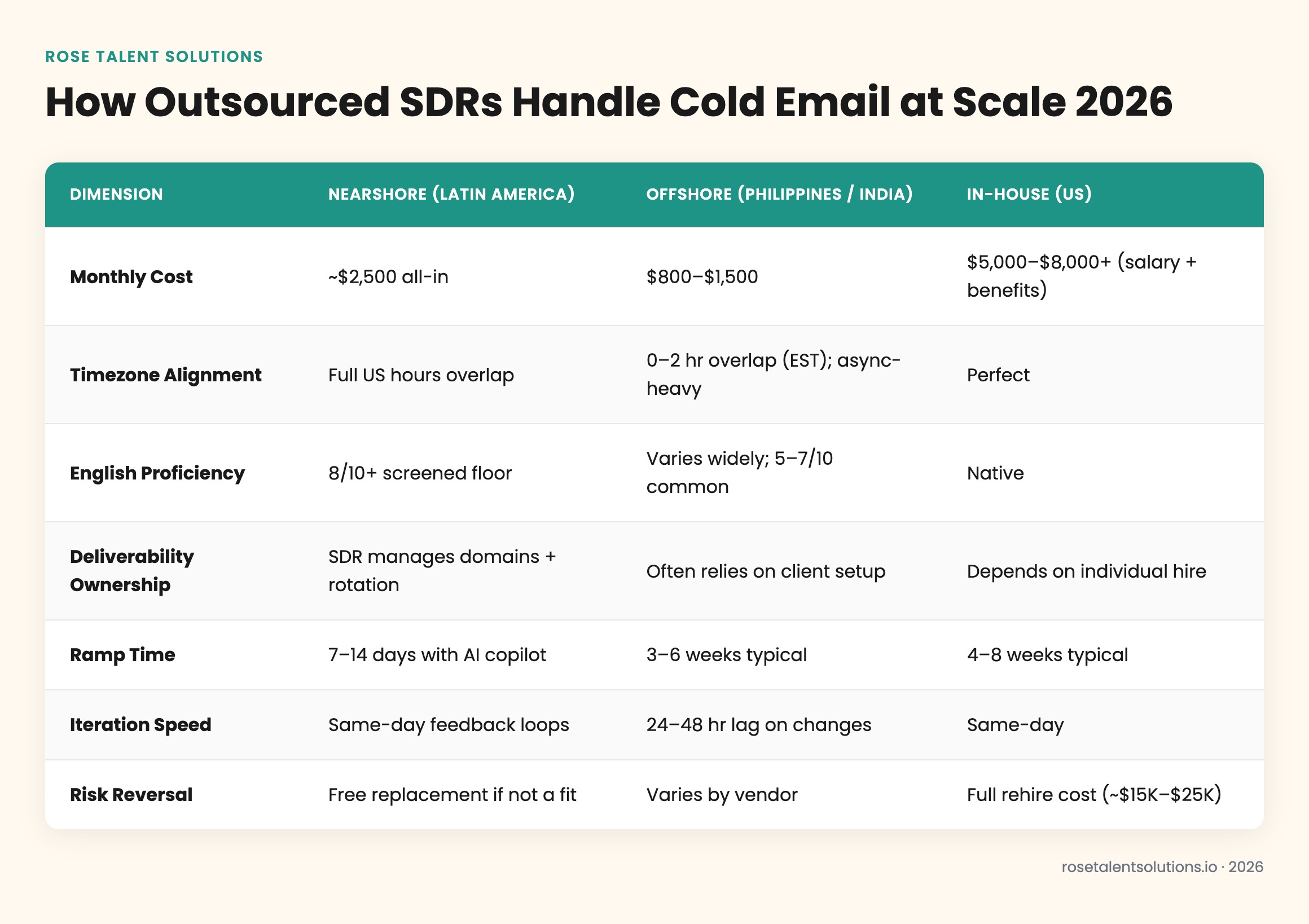
The timezone issue is particularly acute for cold email because the best sending windows for B2B prospects — typically Tuesday through Thursday, 8–10am in the prospect's local time — require your SDR to be live during those hours, ready to respond to a reply within minutes. Research from Yesware (2023) confirms that replying to a cold email response within 5 minutes increases the probability of booking a meeting by over 400% compared to a same-day reply that comes hours later. An offshore SDR working on a 12-hour lag structurally cannot execute on that window.
When weighing the full financial picture, the outsourced vs. in-house SDR ROI comparison we published breaks down total cost of ownership — including recruiting, benefits, churn, and ramp costs — in a way that makes the $2,500/month flat rate easy to contextualize.
How AI Copilots Make Outsourced SDRs Faster in 2026
Every Rose Talent nearshore SDR ships with a role-specific AI copilot trained on the tools your team already uses — whether that's Apollo, HubSpot, Salesforce, or Outreach. This isn't a generic ChatGPT wrapper. It's a purpose-built assistant that knows your ICP, your product positioning, your approved sequence templates, and your objection-handling playbook from day one.
In practice, the AI copilot handles three high-leverage tasks. First, it generates personalized first lines at scale — pulling from the prospect's LinkedIn activity, recent press, or job posting language to create a non-template opener for each contact. Second, it drafts subject line variants for A/B testing, typically generating 5–10 options per sequence that the SDR then scores and selects from. Third, it writes reply drafts for common response types — interest, referral, "not the right person," and objection — so the SDR can respond within minutes rather than composing from scratch.
AI personalization at scale isn't about removing the human — it's about removing the bottleneck. A nearshore SDR using an AI copilot can handle the personalization workload of 3 reps working manually, while maintaining the judgment layer that keeps replies from sounding robotic. Explore the full Rose AI advantage to see how copilots are trained per role.
According to Gartner (2024), SDRs who use AI-assisted personalization tools show a 35% improvement in meeting-booked-per-email-sent rates compared to reps using static templates. That's not a marginal gain — it's the difference between a program that pays for itself in 60 days and one that gets cut in 90.
It's also worth noting that AI copilots extend naturally into LinkedIn outreach. If your SDR program includes multi-channel sequences — email + LinkedIn connection + voice message — our post on whether a virtual assistant can handle LinkedIn outreach at scale covers the tactical setup in detail, including what LinkedIn's automation rules allow and what requires a human touch.
"The reps who win in 2026 aren't the ones sending the most emails — they're the ones whose infrastructure ensures every email actually lands in a primary inbox, and whose AI handles personalization so the human can focus on conversations." — Jason Bay, Founder at Outbound Squad (2024)
How Rose Talent's SDR Onboarding Process Gets You to Sends in 7 Days
One of the most common objections to outsourcing SDR work is ramp time. "It'll take months to get someone up to speed on our product." In practice, with the right infrastructure, a nearshore SDR running a structured onboarding process can be sending live sequences within one week of placement. Here's the exact sequence:
ICP & Positioning Call (Day 1)
The SDR joins a 60-minute session with your team to lock down ICP filters, messaging pillars, objection responses, and sequence approval. The AI copilot is initialized with your product context during this call.
Domain & Inbox Setup (Days 1–3)
3–5 sending domains are registered, MX records configured, and inboxes entered into a warm-up pool. Sending starts at 20 emails/day per inbox and scales to full capacity by day 14.
Sequence Build & Approval (Days 2–4)
The SDR drafts 2–3 sequence variants (each 4–6 steps), including subject lines, body copy, and follow-up logic. You review and approve. AI copilot generates first-line personalization for the seed list.
Seed List Send & Optimization (Days 5–7)
First 100–200 contacts receive the approved sequence. Reply data from day 5 onward informs subject line and CTA adjustments before full volume launches in week 2.
Full Volume + Weekly Reporting (Week 2+)
The SDR moves to full sending volume (200–500/day), delivers a weekly report covering open rate, reply rate, positive reply rate, and meetings booked — with recommendations for next-cycle optimizations.
The flat $2,500/month rate covers recruiting, vetting, onboarding support, payroll, HR, and ongoing management — not just the rep's time. There's no long-term contract, and if the placement isn't the right fit, Rose replaces them at no additional cost. You can review the full service model on the get started page or explore role-specific options under specialized roles.
Why Nearshore SDRs Win for Cold Email
- Full US-hours overlap — live during your prospect's prime sending window
- English proficiency screened to 8/10+ — copy reads native, not translated
- AI copilot pre-trained on your stack from day one — no tool ramp lag
- Same-day iteration on subject line and CTA tests
- Flat $2,500/month — no recruiting fees, no benefits overhead
Limitations to Plan Around
- Domain warm-up takes 10–14 days — plan for a soft launch period
- SDR needs clear ICP definition from you upfront — garbage in, garbage out
- Not a fit if you need a closet AE who also demos — this is a dedicated top-of-funnel role
According to SHRM (2023), the average cost-per-hire for a US sales role is $4,700 in direct recruiting costs alone — before salary, benefits, or the 3–6 month ramp period where the rep produces below capacity. The nearshore model eliminates the recruiting cost, compresses ramp time with AI copilots, and removes the $5K–$8K/month salary burden entirely.