
Nearshore sales development reps have quietly become one of the highest-leverage hires a US growth team can make in 2026. If you're trying to figure out how much an outsourced sales development rep costs — and whether that cost makes sense against hiring in-house — you need a clear-eyed look at what different SDR models actually charge, what you get for that money, and where the hidden expenses live. This guide breaks it all down with real numbers so you can make a direct comparison before signing anything.
A Sales Development Representative (SDR) handles top-of-funnel prospecting: cold outreach, lead qualification, and booking discovery calls for your closers. When you outsource that function, you pay a third party — an agency, a staffing firm, or a nearshore provider — to supply that talent rather than hiring directly. Understanding how much an outsourced sales development rep costs requires comparing four distinct models, because the price range runs from $800/month to $15,000/month depending on which one you choose.
According to SHRM's Human Capital Benchmarking data (2023), the average cost-per-hire across all US roles sits near $4,700 — and sales roles skew higher. Add a base salary of $45,000–$55,000/year for an entry-level SDR, plus benefits, payroll taxes, and the 3–6 month ramp period where quota isn't being hit, and the true first-year cost of an in-house sales development rep routinely clears $80,000. Outsourcing sidesteps most of that overhead, which is why so many growth-stage teams are asking exactly how much an outsourced sales development rep costs before committing to a full-time hire.
How Do Outsourced Sales Development Rep Pricing Models Work in 2026?
There is no single answer to how much an outsourced sales development rep costs. The number you pay depends on four distinct models, each with a different cost structure, risk profile, and quality ceiling. Understanding the model first prevents sticker-shock later.
1. US-Based SDR Agencies charge a monthly retainer, typically $4,000–$8,000/month for a fractional SDR (part-time dedicated), or $8,000–$15,000/month for a fully dedicated rep. These firms carry high overhead because they employ W-2 US workers and layer on thick management margins. You're paying for brand, process, and domestic labor rates simultaneously.
2. Offshore SDR Agencies (primarily Philippines- or India-based) advertise rates as low as $800–$2,000/month. The catch: significant timezone friction for US sales cycles, variable English proficiency, and high turnover rates that restart your ramp clock every few months. According to McKinsey's B2B sales research (2024), sales rep ramp time averages 3.2 months — every turnover event costs you a full quarter of pipeline.
3. Nearshore SDR Staffing — Latin America-based reps working US business hours — hits the sweet spot. When buyers ask how much an outsourced sales development rep costs from a nearshore provider, the answer is typically $2,000–$3,500/month for a full-time dedicated rep, all-in. Rose Talent Solutions charges a flat $2,500/month covering recruiting, vetting, payroll, HR, and ongoing management. No hidden per-seat fees, no setup charges.
4. Freelance SDRs via Platforms (Upwork, Fiverr) range from $15–$40/hour, but you carry all employer risk, manage compliance yourself, and get zero replacement protection if the hire doesn't work out. The apparent savings disappear fast once you factor in management time and turnover.
What Does an Outsourced Sales Development Rep Actually Cost When You Add Everything Up?
Sticker price and total cost are two different numbers. This is where most buyers get burned when comparing outsourced sales development rep pricing. To compare models honestly, you need to account for recruiting time, onboarding overhead, management hours, and the cost of turnover — none of which appear on the proposal's cover page.
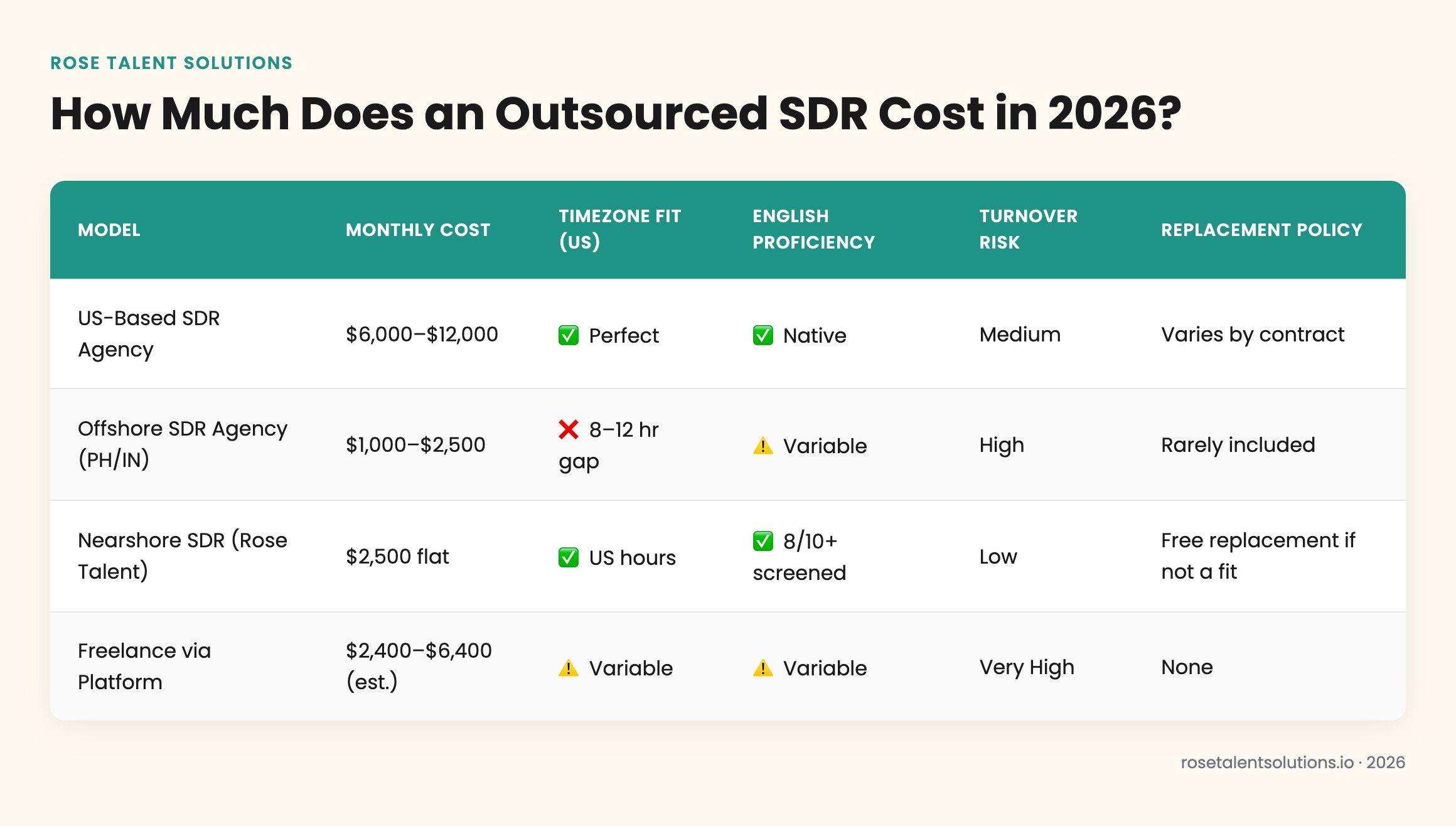
| Model | Monthly Cost | Timezone Fit (US) | English Proficiency | Turnover Risk | Replacement Policy |
|---|---|---|---|---|---|
| US-Based SDR Agency | $6,000–$12,000 | ✅ Perfect | ✅ Native | Medium | Varies by contract |
| Offshore SDR Agency (PH/IN) | $1,000–$2,500 | ❌ 8–12 hr gap | ⚠️ Variable | High | Rarely included |
| Nearshore SDR (Rose Talent) | $2,500 flat | ✅ US hours | ✅ 8/10+ screened | Low | Free replacement if not a fit |
| Freelance via Platform | $2,400–$6,400 (est.) | ⚠️ Variable | ⚠️ Variable | Very High | None |
If you want a deeper breakdown of what drives ROI differences between these outsourced sales development rep models, the outsourced vs. in-house SDR hiring ROI comparison on the Rose blog walks through the math with line-item detail.
"The biggest mistake companies make when evaluating outsourced SDRs is comparing the hourly rate without accounting for ramp time, management overhead, and the opportunity cost of a six-hour timezone gap on a US sales cycle." — Lars Nilsson, VP of Global Sales Development at Cloudera (2022)
How Does Outsourced Sales Development Rep Cost Compare to Hiring In-House in 2026?
Let's put real numbers on a side-by-side. An in-house sales development rep in the US earns a median base salary of $50,000–$58,000/year, according to Bureau of Labor Statistics occupational data (2024). Stack on employer payroll taxes (~7.65%), health insurance (~$7,000/year employer contribution), equipment, software seats, and a recruiting fee of 15–20% of first-year salary, and the true loaded cost of an in-house SDR lands between $75,000 and $95,000 in year one.
A nearshore outsourced sales development rep through Rose Talent costs $30,000/year flat ($2,500 × 12). That's a 60–70% cost reduction against a comparable in-house hire — with no long-term contract tying up your budget if business conditions shift. The outsourced sales development rep cost advantage is not marginal; it's structural.
The productivity gap has also narrowed sharply. Every Rose Talent SDR ships with a role-specific AI copilot trained on the tools your team already uses — whether that's Salesforce, HubSpot, Outreach, or Apollo. That accelerates ramp time and means your rep is running sequenced outreach from week one, not week eight. Learn more about how this works on the AI advantage page.
According to Gartner's sales productivity research (2023), the average SDR takes 3.2 months to hit full productivity. AI tooling cuts that ramp significantly for reps who arrive pre-trained on your specific stack — a meaningful difference when every month of ramp is a month of pipeline you're not building.
The hidden cost of an offshore outsourced sales development rep isn't the monthly rate — it's the timezone gap. A prospect who receives a follow-up 14 hours after expressing interest converts at a fraction of the rate of one who hears back within 90 minutes. Nearshore SDRs working US hours close that gap entirely, making the real outsourced sales development rep cost far lower than the sticker price suggests.
What Are the Real Hidden Costs of Cheap Offshore Outsourced SDR Services?
Low headline rates mask several recurring costs that compound over a 12-month engagement. Before you anchor on a $1,200/month offshore quote as your baseline for how much an outsourced sales development rep costs, account for these line items that almost never appear in the proposal.
Turnover replacement cost. Offshore SDR agencies often see annualized turnover above 60%, according to Gallup's workforce engagement research (2023). Each replacement resets your ramp clock — and your pipeline. A rep who churns at month four cost you four months of ramp investment and delivered maybe six to eight weeks of full-productivity outreach.
Management overhead. Offshore teams operating on a 10-hour timezone lag require your sales manager to review activity, answer questions, and course-correct asynchronously. That typically costs 5–8 hours of manager time per week — hours that aren't free. At a $100,000 manager salary, 6 hours/week equals roughly $15,000/year in hidden management drag that never shows up when buyers compare outsourced sales development rep costs across providers.
Quality correction cycles. Variable English proficiency on cold email and cold calls means your brand takes reputational hits with prospects. One poorly written sequence sent to 500 target accounts is hard to undo. Rose's published English proficiency floor of 8/10+ on standardized screens exists specifically to prevent this. If you're evaluating outsourced sales development rep services for a SaaS product, the guide on how to hire outsourced SDR services for SaaS covers exactly what vetting criteria to demand from any provider.
For a full treatment of the outsourced sales development rep cost landscape — including per-meeting and performance-based pricing models — the outsourced SDR cost breakdown post covers those structures in detail.
How Does Rose Talent's SDR Onboarding Process Work in 2026?
Discovery Call (Day 1)
Rose maps your ICP, outreach stack, and pipeline goals. This brief takes 30 minutes and directly informs candidate matching — you're not handed a generic shortlist.
Candidate Matching (Days 2–5)
Rose's team surfaces 2–3 pre-vetted nearshore sales development rep candidates with demonstrated cold outreach experience and 8/10+ English scores. You interview and select.
AI Copilot Setup (Days 5–7)
Your SDR's role-specific AI copilot is configured for your CRM and sequencing tools — Salesforce, HubSpot, Outreach, Apollo, or your stack of choice — before their first day.
Live Outreach Begins (Week 2)
Your rep starts running sequences within their first week. Rose handles payroll, HR, and compliance so you never touch an employment contract.
Ongoing Management & QA (Monthly)
Rose monitors performance and handles any HR issues. If the team member isn't a fit, you get a free replacement — no additional cost, no debate.
Month-to-month terms mean you can scale headcount up or down with 30 days written notice — no long-term contract locking you into headcount you don't need. If you're ready to see what a dedicated nearshore outsourced sales development rep looks like inside your pipeline, the fastest path is the intake form at Rose's start page.
Nearshore vs. Offshore vs. In-House: Which Outsourced Sales Development Rep Model Wins in 2026?
The right model depends on your stage, budget, and pipeline velocity requirements. Here's an honest pros/cons view of nearshore SDR staffing — the model Rose operates — versus the alternatives. This framing is especially useful if you're benchmarking how much an outsourced sales development rep costs relative to what you actually get back.
Nearshore SDR (Pros)
- US-hours availability — no timezone lag on follow-ups
- Flat predictable monthly cost ($2,500 all-in)
- AI copilot pre-trained on your stack accelerates ramp
- Free replacement guarantee if not a fit
- No long-term contract — cancel with 30 days written notice
- Rose handles payroll, HR, compliance in full
Nearshore SDR (Cons)
- Not a native US accent — some enterprise buyers have preferences
- Still requires you to provide playbooks and ICP clarity upfront
- Not ideal if your AE team needs in-person whiteboard sessions with SDRs
One often-overlooked capability of well-trained nearshore outsourced sales development reps is cold email at scale. The sequencing, personalization, and deliverability management that drives modern outbound are all tool-dependent skills — not geography-dependent ones. The post on how outsourced SDRs handle cold email at scale addresses exactly how nearshore reps manage deliverability and sequence logic at high send volumes.
According to Statista's global email usage data (2024), over 4.7 billion people use email globally — and B2B cold email remains the highest-volume top-of-funnel channel for most SDR teams. The outsourced sales development reps who win in 2026 are the ones who combine strong English communication with disciplined tool usage. That's exactly the profile Rose screens for at the 8/10+ English floor.
For businesses evaluating outsourced sales support alongside administrative and financial functions, Rose also staffs outsourced bookkeeping and accounting roles and full-cycle property management virtual assistants — making it possible to consolidate nearshore staffing under one provider at the same flat rate.