
Why SaaS Companies Are Rethinking Sales Development in 2026
If you run a SaaS company and your pipeline is inconsistent, the nearshore model — SDRs based in Latin America working your exact US business hours — is the fastest path to fixing it without rebuilding your entire go-to-market from scratch. Building an internal SDR team is slow, expensive, and brutal to manage. Recruiting, onboarding, ramping, and replacing junior sales reps eats twelve to eighteen months before you see a predictable return. That timeline kills growth plans.
Outsourced SDR services have become a genuine game-changer for SaaS companies that need qualified pipeline without the overhead of a full recruiting machine. The model has matured significantly — the best providers today are not body shops. They are embedded sales functions with dedicated reps, defined SLAs, and sector-specific playbooks built for software companies.
This guide covers everything you need to make a smart hiring decision in 2026: what outsourced SDR services actually cost, how to benchmark performance, what red flags to watch for, and how to structure the legal relationship so you own your data when the engagement ends.
According to Salesforce's State of Sales report (2024), high-performing sales teams are nearly three times more likely to use AI-assisted outreach and outsourced prospecting functions than underperforming ones. That gap is widening, not closing.
What Is an Outsourced SDR Service and How Does It Work for SaaS?
An outsourced SDR (Sales Development Representative) service is an external team or dedicated individual that handles the top-of-funnel prospecting function on behalf of your company. Their job is to identify target accounts, execute outbound sequences, qualify inbound leads, and book discovery calls for your account executives — without sitting on your payroll.
For SaaS specifically, the SDR function carries unique complexity. Your buyers are often technical — CTOs, VPs of Engineering, Heads of Ops — your sales cycles involve free trials and product demos rather than brochures, and your ICP shifts as your product expands into new segments. A generalist SDR firm that sells for manufacturing companies will fumble all of that. You need a provider with documented SaaS experience: familiarity with tools like Outreach, Salesloft, Apollo, and HubSpot, and reps who can speak intelligently about integration capabilities, API limits, and onboarding timelines without reading from a script.
Outsourced prospecting in the SaaS context also means the vendor must understand your competitive landscape well enough to handle objections in real time. That is a higher bar than most listicles admit. Sales development outsourcing only works at this level when the vendor has genuine SaaS vertical depth — not just a list of software logos on their homepage.

How Nearshore SDRs Outperform Offshore for SaaS Sales Development in 2026
The offshore vs. nearshore debate is settled for SaaS sales roles. Offshore SDRs — typically based in the Philippines or India — work six to twelve hours outside US business hours. That gap does not just create scheduling friction; it kills deal momentum. A prospect who books a call via your SDR's sequence expects follow-up that day, not the next morning. Every hour of lag in a competitive SaaS deal is a door opened for a competitor.
Nearshore SDRs based in Latin America work your US business hours natively. They are online when your AEs are online, when your prospects are online, and when your Slack is active. The timezone alignment alone justifies the model — but it is not the only advantage. Rose Talent screens every placement at an 8/10 or higher English proficiency floor, meaning your SDR is not just reachable during business hours — they communicate with fluency that holds up in live sales conversations.
| Model | Typical Monthly Cost (per rep) | Timezone Fit (US hours) | English Proficiency | SaaS SDR Experience | Ramp Time |
|---|---|---|---|---|---|
| Onshore US SDR Firm | $6,000 – $12,000+ | ✅ Perfect | Native | Varies widely | 60–90 days |
| Offshore (Philippines/India) | $800 – $1,800 | ❌ 6–12 hr gap | 3–6 / 10 avg. | Low SaaS density | 90–120 days |
| Nearshore Latin America (Rose Talent) | $2,500 flat | ✅ US hours native | 8/10+ screened floor | SaaS-trained AI copilot included | 30–45 days |
| Freelance / Upwork SDR | $1,200 – $3,500 | ⚠️ Inconsistent | Variable | No vetting standard | Unknown |
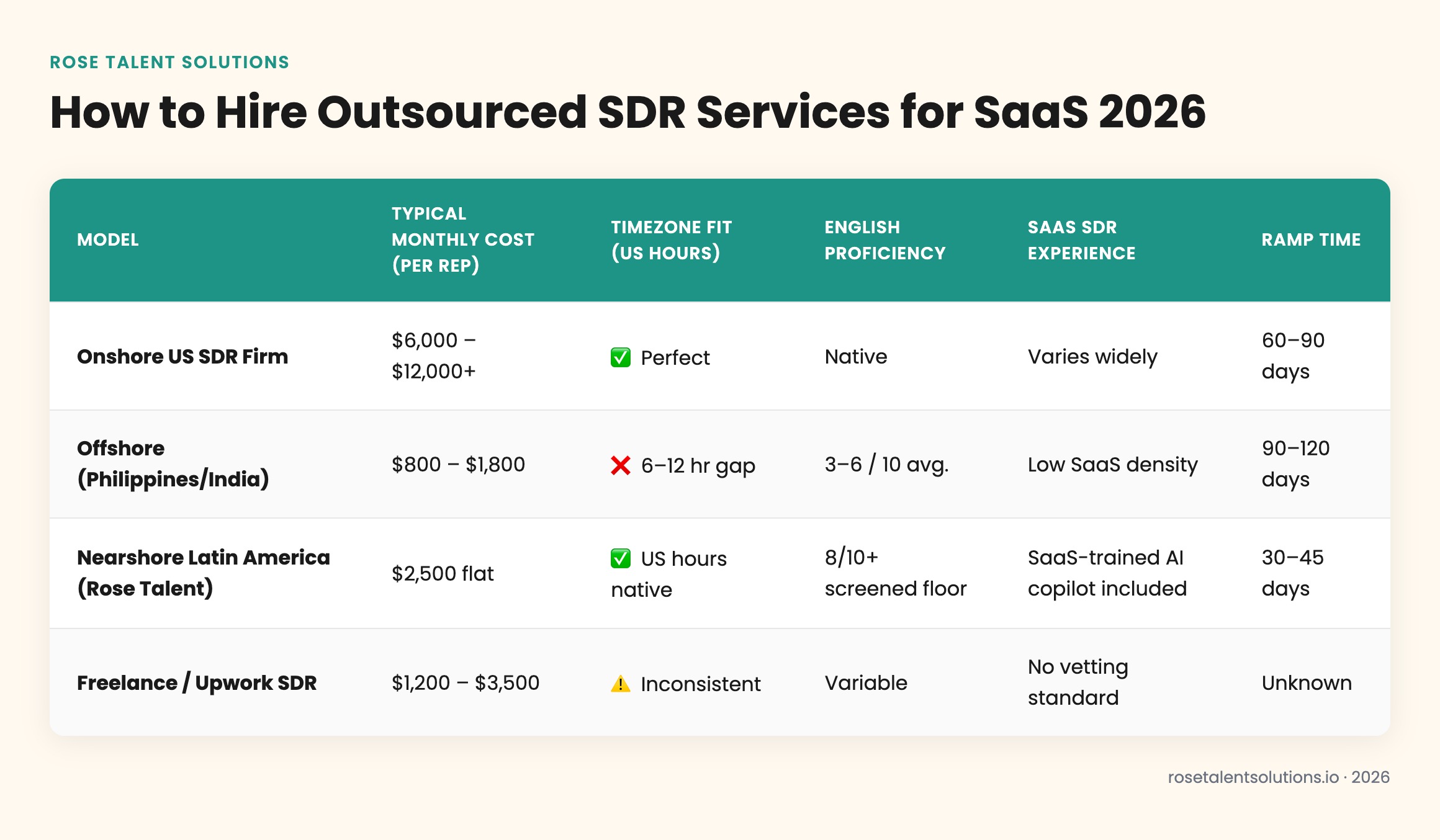
Rose Talent's nearshore SDRs come with a role-specific AI copilot trained on the exact tools your sales stack uses — Outreach, HubSpot, Apollo, Salesforce — so they are not learning your software from scratch on week one. That is the sales development outsourcing model built for SaaS in 2026, not 2015.
How to Structure the Pricing Conversation Before You Sign Anything
Outsourced SDR pricing falls into three primary models, and each carries different risk profiles for SaaS companies at different stages.
Retainer-based pricing is the most common and most transparent model. You pay a fixed monthly fee — typically $2,500 to $12,000 per rep depending on geography and seniority — for dedicated hours, defined activities, and agreed-upon output metrics. This is the model Rose Talent uses: $2,500 per month, full-time, all-in. The advantage is predictability. The risk is that a bad vendor will collect the retainer while delivering vanity metrics (emails sent, calls logged) rather than pipeline outcomes (meetings held, qualified opportunities created).
Performance-based pricing sounds attractive — you only pay per qualified meeting or per opportunity. But in SaaS, this model creates perverse incentives. Reps optimize for booking any meeting, not the right meeting. Your AEs waste hours on demos with prospects who never had budget or authority. According to Gartner's Sales Performance research (2023), companies using purely performance-based SDR contracts report 23% lower opportunity-to-close rates than retainer-based engagements — because lead quality erodes when reps are chasing booking bonuses.
Hybrid pricing combines a lower base retainer with a per-meeting or per-opportunity bonus. This is the most aligned model when structured correctly: the base covers dedicated time and activity, the bonus rewards quality outcomes. If you pursue this, define "qualified meeting" in writing before signing — minimum company size, decision-maker title, confirmed budget conversation, and a 24-hour no-show policy that voids the bonus.
The hidden cost of performance-based SDR contracts is not the per-meeting fee — it is the 30–40% of AE capacity burned on unqualified demos booked by reps gaming their own incentive structure. Always negotiate a meeting quality clause into any performance-based agreement before you sign.
Rose Talent's flat $2,500 per month model sidesteps this entirely. One price, one rep, full-time, every output metric agreed upfront. No hidden layers, no long-term contract required.
How to Benchmark Outsourced SDR Performance: KPIs and Realistic Ramp Timelines in 2026
One of the most common mistakes SaaS leaders make when evaluating a sales development outsourcing engagement is judging performance too early against the wrong metrics. Here is how to do it correctly.
Weeks one through three are ramp time. Your SDR is learning your ICP, your messaging, your objection landscape, and your tech stack. Expect lower output volume. The right metrics to track here are activity consistency (sequences launched, calls completed) and message quality (is the rep representing your positioning accurately?) — not meetings booked.
Weeks four through eight are the proving window. By now, a competent nearshore SDR should be hitting industry-standard benchmarks. According to DemandGen's B2B Buyer Benchmark Study (2023), average SDR meeting-booking rates in SaaS run 15–25 qualified meetings per rep per month, with rates of 25–35 achievable for well-defined ICPs paired with strong outbound sequences. If you are not seeing at minimum ten qualified meetings in month two, the problem is either messaging or ICP clarity — both of which are your responsibility to fix alongside the vendor, not the vendor's problem alone.
Month three and beyond, you benchmark on pipeline contribution: what percentage of your active opportunities originated from the SDR function, and what is the average deal size and close rate of those opportunities versus inbound or other channels? These are the numbers that justify or end the engagement.

Red Flags to Watch for When Vetting Outsourced SDR Vendors
The outsourced SDR market has no shortage of firms that will over-promise and under-deliver. The specific warning signs below should end a sales conversation immediately.
Green Flags — Signs of a Real Vendor
- Can name specific SaaS verticals they have worked in and explain your ICP's buying behavior without prompting
- Provides sample reporting dashboards and defines "qualified meeting" contractually before you ask
- Offers a transparent ramp timeline with defined checkpoints and mutual accountability on both sides
- Data ownership clause explicitly assigns your contact lists and conversation data to you on exit
- Will introduce you to a current SaaS client reference before you sign anything
Red Flags — Walk Away Immediately
- Leads with emails sent and calls logged as primary success metrics — these are vanity metrics, not pipeline proof
- Cannot explain how they handle GDPR or CCPA compliance for your prospect data
- Refuses to include SLA floors (minimum meetings per month) in the contract language
- No non-solicitation clause — meaning your best SDR could poach your prospects on exit
- Pitches a "dedicated" rep who is actually shared across four to six clients simultaneously
- Locks you into 12-month minimums with no performance exit clause
Ask every vendor directly: "Who owns the contact data and conversation history if we end the engagement?" A vendor who hesitates or deflects on that question is telling you exactly who benefits from that data when you leave. Rose Talent's month-to-month model with 30 days written notice — no long-term contract — means you are never locked in, and your data is yours from day one. The AI advantage model also ensures your sales stack integrations are documented and exportable if the engagement ever ends. According to SHRM's employment law guidance (2024), non-solicitation clauses are enforceable in most US states when narrowly scoped to clients and prospects — make sure yours is in writing before any SDR touches your CRM.
How to Transition from Outsourced SDR Back to an In-House Team
Outsourced SDR services are not always permanent. Many SaaS companies use them as a bridge: prove pipeline economics with an outsourced model, then internalize the function once unit economics justify a full-time SDR manager and a team beneath them. Here is how to do that transition cleanly.
Document the Playbook Before You Exit
At least 60 days before ending the outsourced engagement, require the vendor to deliver a complete sequence library, ICP document, objection-handling guide, and call recording archive. This is your institutional knowledge — it took months to build and must survive the transition intact.
Hire Your SDR Manager First
Do not hire junior reps before you have someone who can coach them. Your first internal hire should be a senior SDR or BDR who has managed a small team — they become the internal owner of the playbook the outsourced vendor built. According to the US Bureau of Labor Statistics (2024), the median annual salary for a sales manager is $130,600 — budget accordingly before committing to full internalization.
Run Parallel for 30 Days
Overlap the outsourced vendor and your first internal hire for one full month. This ensures no pipeline gaps, gives your internal hire a live learning environment, and surfaces any ICP or messaging gaps before you are operating without a safety net.
Give 30 Days Written Notice
Under a properly structured engagement — like Rose Talent's month-to-month model — you cancel with 30 days written notice. No penalties, no clawbacks. Time the notice to align with your parallel-run start date so the offboarding is clean and your pipeline stays warm throughout.
For SaaS companies not yet ready to internalize, a hybrid approach works well: outsource the prospecting function while building internal AE capacity. The outsourced SDR generates pipeline; your AEs close it. This preserves capital and keeps your internal headcount lean while you scale ARR. Many Rose Talent clients in the SaaS space also layer in operations support roles alongside their SDR function to handle contract admin, demo scheduling, and CRM hygiene — keeping the SDR focused purely on prospecting.
How to Start Your First Outsourced SDR Engagement the Right Way in 2026
The SaaS companies that get the most from outsourced SDR services are the ones that do the pre-work before the vendor ever dials a number. That means a written ICP (industry, company size, tech stack signals, buyer titles, disqualifiers), a sequenced messaging framework with at least three value propositions tested internally, and a defined handoff protocol so booked meetings do not fall through the cracks between the SDR and your AE team.
If you can hand a vendor a documented ICP and a proven sequence on day one, your ramp window compresses from 90 days to 30. If you cannot, the first six weeks of the engagement will be spent building what you should have already had — and you will pay for that time. This is the core principle behind any effective sales strategy guide for outsourced prospecting: preparation on your side is a force multiplier on theirs.
Rose Talent's nearshore SDR model is built around low switching risk. Every placement comes with a role-specific AI copilot trained on your sales tools, so the ramp is not starting from zero. Every placement also comes with a role-specific AI copilot trained on your sales tools, so the ramp is not starting from zero. And if the placement is not the right fit, Rose replaces them at no additional cost.
According to McKinsey's Growth, Marketing and Sales insights (2024), companies that treat outsourced sales functions as integrated team members — with shared goals, shared tools, and shared accountability — see 2.4x higher pipeline contribution from those functions than companies that treat vendors as external service providers managed at arm's length.
That integration is exactly what the nearshore model enables. SaaS companies using Latin America-based SDRs on US hours are outperforming their offshore counterparts in every pipeline metric that matters in 2026 — because the working relationship actually functions in real time, every day, inside the same business hours your AEs and your prospects share.