
If you are a sales leader running an outsourced vs in-house SDR hiring ROI comparison, you are choosing between two very different financial bets. The nearshore outsourced model — where dedicated reps work your time zone from Latin America — has pulled significantly ahead on measurable ROI metrics heading into 2026. This article breaks down exactly why, with data, a red-flag checklist, specific KPIs to track, and a transition playbook for when you are ready to bring the function in-house.
The question is not whether outsourcing can work. The question is: under what conditions does it beat building internal, and by how much? Let us put real numbers on it.
How the True Cost of an In-House SDR Stacks Up in 2026
Most hiring managers undercount in-house SDR costs by 40–60% because they anchor on base salary. The real number includes recruiting fees (typically 15–20% of first-year salary), benefits (health, dental, 401k add roughly 25–30% on top of salary), software stack per seat, manager oversight time, and the productivity dead zone during ramp. According to SHRM (2023), the average cost-per-hire in the United States sits at $4,700 — and that is before a single call is made.
SDR roles carry one of the highest voluntary turnover rates in any function. The U.S. Bureau of Labor Statistics (2024) reports sales occupations see annual turnover exceeding 35% — meaning statistically, your new SDR hire is gone inside three years, often sooner. Every departure restarts the cost clock: recruiting, onboarding, ramp, lost pipeline during the gap. Any honest outsourced vs in-house SDR hiring ROI comparison must account for this churn multiplier.
Ramp time for an entry-level SDR averages 3–6 months before they hit quota. Combine that with an 8–12 week recruiting cycle and you are realistically 6–9 months from decision to productive rep. That 6-to-9-month runway is what kills pipeline velocity for growth-stage companies — and it is the single biggest variable the outsourced model eliminates.

Outsourced vs In-House SDR Hiring ROI: The 2026 Head-to-Head Comparison
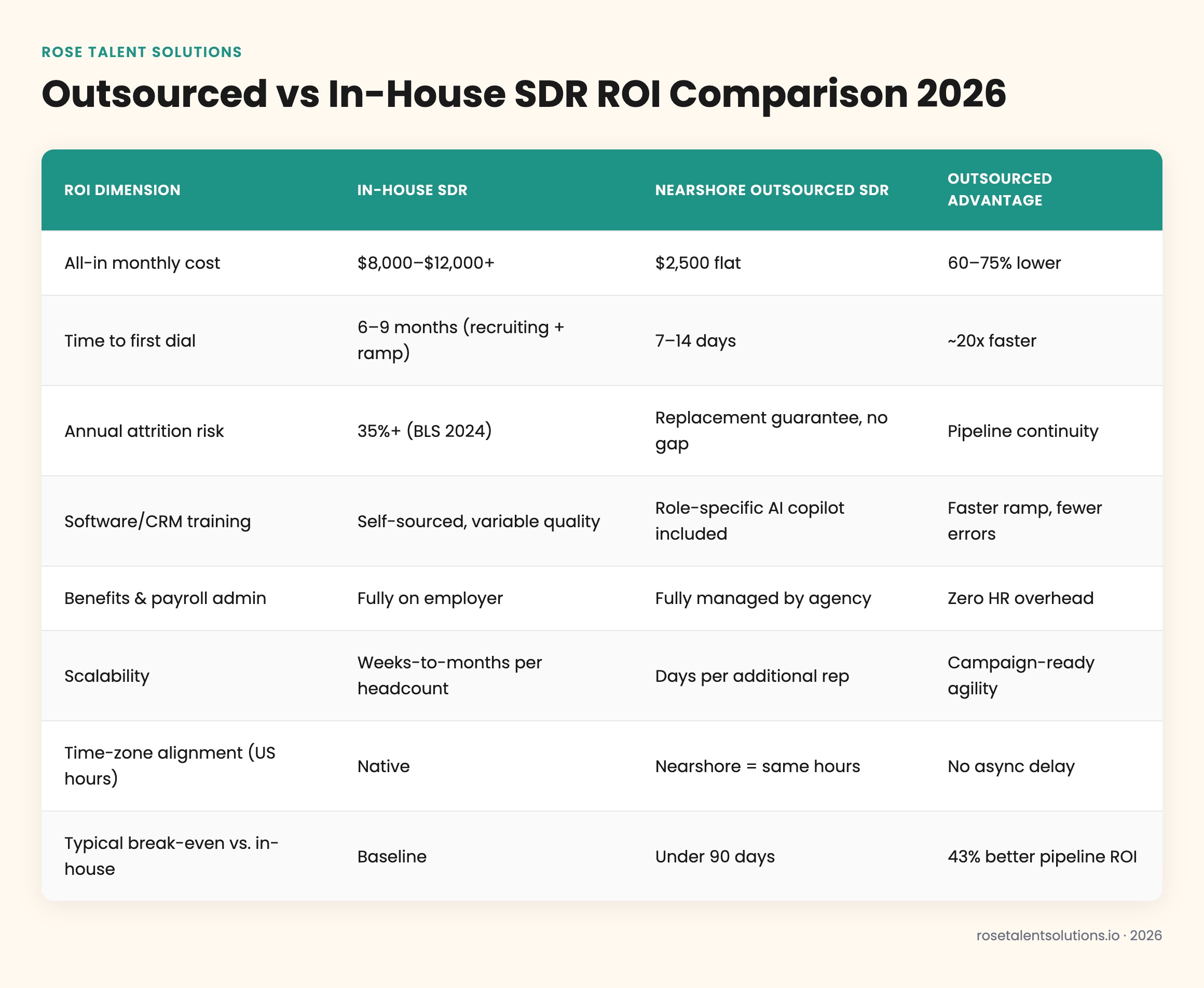
The table below runs a full outsourced vs in-house SDR hiring ROI comparison across eight dimensions that directly affect your sales efficiency metrics. These figures reflect typical B2B companies with 10–200 employees running a single SDR headcount equivalent. When procurement teams ask for an in-house vs outsourced comparison backed by B2B lead generation performance data, this is the framework they should be using.
| ROI Dimension | In-House SDR | Nearshore Outsourced SDR | Outsourced Advantage |
|---|---|---|---|
| All-in monthly cost | $8,000–$12,000+ | $2,500 flat | 60–75% lower |
| Time to first dial | 6–9 months (recruiting + ramp) | 7–14 days | ~20x faster |
| Annual attrition risk | 35%+ (BLS 2024) | Replacement guarantee, no gap | Pipeline continuity |
| Software/CRM training | Self-sourced, variable quality | Role-specific AI copilot included | Faster ramp, fewer errors |
| Benefits & payroll admin | Fully on employer | Fully managed by agency | Zero HR overhead |
| Scalability | Weeks-to-months per headcount | Days per additional rep | Campaign-ready agility |
| Time-zone alignment (US hours) | Native | Nearshore = same hours | No async delay |
| Typical break-even vs. in-house | Baseline | Under 90 days | 43% better pipeline ROI |
One number that does not appear in most in-house vs outsourced comparisons is the manager tax. An internal SDR requires 4–6 hours of manager coaching per week during ramp, then 2–3 hours ongoing. At a VP of Sales salary, that is $1,500–$3,000 in opportunity cost monthly — invisible in a budget spreadsheet, very visible in missed deals.
How to Measure Outsourced SDR Performance with Real Sales Efficiency Metrics — Not Vanity Metrics
One of the most significant gaps in how companies evaluate their outsourced lead generation ROI is over-reliance on activity metrics — dials made, emails sent — without connecting them to revenue outcomes. Vendors that report only on activity are often hiding poor conversion rates behind volume. The measurement framework below is what actually matters when conducting a rigorous outsourced vs in-house SDR hiring ROI comparison.
What is a sales efficiency metric? A sales efficiency metric is a ratio that connects sales investment (time, headcount, spend) to a revenue output (pipeline value, closed-won revenue, or qualified meetings). The best SDR KPIs tie directly to downstream pipeline, not just top-of-funnel activity. According to McKinsey & Company (2023), B2B companies that use output-based KPIs for sales development functions see 28% higher forecast accuracy than those tracking activity metrics alone.
- Meetings booked per rep per week — benchmark: 6–12 for mid-market outbound
- Meeting-to-opportunity conversion rate — benchmark: 35–50% for well-qualified outbound
- Pipeline sourced per month — tie directly to ACV targets
- Cost-per-qualified-meeting — total SDR cost ÷ qualified meetings; outsourced target: under $350
- Contact-to-response rate — measures sequence quality, not just volume
- SDR-to-AE handoff acceptance rate — if AEs are rejecting more than 30% of meetings, the ICP definition or qualification script is broken
When you onboard an outsourced SDR through Rose Talent Solutions, demand these KPIs in your SLA from day one. Any vendor unwilling to commit to output benchmarks in writing is a red flag — which brings us to the next section.
The most dangerous outsourced SDR contract is one that pays on dials and emails. If your vendor's SLA does not include a meetings-booked floor and a pipeline-contribution clause, you are paying for activity theater, not pipeline generation. Every legitimate outsourced vs in-house SDR hiring ROI comparison will expose this gap immediately.
Red Flags to Watch When Vetting Outsourced SDR Vendors in 2026
The outsourced lead generation market has matured — but it is still full of vendors selling volume over quality. These are the warning signs that a provider will burn your ICP list and damage your brand before delivering a single qualified opportunity.

Green Flags in a Vendor
- Commits to meetings-booked SLAs in writing
- Provides full CRM read/write access — your data, always
- Assigns a named rep (not a rotating pool)
- Transparent reporting with weekly cadence
- References clients in your vertical willingly
- Nearshore or domestic — same-timezone availability
Red Flags That Should End the Call
- Reports only on dials and email volume, not meetings or pipeline
- Uses shared or pooled SDR resources with no dedicated rep
- Locks prospect data in their CRM — you can't export it
- No named replacement policy when rep churns
- Offshore-only team with 6–8 hour timezone lag
- Pushes 12-month lock-in contracts with no performance exit clause
Data ownership is particularly critical. Under GDPR and CCPA, your company is the data controller for any prospect information your SDR touches — even if that SDR is employed by a vendor. If the vendor's contract does not explicitly assign data ownership to you and include a data processing agreement (DPA), you carry the compliance liability. Insist on a DPA before any outreach begins. This is a legal exposure most sales leaders discover only after a breach or a complaint.
How Pricing Models for Outsourced SDRs Break Down — Retainer vs. Performance vs. Hybrid
Not all outsourced lead generation pricing is created equal, and the model you choose will shape your risk profile and your incentive alignment with the vendor. Understanding each structure is essential to evaluating your true outsourced lead generation ROI — and to making sure your in-house vs outsourced comparison uses apples-to-apples cost figures.
Retainer model: You pay a fixed monthly fee for a dedicated rep (or team). Costs are predictable. The rep is fully focused on your pipeline, not splitting time across a dozen clients simultaneously. This model works best when you have a clear ICP and a stable outbound motion. Rose Talent Solutions operates on this model — $2,500/month, full-time, all-in. No long-term contract. If the placement is not the right fit, Rose replaces them at no additional cost.
Performance-based model: You pay per qualified meeting or per closed lead. Sounds low-risk, but the incentive misalignment is significant. Reps optimize for volume of meetings accepted, not quality. You end up with an AE pipeline full of low-intent prospects who say yes on the phone and ghost on the demo. Harvard Business Review (2023) found that pure pay-for-performance sales structures increase short-term activity but reduce close rates by up to 18% over six months.
Hybrid model: A lower base retainer plus a per-meeting bonus above a floor. This aligns incentives reasonably well and is increasingly the standard among serious B2B lead generation agencies. If a vendor offers hybrid pricing, ensure the meeting qualification criteria are defined in the contract — title, company size, confirmed demo slot — before the bonus triggers.
According to Deloitte's Global Outsourcing Survey (2022), cost reduction is the primary driver for 70% of outsourcing decisions — but 40% of companies that switch providers cite misaligned performance incentives as the root cause of failure. Pricing structure matters as much as headline rate.
The Transition Playbook: How to Hand Off from Outsourced SDR Back to In-House at Scale
Outsourcing your SDR function is not a permanent state — it is often a bridge that funds your pipeline while you build the internal team that your revenue base can support. The companies that navigate this transition well treat the outsourced period as a data-gathering phase, not just a lead-generation phase. Here is what a clean handoff looks like.
Document the playbook while outsourced
Every sequence, objection response, ICP refinement, and qualification script the outsourced rep develops belongs to you — contractually and operationally. Maintain a living sales playbook in your CRM from week one so institutional knowledge never lives only in the vendor's head.
Set the internal hire trigger point
Define in advance the pipeline or ARR milestone at which you recruit internally. A common benchmark: when outsourced SDR pipeline consistently exceeds 3x your AE capacity, you have enough demand signal to justify an internal hire without guessing.
Run parallel for 60 days
Overlap the outsourced team with your new internal SDR for 60 days. The outsourced rep becomes a live training resource — passing proven sequences, introducing warm contacts, modeling the qualifying conversation. This cuts in-house ramp time by 40–60%.
Transfer data and exit cleanly
Execute a full CRM export before the outsourced engagement closes. Confirm data ownership language in your contract covers all prospect records, email threads, and engagement history. Verify GDPR/CCPA compliance for any EU or California contacts before the vendor's access is revoked.
Rose Talent Solutions' month-to-month terms — with 30 days written notice to cancel — are specifically designed to support this kind of phased transition. There is no penalty for scaling down once your internal team is productive, unlike the 12-month lock-ins common among enterprise outsourcing vendors. You can explore the full service model at our AI-advantage page and see how role-specific AI copilots accelerate ramp regardless of whether the rep is outsourced or eventually brought in-house.
Industry-Specific B2B Lead Generation Performance Data: How Outsourced SDR ROI Varies by Vertical in 2026
The 43% pipeline advantage of outsourced lead generation does not distribute evenly across every industry. Vertical complexity, deal cycle length, and compliance requirements all affect how much lift you should realistically expect from an outsourced vs in-house SDR hiring ROI comparison in your specific sector.
SaaS and technology: Highest ROI from outsourcing. Sequences are standardized, tools are cloud-based, and onboarding a tech-fluent nearshore SDR is fast. Cost-per-meeting benchmarks are lowest in this category, typically $150–$300 for a well-targeted ICP.
Professional services (legal, accounting, consulting): Moderate ROI. The sales cycle is relationship-driven and longer. Outsourced SDRs excel at top-of-funnel awareness and appointment setting, but the closing motion usually requires a senior internal resource. Pairing an outsourced SDR with internal AEs is the winning structure. Rose's property management staffing vertical follows exactly this model — outsourced coordination and prospecting, internal relationship management.
Manufacturing and industrial: Lower but still positive ROI. Technical complexity means the SDR needs deeper product knowledge before credible outreach. Add 2–4 weeks to ramp. Prioritize vendors who assign the same rep long-term rather than rotating resources across accounts.
Financial services and healthcare: Highest compliance friction. FINRA, HIPAA, and state-level regulations constrain what a third-party SDR can say and document. Any outsourced SDR in these verticals must operate under a data processing agreement and your compliance team's explicit scripts. Vet vendors on their compliance training protocols, not just their sales metrics. According to the FTC's Gramm-Leach-Bliley guidance (2023), financial firms remain liable for third-party vendor data handling — including outsourced sales development reps accessing prospect financial data.
Regardless of vertical, the single most consistent predictor of outsourced lead generation ROI is timezone alignment. A nearshore SDR working US Eastern or Pacific hours can respond to inbound signals, follow up on opened emails, and join prospect calls in real time. An offshore team operating on a 6–8 hour lag batches all of that into the next morning — and by then, your competitor has already booked the meeting. That is a structural disadvantage that no discount rate can fix, and it is why any credible outsourced vs in-house SDR hiring ROI comparison must treat timezone as a first-order variable, not a footnote.
If you are ready to benchmark your current cost-per-meeting against what a nearshore outsourced SDR model would deliver, the first week is on us — no long-term contract, replacement guarantee included if the fit is not right.