
Nearshore sales development is one of the most underused levers in early-stage startups — and one of the most misunderstood. Most founders ask when should a startup hire its first outsourced SDR only after pipeline has already dried up and the CEO is back to cold-calling prospects at 10pm. This guide gives you a concrete framework: the signals that tell you it's time, the math that tells you which model to choose, and the steps to place a Latin America-based outsourced SDR who works your hours, speaks fluent English, and ships with an AI copilot trained on your sales stack.
According to Salesforce's State of Sales (2024), 47% of B2B sales teams cite pipeline generation as their single biggest challenge. If you're founder-led selling and pipeline is your bottleneck, knowing exactly when should a startup hire its first outsourced SDR isn't an academic question — it's the unlock your revenue needs.
What Is an Outsourced SDR, and How Does the Nearshore Model Work in 2026?
An outsourced SDR (Sales Development Representative) is a full-time or fractional sales rep employed through a staffing or agency partner rather than directly on your payroll. Their job is top-of-funnel: prospecting, cold outreach, qualification, and booking discovery calls for your account executives or founders.
A nearshore outsourced SDR specifically means the rep is based in Latin America — countries like Colombia, Mexico, Argentina, or Costa Rica — and works your US, Canadian, or UK business hours in real time. This is fundamentally different from offshore models based in the Philippines or India, where time-zone gaps of 8–13 hours mean your SDR is running cold email sequences while your prospects are asleep, and voicemail callbacks arrive in the middle of your night.
Rose Talent Solutions places nearshore SDRs who pass an 8/10+ English proficiency screen, arrive pre-trained on your CRM and outreach tools, and come with a role-specific AI copilot — so they're writing sequences, updating pipeline records, and personalizing outreach from day one. Learn more about how that AI layer works on the Rose AI Advantage page.

The 5 Signals That Tell You When a Startup Should Hire Its First Outsourced SDR in 2026
There is no universal ARR threshold that triggers the right moment. The question of when should a startup hire its first outsourced SDR depends on your sales motion, deal size, and founder bandwidth. But five recurring signals, taken together, indicate you're ready to make the move.
Signal 1 — You have a repeatable sales script. If you can't describe what your SDR should say on a cold call, they will fail. A documented discovery script and objection-handling guide are the minimum. If you don't have this yet, build it before hiring your first outsourced SDR.
Signal 2 — You've closed at least 5–10 customers yourself. Founder-led sales proves the offer resonates. Without that proof, you're asking an SDR to run outreach for a thesis, not a product. According to the U.S. Bureau of Labor Statistics (2024), median annual wages for sales reps in the US exceed $67,000 — before benefits, equity, or management overhead. A nearshore outsourced SDR at $2,500/month is a fraction of that cost, but you still need a proven offer to make their pipeline work.
Signal 3 — Your inbound volume is insufficient to fill an AE's calendar. If your AE or founder is running fewer than 10 discovery calls per week, you need outbound. A startup's first outsourced SDR fills that calendar through targeted prospecting, cold email, and live calling during peak connect windows.
Signal 4 — You're in a high-volume outreach vertical. SaaS, B2B services, logistics, and real estate tech are all verticals where cold email and cold calling at scale move the needle. If your sales cycle requires 100 touches to close 1 deal, you need dedicated prospecting capacity. Our deeper guide on how outsourced SDRs handle cold email at scale walks through sequencing strategy in detail.
Signal 5 — The CEO is still the primary prospector. If you're personally sending cold emails and booking your own discovery calls, you've hit the ceiling. Every hour you spend prospecting is an hour not spent on product, investors, or customer success. That's the clearest signal that it's time for a startup to hire its first outsourced SDR.
"The biggest mistake early-stage founders make is waiting until they're desperate for pipeline before building their outbound function. By then, you've lost three to six months of compounding activity." — Aaron Ross, Author of Predictable Revenue and Co-CEO at Predictable Revenue Inc. (2023)
How Nearshore Compares to Offshore and Onshore SDRs: A 2026 Cost and Performance Breakdown
The SDR hiring decision isn't just outsourced vs. in-house — it's also where you outsource. The table below shows how the three major models stack up across the dimensions that matter most to an early-stage startup evaluating its first outsourced SDR hire.
| Factor | Onshore (US/Canada) | Nearshore (Latin America) | Offshore (Philippines/India) |
|---|---|---|---|
| Monthly all-in cost | $6,500–$10,000+ | $2,500 flat | $800–$1,800 |
| Timezone overlap with US | Full | Full (US business hours) | 0–4 hrs overlap typical |
| English proficiency (avg) | Native | 8/10+ screened fluency | Variable; 5–7/10 common |
| Cold call effectiveness | High | High (real-time, live calls) | Low-Medium (async/batched) |
| Ramp time (avg) | 4–6 weeks | 1–2 weeks with AI copilot | 6–10 weeks |
| Contract flexibility | 6–12 month typical | Month-to-month, 30-day notice | Variable |
| Replacement guarantee | Rare | Free replacement if not a fit | Rare |
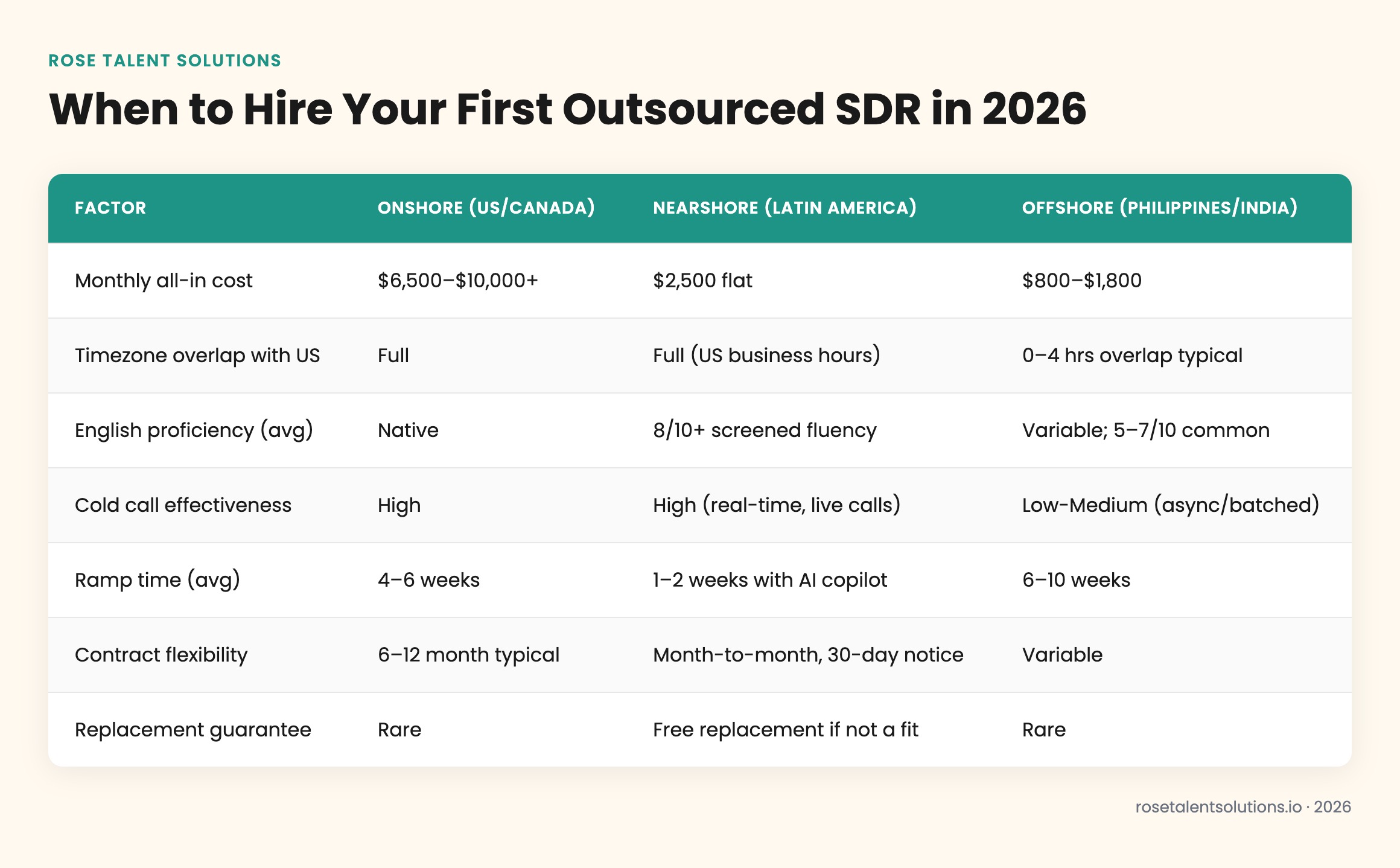
For most seed-to-Series A startups, the nearshore model threads the needle: high-quality English, real-time availability for live calls, and a cost structure that doesn't require a $500K ARR threshold just to break even on the hire. If you want to dig deeper into the ROI math, our outsourced vs. in-house SDR ROI comparison runs the numbers side by side.
How to Actually Hire Your First Outsourced SDR: The 2026 Step-by-Step Process
Knowing when should a startup hire its first outsourced SDR is half the battle. Knowing how to execute without wasting 90 days is the other half. The process below reflects what actually works for early-stage startups placing their first nearshore outsourced SDR.
Document Your Ideal Customer Profile and Outreach Playbook
Before any recruiter starts sourcing, write down who you're targeting (ICP), what the opening message says, what objections come up, and what a qualified lead looks like. This becomes the SDR's training document and your hiring filter.
Define the Tech Stack the SDR Will Live In
List every tool: CRM (HubSpot, Salesforce, Pipedrive), sequencing platform (Apollo, Outreach, Lemlist), dialers (Aircall, RingCentral), and enrichment tools (Clay, ZoomInfo). Rose matches candidates who already know your stack and trains the AI copilot to it before day one.
Submit Your Role Brief and Get Matched
Rose's recruiting team sources from a vetted Latin America talent pool, screens for English proficiency (8/10+ minimum), and presents matched candidates — typically within 7 days. You interview your top pick and approve before anyone starts.
Run a Structured Onboarding Week
Spend day one on your ICP and pitch, day two on the CRM workflow, day three doing live call shadowing, and days four and five running supervised outreach. A well-structured first week with a nearshore SDR who knows the tools cuts ramp time to under two weeks.
Set Weekly KPIs and Review Cadence
Define the metrics from the start: dials per day, emails sent, meetings booked, show rate. A 15-minute weekly review call keeps performance visible and catches drift early. If the fit isn't right, Rose's replacement guarantee means you don't start over from scratch financially.
For SaaS-specific considerations around sequencing, tool selection, and SDR compensation benchmarks, our guide on how to hire outsourced SDR services for SaaS covers the vertical in detail.

What Does a Startup's First Outsourced SDR Actually Cost vs. What You Get Back in 2026?
The all-in cost of a Rose nearshore outsourced SDR is $2,500 per month — flat. That includes recruiting, vetting, payroll processing, HR, and ongoing management. No long-term contract. Cancel with 30 days written notice. If the team member isn't a fit, they're replaced at no additional cost.
Compare that to a US-based SDR. According to SHRM's hiring cost benchmarks (2024), the average cost-per-hire in the US is $4,683 — before the first day of salary, before benefits, before payroll taxes, and before the 90-day ramp period where productivity is low. A domestic SDR at $55,000 base salary runs roughly $6,500/month fully loaded. That's 2.6× the cost of a nearshore hire.
The real SDR cost comparison isn't salary vs. salary — it's the fully-loaded number: base pay + benefits + payroll tax + recruiting fees + ramp time opportunity cost. When you stack all of that, a nearshore outsourced SDR at $2,500/month delivers comparable pipeline activity at roughly 35–40 cents on the dollar versus a US hire. For any startup asking when should a startup hire its first outsourced SDR, the answer is: as soon as the offer is proven, because the cost barrier is far lower than most founders assume.
What does that $2,500 buy in pipeline? It depends on your ACV and close rate, but a focused outsourced SDR running 50–80 dials per day and 150–200 outbound emails per week should generate 8–15 qualified meetings per month in most B2B verticals. At a $15,000 ACV and a 25% close rate from discovery, that's $30,000–$56,000 in monthly pipeline contribution — a 12×–22× return on the SDR investment.
According to McKinsey's B2B sales research (2023), companies that invest in dedicated outbound SDR functions see 3× faster pipeline growth compared to those relying on inbound alone. Early investment in outbound capacity compounds — every month of SDR activity builds a warmer list, refines the message, and shortens future sales cycles.
If appointment setting is a large part of the SDR role at your company, see also our guide on how to hire a virtual appointment setter for role-specific screening criteria and compensation benchmarks.
Common Mistakes Startups Make When Hiring Their First Outsourced SDR
Even with the right timing and the right model, early-stage startups repeat the same five mistakes when placing their first outsourced SDR. Knowing them in advance is worth more than any playbook.
What Works
- Documenting the ICP and outreach script before the outsourced SDR starts
- Choosing a nearshore rep who already knows your CRM and outreach tools
- Setting weekly meeting-booked KPIs from day one
- Running live call shadowing in the first week
- Reviewing sequences and reply rates weekly, adjusting monthly
What Fails
- Hiring a startup's first outsourced SDR before the sales script is written — SDR improvises, quality drops
- Choosing offshore for cost savings, losing all call-window coverage
- No defined KPIs — SDR is "busy" but pipeline stays empty
- Skipping onboarding and expecting the SDR to self-ramp in a new tool
- Waiting until the CEO is completely overwhelmed before starting the process
The single most common failure mode is hiring too early for the wrong reason: "we need more pipeline" is not a strategy. Before the outsourced SDR starts, you need a list of target accounts, a validated opening message, and a clear definition of what "qualified" means for your AE. Without those three inputs, even an excellent SDR will generate noise instead of meetings.
Rose's onboarding process includes a role-brief session where we help you define exactly those inputs before the first candidate is sourced. That upfront clarity is what cuts ramp time and improves meeting quality in the first 30 days.
According to Gallup's workplace research (2023), employees who receive clear expectations and structured onboarding in their first week are 2.6× more likely to be high performers at 90 days. For a startup's first outsourced SDR, that number matters: a fast ramp is the difference between pipeline in month one versus month four.