
What Is a Virtual Appointment Setter — and Why 2026 Is the Year to Hire One
Nearshore virtual appointment setters are remote sales-development professionals based in Latin America who handle top-of-funnel outreach — cold calls, follow-up sequences, LinkedIn touches, and calendar booking — entirely on behalf of your sales team. They work your exact US business hours, communicate in fluent English, and live inside your CRM the same way an in-house SDR would, minus the overhead of a full-time W-2 hire.
A virtual appointment setter is not a general admin assistant. The role is narrowly defined: identify qualified prospects, execute outbound cadences, handle objections on the first touch, and hand a booked meeting to a closer. That specificity is important because it shapes every hiring decision you make — from the job description you write to the tool stack you build around them.
Demand for this role has accelerated sharply. Phone and email outreach remains the dominant channel for B2B pipeline generation, and companies that staff dedicated setters instead of asking closers to self-prospect consistently produce more revenue per sales rep. According to the U.S. Bureau of Labor Statistics (2024), sales-related occupations account for over 14 million jobs in the US economy — yet most small and mid-size businesses still rely on their closers to fill their own calendars, burning expensive senior-rep time on low-value prospecting.
If your closers are still cold-calling their own lists, a virtual appointment setter is not a luxury — it is the highest-leverage hire you can make this year. The only question is where to find one and how to vet them correctly.
How to Write a Job Description That Attracts the Right Virtual Appointment Setter in 2026
Most job descriptions for this role are too vague. They ask for "strong communication skills" and "CRM experience" without specifying which CRM, which outreach cadence, or what a qualified meeting actually looks like for your business. Vague descriptions attract generalist applicants. Specific descriptions attract setters who have done the exact job before.
Your job description should include four concrete elements: (1) the outreach channels they will own — cold calling, email sequences, LinkedIn, or a combination; (2) the CRM and sequencing tools they must know on day one — HubSpot, Salesforce, Apollo, Outreach, Salesloft, or others; (3) the definition of a qualified meeting — industry, company size, title, and pain point that qualify a prospect for a demo; and (4) the volume expectation — dials per day, emails per day, and meetings-booked target per week.
According to SHRM's Talent Acquisition research (2024), job postings that include specific performance benchmarks receive 34% more qualified applications than those that use generic competency language. For a setter role, that means stating something like "target: 8–12 booked meetings per week from 60–80 daily dials" rather than "results-oriented team player."
If your setter will be handling LinkedIn outreach in addition to calls and email, it is worth reading whether a virtual assistant can realistically manage LinkedIn outreach at scale — the channel has distinct compliance rules and engagement patterns that not every setter is trained on.

Nearshore vs. Offshore vs. Onshore: Which Virtual Appointment Setter Model Wins in 2026?
The sourcing model you choose determines almost everything downstream — time zone alignment, English fluency, ramp speed, and your ability to correct course if the first hire is not a fit. There are four realistic options: hire a nearshore VA through a staffing partner, hire offshore through a low-cost agency, post a freelance listing on Upwork or Fiverr, or hire an in-house W-2 setter. Each has a fundamentally different risk and cost profile.
| Model | Typical Monthly Cost | Time Zone Fit (US) | English Level | Avg. Ramp Time | Replacement Safety Net |
|---|---|---|---|---|---|
| Nearshore VA (Latin America) | ~$2,500/mo flat | ✅ Same hours | 8/10+ fluent | 5–10 days | Free replacement if not a fit |
| Offshore VA (Philippines / India) | $800–$1,500/mo | ❌ 6–14 hr gap | Variable (5–7/10) | 2–4 weeks | Rarely included |
| Freelance (Upwork / Fiverr) | $1,000–$3,500/mo | Variable | Variable | 2–6 weeks | None — restart from scratch |
| In-House W-2 Setter (US) | $5,000–$7,500/mo fully loaded | ✅ Same hours | ✅ Native | 3–6 weeks | Full rehire cycle if it fails |
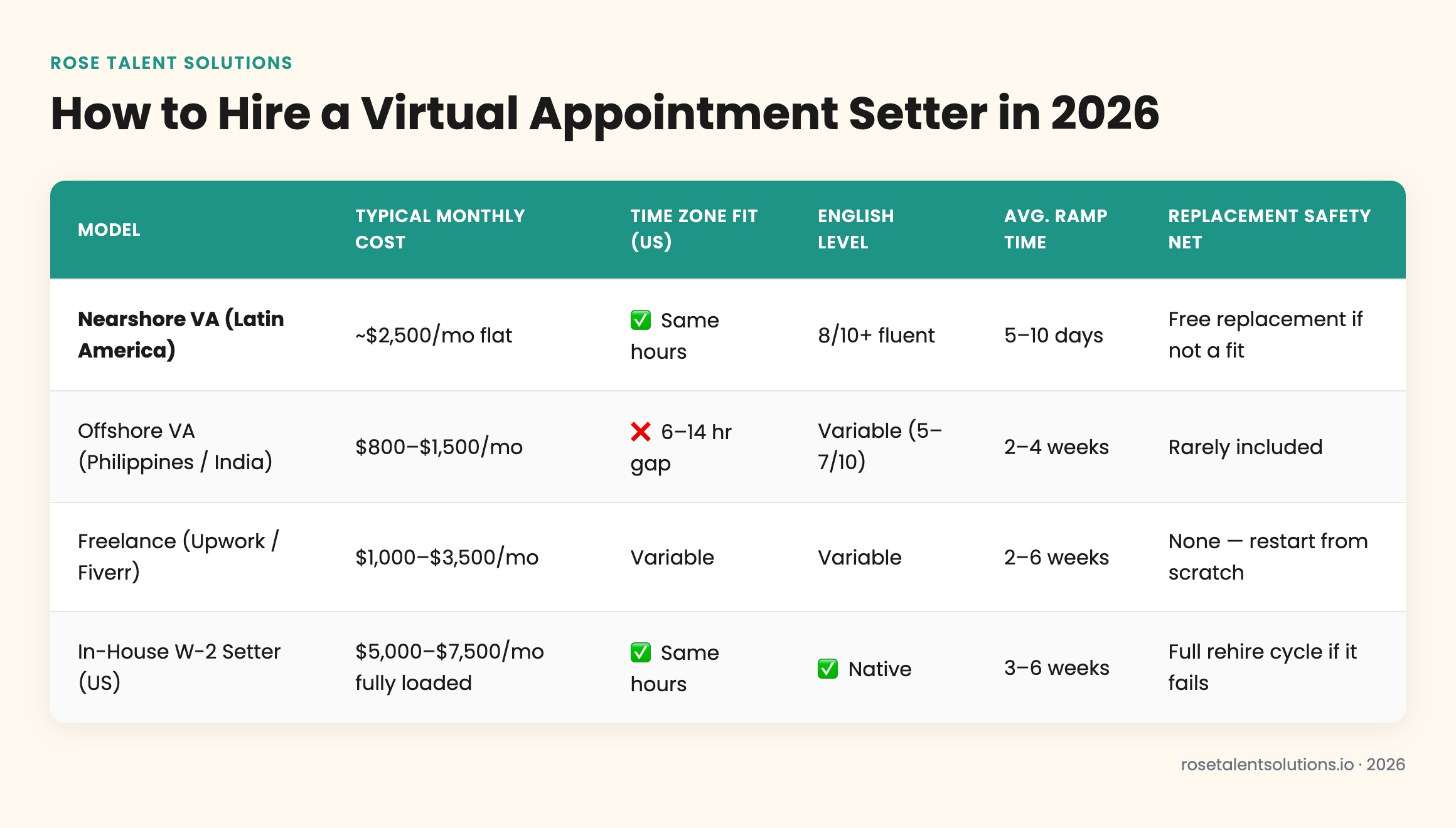
The offshore model looks attractive on a line-item budget until you account for the time zone gap. A setter in the Philippines or India working overnight to cover US hours is fatigued, less persuasive on cold calls, and unable to get a live manager on the phone when a prospect asks a question they cannot answer. McKinsey's organizational performance research (2023) consistently identifies asynchronous communication as one of the top five drivers of cross-functional slowdowns — and sales is the function least able to tolerate that lag.
For a deeper look at how the cost math actually plays out when you factor in ramp time, churn, and manager overhead, the outsourced vs. in-house SDR ROI comparison breaks down the full picture with numbers most hiring managers overlook.
How to Screen and Vet a Virtual Appointment Setter Before You Hire Them in 2026
Vetting a setter is different from vetting a general VA. You are not testing for organizational skills or written communication alone — you are testing for live phone presence, objection handling speed, and CRM hygiene under pressure. Most candidates who look strong on paper fall apart in a live role-play call. Build your screening process around that reality.
The single most predictive screen for a virtual appointment setter is a live cold-call role-play — not a resume review, not a written test, and not a reference check. Give them a realistic prospect persona and a product brief 30 minutes before the call. How they handle the first objection tells you everything.
A five-stage vetting process that consistently surfaces strong setters looks like this:
Async Video Screen
Ask candidates to record a 90-second cold-call opener for a fictional product. You are screening for accent clarity, pace, energy, and natural phrasing — not a memorized script.
Written Cadence Sample
Ask them to write a 3-step email sequence for a B2B SaaS product targeting VP of Sales. You are screening for personalization logic and call-to-action sharpness, not grammar perfection.
Live Role-Play Call
Run a 10-minute mock cold call where your hiring manager plays a skeptical prospect. Throw two real objections — "we already have a vendor" and "send me an email." Watch how they pivot.
CRM Task Test
Give them a 15-minute live exercise in your actual CRM — log a call outcome, build a sequence, and update a contact record. This surfaces tool fluency that resumes cannot prove.
Reference or Work Sample Review
Ask for one documented example of a week's activity: dials, connects, meetings booked. Real setters have this data. Candidates who cannot produce it have not held the role seriously.
When you hire through a staffing partner like Rose Talent Solutions, steps 1 through 4 are completed before a candidate reaches your desk. Every team member also ships with a role-specific AI copilot trained on your outreach stack — whether that is HubSpot, Apollo, Outreach, or Salesloft — which cuts tool-ramp time from weeks to days.
According to Gallup's employee engagement meta-analysis (2023), structured onboarding with clear role expectations in the first 30 days increases new-hire retention by 82% and productivity by 70%. For a setter role, that means documented daily targets, a call recording review cadence, and a clear definition of what a qualified meeting looks like — all set before day one.

How Cold Email and Multi-Channel Cadences Change What You Need From a Setter in 2026
Appointment setting in 2026 is not a single-channel activity. The highest-performing setters run coordinated cadences across cold calls, personalized email, and LinkedIn — and they do it systematically, not reactively. If you are hiring a setter who will only dial, you are leaving pipeline on the table. If you are hiring a setter who will only send email, you are leaving the fastest-converting channel — the phone — uncovered.
Understanding how outsourced SDRs handle cold email at scale is critical before you hire, because the technical infrastructure behind high-volume email — domain warming, deliverability monitoring, personalization at scale — is a distinct skill set that not every setter has. Ask specifically about their experience with sending infrastructure, not just copywriting.
The multi-channel reality also affects how you measure output. Dials per day is a useful leading indicator, but the metric that actually matters is meetings booked per 100 prospects touched — a number that accounts for all channels combined and normalizes for list quality. Top-tier nearshore setters typically hit 6–10 qualified bookings per 100 contacts worked across a 5-day week, depending on industry and ICP definition.
"The best SDRs I've seen aren't the ones who dial the most — they're the ones who synthesize the right channel, the right message, and the right timing into a single coherent sequence. That's a skill you can train, but you have to hire for the raw material first." — Kyle Coleman, CMO at Copy.ai (2024)
If your business is a SaaS company specifically, the overlap between appointment-setting skills and full-cycle SDR work is significant. The guide to hiring outsourced SDR services for SaaS businesses covers how to structure quota, compensation, and ramp expectations for a technical sales audience — worth reading before you finalize your setter's job scorecard.
Nearshore Virtual Setter — Pros
- Works US hours in real time — no async lag on live objections
- English fluency at 8/10+ — credible on the phone with US buyers
- Flat $2,500/mo all-in — recruiting, HR, payroll, and management included
- Free replacement if not a fit — zero restart cost if the match is wrong
- AI copilot trained on your outreach stack from day one
DIY Freelance Hiring — Cons
- Full vetting burden falls on you — no pre-screened pipeline
- No replacement guarantee — bad hire means a full restart cycle
- Payroll, compliance, and HR entirely your problem
- Time zone and English quality vary widely with no floor
- No ongoing management support — setter drifts without accountability structure
The economics are straightforward. A US-based in-house setter costs $60,000–$90,000 per year in salary alone before benefits, payroll tax, equipment, and manager time. A nearshore setter through Rose costs $30,000 per year all-in — roughly half — with no long-term contract and a free replacement if the placement is not right. For most growth-stage businesses, the decision is not whether to hire a virtual setter but which sourcing model removes the most execution risk.
You can review the full service model and start the placement process at the Rose Talent Solutions intake page. If you want to explore the broader sales-development capability first, the Rose staffing overview covers the full range of roles the team places, from appointment setters to full-cycle SDRs.
According to Statista's virtual assistant market data (2024), the global VA market is projected to reach $25.6 billion by 2025, with North American demand growing fastest in sales-adjacent roles. The supply of qualified nearshore talent from Latin America is growing to match — but the best candidates are placed quickly. Waiting six months to make this hire costs you six months of pipeline.