
Nearshore virtual assistants are reshaping how property management companies scale — but the single biggest mistake operators make is dumping every task on a new VA at once. The right move is sequencing. Start with the work that's eating your mornings, blocking your license revenue, and keeping you chained to your inbox at 9 p.m. Get those tasks off your plate in week one, and everything else follows naturally. This guide lays out exactly which tasks your property management VA should own first — and why that order matters more than the task list itself.
Why Task Sequencing Determines Whether Your VA Hire Succeeds or Fails in 2026
Most property managers hire a VA and hand them a 40-item SOP document on day one. Two weeks later, the VA is underwater, the manager is frustrated, and both sides feel like the hire was a mistake. The problem isn't the VA — it's the rollout. Task sequencing means identifying which responsibilities produce the highest time-return for you personally, and delegating those first, before anything else.
Property management is a communication-heavy business. According to Buildium's State of the Property Management Industry Report (2024), property managers spend an average of 40% of their workweek on tenant communication and maintenance coordination — tasks that are entirely delegable to a trained VA. That's 16 hours a week you could redirect to business development, acquisitions, or frankly, leaving the office before 6 p.m.
The sequencing framework below is built around one question: what creates the most friction in your day right now? For the vast majority of property managers, the answer lands in the same four categories every time.
Task Priority #1 in 2026: Tenant Communication and Inbox Management
Tenant-facing communication is the first task your VA should own — full stop. This includes responding to inbound emails and texts, answering maintenance request questions, sending lease renewal reminders, and handling the endless "when is my move-in date?" calls that fragment your focus every morning. If you're currently touching every tenant message yourself, you're operating as your own front-desk coordinator, and that's a $2,500/month mistake when a trained VA can handle it at that exact cost.
A well-scoped property management VA can handle tenant communication across AppFolio, Buildium, Rent Manager, or whatever platform you run. If you're using AppFolio specifically, see our detailed breakdown of how to hire and onboard an AppFolio virtual assistant — the task handoff process is different from generic inbox delegation and matters for platform-specific workflows.
The business case is straightforward: tenant satisfaction is directly tied to response speed. According to the National Association of Realtors (2024), renters who receive a response within one hour are significantly more likely to renew their lease than those who wait 24 hours or more. Every hour your inbox sits unanswered is a retention risk.
Task Priority #2: Maintenance Request Coordination
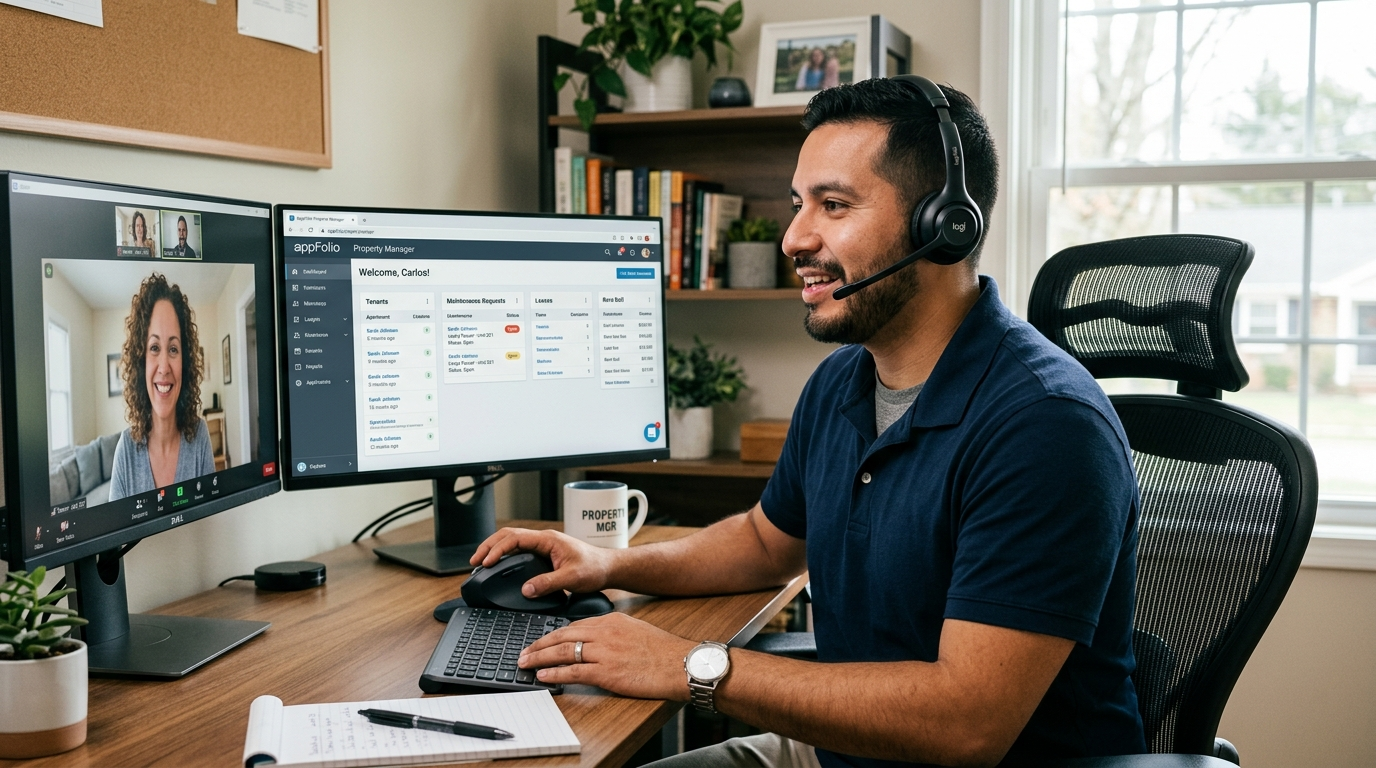
Maintenance coordination is the second task to hand off — and the one most property managers underestimate in complexity. A trained VA can receive the initial request, triage by urgency, dispatch the appropriate vendor, confirm the work order in your PM software, follow up with the tenant on completion, and close the ticket. That's a six-step workflow your VA can own entirely once they're up to speed on your vendor list and your PM platform.
This is also where AI copilots make a measurable difference. Every Rose Talent Solutions team member ships with a role-specific AI copilot trained on the software they're running — AppFolio, Buildium, or otherwise. That means your VA isn't learning your platform from scratch; they arrive knowing the maintenance workflow inside the tool, cutting ramp time dramatically.
"The number one operational bottleneck I see in property management companies under 500 units isn't leasing — it's maintenance coordination. It's almost always being handled by the owner or a senior PM who's massively overqualified for that work." — Jordan Muela, CEO at LeadSimple (2023)
The data backs this up. AppFolio's Property Manager Industry Pulse (2024) found that maintenance and repair management ranked as the top operational pain point for independent property managers two years running. Delegating this workflow to a trained VA doesn't just save you time — it improves tenant satisfaction scores and vendor relationships simultaneously.
How to Compare Your VA Options Before You Hire in 2026
Not all virtual assistant models deliver the same result for property management. Timezone alignment, English fluency, and software familiarity vary dramatically between nearshore, offshore, and onshore staffing models. Before you commit to any hire, understand what you're actually choosing between.
| Factor | Nearshore VA (Latin America) | Offshore VA (Philippines/India) | Onshore VA (US-based) |
|---|---|---|---|
| Timezone Overlap with US | Full overlap (US business hours) | Partial to none (6–12 hr gap) | Full overlap |
| English Proficiency | 8/10+ screened fluency | Varies widely (4–8/10) | Native |
| Monthly Cost (Full-Time) | ~$2,500 flat | $1,200–$2,000 (hidden HR costs) | $5,000–$8,000+ |
| PM Software Readiness | Pre-trained on AppFolio, Buildium | General training, rarely PM-specific | Varies by candidate |
| Cultural Alignment with US Clients | High | Moderate | High |
| Replacement if Not a Fit | Yes, at no additional cost | Varies by agency | Rarely included |
For a deeper breakdown of why timezone alignment changes everything for tenant-facing roles, read our full comparison of nearshore vs. offshore VAs for property management — specifically the section on maintenance coordination response times, which is where offshore models break down fastest.
Task Priority #3: Leasing Inquiries and Showing Coordination
Leasing inquiries are time-sensitive and repetitive — a perfect combination for VA delegation. Your VA should handle initial prospect responses, pre-qualification questions, showing scheduling, application follow-ups, and move-in coordination. According to the National Multifamily Housing Council (2024), lease-up speed is the single largest driver of NOI variance for operators managing 50–500 units. Every day a unit sits vacant because no one followed up with a prospect is direct revenue loss.
A VA handling your leasing inbox can respond to Zillow, Apartments.com, and direct website inquiries within minutes — not hours — during US business hours. That speed advantage compounds: faster response rates lead to more showings, more applications, and shorter vacancy cycles.
Leasing inquiry response time under 5 minutes increases prospect-to-showing conversion by up to 8x compared to a 24-hour response, according to contact-rate research across sales verticals. In a competitive rental market, your VA's response speed is a competitive moat.
If you manage HOA communities alongside rental portfolios, the leasing coordination workflow extends into resident onboarding and CC&R communication — tasks that are equally delegable. See our guide on whether a virtual assistant can handle HOA management for the specific task breakdown in that context.

Task Priority #4: Rent Collection Follow-Up and Accounts Receivable
Rent collection follow-up is unglamorous and time-consuming — which makes it ideal for a VA. The workflow is highly scriptable: identify late payers in your PM software on the 4th or 5th of the month, send the first reminder via email and text, escalate to a phone call by day 7, document everything in the platform, and flag chronic late payers for your review. Your VA owns every step of that chain except the final decision on late fees or legal escalation.
The Bureau of Labor Statistics (2024) notes that property, real estate, and community association managers are among the occupations with the highest administrative time burden relative to their licensed output — rent collection administration being a primary contributor. Offloading that to a trained VA lets licensed managers work at the top of their license.
For operators who need bookkeeping support beyond collection follow-up — reconciliations, owner disbursements, CAM reconciliation — Rose's bookkeeping and accounting VA service pairs directly with property management VAs for a full back-office solution. Many clients run both simultaneously once they see how much the PM VA clears off their plate in the first 30 days.
How Rose Talent Solutions Onboards Your Property Management VA in 2026
Understanding the onboarding sequence helps you set realistic expectations and get to productivity faster. Here's how the process works from match to full task handoff.
Role Scoping Call
Rose's team meets with you to identify your top 5 task categories, your PM software stack, and your communication preferences. This call takes 30–45 minutes and directly shapes who we match you with.
Candidate Matching (2–5 Days)
We surface 1–2 pre-vetted candidates who have already been screened for English fluency (8/10+ floor), property management software familiarity, and US timezone availability. You review profiles and meet your top match.
AI Copilot Configuration
Your VA's role-specific AI copilot is configured for your exact software — AppFolio, Buildium, Rent Manager, or a combination. This cuts ramp time from weeks to days on platform-specific workflows.
Task Priority Handoff (Week 1)
We recommend delegating tenant communication first, then maintenance coordination in week 2. Full task scope is typically live by day 21 — not day 1, which is intentional.
Ongoing HR and Management
Rose handles payroll, compliance, performance check-ins, and HR. If your VA isn't a fit at any point, we replace them at no additional cost. No scrambling to post a job and restart the process yourself.
The flat rate is $2,500/month — full-time, 40 hours a week, with recruiting, vetting, payroll, HR, and ongoing management included. Month-to-month with no long-term contract. If you're ready to scope your first hire, start the process here and we'll have a match ready inside a week.
What Tasks Should You NOT Hand Off in the First 30 Days?
Sequencing also means knowing what to hold back. In the first 30 days, avoid delegating tasks that require your legal judgment (eviction decisions, lease negotiations with problematic tenants), owner-facing reporting that requires relationship context, and anything requiring your real estate license to execute. These aren't VA tasks — they're principal tasks that need your direct involvement. Trying to offload them too early creates liability exposure and erodes owner trust.
Delegate First (Days 1–30)
- Tenant inbox and communication
- Maintenance request triage and vendor dispatch
- Leasing inquiry response and showing scheduling
- Rent collection follow-up and late notices
- Data entry and PM software updates
Hold Back (First 30 Days)
- Eviction filing decisions and legal escalation
- Owner financial reporting with relationship context
- Lease negotiations with non-standard terms
- Tasks requiring your real estate license
- Vendor contract approvals above your set threshold
For a broader picture of the full scope of what a trained VA can and can't handle across a property management operation, the post on what a property management virtual assistant actually does day-to-day covers the complete task inventory — including the tasks that expand into VA ownership in months 2 and 3 as the relationship matures.
According to Gallup's research on employee engagement and productivity (2023), workers given clear role ownership and sequenced responsibility ramp to full productivity 34% faster than those handed an undefined broad scope on day one. The same principle applies to VAs — clear sequencing isn't micromanagement, it's the difference between a hire that sticks and one that churns in 60 days.