
How Nearshore Virtual Assistants Are Reshaping HOA Management in 2026
Nearshore virtual assistants — based in Latin America, working your exact business hours, and fluent in English — are quietly becoming the default staffing solution for HOA management companies that want to scale without ballooning payroll. If you've been asking whether a virtual assistant can actually handle HOA management, the short answer is yes: not just answering emails, but owning entire operational workflows end-to-end.
The HOA industry manages more than 365,000 community associations across the United States, housing roughly 74 million Americans, according to Community Associations Institute (CAI) (2023). Behind every one of those communities sits a stack of repetitive, high-volume administrative tasks — violation notices, work order routing, vendor follow-ups, meeting prep, and dues reconciliation — that burn hours without requiring a licensed, on-site manager to execute them. That's exactly the workload a well-trained VA absorbs.
What's changed in 2026 is the software layer. Every Rose Talent Solutions team member ships with a role-specific AI copilot trained on the exact platform your HOA runs — AppFolio, Buildium, TOPS, or Condo Control. That means your VA isn't spending week one learning where the violation module lives. They're processing their first batch of inspection reports on day three.
What HOA Tasks Can a Virtual Assistant Actually Own in 2026?
The clearest way to answer "can a virtual assistant handle HOA management" is to walk through the task list a community manager actually executes in a given week. Most of it is remote-executable. Here's how a trained HOA VA handles each category:
- Resident communications: Answering inbound emails and calls, routing urgent maintenance issues, responding to dues questions, and sending community announcements. A VA can own the entire inbox and phone queue during business hours.
- Violation tracking and notices: Logging inspection findings, generating violation letters inside your software, tracking cure deadlines, and escalating unresolved cases to the on-site manager. This is one of the highest-volume, most rule-based tasks in HOA ops — ideal for delegation.
- Maintenance coordination: Creating and routing work orders, following up with vendors on open tickets, updating owners on status, and closing out completed jobs. According to Buildium's State of the Property Management Industry Report (2024), maintenance coordination is the single most time-consuming task property managers report — averaging 30% of their weekly hours.
- Meeting preparation and minutes: Drafting board meeting agendas, compiling financial summaries, recording and transcribing minutes, and distributing action items post-meeting.
- Accounts payable and bookkeeping support: Entering invoices, reconciling vendor payments, flagging discrepancies, and preparing monthly financial snapshots for board review. (For deeper AP coverage, see Rose's bookkeeping and accounting VA service.)
- Document management: Maintaining resident files, CC&R version control, vendor contracts, and certificate of insurance tracking.
What a virtual assistant does not replace: physical site inspections, in-person board meetings, emergency on-site response, and legal decision-making. Those roles stay with your licensed manager or management company. The VA handles everything that feeds those functions.
The remote-work infrastructure that makes this possible is now mainstream. According to Pew Research Center's American Workers survey (2023), more than half of workers whose jobs can be done remotely are doing so at least part of the time — and the administrative workflows that dominate HOA management are among the most portable categories of work that exist.
How Nearshore Compares to Offshore and In-House HOA Coordinators in 2026
Not all virtual assistants are equal, and the differences matter enormously in HOA management — where a six-hour timezone lag can turn a leaking pipe into a flooded unit. The comparison below lays out what separates a nearshore VA from offshore alternatives in property management contexts.
| Factor | Nearshore VA (Latin America) | Offshore VA (Philippines/India) | In-House Coordinator (US) |
|---|---|---|---|
| Monthly cost | ~$2,500 flat (all-in) | $800–$1,500 (platform fees extra) | $4,500–$6,500 (salary + benefits + overhead) |
| Timezone overlap | Full US business hours (EST/CST/PST) | 0–4 hrs overlap; most work overnight | Full — but limited to one location |
| English proficiency | 8/10+ screened floor | Variable; 6–7/10 average | Native or near-native |
| Software readiness (AppFolio/Buildium) | Pre-trained AI copilot included | Self-trained; ramp time 3–6 weeks | Depends on hire — ramp time 2–4 weeks |
| Recruiting, HR, payroll | Fully managed by Rose | Varies by platform | Your HR burden entirely |
| Replacement if not a fit | Free replacement included | Depends on platform policy | Full rehire cost ($3,000–$8,000) |
| Contract requirement | No long-term contract; month-to-month | Often 3–6 month minimums | At-will, but separation costs apply |
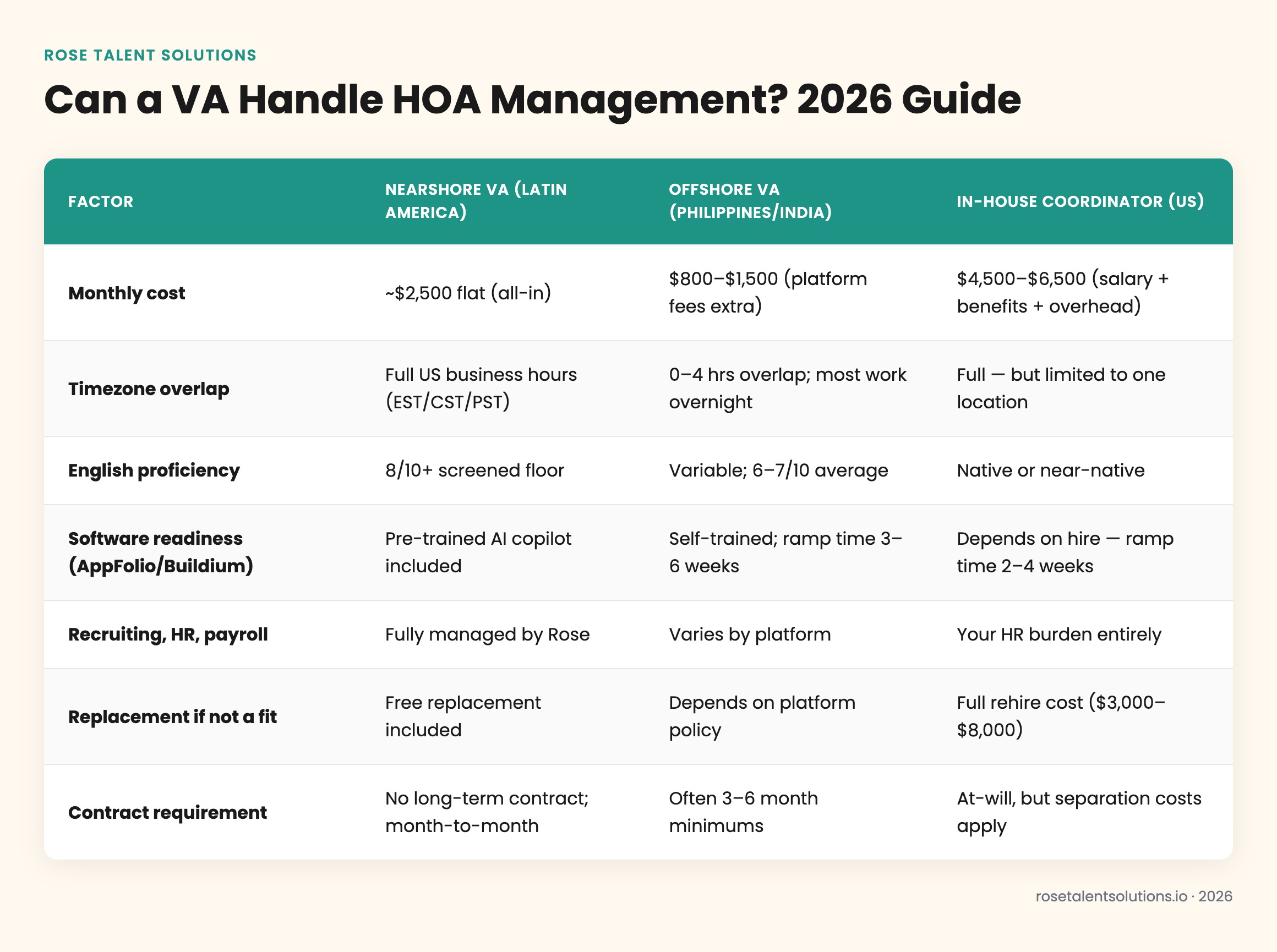
The offshore price tag looks attractive on a spreadsheet until you account for the timezone gap. Every urgent resident issue that arrives at 2pm your time sits unanswered for 12–14 hours when your VA is asleep on the other side of the world. In HOA management — where boards and residents expect same-business-day responses — that gap is a liability, not a savings.
Staffing quality issues compound this further. According to SHRM's Employee Retention research (2023), replacing an administrative employee costs an average of 50–60% of that role's annual salary in recruiting, onboarding, and lost productivity. For HOA coordinators, that math makes every bad hire expensive — which is exactly why a managed model with a built-in replacement guarantee changes the risk profile entirely.
How an HOA Virtual Assistant Gets Up and Running: The Rose Onboarding Process in 2026
One of the most common objections from HOA operators is setup time. "It'll take three months before they know our systems." In practice, with a properly matched and software-trained VA, the ramp curve is far shorter. Here's how the process works at Rose:
Role scoping call
Rose works with you to map the exact task list your HOA coordinator will own — violation workflow, communication queue, AP entry, or all three. The match is built around your software stack and community count.
Candidate matching (5–7 days)
Rose sources, vets, and presents pre-screened candidates with HOA or property management backgrounds and confirmed 8/10+ English scores. You review profiles and interview your top choice.
AI copilot activation
Your VA's role-specific AI copilot — trained on AppFolio, Buildium, or your HOA platform — is activated before day one. Standard workflows, templates, and escalation rules are loaded in advance.
Shadowed first week
Your VA shadows your current process, asks clarifying questions, and runs their first live tasks with light supervision. Most operators report independent task execution by day three to five.
Ongoing HR and management
Rose handles payroll, HR, and performance oversight on an ongoing basis. If the placement isn't the right fit, Rose replaces them at no additional cost — no re-recruiting fees, no delays.
The full onboarding model is detailed on Rose's property management staffing page, including which HOA-specific workflows are covered from day one. If you're evaluating software-specific options, Rose's deep-dives on hiring an AppFolio-trained virtual assistant and working with a Buildium-specialized VA cover platform-specific task maps in detail.
The hidden cost of an understaffed HOA management office isn't the overtime — it's resident churn. According to Gallup's State of the American Workplace (2023), poor responsiveness is the top driver of disengagement in service relationships. In HOA contexts, that translates directly to board complaints, delinquency disputes, and management contract cancellations. A VA who owns the communication queue prevents those dominoes from falling.
What Does It Actually Cost to Staff an HOA VA in 2026 vs. In-House?
The Bureau of Labor Statistics reports that the median annual wage for a property, real estate, and community association manager in the United States was $60,670, according to the U.S. Bureau of Labor Statistics Occupational Outlook Handbook (2024). Add benefits (health insurance, PTO, employer FICA), and total employment cost for a mid-level HOA coordinator typically lands between $70,000 and $85,000 per year — or $5,800 to $7,000 per month.
Rose's nearshore HOA VA comes in at a flat $2,500/month. That rate includes recruiting, vetting, payroll processing, HR, and ongoing management oversight. There is no long-term contract — you can cancel with 30 days written notice. And if the team member isn't the right fit, Rose replaces them at no additional cost.
"The administrative burden on community managers has grown faster than compensation — managers today are handling 15–20% more units per person than they were five years ago, and the turnover rate reflects that pressure." — Dawn Bauman, CAE, Chief Strategy Officer at Community Associations Institute (2023)
The math is straightforward: at $2,500/month, a full-time HOA VA costs roughly $30,000/year. Compared to an in-house hire at $75,000 all-in, that's $45,000 in annual savings per coordinator role — enough to fund a second VA and still come out ahead. For HOA management companies running 10–50 communities, that stack compounds fast.
Remote work adoption trends also validate the model's staying power. According to McKinsey Global Institute's Future of Work analysis (2023), roles built predominantly around information processing, communication, and data management — exactly the profile of an HOA coordinator — have among the highest potential for remote execution of any job category. That's not a trend; it's a structural shift that makes nearshore staffing a permanent, not temporary, advantage.
The cost model is detailed further on Rose's getting started page, where you can scope your specific role and see typical placement timelines.
Why Nearshore HOA VAs Work
- Full US business hours — real-time resident response, not overnight batching
- Pre-trained on AppFolio, Buildium, TOPS, and Condo Control via AI copilot
- $2,500/month flat — recruiting, HR, payroll, and management included
- No long-term contract; free replacement if placement isn't a fit
- English proficiency screened to 8/10+ — board-ready communication quality
What a VA Can't Replace
- Physical site inspections and in-person violation walkthroughs
- Emergency on-site response (burst pipe, gate failure, etc.)
- In-person board and annual meeting facilitation
- Legal decisions requiring a licensed community manager
For HOA companies evaluating the full software-plus-staffing picture, Rose's breakdown of the best Buildium virtual assistant services for 2026 is worth reviewing — it maps specific Buildium modules to VA task ownership, which is directly applicable to HOA operations. And if you want to understand how the AI copilot layer works across all platforms, the Rose AI advantage page walks through the technology in detail.
The staffing model for HOA management is shifting. The companies adding communities fastest in 2026 aren't hiring more on-site staff — they're building lean management teams backed by nearshore coordinators who own the administrative and communications layer entirely. The question was never really "can a virtual assistant handle HOA management." The real question is how many communities you're leaving on the table by not having one.