What Is a Nearshore Virtual Assistant for Property Management?
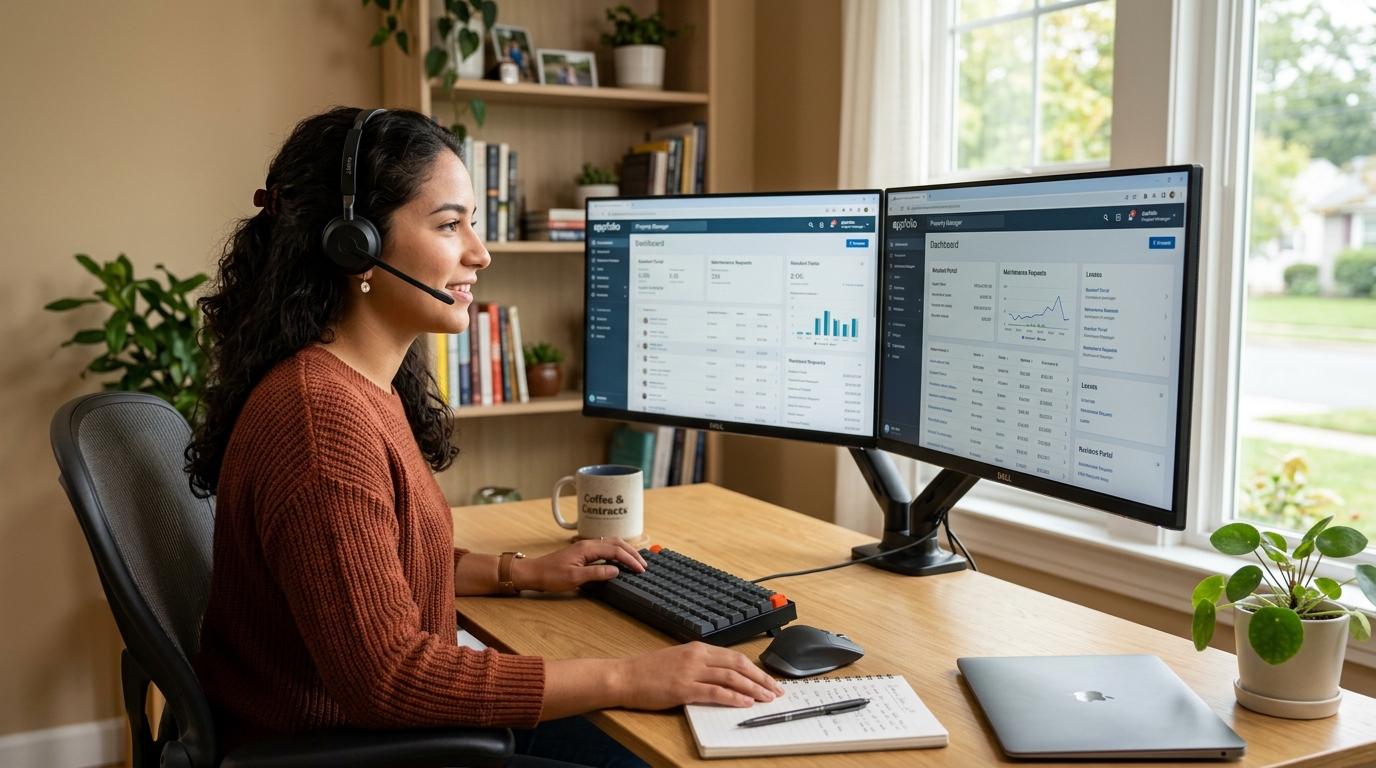
A nearshore virtual assistant is a full-time remote team member based in Latin America — countries like Colombia, Mexico, Costa Rica, or Argentina — who works your exact US business hours and communicates in fluent English. This is fundamentally different from offshore outsourcing, where time-zone gaps of 8–13 hours make real-time tenant communication nearly impossible.
For property managers, that distinction matters more than it does in almost any other industry. A tenant with a burst pipe at 10 a.m. Tuesday needs a response now — not 14 hours later when an overnight batch queue gets processed. A property management virtual assistant from Latin America picks up that ticket the same moment you would, inside your AppFolio or Buildium portal, without you touching it.
The term "nearshore" refers specifically to geographic and time-zone proximity. Latin America sits in UTC−3 to UTC−8, overlapping perfectly with US Eastern through Pacific time zones. According to the U.S. Bureau of Labor Statistics (2024), property, real estate, and community association manager roles are growing faster than the supply of affordable on-site staff — and portfolio growth continues to outpace hiring capacity at every level.
That staffing gap is exactly the problem nearshore virtual assistants solve — at a fraction of the cost of a W-2 hire, with no long-term contract, and with specialized software training already baked in.

Nearshore vs. Offshore vs. Domestic: 2026 Comparison for Property Managers
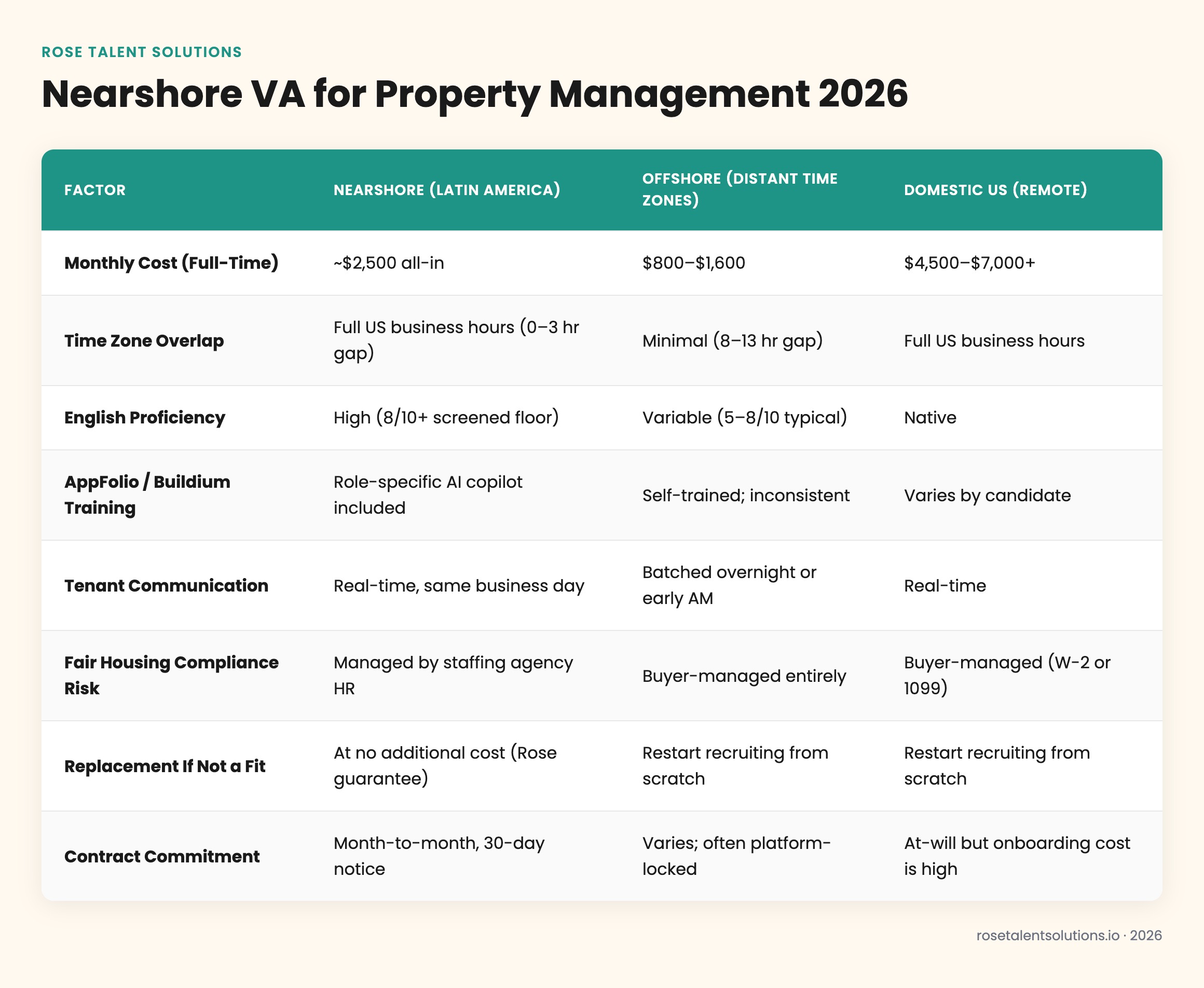
Most property managers considering VA staffing are weighing three options: hire domestically, go offshore (remote teams in distant time zones), or go nearshore (Latin America). Each has a different cost profile, time-zone reality, and risk surface. Below is an honest side-by-side across the eight factors that actually determine whether a VA works in a property management context.
| Factor | Nearshore (Latin America) | Offshore (Distant Time Zones) | Domestic US (Remote) |
|---|---|---|---|
| Monthly Cost (Full-Time) | ~$2,500 all-in | $800–$1,600 | $4,500–$7,000+ |
| Time Zone Overlap | Full US business hours (0–3 hr gap) | Minimal (8–13 hr gap) | Full US business hours |
| English Proficiency | High (8/10+ screened floor) | Variable (5–8/10 typical) | Native |
| AppFolio / Buildium Training | Role-specific AI copilot included | Self-trained; inconsistent | Varies by candidate |
| Tenant Communication | Real-time, same business day | Batched overnight or early AM | Real-time |
| Fair Housing Compliance Risk | Managed by staffing agency HR | Buyer-managed entirely | Buyer-managed (W-2 or 1099) |
| Replacement If Not a Fit | At no additional cost (Rose guarantee) | Restart recruiting from scratch | Restart recruiting from scratch |
| Contract Commitment | Month-to-month, 30-day notice | Varies; often platform-locked | At-will but onboarding cost is high |
The offshore cost advantage looks compelling until you model the real operational math. If your VA is 11 time zones away, every tenant issue that arrives after 9 a.m. EST sits unresolved for the rest of your business day. According to the National Multifamily Housing Council (2023), resident satisfaction scores drop sharply when maintenance and communication response times exceed four hours — directly affecting lease renewal rates.
Which Property Management Tasks Are Safe to Delegate to a VA in 2026?
This is the question every property manager asks — and almost no vendor answers honestly. Not every task belongs in a VA's queue. Some require a licensed professional or carry direct legal exposure. Here is a practical delegation framework built for 100–500 unit portfolios running on AppFolio, Buildium, or Yardi.
Safe to delegate fully: tenant inquiry responses, maintenance work-order creation and status updates, rent reminder and delinquency outreach (following your scripted templates), lease renewal scheduling, vendor coordination calls, owner report distribution, move-in/move-out checklist tracking, application processing data entry, and utility billing reconciliation.
Delegate with your review step: lease drafting (VA preps, you approve), late-fee posting (VA flags, you authorize), security deposit accounting entries, and any written communication that references lease termination or legal action.
Keep in-house or with licensed counsel: eviction filings and court appearances, fair housing determinations on application denials, decisions on reasonable accommodation requests, and any communication where your state requires a licensed property manager to sign off. Misclassifying who made a fair housing decision is a liability that no VA arrangement — nearshore or otherwise — should absorb.
The hidden cost of distant-timezone VAs isn't the hourly rate — it's the 6–13 hour gap that turns every same-day tenant issue into a next-morning batch, eroding resident satisfaction and lease renewal rates quarter by quarter.
Data privacy is a real consideration here too. Your VA will have access to tenant Social Security numbers, bank account data (if you collect ACH), and lease financials. Rose team members operate under data handling agreements, and your AppFolio or Buildium portal's role-based permissions let you restrict exactly what each user can view or export. According to the Federal Trade Commission's Gramm-Leach-Bliley guidance (2023), businesses that collect consumer financial data must implement written information security programs — which includes your VA's access controls. Set those permissions before day one.
How AppFolio and Buildium VAs Are Trained — And Why It Changes the ROI
Generic VA platforms recruit generalists and hand you a resume. Rose's AI advantage model works differently: every team member is paired with a role-specific AI copilot trained on the exact software stack they'll operate in — AppFolio, Buildium, QuickBooks, Yardi, or whichever platform your portfolio runs on. That means your AppFolio virtual assistant arrives knowing how to pull owner statements, process work orders, post charges, and run vacancy reports before their first Monday with you.
Why does that matter to your ROI? Because the average PM operator spends 3–6 weeks training a new in-house coordinator from scratch on software alone — before they've learned a single company SOP. An AI-copilot-equipped Buildium VA compresses that to days, not weeks. The ramp cost — measured in your time and your senior staff's time — drops substantially.

Here is how the ROI math looks for a 200-unit portfolio operator. A W-2 property management coordinator in a mid-size US market costs $48,000–$58,000 in base salary, plus benefits, payroll taxes, PTO, and recruiting fees — all in, closer to $65,000–$75,000 per year, according to BLS Occupational Employment and Wage Statistics (2024). A nearshore VA through Rose costs $30,000 per year ($2,500 × 12), covering recruiting, vetting, payroll, HR, and ongoing management. That is a $35,000–$45,000 annual savings on a comparable full-time role — before you factor in the software training and the replacement guarantee.
The bookkeeping and accounting VA track follows the same model — nearshore coordinators trained on QuickBooks or AppFolio's accounting module handle owner disbursements, CAM reconciliations, and delinquency reporting without a US-market CPA rate attached to every transaction.
How Rose's Nearshore Staffing Process Works — From Brief to Day One
One of the biggest gaps in competitor content is that nobody walks through what onboarding actually looks like. Here is the Rose process for nearshore staffing property management placements, from intake call to your VA's first logged work session.
Role Brief and Intake
You tell Rose your software stack (AppFolio, Buildium, Yardi), your portfolio size, and the specific tasks you want covered. This takes one 30-minute call. Rose maps the brief to a candidate profile.
Vetting and English Screening
Rose runs candidates through a minimum 8/10 English proficiency screen plus software-specific assessments. You only see finalists — typically 1–3 candidates — not a stack of 40 resumes.
AI Copilot Assignment
Your VA is paired with a role-specific AI copilot trained on your platform before their start date. This pre-loads platform workflows, your lease templates, and your communication standards into their daily toolset.
Free Replacement If Not a Fit
If the placement is not the right fit, Rose replaces them at no additional cost. Combined with month-to-month billing and 30 days written notice, the risk to test a Rose placement is structurally low.
Ongoing Management and KPI Tracking
Rose handles payroll, HR, time tracking, and performance check-ins. You get a monthly ops summary. If your VA's output drops below target — measured against KPIs you set at intake — Rose addresses it before you have to escalate.
On the KPI question specifically: the metrics that matter for a property management VA are response-time SLA (target: tenant inquiries answered within 2 business hours), work-order creation accuracy rate (target: 98%+), lease renewal outreach completion rate, and owner report delivery timeliness. These are measurable, trackable in AppFolio or Buildium's activity logs, and should be set in writing during your intake call. According to Gallup's workplace research (2023), employees — including remote staff — who have clearly defined goals are 3.6 times more likely to be engaged than those without them. Vague delegation produces vague output; specific KPIs produce specific results.
Nearshore vs. Offshore for PM Coordinator Outsourcing: The Honest Pros and Cons in 2026
If you're genuinely weighing nearshore against offshore for your PM coordinator outsourcing decision, here is the unvarnished version. Offshore teams in distant time zones are cheaper on paper. Nearshore wins on operational fit for US property management. The question is which tradeoff your portfolio can actually absorb.
Nearshore Pros
- Full US business hours overlap — real-time tenant and owner communication
- Minimal cultural and language friction on phone calls and written communication
- Replacement guarantee with no restart cost if fit isn't right
- Role-specific AI copilot for AppFolio, Buildium, or Yardi built in
- Month-to-month, no long-term contract — cancel with 30 days written notice
Offshore Cons
- 8–13 hour time-zone gap means tenant issues sit unresolved overnight
- English proficiency varies significantly; phone-heavy roles suffer most
- Software training is self-managed — no platform-specific AI tooling
- No built-in replacement guarantee; recruiting restarts from zero
- Platform-specific compliance and data access controls often left to buyer
The offshore price gap is real — roughly $900–$1,600/month versus $2,500/month nearshore. But model the downstream cost honestly. If a distant-timezone VA's overnight batching causes one lease non-renewal per quarter on a $1,400/month unit, that is $5,600/year in lost revenue on a single unit — nearly three months of the cost difference erased by one tenant who didn't hear back fast enough. According to NMHC research on resident satisfaction (2022), communication responsiveness is the single highest-weighted factor in lease renewal decisions, outranking even unit condition in survey results.
For property managers running 100–500 units on AppFolio or Buildium, the operational case for nearshore is straightforward: you need real-time bandwidth, not overnight processing. The $900/month premium pays for itself the first time a same-day maintenance escalation saves a renewal.