
Nearshore AppFolio virtual assistants have quietly become the fastest-growing hire in property management operations — and for good reason. When your AppFolio dashboard holds 200+ units, hundreds of maintenance requests, and a monthly AP cycle, you need someone who can open the software and work it, not spend six weeks learning where the lease templates live. This guide breaks down exactly what an AppFolio VA does, what it costs, how to vet one, and why Latin America has become the go-to talent pool for US property managers who want real-time coverage without the overhead of a W-2 hire.
Property management is one of the most operationally dense small businesses in existence. According to AppFolio's 2024 Property Management Industry Pulse, 57% of property managers cite staffing and operational efficiency as their top challenge — ranking above even market volatility. The gap between what your AppFolio platform can automate and what it actually automates in your business is almost always a people problem, not a software problem.
What Does an AppFolio Virtual Assistant Actually Do in 2026?
An AppFolio virtual assistant is a dedicated remote team member whose entire job is to operate inside your AppFolio instance. That's a narrower, more useful definition than a generic "property management VA." Generic VAs know property management concepts. An AppFolio VA knows your software — the specific navigation paths, report filters, lease workflows, and AP queue that your business runs on every day.
Here's what a trained AppFolio VA typically owns week to week:
- Leasing coordination: Responding to inquiry leads from AppFolio's built-in listing syndication, scheduling showings, processing rental applications, and moving approved applicants through the lease signing workflow.
- Work order management: Triaging inbound maintenance requests, assigning vendors, tracking open tickets, and updating tenants on status — all inside AppFolio's maintenance module.
- Owner reporting: Pulling monthly owner statements, formatting distribution summaries, and flagging variances before the reports go out.
- Accounts payable support: Coding vendor invoices, reconciling AppFolio's bank feeds, and preparing payable batches for owner or PM approval. This is where an AppFolio bookkeeping VA saves the most time on a per-hour basis.
- Tenant communications: Handling renewal notices, late payment outreach, and lease compliance follow-ups via AppFolio's communication tools.
The key word is trained. A VA who has never logged into AppFolio before will spend their first 30-60 days oriented to the platform rather than productive inside it. That's why software-specific vetting matters more than general property management experience when you're hiring for this role.

How Nearshore AppFolio VAs Outperform Offshore in 2026
The offshore VA market — primarily Philippines and India-based services — has been the default for property managers trying to reduce labor costs for the past decade. But "cheaper per hour" is a misleading metric when you factor in the operational friction of a 6-12 hour timezone gap. When a prospective tenant submits an inquiry at 10am EST and your offshore VA doesn't see it until their morning (your evening), that lead has already toured with your competitor.
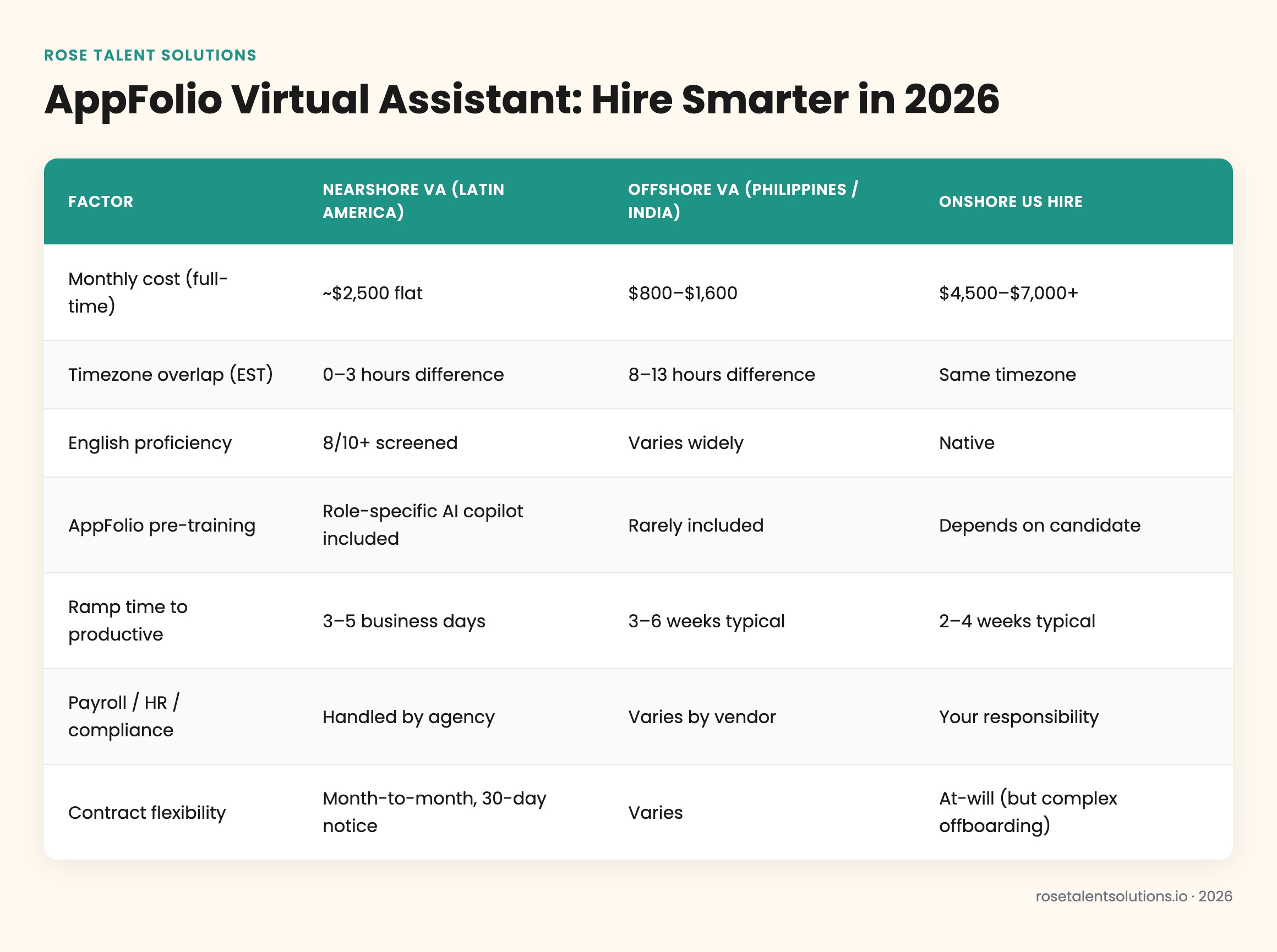
What is a nearshore VA? A nearshore virtual assistant is a remote team member based in Latin America — countries like Colombia, Mexico, Costa Rica, and Argentina — who works in US business hours, communicates in fluent English, and operates within 0-3 hours of Eastern time. The geographic and cultural proximity to the US market is what separates nearshore from offshore, not just the time zone. According to the US Bureau of Labor Statistics (2024), property and real estate managers spend the majority of their working hours on tenant-facing and coordination tasks — exactly the work that requires real-time responsiveness.
| Factor | Nearshore VA (Latin America) | Offshore VA (Philippines / India) | Onshore US Hire |
|---|---|---|---|
| Monthly cost (full-time) | ~$2,500 flat | $800–$1,600 | $4,500–$7,000+ |
| Timezone overlap (EST) | 0–3 hours difference | 8–13 hours difference | Same timezone |
| English proficiency | 8/10+ screened | Varies widely | Native |
| AppFolio pre-training | Role-specific AI copilot included | Rarely included | Depends on candidate |
| Ramp time to productive | 3–5 business days | 3–6 weeks typical | 2–4 weeks typical |
| Payroll / HR / compliance | Handled by agency | Varies by vendor | Your responsibility |
| Contract flexibility | Month-to-month, 30-day notice | Varies | At-will (but complex offboarding) |
How the AI Copilot Advantage Changes AppFolio Onboarding
One of the most common concerns property managers raise when hiring a remote AppFolio team member is ramp time. "How long before they're actually productive?" It's the right question — and for traditional VA hires, the honest answer is 3-6 weeks. That window costs you real work: leads not followed up, invoices that pile up, owner reports that go out late.
Rose's approach is different because every placed team member ships with a role-specific AI copilot trained on the actual software they'll use — including AppFolio, QuickBooks, and any third-party integrations in your stack. Think of it as a software-specific knowledge base they can query in real time: "How do I run the delinquency report for just Building A?" "Where do I code a plumbing invoice for Unit 204?" That's not a Google search — it's an instant, accurate answer inside their workflow.
The hidden cost of a slow onboarding isn't the training time itself — it's the 30-60 days of full-time pay you spend before the hire is generating more value than they consume. A role-specific AI copilot compresses that window from weeks to days by eliminating the "where is that?" phase of AppFolio navigation entirely.
This matters even more when you consider AppFolio's integration ecosystem. Your AppFolio instance is likely connected to QuickBooks for consolidated financials, a tenant screening service like TransUnion SmartMove, and listing platforms like Zillow or Apartments.com. A VA who knows AppFolio but not its integrations will hit friction points at every handoff. According to Buildium's State of the Property Management Industry Report (2024), 68% of property management companies now use at least three integrated software tools in their daily operations — meaning your AppFolio VA needs to be fluent in the entire stack, not just the primary platform.

How to Vet and Hire an AppFolio VA: The 2026 Checklist
Most VA marketplaces let you post a job, interview candidates, and hire whoever looks best on a resume. That model fails for software-specific roles because a convincing interview is not the same as demonstrated platform fluency. When you're hiring an AppFolio property management assistant, use this vetting sequence instead:
Require a live AppFolio demo task
Give candidates a sandbox login and a specific task: run a delinquency report, create a work order, or process a mock AP batch. Time them. Watch where they hesitate — hesitation at the navigation level means they've never used the software at depth.
Test English on a property-specific scenario
Ask them to draft a renewal notice or a maintenance delay email to a tenant. This tests writing quality, tone calibration, and comprehension simultaneously — more revealing than a conversation about their work history.
Confirm timezone and availability overlap
Your AppFolio leasing assistant needs to be reachable during your peak hours — typically 9am to 5pm in the timezone where your properties sit. Get a confirmed schedule commitment in writing before any placement.
Validate integration familiarity
Ask specifically about QuickBooks sync, tenant screening integrations, and listing platform feeds. If they only know AppFolio in isolation, that's workable — but you need to know the gap upfront so training covers it on day one.
Clarify data access and security protocols
Tenant SSNs, bank routing numbers, and lease records all live in AppFolio. Your VA should use role-based access controls — read and edit access scoped to their specific function only. Confirm your VA staffing partner has a documented data security policy before any credentials are shared.
Data security deserves a longer conversation than most PM operators give it at the hiring stage. AppFolio stores sensitive tenant PII — social security numbers, income documentation, bank information. According to the Federal Trade Commission's Gramm-Leach-Bliley Act guidance, businesses that collect financial information from consumers have affirmative obligations to safeguard that data — obligations that extend to contractors and vendors who access your systems. That's not a reason to avoid remote hires; it's a reason to choose a structured agency placement over a freelance marketplace, where vetting and accountability are inconsistent.
What Does a Nearshore AppFolio VA Cost — and What's Included?
The fully-loaded cost of a W-2 property management coordinator in the US runs $50,000–$70,000 per year once you add salary, payroll taxes, benefits, recruiting fees, and management overhead, according to SHRM's cost-of-hire research (2023). A nearshore AppFolio VA through Rose is a flat $2,500/month — $30,000/year — with recruiting, vetting, payroll, HR compliance, and ongoing management included in that number. There's no markup on hours, no surprise invoices for onboarding, and no long-term contract locking you in.
The free replacement guarantee is the risk reversal that makes this pricing model work for operators who've been burned by bad VA hires before. If your placed team member isn't a fit — for any reason — Rose replaces them at no additional cost. You don't restart the search, you don't pay twice, and you don't lose the institutional knowledge your first VA built up in the platform. The replacement comes pre-vetted to the same AppFolio proficiency standard.
Why nearshore AppFolio VAs work
- Real-time US-hours availability — no overnight batching of tenant issues
- Fluent English means owner and tenant communications go out polished, not proofread-first
- Latin American cultural alignment with US business norms reduces miscommunication
- Flat monthly pricing makes budgeting predictable — no hourly overages
- Agency-managed payroll and HR means zero compliance exposure for you
What to plan for
- First 3-5 days require your attention to share SOPs and system access
- AppFolio admin permissions need to be scoped and set up by your team before day one
- Integration-specific workflows (QuickBooks sync, screening tools) may need documented SOPs if not already written
For property managers managing anywhere from 30 to 300+ units, the math is simple: at $2,500/month you're getting a full-time, software-trained AppFolio coordinator for roughly $15/hour all-in. A part-time local hire at the same hourly rate gives you 20 hours a week and costs you recruiting and payroll overhead on top. The nearshore model isn't a compromise — it's an upgrade in coverage at roughly half the fully-loaded cost of a comparable onshore hire. According to NMHC's Apartment Industry Operations Report (2023), labor costs now represent the single largest operating expense line for most property management firms — making remote staffing strategy one of the highest-leverage decisions an operator can make.