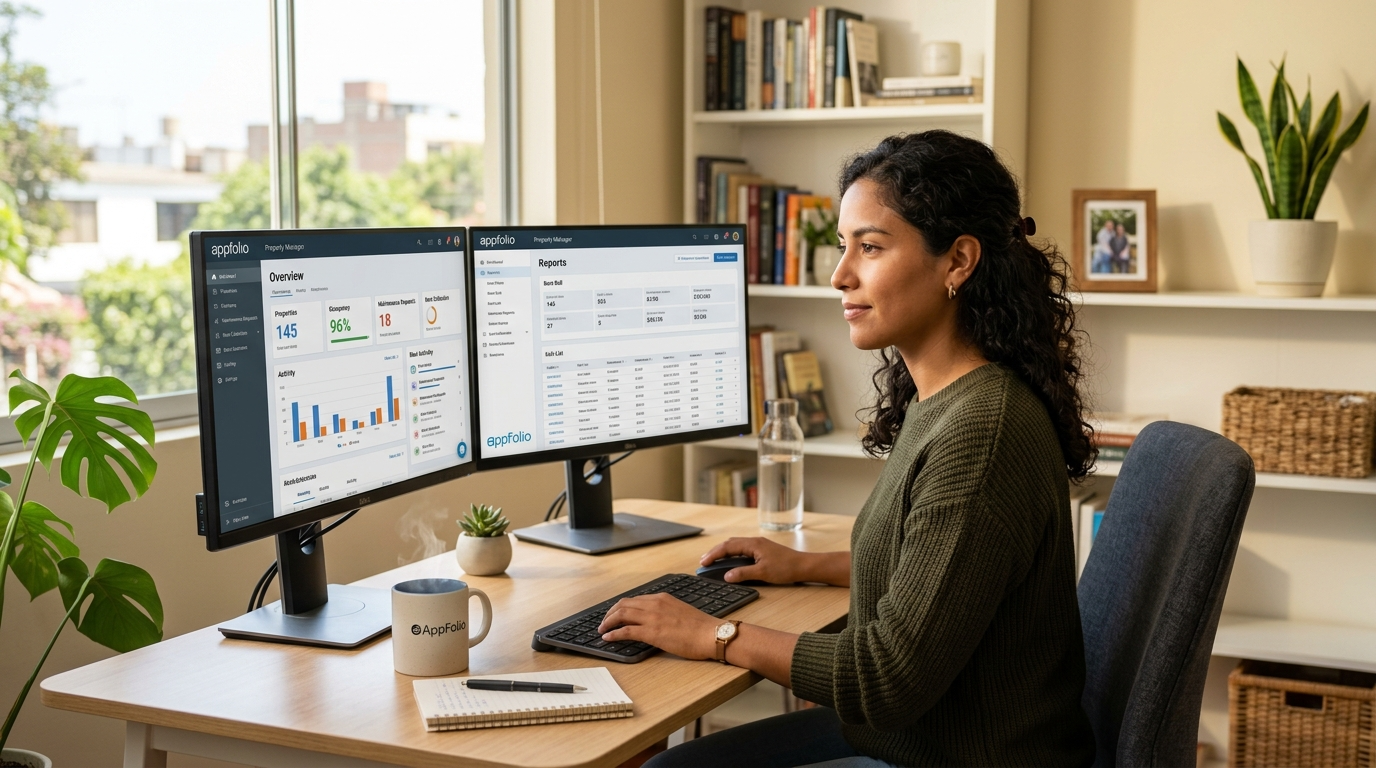
Nearshore virtual assistants have quietly become one of the most practical staffing moves in residential property management — and if you're still handling your own tenant calls, maintenance tickets, and lease renewals, you're leaving serious margin on the table. A property management VA is a full-time, remote team member based in Latin America who works your exact business hours, communicates in fluent English, and runs your day-to-day operations inside the software you already use. This guide breaks down exactly what they do, what it costs, and how to know whether you're ready to hire one.
What Is a Property Management Virtual Assistant?
A property management virtual assistant is a trained, full-time remote professional who performs administrative, operational, and tenant-facing tasks on behalf of a property management company or landlord. They are not a call-center agent, not a part-time freelancer, and not a generalist assistant who happens to know real estate. A purpose-built property management VA knows how to navigate platforms like AppFolio, Buildium, Yardi, and Rent Manager from day one — because they've been screened, trained, and matched specifically for the role.
The term "nearshore" matters here. A nearshore VA is based in Latin America, works US business hours (not overnight on a 12-hour lag), and typically scores 8/10 or higher on English proficiency screens. That's a fundamentally different product than a generic offshore VA hired from a freelance marketplace. If you want to understand why that distinction drives real operational outcomes, the nearshore vs. offshore VA breakdown for property management goes deep on exactly that comparison.
That 72% number is why this role exists. When your licensed property managers are spending the majority of their time on scheduling, data entry, and follow-up emails, they're not doing the revenue-generating work only they can do — site visits, owner relationships, portfolio growth. A VA absorbs the administrative layer so your licensed staff can operate at the top of their license, according to Buildium's State of the Property Management Industry (2024).
What Tasks Does a Property Management VA Handle in 2026?
The scope is broader than most operators expect. Here's the core task map — organized by function, not just a bullet dump.
Tenant Communication and Leasing Support
Your VA handles inbound tenant inquiries by phone, email, and text — answering questions about availability, pricing, pet policies, and application requirements. They process rental applications, run applicant screening checklists, coordinate move-in scheduling, and send lease execution reminders. Response time is the metric that separates good leasing outcomes from lost prospects, and a nearshore VA in your time zone answers by 9 a.m. rather than batching responses overnight.
Maintenance Coordination
Maintenance is the biggest time sink in property management. Your VA receives maintenance requests through your resident portal, triages them by urgency, dispatches pre-approved vendors, tracks work order status, and closes out tickets once the tenant confirms resolution. They update every step inside AppFolio or Buildium so your team has a live audit trail without lifting a finger. For companies running a large number of units, this alone can absorb a full 40-hour week. Our detailed guide on hiring an AppFolio-trained virtual assistant covers exactly which workflows map to this platform.
Lease Administration and Renewals
Lease renewals are a recurring revenue protection task that almost always gets deprioritized. A VA builds and manages a renewal pipeline: tracking expiration dates 90–120 days out, sending templated renewal offers at the right intervals, collecting signed addenda, and updating lease terms in your property management system. They also generate move-out notices, coordinate final inspections on the calendar, and process security deposit documentation.
Bookkeeping and Financial Administration
Many property management VAs are trained to handle owner statement generation, rent posting, late fee calculation, and AP/AR follow-up inside QuickBooks or directly in your PM software. This does not replace your CPA or controller — but it handles the data-entry and reconciliation layer that typically eats 8–12 hours per week, according to QuickBooks Small Business Research (2023). If you need a dedicated bookkeeping VA rather than a generalist PM admin, Rose's bookkeeping and accounting staffing program places specialists in that exact lane.

HOA and Community Management Support
If you manage homeowner associations, the administrative volume is a different beast — board meeting minutes, violation notices, architectural review requests, dues collection follow-up, and owner portal management. A specialized VA can handle all of it. For a full breakdown of what's possible, the post on whether a virtual assistant can handle HOA management walks through the exact task list and the compliance guardrails to keep in place.
How Nearshore VAs Compare to Offshore and Onshore Options in 2026
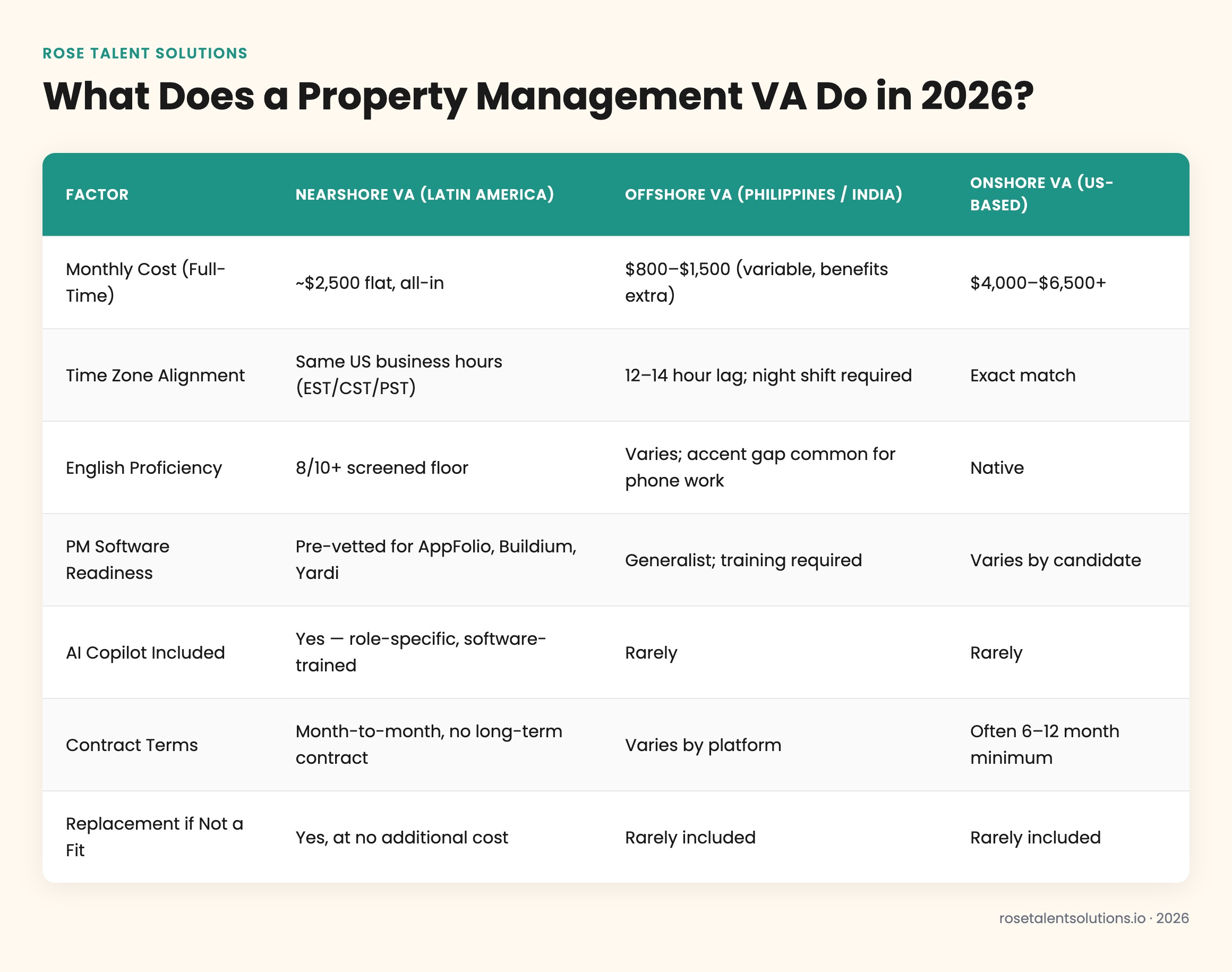
Not all virtual assistants are the same product. The table below isolates the variables that actually matter for property management operations — because a VA who works 8 time zones away from your tenants is a qualitatively different tool than one who shares your business hours.
| Factor | Nearshore VA (Latin America) | Offshore VA (Philippines / India) | Onshore VA (US-Based) |
|---|---|---|---|
| Monthly Cost (Full-Time) | ~$2,500 flat, all-in | $800–$1,500 (variable, benefits extra) | $4,000–$6,500+ |
| Time Zone Alignment | Same US business hours (EST/CST/PST) | 12–14 hour lag; night shift required | Exact match |
| English Proficiency | 8/10+ screened floor | Varies; accent gap common for phone work | Native |
| PM Software Readiness | Pre-vetted for AppFolio, Buildium, Yardi | Generalist; training required | Varies by candidate |
| AI Copilot Included | Yes — role-specific, software-trained | Rarely | Rarely |
| Contract Terms | Month-to-month, no long-term contract | Varies by platform | Often 6–12 month minimum |
| Replacement if Not a Fit | Yes, at no additional cost | Rarely included | Rarely included |
"Virtual staffing in property management isn't about cutting costs anymore — it's about building a scalable ops layer that lets your licensed team focus on relationships and growth." — Matthew Tringali, Co-Founder at Buildium (2023)
How the AI Copilot Advantage Works in 2026
Every Rose team member ships with a role-specific AI copilot trained on the software they use — AppFolio, Buildium, QuickBooks, and others. This is not a generic ChatGPT wrapper. It's a purpose-built assistant that knows your workflow, your templates, your lease language, and your vendor roster. The practical effect: a new VA reaches full productivity significantly faster than a traditionally trained hire, and they make fewer errors on repetitive data-entry tasks because the copilot surfaces the right field, the right form, and the right next action in real time.
According to McKinsey's research on generative AI's economic potential (2023), AI-assisted knowledge workers complete structured administrative tasks 30–40% faster than unassisted counterparts. In property management terms, that means more work orders closed per shift, more lease renewals processed per week, and faster tenant response times — without hiring a second person. You can learn more about how this works in practice on Rose's AI advantage page.
The hidden cost of offshore VAs isn't the lower hourly rate — it's the 10–14 hour timezone gap that turns every urgent tenant issue into an overnight batch response, and the months of software training you absorb before they reach baseline productivity.

The property management industry as a whole is leaning harder into technology. According to the National Apartment Association's research division (2024), over 60% of multifamily operators now prioritize technology proficiency when hiring operations staff — up from 38% in 2020. Pairing a trained VA with an AI copilot is how you meet that standard at a cost that doesn't require a VC round.
How Rose Talent Solutions Places a Property Management VA in 2026
If you've never hired a remote team member before, the process feels more complicated than it is. Here's exactly how it works at Rose:
Intake Call
You spend 30 minutes with a Rose placement specialist mapping your current workflow — which software you use, which tasks are eating your team's time, and what a successful hire looks like in 90 days.
Candidate Matching
Rose's recruiting team pulls from a pre-vetted Latin America talent pool, screening for PM software experience, English proficiency (8/10+ floor), and US-hours availability. You receive a shortlist — typically within 5–7 business days.
Interview and Selection
You interview your top candidates directly. No blind placement — you choose who joins your team based on your own judgment of fit.
Onboarding and Copilot Setup
Rose handles payroll, HR, and compliance. The role-specific AI copilot is configured for your software stack before day one. Your VA starts with a structured 30-day onboarding plan.
Ongoing Management
Rose provides ongoing HR support, performance check-ins, and — if the team member ever isn't a fit — a free replacement at no additional cost. Month-to-month terms, no long-term contract required.
Is a Property Management VA Right for Your Business?
The clearest signal you need a VA is this: if you or a licensed team member is spending more than 10 hours a week on tasks that don't require a real estate license, you are almost certainly overpaying for that labor and under-investing in growth. The Bureau of Labor Statistics (2024) puts the median annual wage for US property managers at $62,850 — roughly $30/hour. If your $30/hour manager is spending 10 hours a week on work a $15/hour admin could do, you're burning $15,000 a year in misallocated labor on just that one employee.
A full-time nearshore VA at $2,500/month ($30,000/year) absorbs 40 hours per week of administrative work and frees your licensed team to manage more doors, build owner relationships, and close more management agreements. The unit economics are not subtle. If you're ready to scope the role for your portfolio, the intake process starts here.
A Nearshore VA Is a Strong Fit If…
- You manage 50+ units and your admin tasks are stealing licensed-staff hours
- You use AppFolio, Buildium, Yardi, or Rent Manager and want someone who knows the software
- You need real-time tenant communication during US business hours
- You want month-to-month flexibility with a free replacement guarantee
- You're scaling your portfolio and need ops capacity before you can afford a full US hire
A Nearshore VA May Not Be the Right Fit If…
- You manage fewer than 20 units and the task volume doesn't support 40 hours/week
- Your processes are undocumented and you're not ready to train a new team member
- You need someone physically on-site for property inspections or in-person tenant interactions
- Your state requires specific licensed activities that a VA cannot legally perform
Also worth considering: if your portfolio includes HOA communities alongside traditional residential units, the administrative demands are compounded. The post on Buildium virtual assistants covers how VAs handle the dual-workflow challenge of managing both unit types inside a single platform — including the reporting, violation tracking, and board communication cadences specific to HOA management.
According to the National Multifamily Housing Council (2024), over 44 million US households rent their homes — and the operational complexity per unit continues to grow as resident expectations for digital communication and rapid maintenance response increase. Property managers who build a scalable VA layer now will be structurally positioned to absorb portfolio growth without proportional headcount increases. That's the real compounding advantage here.