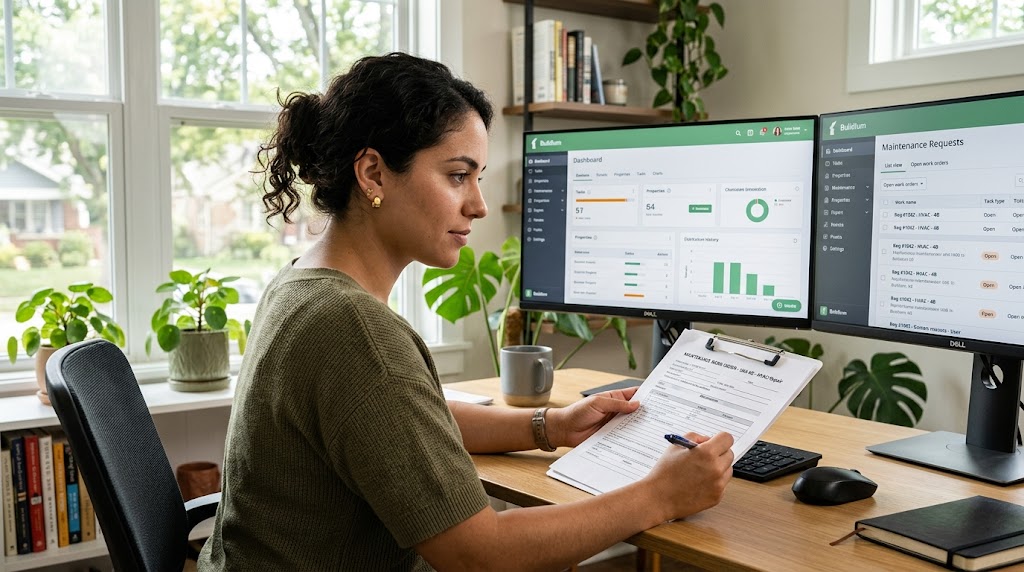
Nearshore virtual assistants trained on Buildium are quietly becoming the operational backbone of US property management companies — and the numbers explain why. The average US property manager spends more than 60% of their week on administrative tasks that a skilled VA could handle, according to Buildium's State of the Property Management Industry Report (2024). If you're still fielding every maintenance request, posting every vacancy, and chasing every rent payment yourself, this guide will show you exactly how to delegate those tasks to a Buildium-trained VA — and what it actually costs.
What Is a Buildium Virtual Assistant (and What Can They Actually Do)?
A Buildium virtual assistant is a remote team member with demonstrated proficiency in Buildium's property management platform — covering tenant portals, work order management, lease tracking, owner reporting, and accounting modules. They are not general VAs who happen to have Googled "Buildium" before an interview. A properly vetted Buildium VA arrives knowing the software's permission hierarchy, can create and close work orders without supervision, and understands how maintenance requests flow from submission to invoice reconciliation.
The tasks a Buildium VA typically owns include: responding to tenant inquiries through the Buildium portal, posting and updating rental listings, tracking lease renewals and expiration alerts, logging maintenance vendor communications, reconciling owner disbursements, and pulling monthly performance reports for owners. For growing property management companies, this task set represents the majority of daily operational volume — the exact work that keeps a PM principal buried in their inbox instead of growing the portfolio.

How Much Does a Buildium Virtual Assistant Cost in 2026?
This is the question every property manager asks first — and the answer depends entirely on where and how you source the VA. Freelance platforms like Upwork list property management VAs at anywhere from $8 to $35 per hour depending on experience and location. At 40 hours per week, that's a range of $1,280 to $5,600 per month — before you factor in recruiting time, no-shows, turnover, and the hours you spend acting as the HR department.
Rose Talent Solutions prices its property management virtual assistant service at a flat $2,500 per month — full-time, all-in. That figure covers recruiting, vetting, payroll, HR, and ongoing management. There is no long-term contract, and if the team member isn't a fit, Rose replaces them at no additional cost. Compare that to the loaded cost of a US-based property management coordinator: median salary of $45,000–$55,000 per year plus benefits, payroll taxes, and office overhead, according to the U.S. Bureau of Labor Statistics (2024). The math is not subtle.
How to Train a VA Inside Buildium: 2026 Step-by-Step
No competitor article walks through this. Here is the actual process for granting a VA access to Buildium and building the SOPs they need to work independently from day one.
Create a Restricted User Role in Buildium
Navigate to Settings → User Roles → Add Role. Define exactly which modules the VA can access — work orders, tenant communication, lease tracking — and explicitly exclude financial approval permissions until trust is established. Principle of least privilege applies here.
Invite the VA as a Staff User
Go to Settings → Users → Invite User. Assign the restricted role you just created. The VA receives a login invite via email and sets their own password — you never share a master credential. Every action they take is logged under their username for audit purposes.
Record a Loom Walkthrough for Each Task Type
Screen-record yourself completing one full cycle of each task: creating a work order, responding to a tenant message, running an owner statement. These recordings become the VA's reference library. Aim for 5–10 minute videos, one task per video, stored in a shared Google Drive folder.
Set a 2-Week Shadow Period
The VA observes and mirrors your workflow for the first two weeks, completing tasks in a test environment or flagging for your approval before submitting. This surfaces gaps in the SOPs before they hit live tenants or owners.
Activate the AI Copilot Layer
Rose Talent team members ship with a role-specific AI copilot trained on Buildium's knowledge base. Activating this layer means the VA can answer edge-case questions (e.g., how to handle a partial payment in Buildium's ledger) without escalating to you every time. Visit Rose's AI advantage page to see how this works in practice.
Nearshore vs. Offshore vs. Onshore: Which VA Source Wins for Buildium Users?
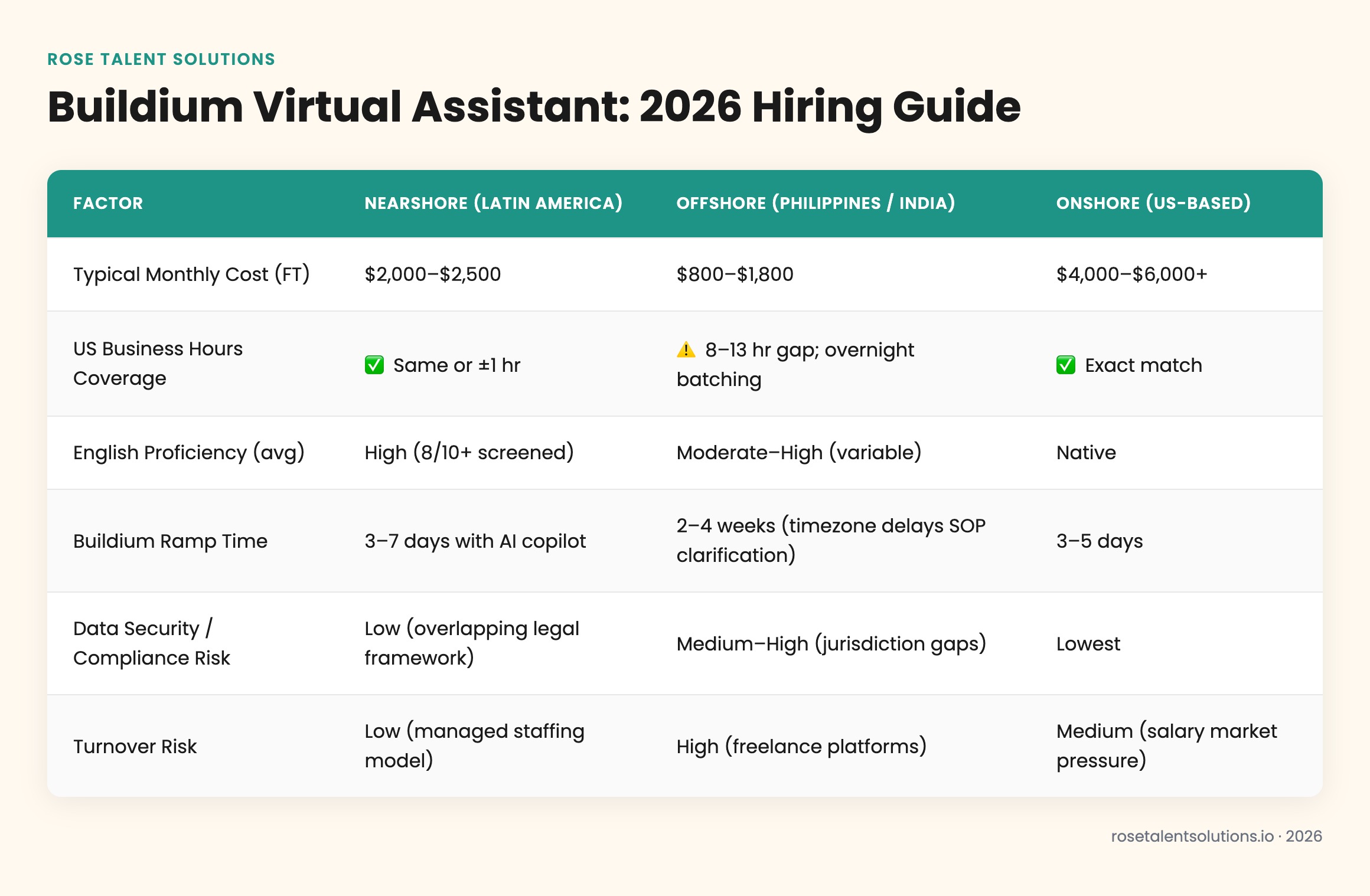
The sourcing decision is where most property managers make an expensive mistake. Choosing a VA based purely on the lowest advertised hourly rate ignores three operational realities: timezone alignment, English fluency, and software ramp time. The table below puts the options head-to-head.
| Factor | Nearshore (Latin America) | Offshore (Philippines / India) | Onshore (US-Based) |
|---|---|---|---|
| Typical Monthly Cost (FT) | $2,000–$2,500 | $800–$1,800 | $4,000–$6,000+ |
| US Business Hours Coverage | ✅ Same or ±1 hr | ⚠️ 8–13 hr gap; overnight batching | ✅ Exact match |
| English Proficiency (avg) | High (8/10+ screened) | Moderate–High (variable) | Native |
| Buildium Ramp Time | 3–7 days with AI copilot | 2–4 weeks (timezone delays SOP clarification) | 3–5 days |
| Data Security / Compliance Risk | Low (overlapping legal framework) | Medium–High (jurisdiction gaps) | Lowest |
| Turnover Risk | Low (managed staffing model) | High (freelance platforms) | Medium (salary market pressure) |
How to Measure Buildium VA Performance: KPIs That Actually Matter
Most property managers who burn out on VAs made the same mistake: they hired without defining what "good" looks like. A Buildium VA without clear KPIs will fill their time — just not necessarily with your highest-value work. Set these benchmarks before day one, and review them in a weekly 15-minute async Loom check-in rather than a live call.
The five KPIs that correlate most directly with PM business health are: (1) Work order response time — target under 2 business hours from submission to vendor contact; (2) Lease renewal outreach rate — 100% of expiring leases contacted 90 days out; (3) Owner statement delivery — monthly reports sent by the 10th of each month without PM intervention; (4) Vacancy posting turnaround — new listing live within 24 hours of unit confirmation; (5) Tenant portal message response rate — 100% of messages acknowledged within 1 business day.
The hidden cost of offshore VAs isn't the hourly rate — it's the 6–13 hour timezone gap that turns every Buildium question into a 24-hour delay. A single missed maintenance escalation can cost more in landlord liability than a month of VA fees. Nearshore eliminates that gap entirely.
Employee productivity tracking matters beyond anecdote. Companies that set clear performance expectations and review them weekly retain remote employees 21% longer, according to Gallup's State of the American Workplace (2023). For a Buildium VA, that retention difference compounds — every month a trained VA stays is a month you're not retraining someone on your property database and SOP library.
Data Security: What to Lock Down Before Your VA Logs Into Buildium
Tenant data, banking details, owner Social Security numbers for 1099s — Buildium holds sensitive information that creates real liability if mishandled. No competitor article addresses this. Before your VA gets credentials, complete this checklist: (1) Use Buildium's role-based permissions to restrict access to financial approval and reporting functions until you've established a track record. (2) Enable two-factor authentication on the VA's Buildium account. (3) Use a password manager (1Password or Bitwarden) to share credentials without exposing raw passwords. (4) Sign a data processing addendum (DPA) with your VA agency — Rose Talent includes this in its standard agreement. (5) Never send owner SSNs or banking ACH details via Buildium messages; use an encrypted channel for 1099-related data (relevant to your bookkeeping and accounting VA workflows as well).
Remote work data breaches cost US businesses an average of $4.88 million per incident, according to IBM's Cost of a Data Breach Report (2024). The risk is not theoretical — but it is manageable with the right access structure before the VA's first login.
Common Mistakes That Kill Buildium VA Engagements in 2026
The failure modes are consistent and predictable. Knowing them in advance is the clearest competitive advantage a property manager can have when building a remote team.
What Works
- Granting Buildium access with restricted permissions from day one — not a shared master login
- Providing pre-recorded Loom SOPs for every recurring task before the VA starts
- Setting weekly KPI check-ins within the first 30 days to catch SOP gaps early
- Sourcing through a managed staffing agency that handles HR, payroll, and replacement
- Choosing a nearshore VA who works your exact business hours — no asynchronous communication lag
What Fails
- Hiring the cheapest freelance rate without vetting Buildium-specific experience
- Giving full admin access before trust and process are established
- Onboarding without written SOPs and expecting the VA to "figure it out"
- Using a VA based 12 hours away and wondering why tenant issues take days to resolve
- No replacement guarantee — when it doesn't work, you absorb the full cost and start over
The number-one failure point across all VA engagements is not skill — it is process. A talented VA without documented SOPs will default to their own judgment, which may not match your business standards. The solution is straightforward: before you post a job, write the job. Document every recurring task in Buildium with step-by-step instructions, expected output, and your quality bar. This library becomes your VA's operating manual — and the asset that makes every future hire dramatically faster to onboard.
If you're ready to explore what a nearshore property management VA looks like for your portfolio, the onboarding process at Rose Talent takes most clients from intake call to first placement in under a week — including Buildium-specific vetting and the role-specific AI copilot layer that accelerates ramp time from weeks to days.