
Nearshore virtual hospitality staff are quietly becoming the operational backbone of high-performing vacation rental businesses across the US, Canada, and UK. While most hosts are still piecing together coverage with part-time local hires or overseas call centers, a growing tier of short-term rental operators are running leaner, faster, and with better guest scores — because they staffed smarter. The short-term rental industry added over 1.3 million new listings between 2021 and 2024, according to AirDNA Research (2024), and the operators winning market share are the ones who solved their staffing problem first.
What is a nearshore virtual assistant? A nearshore VA is a remote team member based in a geographically close country — in Rose's case, Latin America — who works your exact US business hours, communicates in fluent English, and is trained on your specific software stack. Unlike offshore VAs based in the Philippines or India (who typically operate 10–14 hours out of sync with US time), nearshore staff are online when your guests are calling, checking in, or disputing a charge.
That stat should stop you cold if you're still handling guest messages between your day job and dinner. One missed inquiry at 11am on a Tuesday — because your VA is asleep in Manila — is one booking that went to your competitor down the street. Response speed is the single biggest lever on Airbnb and Vrbo search ranking, and it's a lever that only works if someone is actually awake and watching the dashboard.
What Tasks Can Virtual Hospitality Staff Handle in 2026?
The scope of what a well-trained hospitality VA can own is broader than most hosts expect. Guest communication is the obvious starting point — responding to inquiries within minutes, sending pre-arrival instructions, managing check-in logistics, and handling the inevitable "the WiFi isn't working" message at 8pm. But that's just the surface layer.

A trained vacation rental VA can also own: calendar synchronization across Airbnb, Vrbo, and direct booking sites; coordinating housekeeping and maintenance vendor schedules; processing refund requests; writing and responding to guest reviews; managing dynamic pricing updates in tools like PriceLabs or Wheelhouse; and handling owner reporting if you manage properties for other investors. If you're running bookings through a property management system, platforms like AppFolio-trained virtual assistants can handle work order creation, lease admin, and owner communications without any learning curve on the software side — because Rose's AI copilot comes pre-trained on the platform before your VA's first day.
The same logic applies if you're on Buildium. Rose's team has documented the full workflow for Buildium-specialized virtual assistants — from maintenance request routing to trust accounting support — so your VA isn't figuring out the software on your dime.
How Nearshore Compares to Offshore and Onshore Staff in 2026
The staffing options for vacation rental operators break into three broad categories: onshore (US-based), offshore (Philippines, India, Eastern Europe), and nearshore (Latin America). Each has a real cost-benefit profile — and the differences matter more in hospitality than in almost any other industry, because guest experience is time-sensitive by nature.
| Staffing Type | Typical Monthly Cost | Timezone Alignment (US) | English Fluency | Software Pre-Training |
|---|---|---|---|---|
| Onshore (US-based VA) | $4,000–$6,000+ | ✅ Perfect | ✅ Native | ❌ Rarely included |
| Nearshore (Latin America) | $2,500 flat | ✅ Same or 1–2 hrs offset | ✅ 8/10+ screened | ✅ AI copilot included |
| Offshore (Philippines/India) | $800–$1,500 | ❌ 10–14 hr gap | ⚠️ Varies widely | ❌ Rarely included |
| Local Part-Time Employee | $3,200–$5,000+ | ✅ Perfect | ✅ Native | ❌ You train them yourself |
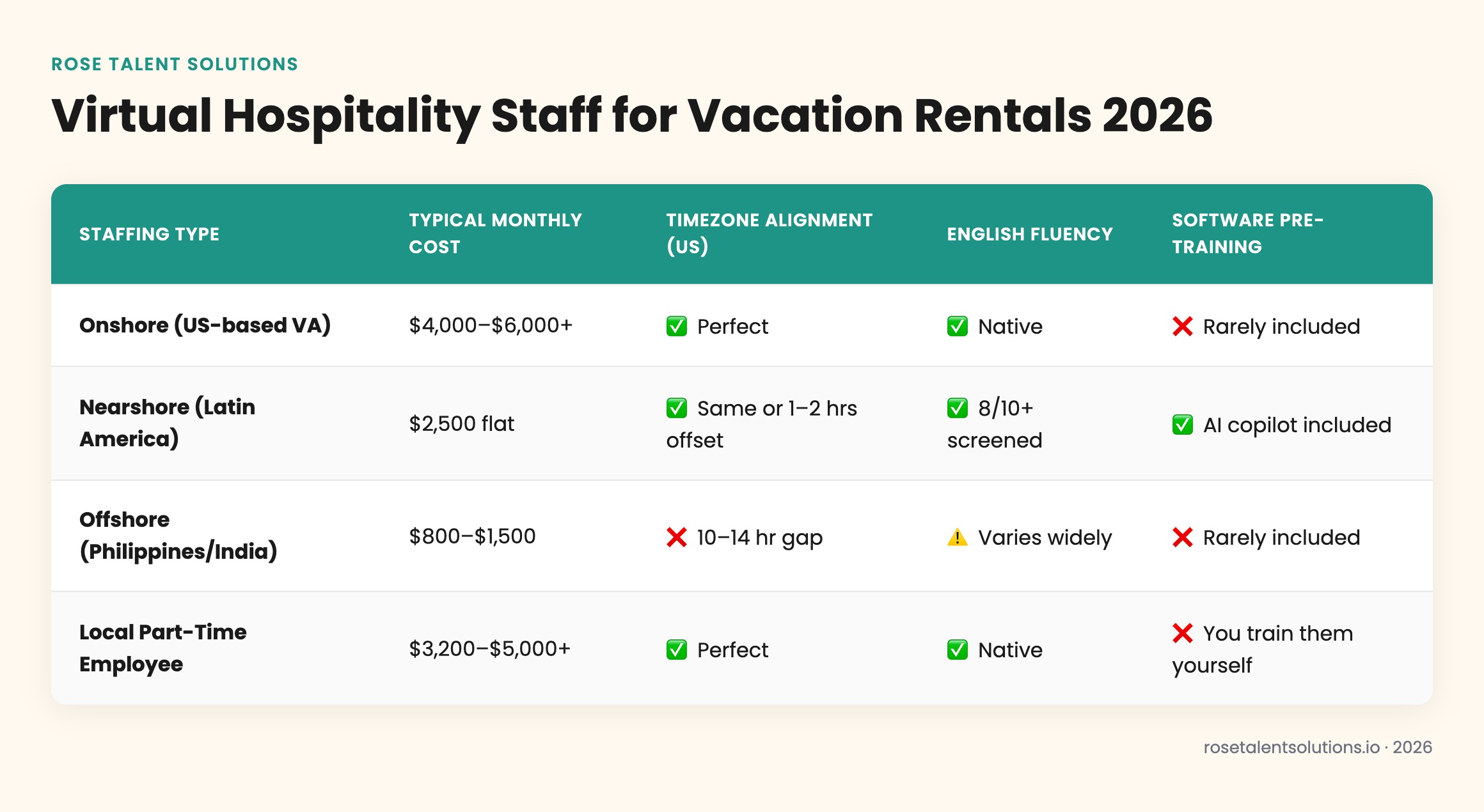
The offshore price point looks attractive until you map it against how short-term rental operations actually run. A guest locked out at 2pm EST needs a response now — not at 9am the next morning when a Manila-based VA comes online. That gap costs you review stars, and review stars cost you ranking. If you want a deeper look at how these two models stack up across property management workflows, the nearshore vs. offshore VA breakdown for property managers covers the operational tradeoffs in detail.
"The short-term rental market is maturing fast — operators who build real support infrastructure now will dominate their markets in three years. The ones still self-managing guest comms will burn out or sell." — Jamie Lane, Chief Economist at AirDNA (2024)
How the AI Copilot Makes Vacation Rental VAs Faster in 2026
Every Rose team member ships with a role-specific AI copilot trained on their assigned software. For a vacation rental hospitality VA, that means the copilot knows the workflows inside Airbnb's Resolution Center, understands how to generate owner statements, can draft templated responses for the 40 most common guest scenarios, and flags booking anomalies before they become problems. This isn't a generic ChatGPT wrapper — it's a workflow tool built for the specific role your VA is filling.

The practical effect: your VA doesn't spend 20 minutes hunting through your SOPs to figure out your refund policy. The copilot surfaces it. They don't re-draft the same check-in message 30 times a month — the copilot generates it, they review and send. According to McKinsey's Generative AI report (2023), generative AI tools can reduce repetitive task time in customer service roles by up to 40% — which translates directly into your VA handling more properties per shift without errors compounding.
The AI copilot isn't a replacement for your VA — it's a force multiplier. A trained nearshore hospitality VA with a role-specific AI copilot can manage the guest communication load of 15–25 active listings without the error rate you'd see from a solo host doing it manually.
You can explore how Rose structures the AI advantage for virtual staff in more detail — the short version is that your VA hits productive output on day one instead of week four, because the copilot handles the context they'd otherwise need months to build.
Labor costs in the virtual staffing market have continued rising for US-based roles. The Bureau of Labor Statistics (2024) puts the median annual wage for administrative support roles at over $42,000 — not counting benefits, payroll taxes, or the cost of your own time recruiting and onboarding. At $2,500/month flat, a Rose nearshore VA costs roughly half that fully loaded, with recruiting, vetting, payroll, HR, and ongoing management included in the price.
How Rose Places and Onboards a Vacation Rental VA: The 5-Step Process
One of the biggest friction points operators cite about hiring VAs is the setup cost — not the dollar cost, but the time cost of sourcing, interviewing, vetting, and training someone from scratch. Rose eliminates most of that. Here's how the placement process actually works:
Intake & Role Scoping
You fill out a short intake form at rosetalentsolutions.io/start describing your property count, platforms, software, and the specific tasks you need covered. Rose uses this to build a role profile.
Candidate Matching
Rose's recruiting team identifies 2–3 pre-vetted candidates from the Latin America talent pool who have direct experience with your software and hospitality workflows. English proficiency is screened at 8/10 or higher — no exceptions.
Interview & Selection
You interview candidates (usually 1–2) and make the call. Most operators lock in their first choice. Average time from intake to placement offer is 7 days.
AI Copilot Configuration
Before your VA starts, Rose configures their role-specific AI copilot for your platforms — Airbnb, Vrbo, direct booking site, and any PMS you're using. Your VA arrives with working tools, not an empty desktop.
Ongoing HR & Management
Payroll, compliance, performance check-ins, and HR are all handled by Rose. You manage the work; Rose manages the employment relationship. If the placement isn't a fit, Rose replaces them at no additional cost.
This structure matters because the alternative — sourcing, interviewing, running skills tests, checking references, handling payroll across borders, and managing compliance — can easily consume 40+ hours of your time before your VA ever logs in. According to SHRM (2023), the average cost-per-hire for a support role in the US runs $4,700 when you factor in recruiter time, job boards, and onboarding. Rose's flat $2,500/month includes all of that infrastructure.
For operators managing a mix of short-term and long-term rentals, the guide to hiring a virtual leasing agent for short-term rentals walks through how to scope a role that covers both guest-facing hospitality work and leasing admin — useful if your portfolio spans Airbnb units and annual tenants under the same roof.
Rose also handles property management virtual staffing more broadly — so if your operational needs grow beyond hospitality into maintenance coordination, owner relations, or financial reporting, you can scale without rebuilding your staffing infrastructure.
Should You Hire a Generalist VA or a Hospitality Specialist?
This is the question most operators get wrong. A generalist VA can handle basic inbox management and calendar tasks. A hospitality specialist understands OTA algorithms, knows how review responses affect search ranking, has worked inside reservation systems, and can recognize the difference between a refund request that should be honored and one that should be disputed. The difference shows up in your review score within 60 days.
Hospitality Specialist VA
- Familiar with Airbnb/Vrbo resolution workflows
- Understands review management strategy
- Trained on dynamic pricing tools (PriceLabs, Wheelhouse)
- Can manage multi-platform calendar sync without errors
- Knows how to escalate maintenance issues correctly
Generalist VA
- Broad skills, shallow on hospitality-specific workflows
- Higher error rate on OTA-specific dispute processes
- No familiarity with review velocity or ranking signals
- Requires more SOPs and training time from you
- May struggle with real-time guest escalation protocols
The Gallup Workplace research (2023) consistently finds that role-specific fit is the strongest predictor of performance in remote roles — more than experience years or education level. Hiring a specialist who's done this work before, in the same software environment you're running, on the same time zone as your guests, is not a marginal improvement. It's a qualitatively different outcome.
The real cost of a generalist VA isn't the lower hourly rate — it's the 90-day ramp time while they figure out your workflows, the review stars lost to slow or off-brand guest responses, and the hours you spend correcting mistakes that a specialist would never make. When you're running 10, 20, or 50 listings, that math compounds fast.
If you're ready to stop patching your guest communication problem with makeshift solutions, the place to start is a conversation about your specific portfolio. Fill out Rose's intake form and you'll have a placement profile within 24 hours — no long-term contract, and if the placement isn't a fit, Rose replaces them at no additional cost.