
Nearshore virtual leasing agents are quietly becoming the competitive edge for short-term rental operators who are tired of 2 a.m. guest messages, double-booked calendars, and the endless grind of listing optimization. If you manage five or more STR units — or you're scaling toward that — delegating leasing and guest-communication tasks to a trained, time-zone-aligned virtual team member is one of the highest-leverage moves you can make in 2026. This guide walks you through exactly how to do it: what the role looks like, where to find the right talent, what to pay, and how to avoid the mistakes that cost operators months of wasted time.
What Is a Virtual Leasing Agent for Short-Term Rentals in 2026?
A virtual leasing agent for short-term rentals is a remote team member who handles the full guest-acquisition and booking-management workflow — inquiry response, listing copywriting, calendar synchronization, pricing-tool oversight, platform communication, and check-in coordination. Unlike a traditional property manager, this role lives entirely in software: Airbnb, VRBO, Guesty, Hostaway, OwnerRez, PriceLabs, and related tools.
The role is distinct from a general virtual assistant. A virtual leasing agent owns booking velocity and occupancy rate as concrete outputs. They respond to guest inquiries within minutes, not hours, because response time directly affects platform search ranking. According to Airbnb (2023), hosts who respond within one hour are significantly more likely to achieve Superhost status — a ranking factor tied directly to revenue per available night.
For a deeper look at how virtual assistants fit into the broader STR hosting operation — beyond just leasing — the Rose guide on the best virtual assistants for short-term rental hosts covers the full stack of roles that scale an STR portfolio.
How Much Does a Virtual Leasing Agent Cost in 2026?
Pricing for virtual leasing agents varies widely depending on how you source them. Freelance platforms like Upwork list STR VAs anywhere from $8 to $22 per hour, but that headline rate hides recruiting time, turnover risk, payroll complexity, and zero management support. When you factor those in, the true cost of a self-sourced freelancer frequently exceeds $3,500 per month — and you're doing all the HR yourself.
Rose Talent Solutions places nearshore virtual leasing agents at $2,500 per month, flat — full-time, 40 hours per week, with recruiting, vetting, payroll, HR, and ongoing management included. There's no long-term contract, and if the team member isn't a fit, Rose replaces them at no additional cost. For context, the U.S. Bureau of Labor Statistics (2024) puts the median annual salary for a domestic property and leasing coordinator at $62,000 — that's roughly $5,150 per month before benefits, payroll taxes, and office overhead.
How Nearshore VAs Outperform Offshore and Domestic Options for STR Leasing in 2026
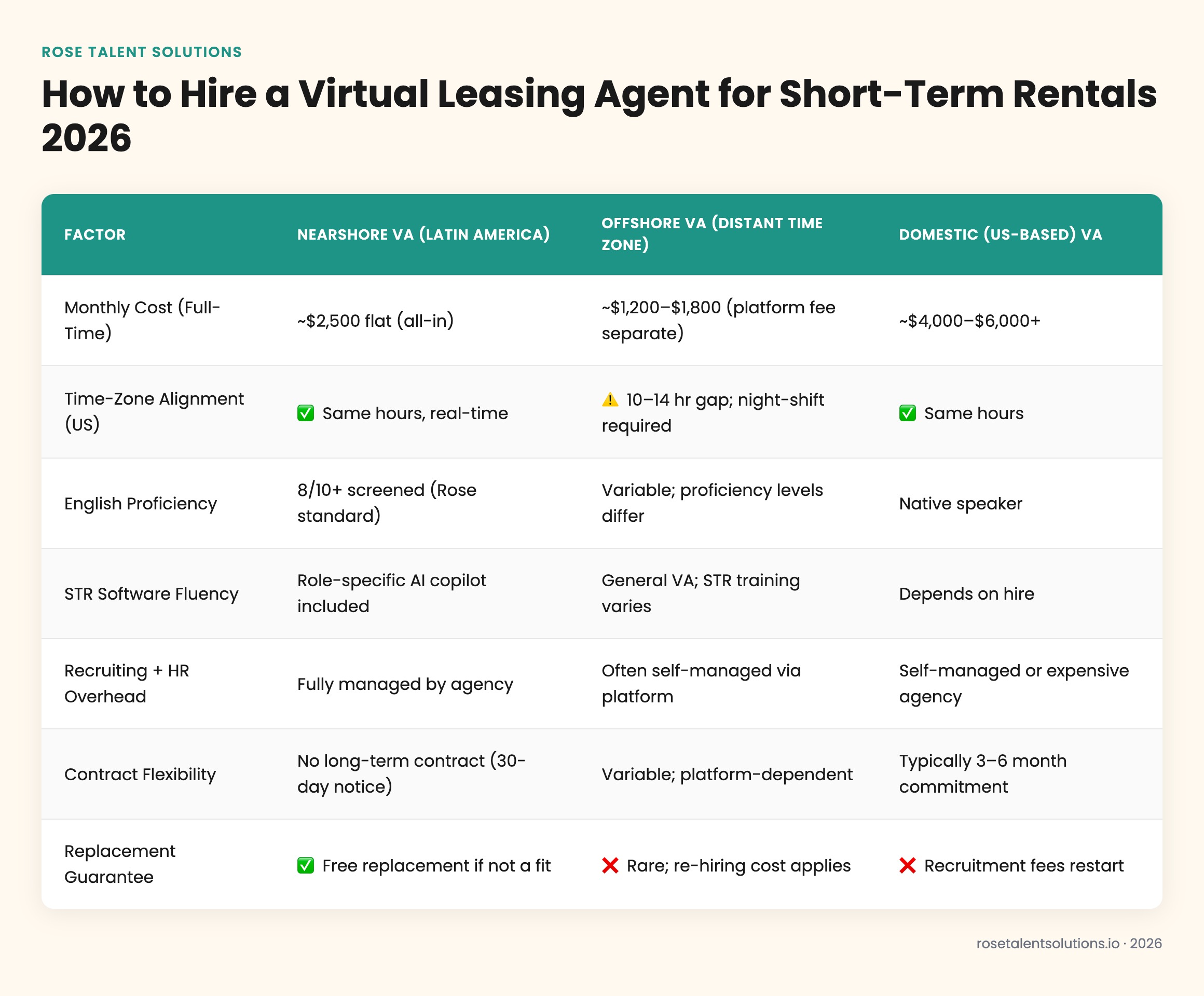
The single biggest practical difference between a nearshore VA and an offshore VA is time-zone alignment. A team member based in Latin America works your US business hours in real time — no night shifts, no coverage gaps, no burnout from unsustainable scheduling. Offshore hires working US Eastern hours from distant time zones face a grueling overnight schedule that accelerates burnout, elevates turnover, and creates coverage gaps precisely when guest inquiries spike: Friday afternoons, Sunday evenings, and holiday weekends. For a detailed breakdown of this dynamic, the Rose comparison post on nearshore vs. offshore VAs for property management quantifies the operational gap across five key metrics.
"Time zone alignment is not a nice-to-have in short-term rentals — it's a revenue variable. Every hour of delayed response on a high-demand weekend is a direct hit to conversion." — Bill Faeth, Founder at Build STR Wealth (2023)
| Factor | Nearshore VA (Latin America) | Offshore VA (distant time zone) | Domestic (US-based) VA |
|---|---|---|---|
| Monthly Cost (Full-Time) | ~$2,500 flat (all-in) | ~$1,200–$1,800 (platform fee separate) | ~$4,000–$6,000+ |
| Time-Zone Alignment (US) | ✅ Same hours, real-time | ⚠️ 10–14 hr gap; night-shift required | ✅ Same hours |
| English Proficiency | 8/10+ screened (Rose standard) | Variable; proficiency levels differ | Native speaker |
| STR Software Fluency | Role-specific AI copilot included | General VA; STR training varies | Depends on hire |
| Recruiting + HR Overhead | Fully managed by agency | Often self-managed via platform | Self-managed or expensive agency |
| Contract Flexibility | No long-term contract (30-day notice) | Variable; platform-dependent | Typically 3–6 month commitment |
| Replacement Guarantee | ✅ Free replacement if not a fit | ❌ Rare; re-hiring cost applies | ❌ Recruitment fees restart |
What Tasks Should Your Virtual Leasing Agent Handle in 2026?
Before you post a job or brief an agency, you need a clear task list. Scope creep is the number-one reason STR VA placements fail — operators hire for "leasing" and then dump 15 unrelated tasks on a team member who was hired to run guest acquisition, not accounts payable. According to SHRM's State of the Workplace Report (2023), unclear role definition is cited as the top driver of early-stage employee disengagement — a finding that applies directly to remote VA placements.
Here is the core task stack for a dedicated virtual leasing agent in a short-term rental operation:
- Inquiry response and pre-booking communication — responding to guest questions on Airbnb, VRBO, and direct booking channels within target SLA (ideally under 60 minutes)
- Listing optimization — updating titles, descriptions, photo ordering, and amenity details based on platform algorithm changes
- Calendar and channel synchronization — preventing double-bookings across OTAs via Guesty, Hostaway, or OwnerRez
- Dynamic pricing oversight — monitoring PriceLabs or Wheelhouse recommendations and flagging anomalies for owner review
- Check-in/check-out coordination — sending automated and manual check-in instructions, door codes, and house rules
- Review management — drafting and posting responses to guest reviews within platform deadlines
- Owner reporting — weekly occupancy and revenue summaries pulled from your PMS
Scope clarity at hire time is more important than platform choice. A virtual leasing agent who owns one focused job — guest acquisition and booking coordination — will outperform a generalist VA given a sprawling task list every time. Write the role description before you talk to any agency.
If your operation also runs long-term rentals or uses AppFolio or Buildium as your PMS backbone, you'll want a VA trained on those platforms specifically. The Rose guides on hiring an AppFolio virtual assistant and a Buildium virtual assistant cover the platform-specific skill screens you should run before making any offer.

How the Hiring Process Works — Step by Step
Most STR operators who've never hired a VA imagine the process is complicated. It isn't, when you work with an agency that manages the pipeline end-to-end. Here's exactly what the process looks like when you start with Rose:
Role Scoping Call
You walk through your current STR stack, average monthly bookings, platforms used, and the specific tasks you need covered. Rose builds a candidate brief from this, not from a generic job template.
Candidate Matching
Rose's recruiting team screens for STR software fluency (Airbnb host tools, Guesty, Hostaway, PriceLabs), English proficiency at 8/10 or above, and availability to cover your operating hours. You receive a shortlist — typically within 3–5 business days.
Interview and Selection
You interview the shortlisted candidates directly. You choose. Rose facilitates but you make the final call — no bait-and-switch where the person you interviewed is replaced by someone different on day one.
AI Copilot Onboarding
Every Rose team member ships with a role-specific AI copilot trained on your software stack. Your new virtual leasing agent arrives knowing how your platforms work — not learning them on your dime.
Ongoing Management and Replacement Protection
Rose handles payroll, HR, and ongoing performance management. If at any point the team member isn't a fit, Rose replaces them at no additional cost — no recruiting fees restart, no lost months.
How the AI Copilot Advantage Changes STR Leasing in 2026
One of the structural differences between hiring a VA through Rose and hiring through a freelance marketplace is the AI copilot that comes with every placement. Each team member is equipped with a role-specific AI assistant trained on the software they'll use daily — whether that's Guesty for channel management, PriceLabs for dynamic pricing, or Hostaway for operations. This isn't a generic ChatGPT wrapper. It's a trained tool that reduces ramp time, increases task accuracy, and gives your VA a second layer of quality control on every guest-facing message.
According to McKinsey's analysis of generative AI's economic potential (2023), AI-augmented workers in customer-facing roles complete tasks 30–40% faster than non-augmented peers performing the same work. In STR leasing, that speed delta translates directly to response-time SLA compliance — which is one of Airbnb's most heavily weighted ranking signals.
Why Nearshore + AI Copilot Works for STR Leasing
- Real-time US-hours availability — no overnight lag on guest inquiries
- AI copilot reduces onboarding time and catches messaging errors before they go to guests
- Flat $2,500/month pricing — predictable overhead as you scale units
- No long-term contract — cancel with 30 days written notice if volume shifts
- Free replacement guarantee removes placement risk entirely
What to Watch Out For
- Scope creep — adding unrelated tasks erodes leasing performance; keep the role focused
- No SOP documentation — VAs can't follow processes that don't exist; you need written SOPs before day one
- Over-automating — AI tools assist but don't replace human judgment on complex guest disputes or refund negotiations
For operators also managing long-term residential units alongside their STR portfolio, Rose's property management staffing page outlines how a single nearshore hire can straddle both functions — handling STR leasing in peak booking windows and shifting to maintenance coordination or tenant communication in slower periods.
What to Look for When Vetting a Virtual Leasing Agent in 2026
Whether you source independently or through an agency, these are the five screens that separate high-performing STR virtual leasing agents from expensive experiments:
- Platform fluency test — ask candidates to walk you through how they'd handle a double-booking scenario across two OTAs. Experienced STR VAs have a protocol; generalists improvise.
- English proficiency score — written fluency matters more than spoken for most STR leasing tasks, but both should meet a measurable bar. Rose's floor is 8/10 on standardized proficiency screens.
- Response-time philosophy — ask how they prioritize competing guest inquiries during high-volume check-in windows. The answer reveals whether they've done this work before.
- SOP adoption ability — give them a sample SOP and ask them to identify what's missing. Good VAs push back constructively; weak ones accept anything.
- Data literacy — can they read an occupancy report and surface an actionable insight? STR leasing increasingly requires basic analytics, not just communication skills.
According to a Gallup Future of Hybrid Work study (2022), remote workers who receive clear role expectations from day one are 2.7× more likely to be engaged at six months compared to those whose responsibilities were defined after hiring. For STR VA placements, this finding reinforces the value of doing the role-scoping work before the first interview, not after.
If your STR operation is also handling bookkeeping — owner disbursements, security deposit tracking, cleaning vendor payments — Rose's bookkeeping and accounting staffing service places nearshore finance VAs who can work alongside your virtual leasing agent as a two-person back-office team, all under the same flat-rate model.