
Nearshore virtual bookkeepers have fundamentally changed what small businesses pay for QuickBooks support — and most owners don't realize it until they've already spent a year overpaying. Whether you're running a 10-person services company, a portfolio of rental properties, or a growing e-commerce brand, the true cost of a QuickBooks bookkeeper in 2026 depends less on the hourly rate you see advertised and more on the hiring model you choose. This guide breaks down every option — in-house employees, US-based freelancers, accounting firms, and nearshore virtual staff — with real numbers so you can make a fully informed decision.
What Does a QuickBooks Bookkeeper Actually Do in 2026?
A QuickBooks bookkeeper manages the day-to-day financial records of your business using Intuit's accounting platform. Core responsibilities include categorizing transactions, reconciling bank and credit card accounts, generating profit-and-loss statements, managing accounts payable and receivable, and preparing data for your CPA at tax time. The role sits below a controller or CFO but above basic data entry — it requires genuine QuickBooks fluency, not just the ability to log in.
In recent years the scope has expanded. Modern bookkeepers are expected to work across QuickBooks Online, QuickBooks Desktop, and integrated payroll modules. Many small businesses also need their bookkeeper to connect QuickBooks to tools like Stripe, Shopify, or property management software such as AppFolio and Buildium. If you're evaluating candidates who haven't touched those integrations, budget extra hours for ramp-up. If you want a broader look at how bookkeeping and accounting support works for small businesses, that resource covers the full scope of tasks you can reasonably delegate.
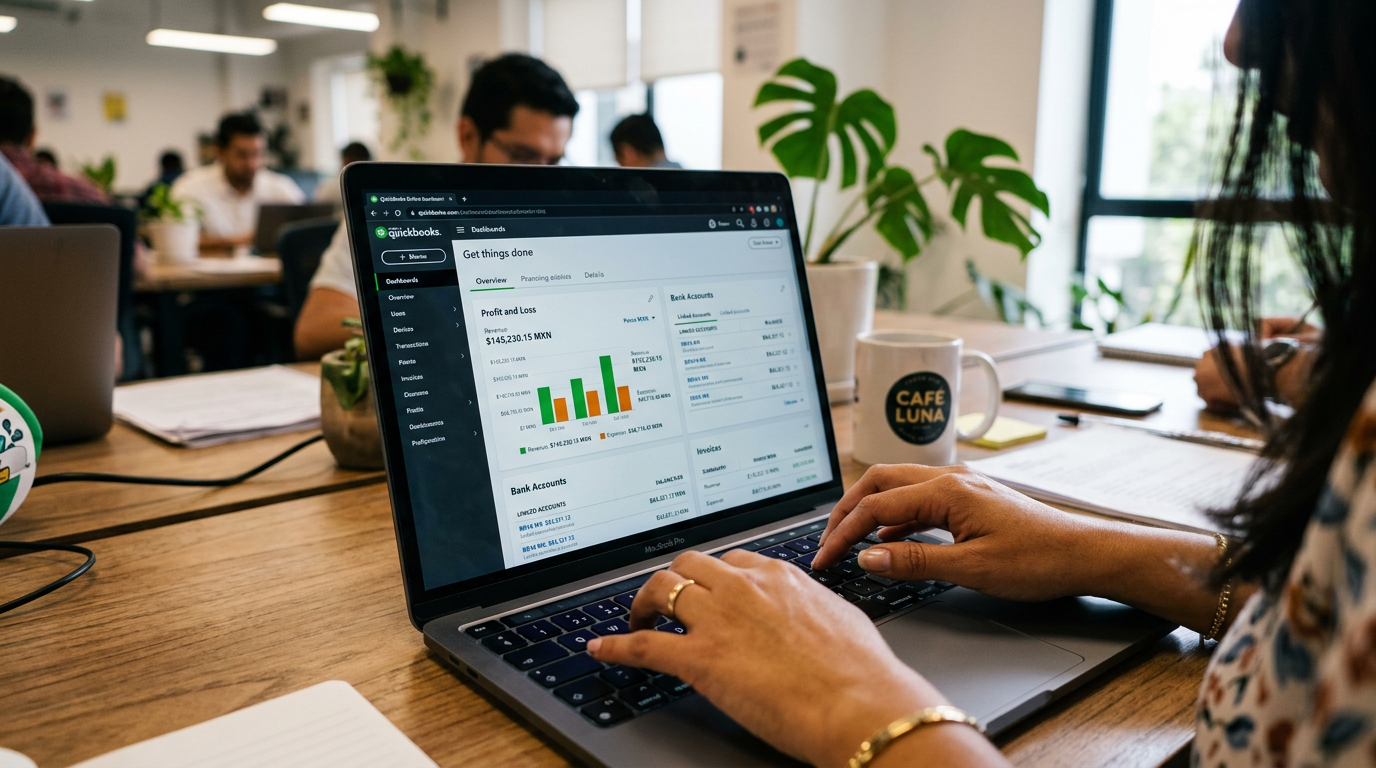
How Much Does a QuickBooks Bookkeeper Cost in 2026? Four Models Compared
Pricing for QuickBooks bookkeeping support varies more than most owners expect — not because the work changes, but because the overhead attached to each hiring model is wildly different. Here's what you're actually paying for under each option, broken down honestly.
In-house employee. The Bureau of Labor Statistics (2024) puts the median wage for US bookkeeping clerks at $22.60/hour, but fully-loaded cost — employer payroll taxes, health insurance, PTO, equipment, office space — pushes the real annual cost of a $40,000 salary hire to $55,000–$65,000, according to SHRM's employee cost calculator (2024). You also carry the full recruiting and replacement risk.
US-based freelancer. Platforms like Upwork and Bench show QuickBooks-certified freelancers billing $35–$75/hour in 2024. At 20 hours/month (part-time engagement), that's $700–$1,500/month — but most growing businesses need closer to 80–160 hours/month, which pushes freelancer costs to $2,800–$12,000/month with zero employment infrastructure underneath them.
Accounting firm / bookkeeping service. Outsourced bookkeeping firms (Pilot, Bench, local CPAs) typically charge $500–$5,000/month depending on transaction volume and services included. These packages often cap hours, don't include a dedicated point of contact, and escalate prices as your business grows.
Nearshore virtual bookkeeper. A dedicated nearshore bookkeeper from a staffing agency like Rose Talent Solutions costs $2,500/month flat — full-time, 40 hours/week, with recruiting, vetting, HR, payroll, and ongoing management included. That works out to roughly $14.42/hour all-in for a dedicated, QuickBooks-trained professional working your business hours from Latin America.
| Hiring Model | Typical Monthly Cost | Hours Included | Dedicated to You? | HR/Payroll Included? | Timezone Overlap (US) |
|---|---|---|---|---|---|
| In-house employee (US) | $4,500–$6,000+ | 160 hrs | Yes | No (you manage) | Full |
| US-based freelancer | $700–$12,000 | 20–160 hrs | Rarely | No | Full |
| Accounting firm / service | $500–$5,000 | Capped / varies | No | No | Full |
| Nearshore VA (Rose Talent) | $2,500 flat | 160 hrs | Yes | Yes (included) | Full (LatAm → US hours) |
How Hidden Costs Drive QuickBooks Bookkeeper Cost Above the Sticker Price
The advertised rate — whether hourly, monthly, or annual salary — is never the full cost. For in-house hires, the average cost-per-hire across all US occupations reached $4,700 in 2023, according to SHRM's Talent Acquisition Benchmarking Report (2023). For bookkeeping roles specifically, that figure climbs when you factor in job board fees, screening time, skills testing, and onboarding. If your bookkeeper leaves after 14 months — close to the median tenure for bookkeeping roles at small businesses, per BLS Employee Tenure data (2024) — you absorb that cost again. Turnover is the hidden tax on in-house hiring that rarely appears in the budget forecast.
For freelancers, the hidden costs are different: ramp time, inconsistent availability, and the absence of any backup coverage when they go on vacation or drop a client. A solo freelancer who disappears during your Q4 close or tax prep season is a financial liability, not just an inconvenience. The real cost of bookkeeper turnover is rarely line-itemed in a hiring budget — but it should be.
The real cost of a QuickBooks bookkeeper isn't just wages — it's wages plus recruiting, onboarding, turnover risk, benefits, payroll taxes, and the hours your operations team spends managing the relationship. A nearshore model bundles all of that into one flat rate and moves the management burden off your plate.
Software costs also add up. QuickBooks Online plans range from $35–$235/month, according to Intuit's official pricing page (2025). If you're adding a payroll module, Advanced plan features, or third-party integrations, that number climbs. A nearshore bookkeeper who already knows which plan tier you need — and which integrations are worth the subscription — pays for themselves in avoided software waste alone.
If you're also evaluating cloud-based alternatives to QuickBooks, the decision framework for choosing a Xero virtual bookkeeper follows a similar cost structure and is worth reading in parallel before you commit to a platform.

How Rose Talent's Nearshore Model Reduces QuickBooks Bookkeeper Cost in 2026
Rose Talent Solutions places full-time virtual bookkeepers based in Latin America with US, Canadian, and UK businesses — that's the nearshore distinction. Unlike offshore providers in the Philippines or India, Latin American team members operate on US business hours by default, speak English at an 8/10 or higher proficiency level (screened before placement), and work within one to three time zones of most US clients. Real-time collaboration with your accountant, your operations team, or your bank doesn't require scheduling around a 12-hour gap.
Every bookkeeper Rose places arrives with a role-specific AI copilot trained on their primary software stack. For QuickBooks, that means the team member is pre-loaded with workflow knowledge for bank reconciliations, chart-of-accounts setup, recurring transaction rules, and report generation — not learning on your dime during week one. For property management clients, the same AI layer extends to AppFolio and Buildium integrations, which is why Rose's property management virtual staff page covers the overlap between financial and operational tasks in detail.
"Small businesses that leverage AI-assisted bookkeeping workflows reduce manual data entry errors by up to 40% and close their books an average of three days faster each month." — Intuit QuickBooks, Small Business Insights Report (2024)
Remote work adoption has also validated the model broadly. According to Gallup's State of the Global Workplace report (2024), fully remote and hybrid workers report higher engagement scores than their fully on-site counterparts — which means the productivity concern about remote bookkeepers is largely unsupported by data. What matters is timezone alignment, communication norms, and software access, all of which the nearshore model addresses directly.
The pricing is $2,500/month flat — no long-term contract, month-to-month, cancel with 30 days written notice. That rate covers recruiting, vetting, payroll, HR, and ongoing management. If the team member isn't the right fit, Rose replaces them at no additional cost. To see the full breakdown of what's included and get matched with a bookkeeper, visit the start page or review the AI advantage details for how the copilot system works in practice.
Is a Nearshore QuickBooks Bookkeeper Right for Your Business in 2026?
The nearshore model works best for businesses that need consistent, full-time bookkeeping coverage but can't justify a $55,000+ in-house hire. That includes most small businesses with $500K–$10M in annual revenue, property managers tracking income and expenses across multiple units, e-commerce operators with high transaction volumes, and professional services firms that need clean books before quarterly reviews. The US Small Business Administration reports that small businesses employ 46.4% of the US private-sector workforce — the vast majority of those employers face exactly this staffing cost pressure.
It's a less obvious fit if you need a bookkeeper physically present in your office, if your financial complexity requires a licensed CPA (not a bookkeeper), or if you have a highly irregular work schedule that doesn't map to standard US business hours. For businesses in that second bucket, a hybrid approach — nearshore bookkeeper for day-to-day QuickBooks work, local CPA for strategy and filings — is often the most cost-effective structure. You can explore more on that breakdown in the detailed QuickBooks virtual bookkeeper cost guide for 2026.
Nearshore QuickBooks VA — Pros
- Full-time, dedicated to your business only
- Works US business hours (real-time collaboration)
- Flat $2,500/month — all overhead included
- Role-specific AI copilot pre-trained on QuickBooks
- No long-term contract; free replacement if not a fit
- English proficiency screened to 8/10+
Nearshore QuickBooks VA — Cons
- Not physically present in your office
- Cannot sign as a licensed CPA or file taxes independently
- Requires basic onboarding on your internal processes (1–2 weeks)
- Best for businesses with predictable, recurring bookkeeping volume
How to Get Started with a Nearshore QuickBooks Bookkeeper in 2026
Getting from "I need a bookkeeper" to "my bookkeeper is live in QuickBooks" takes less than two weeks with the right staffing partner. Rose Talent's placement process is designed to minimize the time between your first conversation and your first reconciled statement.
Submit your role brief
Tell Rose what software you use, your transaction volume, and which tasks you need covered. The intake form takes under 10 minutes at the start page.
Review matched candidates
Rose pre-vets and presents 2–3 candidates within a few business days, each screened for QuickBooks proficiency, English fluency (8/10+), and US-hours availability.
Select and onboard
You choose your team member, Rose handles the employment paperwork, and your bookkeeper begins onboarding to your QuickBooks environment — typically within the first week.
Go live and review
Your bookkeeper is in QuickBooks, reconciling accounts, and generating your first reports. Rose's account team checks in at 30 days — if anything isn't right, replacement is at no additional cost.
For businesses that want to understand the full cost picture before committing, the complete QuickBooks virtual bookkeeper cost breakdown covers every line item in detail, including what questions to ask before you sign anything with any provider.