
Why Bookkeeping and Accounting Support for Small Businesses Is Broken in 2026
Most small business owners are running their books in one of two broken ways: either they're doing it themselves at 11pm on a Sunday, or they're paying a local bookkeeper $60–$80 an hour for work that doesn't require that rate. Neither option scales. Neither gives you the real-time financial visibility you need to make smart decisions.
The smarter path in 2026 is nearshore bookkeeping and accounting support — dedicated, full-time virtual staff based in Latin America, working your exact business hours, trained on the software you already use. Rose Talent Solutions places these professionals for a flat $2,500 per month, all-in. No recruiting fees layered on top. No payroll admin headaches. Just a skilled finance professional in your corner every business day.
According to SCORE (2023), 82% of small businesses that fail cite cash flow problems as a contributing factor — and poor bookkeeping discipline is almost always the upstream cause. Getting this function right isn't a nice-to-have; it's a survival skill.
This guide covers exactly what modern bookkeeping and accounting support looks like — from day-to-day transaction management to management accounting best practices, cost accounting, variance analysis, and budgeting and forecasting. If you want to understand the full scope before hiring, this is your starting point. You can also explore Rose's bookkeeping and accounting service to see how placements work in practice.
What Does "Accounting Support" Actually Cover in 2026?
Bookkeeping is the recording layer: categorizing transactions, reconciling bank and credit card accounts, managing accounts payable and receivable, and keeping your general ledger clean. It's the foundation. Without accurate books, every report above it is fiction.
Management accounting is the analysis layer built on top of those clean books. Management accounting is the practice of using financial and non-financial data to help internal decision-makers — owners, operators, managers — run the business better. It includes things like profitability analysis by product or service line, departmental cost tracking, KPI dashboards, and forward-looking reports. Unlike financial accounting (which looks backward for external compliance), management accounting looks forward and inward.
Cost accounting is a subset of management accounting focused specifically on capturing, classifying, and analyzing all costs associated with producing a product or delivering a service. Cost accounting answers the question: "What does it actually cost us to do what we do?" For a service business, that might mean tracking labor costs per client or per engagement type. For a product business, it means tracking direct materials, direct labor, and overhead per SKU.

Variance analysis connects cost accounting to planning. Variance analysis is the process of comparing actual financial results to budgeted or standard figures, then investigating the gaps. A favorable variance means you came in better than expected; an unfavorable variance means you need to understand why — was it a pricing issue, a volume issue, or an efficiency issue? Regular variance analysis is one of the clearest signals of a mature, well-managed finance function.
Finally, budgeting and forecasting is the planning layer. Budgeting sets a financial target for a future period (typically annual). Forecasting updates that target on a rolling basis as actual data comes in. Together, they give you a live view of where the business is headed — not just where it's been.
How Management Accounting Best Practices Drive Small Business Growth
Most small businesses have decent bookkeeping by the time they hit $500K in annual revenue. What separates the ones that scale past $2M–$5M is whether they've built a management accounting layer on top. The businesses that do this well share a set of repeatable practices.
The first practice is monthly close discipline. Close your books within five business days of month-end, every month, without exception. A late close means decisions are being made on stale data. According to McKinsey & Company, finance teams that close within five days spend significantly more time on analysis versus transaction processing — shifting the function from scorekeeping to strategy.
The second practice is role-specific KPI dashboards. Don't give every stakeholder the same P&L. Build a short dashboard — five to eight metrics — relevant to each decision-maker's function. A sales lead needs revenue by channel and conversion cost. An operations manager needs cost per unit and labor efficiency. An owner needs EBITDA margin, cash runway, and working capital ratio.
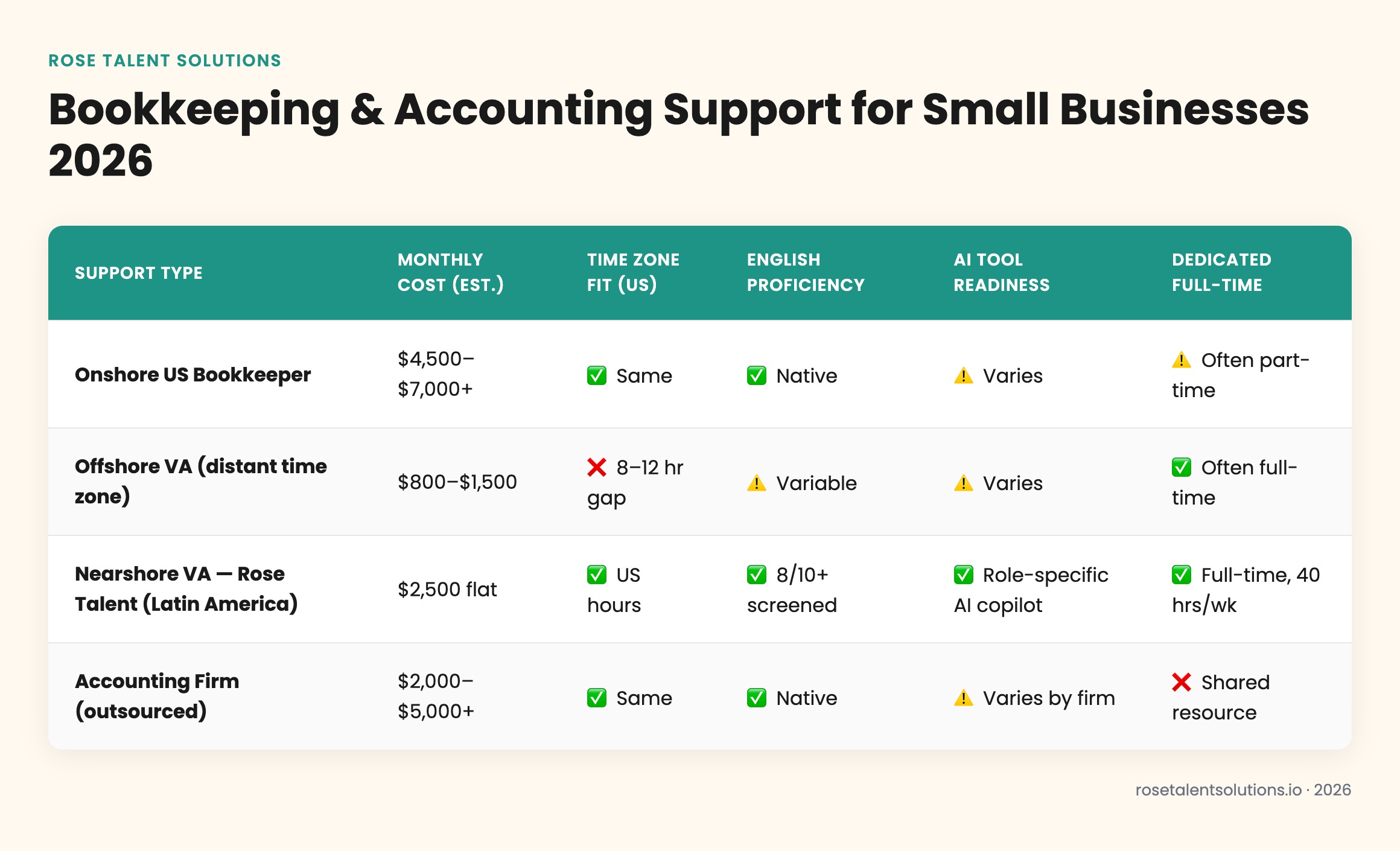
| Support Type | Monthly Cost (est.) | Time Zone Fit (US) | English Proficiency | AI Tool Readiness | Dedicated Full-Time |
|---|---|---|---|---|---|
| Onshore US Bookkeeper | $4,500–$7,000+ | ✅ Same | ✅ Native | ⚠️ Varies | ⚠️ Often part-time |
| Offshore VA (distant time zone) | $800–$1,500 | ❌ 8–12 hr gap | ⚠️ Variable | ⚠️ Varies | ✅ Often full-time |
| Nearshore VA — Rose Talent (Latin America) | $2,500 flat | ✅ US hours | ✅ 8/10+ screened | ✅ Role-specific AI copilot | ✅ Full-time, 40 hrs/wk |
| Accounting Firm (outsourced) | $2,000–$5,000+ | ✅ Same | ✅ Native | ⚠️ Varies by firm | ❌ Shared resource |
The third practice is rolling 13-week cash flow forecasting. Annual budgets are essential, but they don't tell you whether you'll make payroll in six weeks. A rolling 13-week cash forecast — updated weekly with actual cash in, cash out, and committed obligations — is the single most practical tool for surviving a rough quarter. According to the Federal Reserve's 2022 Report on the Economic Well-Being of U.S. Households, nearly half of small businesses could not cover a $400 emergency expense from operating cash — a direct symptom of no forward-looking cash visibility.
How Rose Nearshore VAs Deliver Real Accounting Support in 2026
Every Rose accounting VA ships with a role-specific AI copilot trained on the software your business already uses — QuickBooks, Xero, FreshBooks, Wave, or whatever stack you're running. This isn't a generic "AI assistant." It's a tool calibrated to the workflows of bookkeeping and accounting support specifically. That means your VA can reconcile faster, catch categorization errors before they compound, and generate management reports without you having to build the templates yourself.
The team members Rose places are based in Latin America — chosen specifically because they work US business hours in overlapping time zones. That means your bookkeeper is available when you call, when your bank sends a notice, and when a vendor dispute needs same-day resolution. The AI advantage Rose builds into every placement compounds that value further: a tool-trained VA in your time zone outperforms an untrained hire working an opposite schedule every single time.
The hidden cost of distant-timezone accounting support isn't the hourly rate — it's the 8–12 hour gap that means every urgent question about a vendor invoice or a bank discrepancy waits until the next morning. For small businesses running lean, that lag is operationally dangerous.
According to the U.S. Bureau of Labor Statistics (2024), the median annual wage for bookkeeping and accounting clerks in the United States is $47,440 — roughly $3,950 per month in salary alone, before benefits, payroll taxes, recruiting costs, or software licenses. At $2,500/month all-in, Rose's nearshore model delivers full-time dedicated support at a meaningful discount to a domestic hire's fully-loaded cost.

Rose's pricing is month-to-month with no long-term contract. If the team member isn't a fit for your business, Rose replaces them at no additional cost — that's the risk reversal built into every engagement. You can learn more about how Rose supports operations-heavy businesses and why the nearshore model consistently outperforms traditional far-timezone staffing for finance roles.
How to Build a Scalable Bookkeeping System Starting From Scratch in 2026
Whether you're hiring your first dedicated bookkeeper or upgrading from a part-time arrangement, the setup process matters as much as the hire itself. Here's the sequence Rose recommends for small businesses standing up a proper accounting support function.
Audit Your Chart of Accounts
Before any VA can work effectively, your chart of accounts needs to reflect your actual business model. Spend two hours with your CPA cleaning up account categories — this one-time investment pays dividends in every report that follows.
Define Your Monthly Close Checklist
Document every step in your monthly close: bank reconciliations, credit card reconciliations, AP aging review, AR aging review, payroll journal entries, and any accruals. A written checklist means your VA closes consistently even when you're traveling or unavailable.
Set Up Your Management Reporting Template
Decide which five to eight KPIs matter most to you and build a simple reporting template in your accounting software or a connected tool like Google Sheets. Your VA populates this monthly — you review and act.
Implement Rolling Cash Flow Forecasting
Start a 13-week cash forecast in a simple spreadsheet. Your bookkeeper updates actuals weekly; you review the 90-day runway every Monday morning. This single habit has saved more small businesses from cash crunches than any other practice.
Schedule Quarterly Variance Reviews
Every quarter, sit down with your VA and your CPA to review budget-versus-actual variances across your major cost and revenue categories. Document what drove each significant variance and adjust the next quarter's forecast accordingly.
According to the U.S. Small Business Administration, businesses that maintain accurate, current financial records are significantly better positioned to secure financing, navigate audits, and make timely strategic decisions. The infrastructure described above is exactly what a well-placed nearshore bookkeeping VA can own and maintain on your behalf.
Nearshore Accounting VA — Strengths
- US business hours — real-time availability when issues arise
- English proficiency screened to 8/10+ before placement
- Role-specific AI copilot trained on QuickBooks, Xero, and similar tools
- $2,500/month flat — no recruiting or payroll admin add-ons
- Month-to-month terms, free replacement if not a fit
- Latin America time zone overlap enables live collaboration
Considerations to Plan For
- Requires a documented close checklist for fastest onboarding
- Your CPA still handles tax strategy and filing — VA handles the books
- Works best when you provide software access and clear KPI definitions on day one
If you're ready to stop doing your own books or overpaying a local firm for work that doesn't require that rate, the Rose bookkeeping and accounting placement page walks through exactly how the matching and onboarding process works. Placements typically go live within about seven business days of intake.