
Nearshore virtual assistants are quietly transforming how property management companies operate — and the platform your business runs on has everything to do with how fast that VA gets productive. If you're weighing Propertyware vs RealPage vs Rentec Direct virtual assistants for your portfolio, the software isn't just a detail. It's the difference between a VA who's billing work orders by day three and one who's still watching YouTube tutorials in week two. According to the Buildium State of the Property Management Industry Report (2024), 68% of property management companies now rely on at least one remote staff member, yet fewer than 30% vet those hires specifically for platform fluency before onboarding.
This guide breaks down what a platform-trained nearshore VA actually does inside Propertyware, RealPage, and Rentec Direct — and what separates a high-performing hire from an expensive mistake.
What Is a Nearshore Virtual Assistant for Property Management?
A nearshore virtual assistant is a full-time remote professional based in Latin America — countries like Colombia, Mexico, or Argentina — who works on your time zone and communicates in fluent English. Unlike offshore hires based in the Philippines or India, nearshore VAs share business hours with US, Canadian, and UK operators, meaning a tenant call at 10am Eastern gets answered at 10am, not batched overnight. Rose Talent Solutions screens all candidates to an 8/10 or higher English proficiency standard before any placement is made.
For property managers specifically, a nearshore VA is trained on the exact software stack your company uses — whether that's Propertyware, RealPage, AppFolio, or Rentec Direct. That platform specificity is what collapses ramp time from months to days. If you want a deeper look at how the nearshore model stacks up against offshore alternatives, this comparison of nearshore vs. offshore VAs for property management covers the full picture.
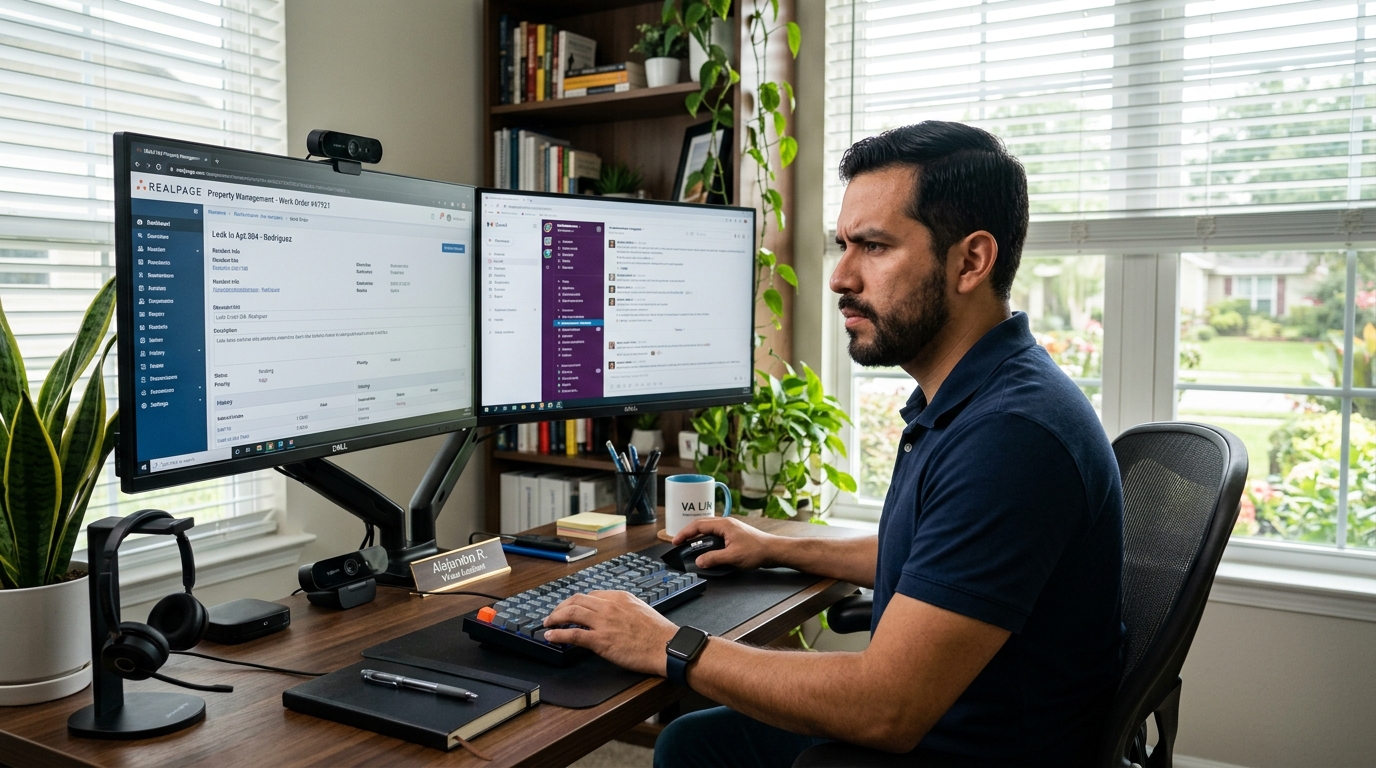
How Each Platform Shapes the VA Role in 2026
Propertyware, RealPage, and Rentec Direct are not interchangeable. Each one has a distinct architecture, a different user interface, and a different set of workflows your VA will live inside every day. Choosing a VA who knows the wrong platform — or none at all — costs you two to four weeks of productive time while they ramp. Here's how the three platforms differ from a VA workflow perspective.
Propertyware is built for single-family residential portfolios. Its VA use cases center on tenant communication portals, maintenance request routing, and owner reporting. A well-trained Propertyware VA handles tenant-facing tickets inside the platform's work order module, auto-populates owner statements, and manages the lease renewal pipeline without ever touching your inbox. Propertyware's open API also means VAs can connect it to external tools like Slack or Zapier, which expands what a remote coordinator can automate.
RealPage is the enterprise-grade option, dominant in multifamily. The platform's complexity is its biggest strength and its steepest learning curve. A RealPage VA typically focuses on leasing follow-up inside the prospect pipeline, charge batch processing, compliance document management, and ledger reconciliation. Because RealPage integrates with AI leasing tools and revenue management modules, a VA trained here also needs familiarity with those adjacent systems — and that's where platform-specific screening matters enormously. According to NMHC's 2024 Apartment Strategies Outlook, multifamily operators using dedicated remote administrative staff report a 21% reduction in leasing cycle time compared to operators relying on on-site staff alone.
Rentec Direct serves the small-to-midsize landlord and PM firm market. Its interface is leaner, which means a Rentec Direct VA can get productive faster — but the tasks are just as mission-critical: rent collection tracking, late notice generation, vendor payment scheduling, and tenant screening coordination. Many Rentec Direct users are owner-operators managing under 200 units who need a VA to function as a full operations coordinator, not just a data-entry resource.
"Software fluency is the single biggest predictor of VA success in property management. A coordinator who genuinely knows the platform can operate independently within a week. One who doesn't can cost you a month of productivity and a frustrated tenant base." — Jordan Muela, CEO at LeadSimple (2024)
How a Comparison Table Reveals the Real VA Decision in 2026
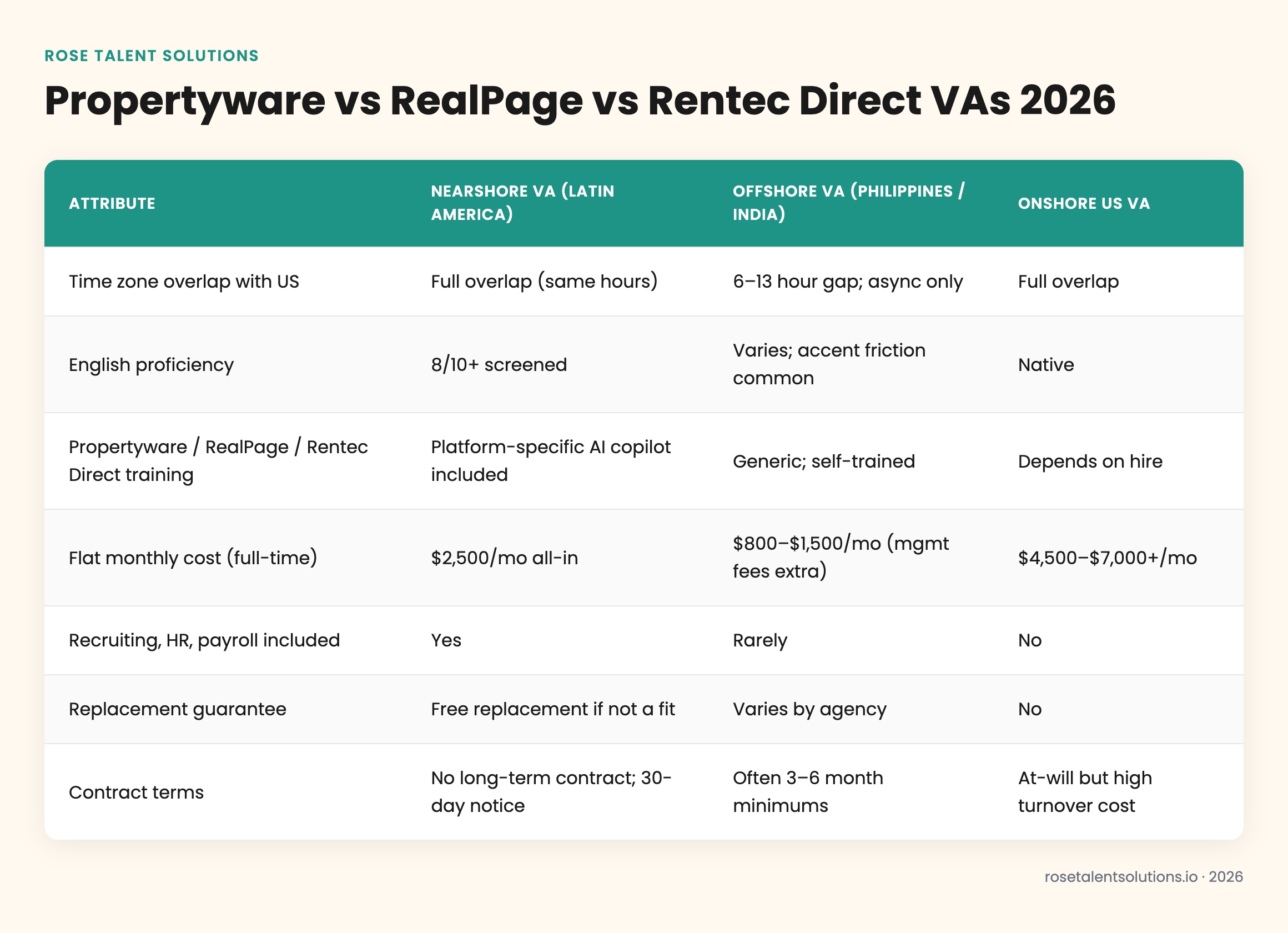
The platform question and the sourcing question are linked. A nearshore VA trained on your specific software stack outperforms a generic offshore hire on almost every measurable dimension — not because of effort, but because of structural advantages like time zone alignment, communication clarity, and pre-loaded platform knowledge. The table below makes that concrete.
| Attribute | Nearshore VA (Latin America) | Offshore VA (Philippines / India) | Onshore US VA |
|---|---|---|---|
| Time zone overlap with US | Full overlap (same hours) | 6–13 hour gap; async only | Full overlap |
| English proficiency | 8/10+ screened | Varies; accent friction common | Native |
| Propertyware / RealPage / Rentec Direct training | Platform-specific AI copilot included | Generic; self-trained | Depends on hire |
| Flat monthly cost (full-time) | $2,500/mo all-in | $800–$1,500/mo (mgmt fees extra) | $4,500–$7,000+/mo |
| Recruiting, HR, payroll included | Yes | Rarely | No |
| Replacement guarantee | Free replacement if not a fit | Varies by agency | No |
| Contract terms | No long-term contract; 30-day notice | Often 3–6 month minimums | At-will but high turnover cost |
How Rose's AI Copilot Closes the Platform Gap Faster Than Traditional Training
Every VA placed through Rose Talent Solutions ships with a role-specific AI copilot trained on their assigned software. For a Propertyware coordinator, that means the AI copilot knows Propertyware's work order module, tenant portal, and owner reporting structure before the VA ever logs into your account. For a RealPage specialist, the copilot is pre-loaded with multifamily leasing workflows, charge batch logic, and compliance document templates.
This isn't a chatbot bolted onto the side of the job — it's a purpose-built knowledge layer that surfaces the right next step inside the VA's actual workflow. The result is a ramp time that shrinks from the industry average of four to six weeks down to five to seven business days for most platform-specific roles. According to McKinsey's 2023 report on generative AI, AI assistance increases knowledge worker productivity by 20–40% on structured administrative tasks — exactly the category that dominates VA work in property management.
If you're managing an AppFolio portfolio alongside one of these platforms, the same principle applies — you can read the full breakdown in our guide to hiring an AppFolio virtual assistant. The AI copilot model works the same way regardless of which platform sits at the center of your stack.
The hidden cost of a generic offshore VA isn't the monthly rate — it's the 6–13 hour timezone gap that turns every tenant issue into a 24-hour delay, and the four to six weeks of ramp time your team absorbs while the VA learns your software from scratch. A platform-trained nearshore VA eliminates both costs before the first invoice arrives.

What Tasks Can a Platform-Trained VA Actually Own in 2026?
This is where most property managers underestimate the scope. A well-matched VA isn't just answering emails — they're running an operational layer of your business. Here are the task categories a platform-trained nearshore VA typically owns within 30 days of placement, regardless of whether they're in Propertyware, RealPage, or Rentec Direct.
- Leasing coordination: Prospect inquiry response, showing scheduling, application processing, screening coordination, lease generation and execution tracking.
- Maintenance management: Work order creation and routing, vendor follow-up, completion verification, tenant communication on status updates.
- Owner reporting: Monthly statement distribution, owner portal updates, delinquency reporting, CAM reconciliation prep.
- Rent collection: Late notice generation, payment tracking, ledger reconciliation, NSF follow-up workflows.
- Compliance and documentation: Lease renewal notices, inspection scheduling, certificate of insurance tracking, move-in/move-out documentation.
The Bureau of Labor Statistics (2024) reports that property and community association managers spend nearly 35% of their working hours on administrative coordination tasks — precisely the category a platform-trained VA absorbs so the manager can focus on portfolio growth and owner relationships. For HOA-specific operations, the VA scope can be even broader; see our deep-dive on whether a virtual assistant can handle HOA management for the full task breakdown.
Short-term rental operators face a parallel challenge. A VA who knows your PM platform can also manage guest communication cadences, dynamic pricing review, and OTA channel coordination. If STR is part of your portfolio, the guide to the best virtual assistants for short-term rental hosts covers the additional skill sets to screen for.
According to SHRM's 2024 Employee Benefits Survey, the average US employer now spends $4,700 per hire in direct recruiting costs alone — before a single hour of training. At $2,500/month all-in with recruiting, vetting, payroll, HR, and ongoing management included, the Rose model eliminates that front-loaded cost entirely. Visit Rose's property management staffing page to see the full role catalog.
How to Get a Propertyware, RealPage, or Rentec Direct VA Placed in 7 Days
The process is faster than most property managers expect. Rose handles recruiting, platform-specific vetting, English proficiency screening, and background checks before you ever meet a candidate. Here's how the placement sequence works.
Discovery call (Day 1)
You tell Rose which platform you run, how many units you manage, and what tasks you need covered. The intake takes about 20 minutes and determines the exact VA profile to recruit for.
Candidate matching (Days 2–4)
Rose's recruiting team pulls from a pre-vetted talent pool of Latin America-based PMs. Every candidate has been screened for platform fluency, English proficiency (8/10+ minimum), and PM-specific task experience.
Your interview (Day 5)
You meet the top one or two candidates. You're evaluating fit and communication style — Rose has already validated the hard skills. Most clients extend an offer in the same session.
AI copilot activation (Day 6)
The VA's role-specific AI copilot is configured to your platform and workflows. This is what collapses ramp time — the VA arrives with institutional knowledge already loaded.
Day one (Day 7)
Your VA is in your platform, working your hours, handling your tasks. Rose manages payroll, HR, and ongoing performance — you just direct the work. If the match isn't right, Rose replaces at no additional cost.
To get started, visit Rose's quick-start page and submit your platform and portfolio details. You can also explore how Rose's AI copilot advantage works before your discovery call if you want to understand the technology layer in detail.
Why Nearshore Wins for PM VAs
- Works your exact business hours — no async lag on tenant issues
- Pre-trained on Propertyware, RealPage, or Rentec Direct before day one
- 8/10+ English proficiency means clear owner and tenant communication
- $2,500/mo flat includes recruiting, HR, payroll — no hidden fees
- No long-term contract; free replacement if not a fit
Where Generic Offshore Falls Short
- 6–13 hour timezone gap batches urgent tenant issues overnight
- Platform training left to the operator — weeks of absorbed ramp cost
- Variable English fluency creates friction with owners and tenants
- Base rate looks cheap; management fees and replacement costs add up fast
- Multi-month contract minimums lock you in before you know if it's working
For bookkeeping and financial reconciliation tasks inside any of these platforms, a dedicated nearshore bookkeeping and accounting VA can layer on top of your PM coordinator role — handling QuickBooks or platform-native ledger work while your coordinator owns the operational side.