
Why Short Term Rental Hosts Are Turning to Nearshore VAs in 2026
Nearshore virtual assistants have become the go-to staffing move for short term rental (STR) operators who are done paying full-time employee overhead — or gambling on offshore hires who disappear during peak check-in hours. A nearshore VA works from Latin America, operates on your exact timezone, and speaks English at a professional level. For an Airbnb or VRBO host managing 10, 20, or 50+ units, that combination is the difference between five-star reviews and a listing full of complaints about slow responses.
The short term rental market is not slowing down. The U.S. vacation rental sector is projected to generate over $20 billion in annual revenue by 2028, according to Statista (2024), with individual hosts managing an average of 3–7 properties. That workload — guest messaging, dynamic pricing updates, calendar syncing, cleaning crew coordination, review management — is simply too much for one person without support.
What separates a great STR virtual assistant from a mediocre one is not just availability — it's platform fluency. The best candidates already know how Airbnb's resolution center works, how to update a VRBO listing's minimum stay rules, and how to escalate a maintenance issue inside a property management system like AppFolio without dropping the ball. That kind of software-specific training takes time to build — or you hire someone who already has it.
What Is a Nearshore Virtual Assistant? (2026 Definition)
A nearshore virtual assistant is a remote professional based in a geographically proximate region — for U.S. and Canadian businesses, that means Latin America. Unlike offshore VAs in the Philippines or India who may work on an 8–12 hour time lag, nearshore VAs operate during North American business hours. Rose Talent Solutions places VAs from Latin America exclusively, and every candidate clears an 8/10+ English proficiency screen before they ever reach a client.
The nearshore model matters specifically for short term rental hosts because guest issues don't wait. A guest locked out at 10 p.m. EST needs a real-time response — not a batched reply at 6 a.m. the next morning. A nearshore VA in Colombia, Mexico, or Argentina is online, alert, and capable of handling that conversation in the moment. If you want to understand how this model stacks up against traditional offshore staffing in depth, the nearshore virtual assistant property management comparison breaks it down with side-by-side data.
"The vacation rental industry has a guest-experience problem that stems directly from hosts being stretched too thin. The operators who scale well are the ones who delegate guest communications early — and delegate it to someone who can respond like a professional, not like an answering machine." — Matt Landau, Founder of VRMB (Vacation Rental Marketing Blog) (2023)
How Nearshore VAs Compare to Offshore and Domestic Hires for STR Hosts in 2026
Before you hire anyone, it helps to see the tradeoffs on one page. The table below maps the three main VA options across the metrics that matter most to short term rental operators: cost, timezone alignment, English fluency, STR platform knowledge, and replacement risk.
| Category | Nearshore VA (Latin America) | Offshore VA (Philippines/India) | Domestic VA (US-Based) |
|---|---|---|---|
| Monthly Cost (Full-Time) | ~$2,500 flat (all-in) | $1,200–$1,800 (platform fees extra) | $4,500–$7,000+ |
| Timezone Fit (US Hours) | ✅ Same or 1–2 hr overlap | ⚠️ 8–13 hr gap; overnight batching | ✅ Perfect |
| English Proficiency | ✅ 8/10+ screened floor | ⚠️ Variable; no standard screen | ✅ Native |
| STR Platform Fluency | ✅ Pre-vetted; AI copilot trained | ⚠️ Self-reported; hard to verify | ⚠️ Depends on candidate |
| Real-Time Guest Response | ✅ Available during US hours | ❌ Delayed 8–12 hrs typically | ✅ Available |
| Replacement if Not a Fit | ✅ Free replacement included | ❌ Restart search yourself | ❌ Restart search yourself |
| Long-Term Contract Required | No long-term contract | Often 3–6 month minimums | Varies widely |
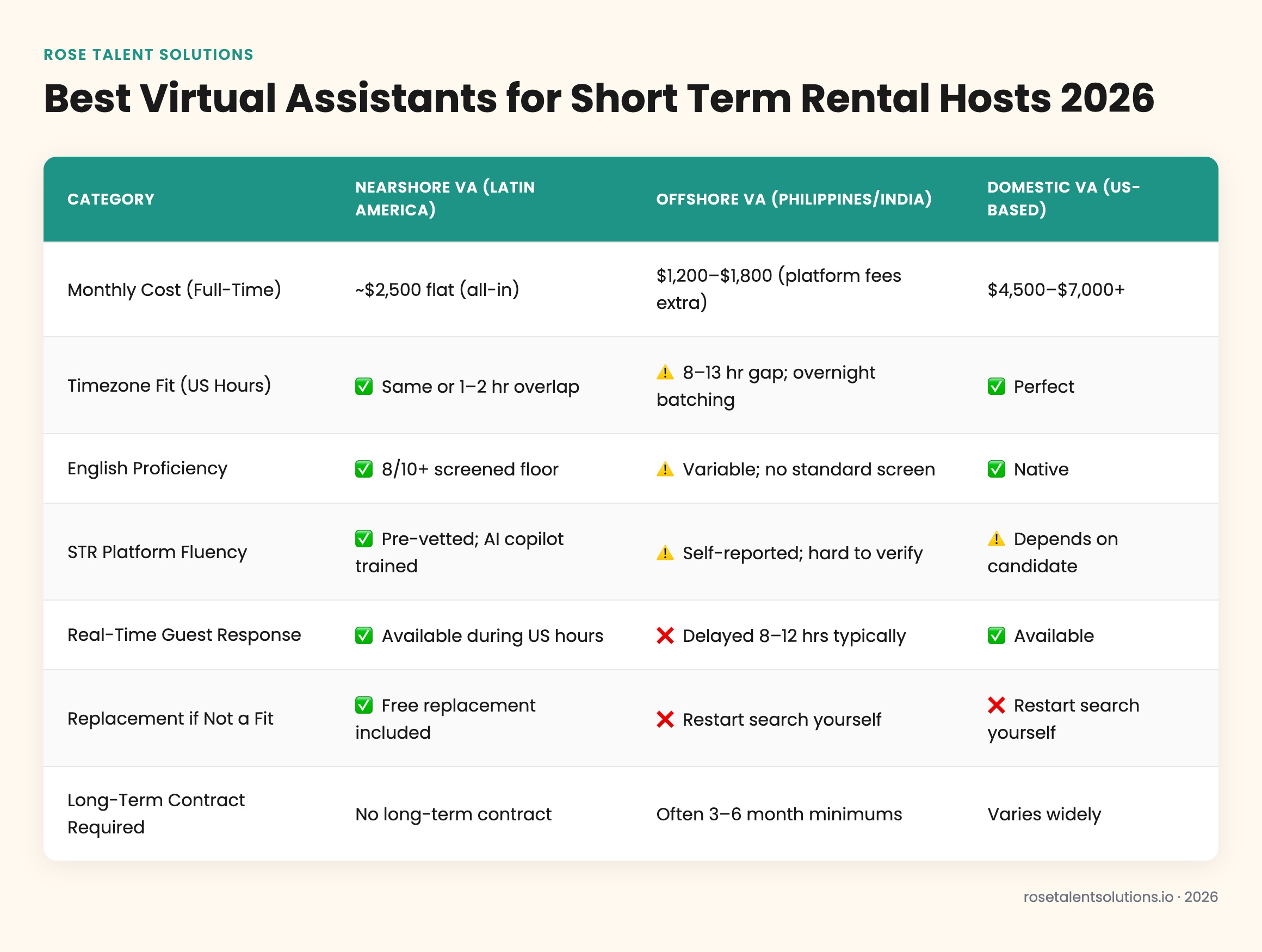
The price difference between nearshore and domestic is real — roughly $2,000–$4,000 per month per hire. But the offshore "savings" evaporate the moment you factor in delayed guest communications, the management overhead of working across time zones, and the turnover cost of re-recruiting when a hire doesn't work out. According to SHRM (2022), replacing an employee costs on average 6–9 months of their salary — even for remote roles.
What Tasks Can a Virtual Assistant Handle for Short Term Rental Hosts?
The scope of what a well-trained STR virtual assistant can own is broader than most hosts realize. The following are the highest-leverage tasks operators delegate first — and where a pre-vetted, platform-trained VA pays back the investment fastest.
- Guest communications: Answering pre-booking inquiries, sending check-in instructions, managing mid-stay requests, and handling post-checkout review prompts.
- Booking and calendar management: Syncing calendars across Airbnb, VRBO, and direct booking sites; adjusting minimum stay rules; blocking maintenance windows.
- Dynamic pricing monitoring: Tracking competitor rates, flagging pricing gaps in tools like PriceLabs or Wheelhouse, and escalating recommendations to the host.
- Cleaning crew coordination: Sending turnover schedules, confirming completions, tracking supply restocking, and managing quality feedback loops.
- Review management: Monitoring incoming reviews, drafting host responses within Airbnb's 14-day response window, and flagging any review that warrants a formal dispute.
- Owner reporting: For co-hosts or property managers handling multiple owners, a VA can compile monthly occupancy and revenue summaries.
- Back-office support: Expense tracking in QuickBooks, invoice reconciliation with cleaning vendors, and basic bookkeeping tasks.
For hosts who have grown into a small portfolio management business, the back-office tasks compound fast. A dedicated VA who can handle both guest-facing communications and back-end bookkeeping eliminates the need for two separate hires. If your operation runs on QuickBooks or needs reconciliation support, Rose's bookkeeping and accounting VA team specializes exactly in that workflow.
Gallup research consistently finds that employees who work within clearly defined roles and with the right tools are significantly more engaged and productive, according to Gallup's State of the American Workplace report (2023). That same principle applies to remote VAs — when a hire arrives with a defined task scope and pre-configured software tools, output quality is measurably higher from week one.
How the AI Copilot Makes STR Virtual Assistants More Effective in 2026
Every Rose Talent Solutions team member ships with a role-specific AI copilot trained on the software they use daily. For STR VAs, that means the AI is preloaded with Airbnb host policies, VRBO listing rules, PriceLabs logic, and the most common guest issue resolution flows. This is not a generic ChatGPT wrapper — it's a purpose-built tool that helps the VA respond faster, escalate smarter, and stay consistent across hundreds of guest interactions. Learn more about how this works on Rose's AI advantage page.
According to McKinsey & Company (2023), generative AI tools can improve individual worker productivity in communication-heavy roles by 20–40%. For an STR VA fielding 50+ guest messages a day, that productivity gain translates directly into faster response times — and faster response times are one of Airbnb's explicit ranking factors for Superhost status.
Airbnb's algorithm rewards hosts with response rates above 90% and response times under one hour. A nearshore VA working your timezone — backed by a role-specific AI copilot — can maintain both thresholds consistently, even during high-volume check-in weekends.
The AI advantage also reduces onboarding time. Most new hires spend their first two weeks learning your systems. When the AI copilot already knows how your property management software works — whether that's a Buildium virtual assistant for hosts using that platform or an AppFolio specialist — the ramp time compresses significantly. The VA arrives trained on the tool, not learning it on your dime.
How Rose Talent Solutions Places STR Virtual Assistants in 2026
The placement process at Rose is designed to get you a qualified, working team member in days — not months. Here is exactly how it works.
Discovery Call
Rose scopes your exact STR operation — number of units, platforms used, task priorities, and timezone requirements — to define the ideal candidate profile before recruiting starts.
Recruiting and Vetting
Rose sources from its Latin American talent network, screens for STR platform experience and 8/10+ English proficiency, and presents a shortlist of candidates typically within 5–7 business days.
Client Interview
You interview the shortlisted candidates directly — Rose does not make the hire without your approval. You choose who joins your team.
Onboarding with AI Copilot
The selected VA is onboarded with their role-specific AI copilot already configured for your platforms — Airbnb, VRBO, PriceLabs, QuickBooks, or whichever tools your operation runs on.
Ongoing Management
Rose handles payroll, HR, and ongoing performance management. If the team member isn't the right fit at any point, Rose replaces them at no additional cost.
The flat $2,500/month fee covers the full stack — recruiting, vetting, payroll, HR, and ongoing management. There are no hidden platform fees, no per-task billing, and no long-term contract. If you want to see the model in action for a property management context, Rose's property management VA service page covers the full scope of what these hires handle day to day.
Nearshore vs. Offshore STR Virtual Assistants: Pros and Cons
If you are still weighing whether nearshore is worth the price premium over a generic offshore platform, the honest comparison looks like this.
Nearshore VA (Latin America) — Pros
- Works your timezone — real-time guest response during US business hours
- English proficiency screened to a defined floor (8/10+)
- Pre-trained on STR platforms with AI copilot support
- All-in pricing — no hidden recruiting or HR costs
- Free replacement if not a fit
- No long-term contract
Generic Offshore VA — Cons
- 8–13 hour timezone gap means batched, delayed guest replies
- English proficiency is self-reported with no standard verification
- Platform training is inconsistent and hard to screen for
- Platform fees, payroll, HR, and recruiting are separate costs you manage
- No structured replacement guarantee if the hire doesn't work out
- Some platforms require 3–6 month minimums
According to the U.S. Bureau of Labor Statistics Job Openings and Labor Turnover Survey (2024), administrative and support role turnover rates remain above 35% annually — a number that climbs higher in unstructured remote arrangements. Structured nearshore placement with a dedicated account manager and clear replacement policy dramatically reduces that exposure for STR operators.
Remote work research from Pew Research Center (2023) confirms that remote workers with clear role definitions and consistent management support report significantly higher job satisfaction and lower turnover intent — a dynamic that translates directly into more stable, reliable VA placements for STR hosts. For hosts who want to go deeper on the staffing model before committing, the best AppFolio virtual assistant services for mid-sized PMCs 2026 covers evaluation criteria that translate directly to the STR context.
The bottom line: if your properties are generating real revenue and your reputation depends on fast, professional guest communication, the nearshore model is not a luxury — it is the operationally correct choice. You can start the placement process with a single call, and you will have a shortlist of candidates within a week.