
What Is Pay for Performance Appointment Setting—and Why SaaS Hosting Companies Are Searching for It in 2026?
Nearshore virtual assistants have quietly become the secret weapon for SaaS hosting companies that want accountable, outcome-tied outreach without handing a per-meeting agency a blank check. Pay for performance appointment setting is a model where the person or team booking your sales meetings is compensated based on results—confirmed, qualified meetings on your calendar—rather than on hours clocked. For SaaS hosting companies selling infrastructure, managed hosting, or cloud services, this matters because your sales cycle is long, your ICP is narrow, and every bad meeting drains a quota-carrying AE's day.
What exactly is pay for performance appointment setting? It is a compensation or pricing structure in which the appointment setter earns a variable reward—a per-meeting fee, a bonus tier, or a commission—only when a qualified meeting is booked and held. Unlike a retainer-based SDR agency that bills you whether meetings happen or not, a performance model aligns the setter's incentive directly with your pipeline goal. The catch most SaaS hosting operators miss: pure per-meeting agency pricing often runs $150–$350 per booked call, which means 40 meetings a month costs more than a full-time nearshore rep at a flat monthly rate.
The smarter hybrid: embed performance incentives inside a flat-rate nearshore staffing model. Your rep earns a monthly base (covered in your flat fee), hits a weekly meeting quota, and you add a small internal bonus for overperformance. You get the accountability of pay-for-performance without the per-meeting agency markup. That is the model this post breaks down for SaaS hosting companies specifically.
How SaaS Hosting Companies Differ From Other B2B Niches—and Why That Changes the Appointment Setting Playbook in 2026
SaaS hosting is not generic B2B software sales. Your prospects—DevOps leads, CTOs at mid-market SaaS firms, infrastructure architects—get hammered with cold outreach daily. According to McKinsey & Company (2024), B2B buyers now complete more than 70% of their purchase research before ever talking to a sales rep. That means your appointment setter cannot lead with features—they have to lead with sharp relevance: stack awareness, migration pain points, uptime SLAs, compliance requirements.

This specificity requirement is why generic offshore call centers consistently underperform for SaaS hosting outreach. When a prospect asks "Do you understand the difference between shared hosting and containerized Kubernetes workloads?"—your setter needs to answer confidently, not stall. Nearshore reps working US business hours, fluent in English at an 8/10+ proficiency standard, with domain training on your specific product, handle that moment in real time. Teams operating in a mismatched timezone handle it hours later, with a script that hasn't been updated in six months.
If you are weighing the broader staffing model question, the complete nearshore vs. offshore vs. onshore VA comparison on the Rose blog breaks down exactly where each model wins—and it is worth reading before you commit to any appointment setting structure for a technical niche like SaaS hosting.
The 2026 Comparison: Pay-Per-Meeting Agency vs. In-House SDR vs. Nearshore VA with Performance Incentives
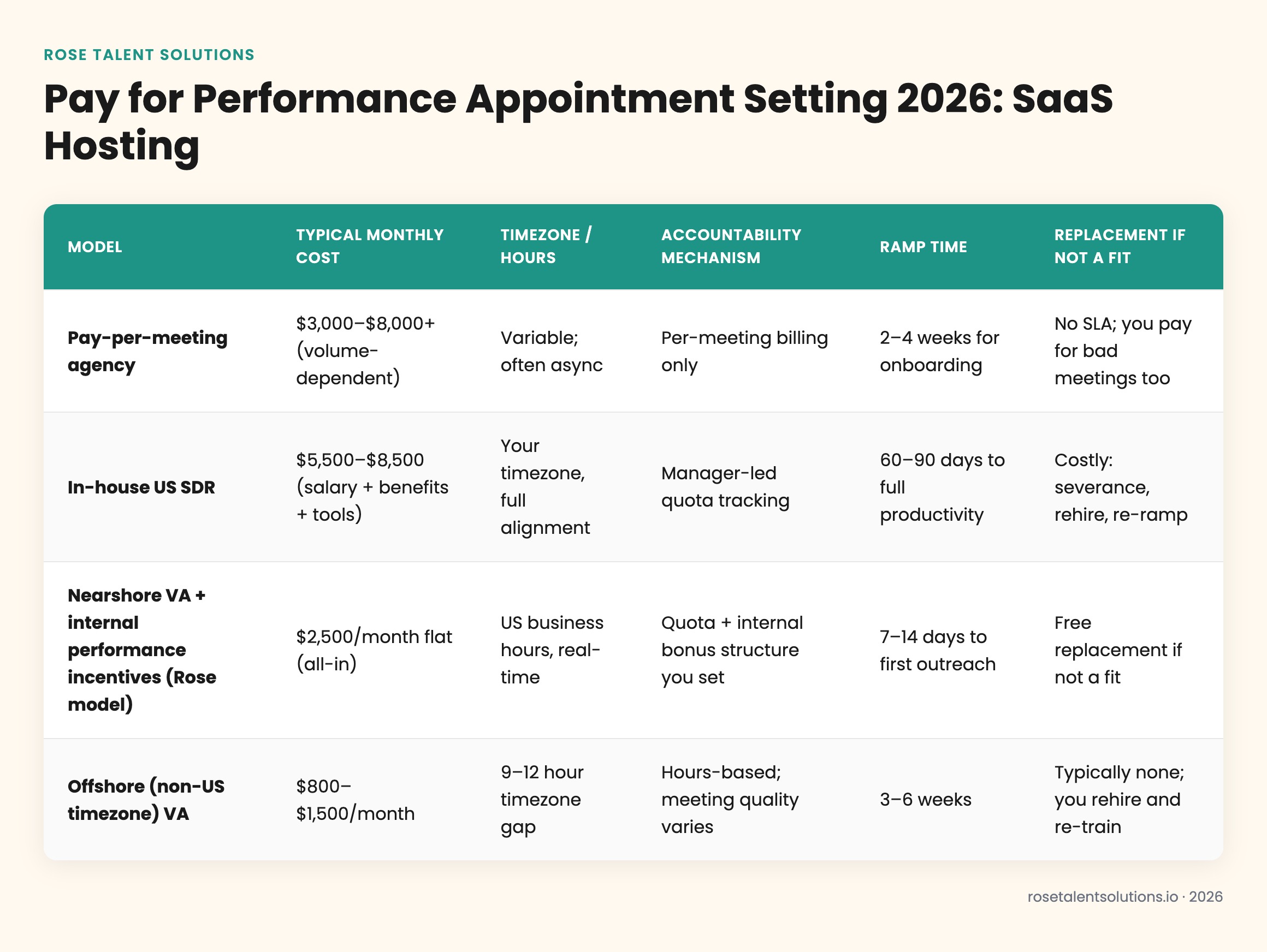
Before you choose a model, you need to see the real numbers side by side. The table below compares the three most common appointment setting structures SaaS hosting companies use in 2026. The goal is a fair comparison—not a sales pitch—so you can make the call that fits your stage and budget.
| Model | Typical Monthly Cost | Timezone / Hours | Accountability Mechanism | Ramp Time | Replacement if Not a Fit |
|---|---|---|---|---|---|
| Pay-per-meeting agency | $3,000–$8,000+ (volume-dependent) | Variable; often async | Per-meeting billing only | 2–4 weeks for onboarding | No SLA; you pay for bad meetings too |
| In-house US SDR | $5,500–$8,500 (salary + benefits + tools) | Your timezone, full alignment | Manager-led quota tracking | 60–90 days to full productivity | Costly: severance, rehire, re-ramp |
| Nearshore VA + internal performance incentives (Rose model) | $2,500/month flat (all-in) | US business hours, real-time | Quota + internal bonus structure you set | 7–14 days to first outreach | Free replacement if not a fit |
| Offshore (non-US timezone) VA | $800–$1,500/month | 9–12 hour timezone gap | Hours-based; meeting quality varies | 3–6 weeks | Typically none; you rehire and re-train |
"Outbound is a volume and consistency game. The reps who book the most meetings aren't necessarily the most talented—they're the most persistent, and persistence requires full-time focus, not a freelance hustle." — Jason Bay, Founder at Outbound Squad (2024)
The performance accountability gap in offshore models is real. According to SHRM's research on employee engagement (2024), workers who have clear, measurable performance targets tied to compensation are 21% more productive than those on fixed-rate contracts with no output benchmarks. That principle applies directly to appointment setters: if there is no consequence for zero meetings booked this week, zero meetings is an acceptable outcome.
For more context on why a large timezone gap specifically underperforms in high-context niches like SaaS hosting, read Rose's breakdown on the key differences between onshore and offshore virtual assistants—particularly the section on communication overhead.
How to Structure Pay for Performance Incentives Inside a Nearshore VA Engagement in 2026
The flat-rate nearshore model handles all the hard parts—recruiting, vetting, payroll, HR, ongoing management—so your only job is to layer in a quota and a bonus structure that drives the behavior you want. Here is a proven sequence for SaaS hosting companies specifically.
Define a Qualified Meeting (Before Day One)
Write down exactly what makes a meeting "qualified" for your AE—title, company size, hosting spend threshold, and a held call of at least 20 minutes. Without this definition, you cannot run a performance model; every booked slot will count regardless of quality.
Set a Weekly Meeting Quota in the Job Brief
For SaaS hosting outreach targeting mid-market DevOps and infrastructure buyers, a realistic quota for a trained nearshore setter is 6–10 qualified, held meetings per week depending on sequence maturity. Set this expectation during placement so Rose matches you with a rep who has hit those numbers.
Add an Internal Overperformance Bonus (Optional)
Many Rose clients add a $25–$50 internal bonus per qualified meeting above quota. This sits on top of the $2,500 flat rate and is paid directly to the rep. It costs you less than agency overage fees and meaningfully changes outreach intensity.
Run Weekly Pipeline Reviews
Every Friday, your nearshore setter sends a pipeline snapshot: contacts touched, replies received, meetings booked, meetings held. You review it in 20 minutes. This rhythm catches underperformance in week two, not month three.
Trigger the Replacement Guarantee if Needed
If the rep is not hitting quota after a fair ramp (typically 30 days), Rose replaces them at no additional cost. You do not restart a hiring process or absorb severance—you get a new matched candidate and resume outreach.
This structure gives you the core benefit of pay for performance appointment setting—accountability tied to output—without the per-meeting agency markup or the 60-day ramp of an in-house hire. According to Gallup's research on performance management (2023), teams with weekly check-ins and clear output metrics outperform teams with monthly or quarterly reviews by a statistically significant margin. Weekly pipeline reviews are not micromanagement—they are the mechanism that makes performance-based outreach actually work.

The hidden cost of pure pay-per-meeting agency models is not the per-meeting fee—it is the quality gap. You pay the same rate for a 45-minute no-show as for a legitimate demo. A nearshore VA on a quota-plus-bonus structure gives you the same performance pressure with full quality control because the rep is exclusively yours, not splitting attention across three agency clients.
What AI Copilots Mean for SaaS Hosting Appointment Setters in 2026
Every Rose team member ships with a role-specific AI copilot trained on the software and workflows relevant to their placement. For appointment setters, that means the rep arrives already familiar with your CRM (HubSpot, Salesforce, or Apollo), your email sequencing tool, and LinkedIn Sales Navigator—not learning them on your dime during week one.
For SaaS hosting specifically, the AI copilot can be trained on your product documentation, your ICP signals (tech stack indicators, AWS spend thresholds, GitHub activity patterns), and your objection library. This is not a chatbot answering for the rep—it is a reference layer that helps them personalize outreach faster and handle technical objections with accuracy. The difference in email open rates and reply rates between a generic templated sequence and a technically personalized one is significant: McKinsey research (2023) shows that personalized B2B outreach generates response rates 5–8× higher than generic broadcast sequences.
If you have looked at appointment setting for other technical B2B niches, the same AI-augmented approach applies. Rose's post on appointment setting for cybersecurity SaaS companies covers how the AI copilot layer handles compliance-heavy buyer conversations—the parallel to SaaS hosting infrastructure conversations is direct.
The AI copilot advantage compounds over time. As your nearshore setter logs objections, books meetings, and tracks which sequences convert, the copilot's recommendations improve. According to the Bureau of Labor Statistics (2024), sales development roles are increasingly requiring comfort with AI-assisted tools as a baseline skill—not a differentiator. Hiring a rep without that fluency in 2026 is like hiring a bookkeeper who doesn't use spreadsheets.
Is Nearshore the Right Fit—Or Should You Go a Different Direction?
Nearshore is not the answer for every SaaS hosting company at every stage. Here is an honest read on when it works and when it does not.
Nearshore VA Works Well When…
- You need full-time outreach coverage (40 hrs/week) at a predictable flat cost
- Your ICP requires real-time US-hours responsiveness—DevOps leads who reply to LinkedIn at 10am expect a human reply by noon
- You want the flexibility of a month-to-month engagement with no long-term contract
- You've burned through per-meeting agency fees and want cost certainty
- You need domain-trained outreach, not a generic call center script
Nearshore VA Is a Harder Fit When…
- You need fewer than 20 hours/week of outreach—part-time VA placements exist but the economics change
- Your sales motion requires the rep to attend in-person events or prospect face-to-face
- Your ICP is exclusively non-English-speaking (rare in SaaS hosting, but worth confirming)
- You have zero sales process documentation—reps need sequences, ICPs, and objection libraries to perform on day one
If you are still evaluating vendors and want a ranked comparison of who offers what, the 2026 guide to the best nearshore virtual assistant companies on the Rose blog benchmarks the major players across pricing, placement speed, and specialization depth. It is the fastest way to shortlist before you book a call with anyone.
For SaaS hosting companies ready to move, the Rose intake form takes under five minutes. You describe your ICP, your current outreach tools, and your meeting quota target—Rose handles the rest, from candidate matching to first placement in approximately seven days. The engagement runs month-to-month with no long-term contract, and if the first rep is not a fit, replacement is at no additional cost.
According to Statista's B2B sales benchmarks (2024), companies that run dedicated, full-time outbound appointment setting functions—rather than relying on AEs to self-prospect—book 2.3× more qualified meetings per quarter. For a SaaS hosting company competing against AWS, GCP, and a dozen well-funded managed hosting players, that pipeline multiplier is not a nice-to-have. It is what keeps your sales team's calendar full while your AEs focus on closing.
The combination of nearshore talent, US-hours coverage, and an internal performance incentive layer is the closest thing to true pay for performance appointment setting that does not punish you with unpredictable per-meeting agency bills. At $2,500 per month all-in, the math closes for nearly every SaaS hosting company with an active pipeline goal—and the month-to-month terms mean you are never locked into a model that stops working.