
Nearshore virtual assistants have quietly flipped the onshore vs offshore virtual assistant debate — and if you're still defaulting to one of those two old options, you're probably leaving real productivity and money on the table. The choice used to be binary: pay premium rates for a US-based assistant, or accept a 10-hour timezone gap and inconsistent English fluency to save on cost. In 2026, there's a third path that most businesses haven't fully evaluated, and it solves the core weaknesses of both legacy models.
This guide breaks down every meaningful difference between onshore, offshore, and nearshore virtual assistants — cost, availability, language, cultural fit, software fluency — so you can make the right call for your business without guesswork.
What Is a Nearshore Virtual Assistant — and How Does It Differ from Offshore?
A nearshore virtual assistant is a remote professional based in a geographically proximate country — for US and Canadian businesses, that typically means Latin America. Nearshore VAs work your actual business hours, speak English fluently, and operate in time zones that overlap entirely with EST, CST, and PST. That last point is not a minor detail; it is the entire value proposition.
An offshore virtual assistant, by contrast, is based in a country with a significant time-zone gap relative to the client — most commonly the Philippines (UTC+8) or India (UTC+5:30). For a business owner in New York, that's an 11–13 hour difference. Work gets batched, handed off overnight, and reviewed the next morning. For asynchronous tasks that's workable. For anything that requires live judgment — tenant calls, leasing inquiries, real-time scheduling — it is a structural liability. You can read a complete breakdown of the nearshore vs offshore vs onshore virtual assistant model to see how the three options stack up across every dimension.
An onshore virtual assistant is US-based (or Canada/UK for those markets). Quality and availability are strong, but the cost structure reflects a domestic labor market. According to the U.S. Bureau of Labor Statistics (2024), the median annual wage for administrative assistants in the United States is $44,080 — and that figure doesn't include benefits, payroll tax, or recruiting overhead, which add another 25–35% to fully-loaded cost.

How the Real Costs of Onshore vs Offshore vs Nearshore VAs Compare in 2026
Cost comparisons in this space are almost always misleading because people compare hourly rates without factoring in hidden overheads. Here's what a complete, apples-to-apples picture actually looks like.
A full-time onshore (US-based) virtual assistant typically runs $18–$30/hour through a staffing agency or platform, which translates to $37,000–$62,000 per year at 40 hours/week. Add employer-side payroll taxes, benefits, and the recruiter's margin and you're well past $55,000 annually for a single hire. That's real money for a business running lean.
Offshore VAs are often marketed at $5–$10/hour. On paper, that's $10,400–$20,800/year. In practice, you'll spend hours managing quality, reworking batched tasks, and dealing with the downstream effects of communication delays. According to Gallup's State of the Global Workplace report (2023), globally disengaged employees cost organizations an average of $8,800 per year in lost productivity per person — and offshore VAs operating 10+ hours out of sync are disproportionately represented in that bucket.
Nearshore VAs through Rose Talent Solutions sit at $2,500/month flat — that's $30,000/year, all-in, for a full-time dedicated team member. Recruiting, vetting, payroll, HR, and ongoing management are included. No separate invoices. No surprise fees. If you want to understand what drives that pricing relative to local Latin American labor markets, this post on average virtual assistant salaries in Latin America explains the wage dynamics transparently.
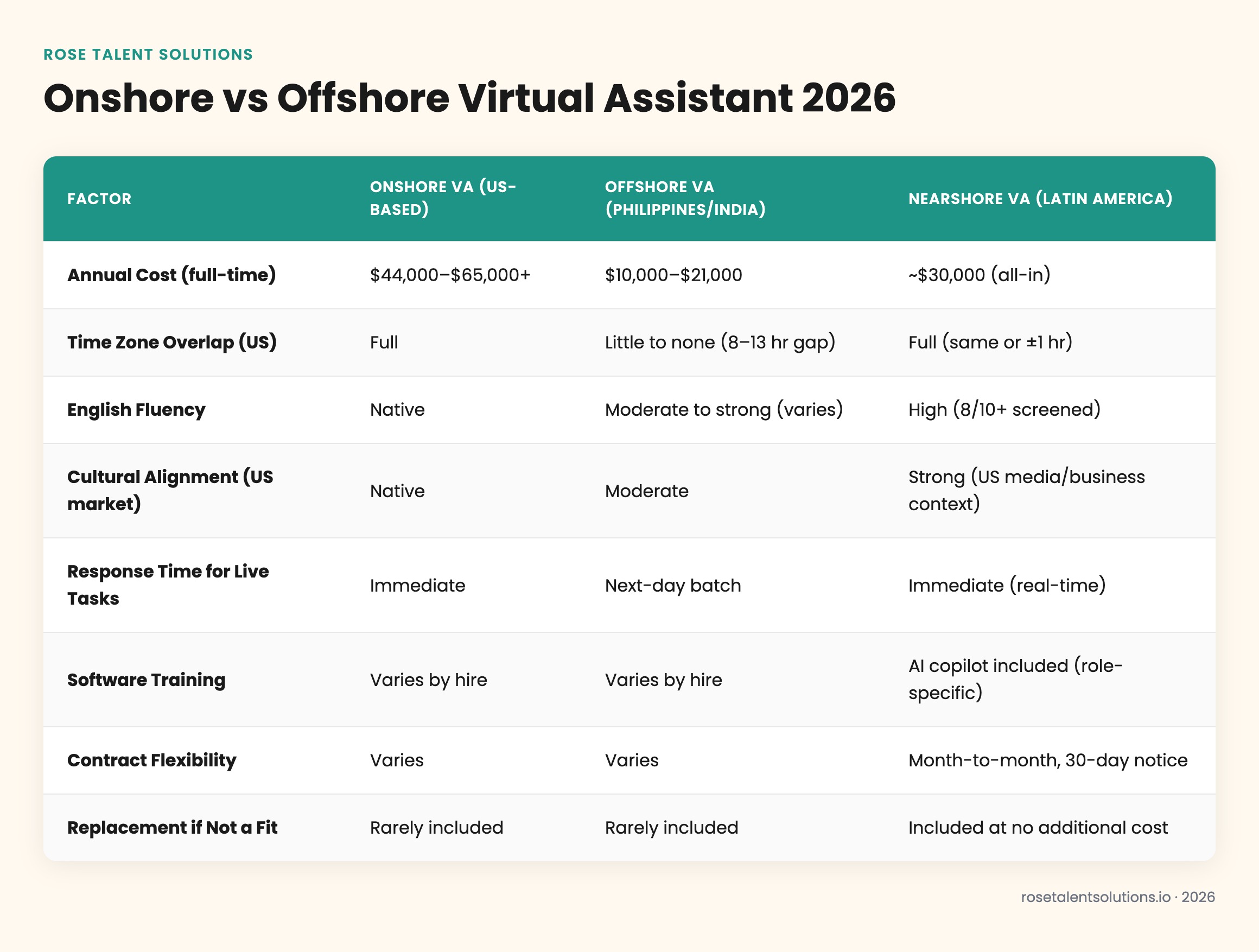
| Factor | Onshore VA (US-based) | Offshore VA (Philippines/India) | Nearshore VA (Latin America) |
|---|---|---|---|
| Annual Cost (full-time) | $44,000–$65,000+ | $10,000–$21,000 | ~$30,000 (all-in) |
| Time Zone Overlap (US) | Full | Little to none (8–13 hr gap) | Full (same or ±1 hr) |
| English Fluency | Native | Moderate to strong (varies) | High (8/10+ screened) |
| Cultural Alignment (US market) | Native | Moderate | Strong (US media/business context) |
| Response Time for Live Tasks | Immediate | Next-day batch | Immediate (real-time) |
| Software Training | Varies by hire | Varies by hire | AI copilot included (role-specific) |
| Contract Flexibility | Varies | Varies | Month-to-month, 30-day notice |
| Replacement if Not a Fit | Rarely included | Rarely included | Included at no additional cost |
How Timezone and Language Gaps Create Hidden Costs in 2026
The offshore model's cost advantage erodes fast once you account for the operational friction caused by an asynchronous workforce. Think through a typical day: a vendor calls with an urgent invoice question at 2pm EST. Your offshore VA won't see it until their morning — which is your midnight. By the time they respond, 18 hours have passed, and what should have been a five-minute resolution has now become a two-day thread.
Time-zone misalignment doesn't just slow tasks down — it removes your VA from the decision loop entirely for the hours that matter most to your customers and vendors. According to McKinsey & Company's Future of Work report (2021), proximity of working hours — not physical location — is the single strongest predictor of effective remote collaboration. That finding has only been reinforced by post-pandemic hybrid work data.
Language fluency is the second hidden cost. Offshore hubs vary widely in English proficiency. The EF English Proficiency Index (2024) ranks Latin American countries like Argentina, Costa Rica, and Colombia significantly higher in English proficiency than most Southeast Asian and South Asian offshore hubs typically used for VA services. Rose's published screening floor is 8/10+ on English proficiency — that's a documented, enforceable standard, not a vague marketing claim.
"When you're running operations that depend on clear written and verbal communication — whether that's coordinating with vendors, responding to clients, or managing internal workflows — fluency gaps don't just cause miscommunication. They destroy trust with the end customer." — Matthew Mottola, Future of Work Expert and Co-Author of The Human Cloud (2021)
The hidden cost of offshore VAs isn't the hourly rate — it's the 8–13 hour timezone gap that converts every real-time task into an overnight batch job, compounding delays across every client interaction and vendor relationship you have.

How Rose's Nearshore Model Is Built for 2026 Business Needs
Rose Talent Solutions is a nearshore staffing agency purpose-built for US, Canadian, and UK businesses that need real-time remote support without the cost of onshore hiring. Every team member is based in Latin America, works your business hours, and clears an English proficiency screen of 8/10 or higher before placement even begins.
The pricing is straightforward: $2,500/month flat for a full-time (40 hrs/week) dedicated team member. That rate includes recruiting, vetting, payroll, HR administration, and ongoing management. There are no add-on fees, no long-term contract required, and the engagement operates month-to-month with 30 days written notice to cancel. If the team member isn't the right fit, Rose replaces them at no additional cost — that's the risk reversal built into every engagement.
One differentiator that's genuinely rare in this space: every Rose team member ships with a role-specific AI copilot trained on their software stack. If you're in property management, your VA arrives already fluent in AppFolio or Buildium. If you need bookkeeping and accounting support, they're trained on QuickBooks workflows before day one. That's the AI advantage built into each placement — and it cuts ramp time significantly compared to a generic hire. According to SHRM's benchmarking data (2023), the average cost-per-hire for an administrative role in the US is $4,700 — before counting the 3–6 weeks of ramp time before the hire reaches full productivity.
Discovery Call
Rose's team maps your role, software stack, and working-hours requirements in a focused 30-minute intake. No generic intake form — this drives the match criteria directly.
Candidate Matching
Rose surfaces 1–3 pre-vetted candidates from its Latin America network who clear the English, skills, and software screens specific to your role. Typical turnaround: 5–7 business days.
Interview and Selection
You interview your shortlisted candidates, ask role-specific questions, and choose. Rose handles the offer, contracting, and HR paperwork on your behalf.
Onboarding with AI Copilot
Your new team member starts with a role-specific AI copilot already configured for your software. First-day orientation focuses on your workflows, not software basics.
Ongoing Support
Rose stays in the loop — managing HR, payroll, and performance support so you don't have to. If something isn't working, replacement is included at no additional cost.
Onshore vs Offshore Virtual Assistant: Who Should Choose Which in 2026?
The honest answer is that the onshore vs offshore framing is somewhat outdated. Most businesses evaluating this question in 2026 are really asking: "Can I get real-time, fluent, reliable remote support without paying domestic rates?" That question has a clear answer — and it isn't purely offshore.
There are specific scenarios where each model still makes sense. Onshore makes sense when your work requires legal US residency, security clearance, or in-person presence — roles that genuinely cannot be performed remotely from another country. Offshore makes sense when your workload is purely asynchronous, high-volume, and low-judgment: bulk data entry, overnight image processing, batch email categorization. For anything requiring live judgment, real-time client communication, or integration into a US-facing workflow, the offshore timezone gap is a real operational problem, not a minor inconvenience. You can explore what distinguishes these options in more depth in this overview of the nearshore virtual assistant model and what it's specifically designed to do.
Nearshore VA — Strengths
- Full US business hours overlap, real-time availability
- High English fluency (screened, documented floor)
- Strong cultural alignment with US business norms
- All-in flat pricing with no hidden HR or payroll overhead
- Role-specific AI copilot reduces ramp time from weeks to days
- Month-to-month flexibility with free replacement if not a fit
Nearshore VA — Limitations
- Not suited for roles requiring US legal residency or physical presence
- Slightly higher cost floor than the cheapest offshore options
- Requires same level of onboarding investment as any remote hire
If you're ready to stop debating the model and just get a qualified team member placed, the fastest path is to start your search with Rose — the intake takes under 30 minutes and typical placement runs 5–7 business days from discovery call to first day.