
Why Cybersecurity SaaS Companies Struggle to Fill Their Calendars in 2026
Nearshore appointment setters are quietly becoming the unfair advantage for cybersecurity SaaS teams that need pipeline without headcount bloat. If you're selling endpoint protection, SIEM tools, compliance automation, or identity management to mid-market IT buyers, you already know the problem: your account executives are world-class closers who spend 40% of their week on prospecting tasks a skilled virtual assistant could handle for a fraction of the cost. That gap is exactly what a dedicated nearshore appointment setting service fills.
Cybersecurity SaaS is one of the most competitive categories in B2B software. CISOs and IT directors receive dozens of cold outreach attempts per week. Breaking through requires persistence, personalization, and — critically — someone available during US business hours who can follow up within minutes of a prospect opening an email or clicking a link. A team member working an asynchronous overnight shift on the other side of the world cannot do that reliably.
That 57% figure matters because follow-up cadence is where most cybersecurity SaaS pipeline dies. Your AEs have the product knowledge to close; they don't have the bandwidth to run eight-touch sequences across 300 prospects simultaneously. A nearshore appointment setting VA, working full-time on your CRM and outreach tools, can. According to RAIN Group (2024), 80% of sales require at least five follow-up contacts — yet 44% of salespeople give up after just one.
What Is an Appointment Setting Service for Cybersecurity SaaS? (Definition)
An appointment setting service for cybersecurity SaaS companies is a dedicated outbound function — handled by a trained specialist — that identifies qualified IT and security decision-makers, runs multi-channel outreach sequences, handles objections, and books discovery calls directly onto your AEs' calendars. The setter does not close deals; they fill the top of the funnel with meetings that match your ideal customer profile.
In the context of cybersecurity SaaS, "qualified" means the prospect has the authority to evaluate security tools, sits inside your target company size range, and has expressed at minimum passive interest — an email open, a LinkedIn profile visit, or a webinar attendance. A good appointment setter knows the difference between a gatekeeper and a genuine champion, and they are trained to speak the language of security buyers without over-engineering the pitch.

When you work with a nearshore staffing agency like Rose Talent Solutions, the $2,500/month flat rate covers recruiting, vetting, payroll, HR, and ongoing management — not just the setter's time. Compare that to a US-based SDR, which costs $60,000–$80,000 per year in base salary alone before you add benefits, recruiting fees, and management overhead, according to the U.S. Bureau of Labor Statistics (2024).
How Nearshore Appointment Setters Outperform Other Models for SaaS Pipeline in 2026
The timezone question is non-negotiable for cybersecurity SaaS sales. Your prospects are IT directors and CISOs working 9-to-5 in Chicago, New York, Dallas, or San Francisco. They do not respond to emails sent at 2am their time and followed up with a call at 7am. Team members working from distant time zones with a 10–13 hour gap are structurally disadvantaged for real-time US outreach — regardless of geography — because the windows simply do not overlap.
Nearshore team members, based in Latin America, work the same business hours as your buyers. When a CISO clicks your cold email at 10:47am EST, your setter can call within four minutes. That speed-to-response multiplier is the single biggest variable in outbound conversion rates. Harvard Business Review (2011, still the most cited study on the subject) found that companies responding to web leads within one hour were seven times more likely to qualify the lead than those that waited even 60 minutes.
"Speed to lead is the most underrated variable in B2B SaaS outbound. The companies winning in 2025 aren't the ones with the best pitch — they're the ones who call back in under five minutes." — Jason Lemkin, Founder at SaaStr (2024)
Beyond timezone, English fluency is a genuine differentiator in cybersecurity sales. Security buyers use precise technical vocabulary — "zero-trust architecture," "SOC 2 Type II," "SIEM integration" — and a setter who stumbles on that language loses credibility instantly. Rose screens every team member at an 8/10 or higher English proficiency floor, specifically because it matters in high-stakes B2B calls. If you want to understand the full nearshore vs. other staffing model trade-offs, that comparison is worth reading before you make a hiring decision.
Comparing Your Appointment Setting Options for Cybersecurity SaaS in 2026
| Option | Monthly Cost | Timezone Fit (US) | English Fluency | CRM/Tool Proficiency | Ramp Time |
|---|---|---|---|---|---|
| Nearshore VA (Rose) | $2,500 flat, all-in | ✅ Same hours | ✅ 8/10+ screened | ✅ AI copilot on HubSpot, Salesforce, Apollo, Outreach | ~1–2 weeks |
| Far-timezone VA (10–13 hr gap) | $800–$1,500/mo | ❌ Overnight hours only | ⚠️ Variable, unscreened | ⚠️ Self-reported, unverified | 3–6 weeks |
| US In-House SDR | $6,000–$8,000/mo (all-in) | ✅ Same hours | ✅ Native | ⚠️ Requires training investment | 6–12 weeks |
| SDR Agency (outsourced) | $5,000–$15,000/mo | ✅ Usually US-based | ✅ Native | ✅ Usually tool-equipped | 4–8 weeks |
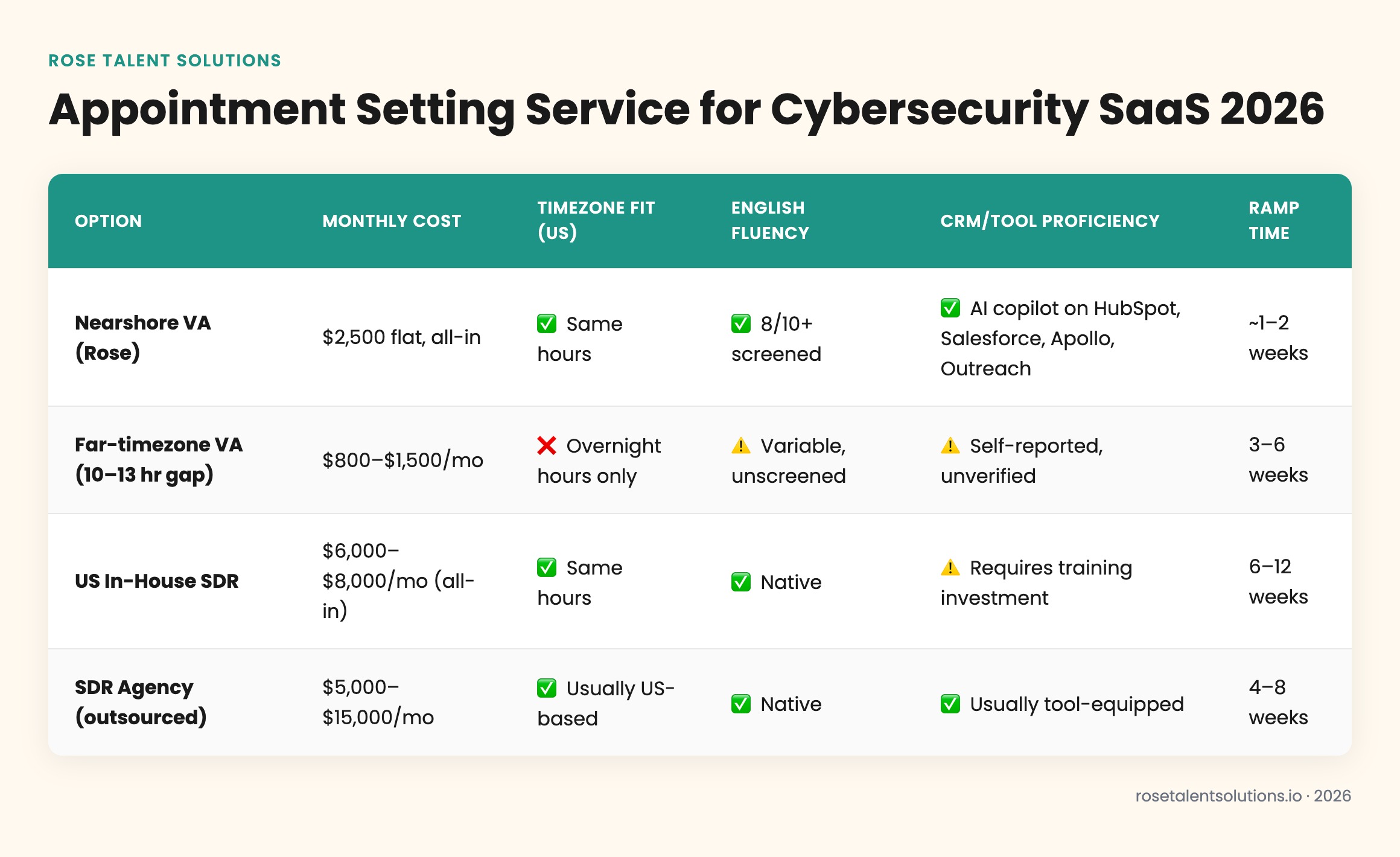
The table makes the value equation clear. A nearshore VA at $2,500/month is roughly one-third the fully-loaded cost of a US SDR, works your exact business hours, and arrives with a role-specific AI copilot trained on the tools your team already uses. If you are evaluating multiple providers, this breakdown of the best nearshore VA companies in 2026 covers what differentiates serious agencies from gig-style marketplaces.
What Does a Cybersecurity SaaS Appointment Setting VA Actually Do Day-to-Day?
Scope clarity is where most hiring decisions go wrong. Companies hire an appointment setter and then hand them a vague mandate to "get meetings." High-performing setters work from a defined playbook. Here is what a full-time nearshore appointment setting VA typically owns for a cybersecurity SaaS company:
- ICP prospecting: Building and enriching lead lists of CISOs, IT Directors, VP of Security, and compliance officers using tools like Apollo.io, ZoomInfo, or LinkedIn Sales Navigator.
- Multi-channel sequencing: Running structured email + LinkedIn + call sequences with 6–10 touchpoints per prospect, personalized to their company's tech stack or recent security news.
- Objection handling: Responding to "send me more info" and "we already have a vendor" replies with trained responses designed to keep the conversation alive.
- Calendar management: Booking confirmed discovery calls into AE calendars via Calendly, HubSpot Meetings, or Chili Piper, with automated reminders to reduce no-shows.
- CRM hygiene: Logging every touchpoint in HubSpot or Salesforce so your pipeline data stays clean and reportable.
- Performance reporting: Sending a weekly summary of dials, emails sent, reply rates, meetings booked, and no-show rate to your sales manager.
Cybersecurity buyers are unusually skeptical of cold outreach — they spend their careers defending against social engineering. Your appointment setter needs to open with relevance (a real security event, a mutual connection, a known compliance deadline) rather than a generic pitch. This is why tool proficiency and industry context matter more in cybersecurity SaaS than in most other verticals.
According to Gartner (2023), B2B buyers now spend only 17% of their total purchase journey meeting with potential suppliers — and when comparing multiple vendors, individual supplier meetings drop to roughly 5% of buying time. That means your setter's job isn't just booking a call; it's booking the right call, with the right framing, at the right stage of the buyer's internal decision process.

How Rose's AI Copilot Makes Cybersecurity SaaS Appointment Setters Faster in 2026
Every Rose team member ships with a role-specific AI copilot trained on the tools and workflows relevant to their function. For an appointment setting VA in cybersecurity SaaS, that means the AI is pre-configured to assist with sequence personalization inside HubSpot or Outreach, draft objection-handling responses, surface intent signals from tools like 6sense or Bombora, and flag prospects whose LinkedIn activity suggests active vendor evaluation.
This is not a generic ChatGPT wrapper. The AI advantage built into every Rose placement is scoped to the specific software stack your setter will use on day one. The practical result is that your VA ramps faster, makes fewer data entry errors, and produces higher-quality personalization at volume — without you having to build the enablement infrastructure yourself.
The salary math also tends to surprise operators. A full-time nearshore setter in Latin America earns a competitive local market wage that reflects genuine purchasing power parity differences — not a race to the bottom. You can explore what Latin American VA compensation actually looks like to understand why the model works economically for both sides.
How to Get Started with a Nearshore Appointment Setting Service for Cybersecurity SaaS
Define Your ICP and Outreach Stack
Before Rose matches you with a setter, get clear on your ideal customer profile (company size, vertical, tech stack, compliance requirements) and which tools your setter will use — HubSpot, Salesforce, Apollo, Outreach, etc. This scoping takes 30 minutes and cuts ramp time in half.
Submit Your Role Brief
Rose's team reviews your requirements and matches candidates from its vetted Latin America talent pool. You'll see profiles within days, not weeks — the average time to first placement is approximately seven days.
Interview and Select Your Setter
You interview shortlisted candidates and choose the best fit. Rose handles the employment paperwork, payroll, and HR from day one — you pay one flat $2,500/month invoice.
Onboard and Launch Sequences
Your setter joins your Slack, gets CRM access, reviews your playbook, and typically runs their first outbound sequence within the first week. The AI copilot is active from day one.
Scale or Adjust Risk-Free
Rose's engagement is month-to-month with no long-term contract. If the team member isn't the right fit, Rose replaces them at no additional cost — that is the only risk reversal you need.
The month-to-month, no long-term contract structure is genuinely important for early-stage cybersecurity SaaS companies. Your headcount needs at Series A look nothing like they do at Series B. You should not be locked into a 12-month SDR agency retainer when your ICP or go-to-market motion might pivot in Q3. Flexibility is a feature, not a footnote. You can start the matching process here with a brief intake form.
Why Nearshore Appointment Setting Works for Cybersecurity SaaS
- Real-time US hours — setters respond to intent signals within minutes, not overnight
- 8/10+ English fluency — credible on the phone with skeptical CISOs and IT Directors
- AI copilot pre-trained on HubSpot, Salesforce, Apollo, Outreach from day one
- $2,500/month all-in — recruiting, HR, payroll, management included
- No long-term contract — month-to-month with free replacement if not a fit
Where to Set Realistic Expectations
- Your setter is not a closer — they book meetings, your AE owns the demo and deal
- You still need to provide a clear ICP, messaging guide, and CRM access
- Pipeline ramp takes 30–60 days of sequence data before conversion rates stabilize
- Not a fit if you need a setter who also handles enterprise contract negotiation or solution engineering
According to McKinsey & Company (2023), B2B companies that added dedicated inside sales or appointment setting resources grew pipeline velocity 2–3x faster than those relying solely on AE-led prospecting. For cybersecurity SaaS companies competing in a crowded market, that velocity difference is often the margin between hitting and missing quarterly targets.
If you are evaluating whether a dedicated setter is the right next hire versus expanding your AE team, the math usually favors the setter first. One AE can only close as many deals as the pipeline allows. A nearshore appointment setter at $2,500/month — less than the cost of one week of a US SDR's fully-loaded compensation — can fill that pipeline and let your AEs do the work they were actually hired to do. Explore the full cost and performance comparison across staffing models to stress-test the numbers for your specific situation.