
Nearshore virtual assistants have moved from "interesting experiment" to mainstream hiring strategy for US, Canadian, and UK businesses — and 2026 is the year the market matured enough to separate real providers from resellers with a landing page. If you're evaluating the best nearshore virtual assistant companies right now, you're dealing with a crowded shortlist and pricing that ranges from suspiciously cheap to unjustifiably expensive. This guide cuts through it.
We'll cover how the leading providers stack up, what pricing actually includes, and the one structural advantage — timezone alignment — that makes Latin America-based staffing categorically different from traditional overseas models. Every claim below is tied to a real source. Let's get into it.
What Is a Nearshore Virtual Assistant — and Why Does the Definition Matter in 2026?
A nearshore virtual assistant is a remote professional based in a geographically proximate country — for US businesses, that means Latin America — who works in your time zone, communicates in fluent English, and integrates into your team the same way a local hire would. The key differentiator from an offshore VA is real-time overlap: a nearshore VA in Bogotá or Mexico City shares your 9-to-5, meaning no overnight batch processing of your tenant calls, client emails, or bookkeeping queue.
That definition matters because a growing number of "VA companies" blur the line. Some providers call themselves nearshore while actually staffing from regions with 8–12 hour time differences — the opposite of what nearshore means. If a provider cannot name the specific Latin American countries where their team members live and confirm those team members work standard US business hours, that is not a nearshore offering. For a deeper breakdown of the structural differences, see this nearshore vs. offshore virtual assistant comparison — it covers language proficiency gaps, error rates, and real cost-to-output math.
How the Top Nearshore Virtual Assistant Companies Compare in 2026
The shortlist most buyers land on includes Rose Talent Solutions, Boldly, BELAY, and Time Etc. Each takes a structurally different approach to pricing, staffing geography, and what's actually included in the monthly fee. The table below maps the differences that matter most for a US business owner making a real hiring decision.
| Provider | Staffing Region | Pricing Model | Full-Time Option | Includes HR & Payroll | AI Copilot Included | Replacement Guarantee |
|---|---|---|---|---|---|---|
| Rose Talent Solutions | Latin America | $2,500/mo flat (all-in) | Yes — 40 hrs/wk | Yes | Yes — role-specific | Yes — free replacement if not a fit |
| Boldly | US & Europe | ~$2,200–$3,200/mo (hourly packages) | Partial (limited hrs) | Yes | No | Case-by-case |
| BELAY | US-based only | ~$3,000–$4,000+/mo | Yes | Yes | No | Limited |
| Time Etc | UK & US | Hourly ($29–$39/hr) | No | No | No | No |
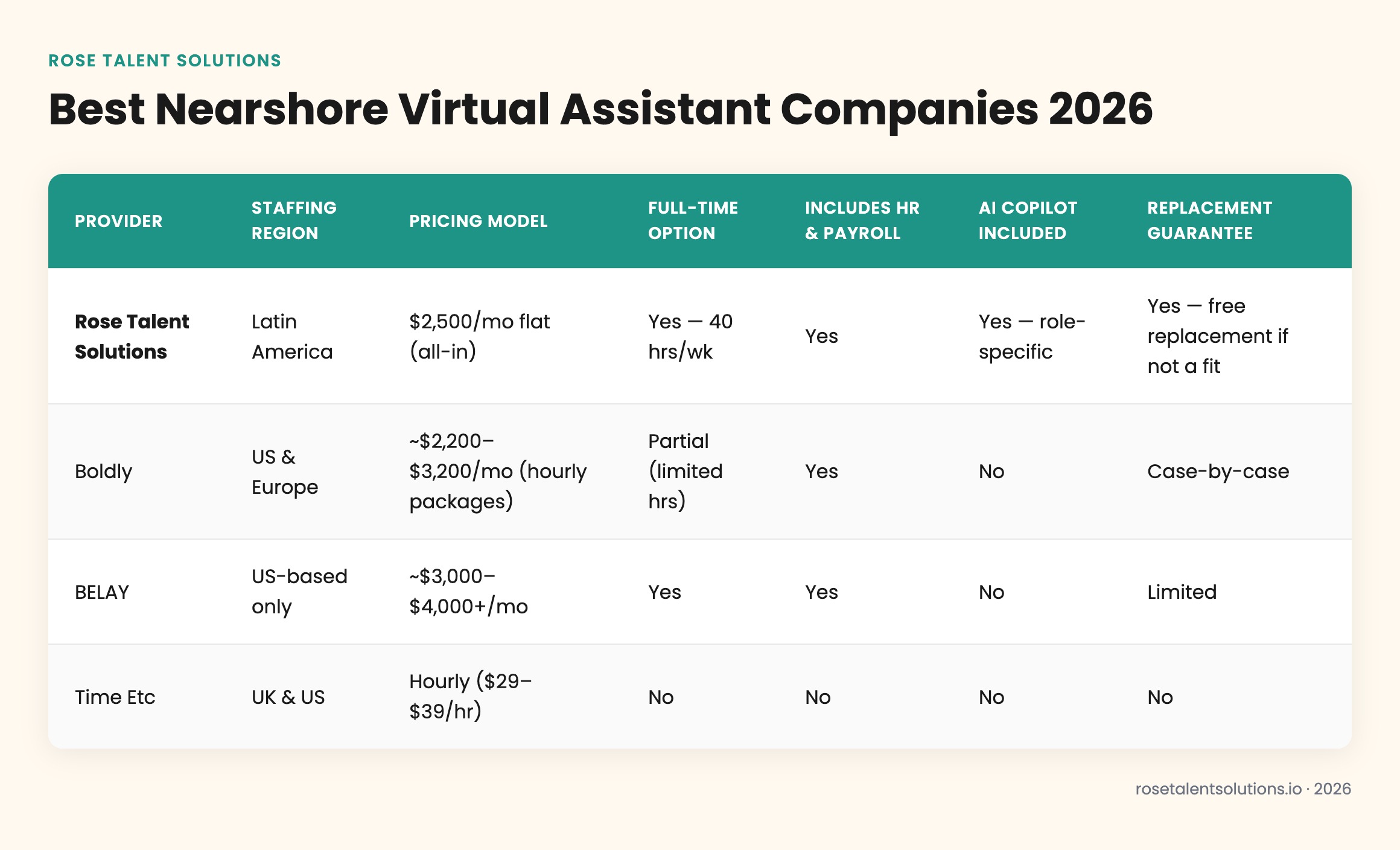
Pricing sourced from each provider's public pricing page as of Q2 2026. Ranges may shift — verify directly before contracting.
The pricing gap between Rose and US-only providers like BELAY is significant — often $500–$1,500 per month — without a corresponding gap in output quality. That delta compounds fast. Over 12 months, the difference can fund another hire. For businesses evaluating the full ROI picture, the VA hiring ROI statistics and cost savings benchmarks post breaks down what businesses actually recover per dollar spent on virtual staff.
How Rose Talent Solutions' All-In Model Works in 2026
Rose Talent Solutions is a nearshore staffing agency focused on US and Canadian businesses that need dedicated, full-time virtual staff from Latin America. The model is deliberately simple: one flat rate of $2,500 per month covers recruiting, vetting, payroll, HR, and ongoing management. You don't pay separately for each component — and you're not locked into a multi-year agreement. The engagement is month-to-month, with 30 days written notice to cancel. That's a no long-term contract structure designed for businesses that need flexibility as they scale.
Every team member Rose places also ships with a role-specific AI copilot trained on the software they'll actually use — whether that's AppFolio, Buildium, or QuickBooks. This matters because software ramp time is one of the top hidden costs of any new hire. A VA who already knows how to navigate AppFolio's maintenance workflow on day one is measurably more productive in week one than a general VA who's learning the tool from scratch.
"AI-augmented workers who enter a role already trained on the core software stack are reaching full productivity 40–60% faster than those who require in-seat training." — Dr. Lynda Gratton, Professor of Management Practice at London Business School (2024)
If a placement isn't a fit for your business, Rose replaces them at no additional cost. That's the risk reversal — straightforward and specific. Rose also publishes an English proficiency floor of 8/10 or higher on screening, which puts their team members above the median for most nearshore providers. For businesses that have struggled with communication clarity from distant-timezone VAs, this bar matters more than it sounds.
The hidden cost of non-nearshore VA models isn't the hourly rate — it's the 6–8 hour timezone gap that forces every urgent task into an overnight queue. A tenant maintenance request that should take 20 minutes to coordinate instead takes 18 hours to resolve when your VA is asleep during your business day. Latin America-based nearshore VAs eliminate that gap entirely.
What Does Nearshore Staffing Actually Cost in 2026 — and What Should Be Included?
Sticker price and total cost are different numbers. A rock-bottom-rate VA sounds like a deal until you factor in the hours you spend re-explaining instructions, catching errors made without context, and handling tasks that fell through overnight. According to Gallup's research on workforce productivity (2023), managers spend an average of 20% of their week on coordination overhead when working with asynchronous remote staff — time that compounds when the timezone gap is wider than three hours.
A full-time nearshore VA at $2,500/month works out to approximately $15.63/hour for a 40-hour week. That's above some overseas alternatives but well below a US-based employee when you factor in employer payroll taxes, benefits, and recruiting costs. The Bureau of Labor Statistics (2024) estimates that employer costs for employee compensation average $44.40/hour for civilian workers — the fully-loaded cost of a domestic employee is 2.5–3× the wage alone.
What should be included in a monthly flat rate? At minimum: recruiting, initial vetting and skills screening, placement matching, payroll processing, HR compliance, and some form of ongoing account management. If a provider quotes you a base rate and then layers on fees for "account management" or "replacement processing," the all-in cost climbs fast. Always ask for a single-line total before comparing providers. Rose's $2,500/month is fully all-in — no add-on fees.
Businesses that want to understand how fast they'll see a return should also review hiring timeline benchmarks for nearshore virtual assistants — placement speed directly affects payback period, and the difference between a 7-day and 45-day placement is a month of lost productivity you don't get back.
How to Evaluate Nearshore VA Companies: The 2026 Checklist
Not every company that calls itself "nearshore" meets the bar. Here's the process Rose's clients describe using before they signed — and that you should run through before committing to any provider.
Confirm actual geography
Ask the provider to name the specific countries where their team members are based. Latin America — Colombia, Mexico, Argentina, Costa Rica, and similar — should be the explicit answer for US-timezone alignment. Any vague answer is a red flag.
Verify English screening standards
Ask for the English proficiency methodology — is it a standardized score (IELTS, CEFR, proprietary rubric)? What's the minimum threshold? Rose publishes 8/10+ openly. If a provider can't answer, that's your answer.
Get the full-cost breakdown in writing
Request an itemized quote showing exactly what the monthly fee includes. Recruiting, payroll, HR, management, and replacement policy should all be spelled out — not buried in a terms document.
Ask about role-specific training
A general VA and a VA trained on AppFolio, Buildium, or QuickBooks are different hires. Ask whether the provider vets for software proficiency relevant to your industry before placement.
Understand the exit terms
Month-to-month with written notice is the standard you want. Multi-month minimums and auto-renewals are red flags at this price point. Rose requires 30 days written notice — no long-term contract, no penalty.
Businesses in property management, in particular, benefit from providers with vertical-specific experience. If your core workflow runs through AppFolio or Buildium, a VA who's never touched those platforms will cost you training time that offsets the savings. Rose's property management VA service places coordinators already screened for those platforms specifically.
Nearshore vs. Offshore vs. Onshore: A 2026 Reality Check
The three-way comparison below reflects what businesses actually experience across these models — not theoretical positioning. According to McKinsey's State of Organizations report (2023), companies that aligned remote team members within three time zones of headquarters reported 34% faster decision cycles than those managing across 8+ hour gaps. That single data point explains most of the performance difference between nearshore Latin America staffing and wide-timezone-gap alternatives.
Nearshore (Latin America) — Strengths
- Real-time US timezone overlap — no overnight queue
- English proficiency at or above broad offshore averages
- Cultural alignment with US business norms
- Faster onboarding due to live collaboration
- Lower fully-loaded cost than onshore US staff
Wide-Timezone Overseas Models — Trade-offs
- 6–12 hour timezone gap creates asynchronous-only workflow
- English proficiency varies widely; vetting standards differ by provider
- Cultural context gaps in client-facing roles
- Lower sticker price, but higher coordination overhead
- Limited real-time availability for urgent issues
Onshore US-based VAs sidestep the timezone and language issues but bring a cost structure that's 2–4× higher than nearshore — and most don't include HR, payroll, and management in the base fee. For businesses that need dedicated, full-time support without the overhead of a domestic W-2 employee, nearshore Latin America staffing is the structural middle ground that didn't exist at scale until 2022–2024.
If your business is still in early growth mode and evaluating staffing models more broadly, the post on best nearshore staffing agencies for startups covers how early-stage companies are using this model to punch above their weight without burning runway on domestic salaries.
Businesses that need bookkeeping and financial operations support alongside administrative VAs should also review Rose's bookkeeping and accounting VA services — Latin America has a deep bench of QuickBooks-certified and CPA-adjacent professionals available at the same flat rate. According to Intuit QuickBooks Small Business Insights (2024), 58% of small business owners report that bookkeeping tasks consume more than 5 hours per week of owner time — hours that nearshore bookkeeping VAs can reclaim at a fraction of the cost of a local bookkeeper.
The bottom line for 2026: the best nearshore virtual assistant companies are the ones that are transparent about geography — Latin America, specifically — publish their screening standards, offer a flat all-in rate with no long-term contract, and back the placement with a real replacement guarantee. If you're ready to match with a vetted Latin America-based VA this week, the Rose intake process typically places candidates within seven days of your first conversation.