
Nearshore virtual assistants have quietly become the default choice for growth-stage US businesses that need real operational support — not just task execution at odd hours. Yet "virtual assistant" still gets lumped into one category, when in reality the nearshore vs offshore vs onshore virtual assistant complete comparison shows that the hiring model you choose determines your timezone overlap, communication quality, legal exposure, and total cost more than any other single variable. This guide breaks down all three models with real numbers so you can make the right call for 2026.
What Is a Nearshore, Offshore, or Onshore Virtual Assistant? 2026 Definitions
An onshore virtual assistant is based in the same country as your business — typically the US, Canada, or UK. They share your timezone and culture completely, but command the highest pay rates, often $25–$60/hour or more depending on specialization, according to U.S. Bureau of Labor Statistics (2024) wage data for secretarial and administrative roles.
An offshore virtual assistant is based in a distant region — most commonly the Philippines, India, or Eastern Europe. Hourly rates can be as low as $5–$12, but the tradeoff is a 10–14 hour timezone gap from US Eastern time, which means most real-time collaboration happens asynchronously, or someone is working at an uncomfortable hour.
A nearshore virtual assistant is based in Latin America — countries like Colombia, Mexico, Costa Rica, or Argentina — and works during standard US business hours. The timezone gap is typically 0–3 hours from any US timezone, English proficiency is high, and monthly costs fall solidly between offshore and onshore rates. The nearshore vs offshore vs onshore virtual assistant complete comparison is not abstract — the model you pick shapes every interaction your VA has with your clients, vendors, and team. For a deeper look at how the nearshore model stacks up specifically against offshore, the nearshore vs. offshore virtual assistant breakdown on the Rose blog covers the nuances in detail.
How Nearshore, Offshore, and Onshore VAs Compare on Cost in 2026
Cost is the first number every business owner asks about, and the range across models is enormous. Onshore VAs in the US start around $3,500–$5,000/month for a full-time, 40-hour-per-week hire when you factor in wages, payroll taxes, benefits, and recruiting fees. At the high end — think experienced executive assistants or bookkeepers in major metros — you're looking at $6,000–$9,000/month all-in. That's before turnover costs, which SHRM (2024) estimates at 50–200% of annual salary for professional roles.
Offshore VAs often advertise $500–$1,200/month, but the true cost is harder to calculate. You typically pay platform fees, deal with higher turnover, and absorb the hidden productivity loss of delayed responses. If a tenant maintenance issue comes in at 10am EST and your offshore coordinator is asleep, that response sits for 8 hours. In property management, leasing, or client-facing services, that lag has real dollar consequences.
Nearshore VAs sit in the $1,800–$3,000/month range for managed placements. At Rose Talent Solutions, the rate is a flat $2,500/month — full-time, 40 hours per week, with recruiting, vetting, payroll, HR, and ongoing management all included. No hidden per-task fees, no platform markups. If you want to understand exactly what drives nearshore pricing, the 2026 nearshore VA cost guide walks through every line item.

How Timezone Overlap Determines Whether Your VA Model Actually Works in 2026
Timezone is the most underrated variable in the nearshore vs offshore vs onshore virtual assistant complete comparison. It determines whether your VA is a real team member or an asynchronous inbox processor. The difference sounds administrative — it's actually operational.
Consider a property management company handling 200 units. Leasing inquiries, maintenance coordination, vendor calls, and owner updates all happen between 8am and 6pm local time. An onshore VA handles all of that in real-time. A nearshore VA in Medellín, Colombia (EST–1) handles it just as well — they're at their desk when your tenants call. An offshore VA in Manila (EST+13) is asleep for most of that window.
The hidden cost of offshore VAs isn't the hourly rate — it's the 10–14 hour timezone gap that turns every real-time decision into an overnight queue. For any client-facing or operations-heavy role, that lag compounds daily into missed leads, delayed resolutions, and frustrated clients.
According to Gallup's workplace research (2023), employees who feel connected to their team in real-time report 17% higher productivity and significantly lower turnover intent. That holds true for remote and virtual workers. Nearshore VAs, because they share your hours and cultural touchpoints, integrate faster and stay longer.
"The biggest mistake companies make when offshoring is underestimating the coordination tax. Every hour of timezone gap adds friction — to handoffs, to escalations, to trust-building. Nearshore models exist precisely to eliminate that tax." — Everett Harper, CEO at Truss (2023)
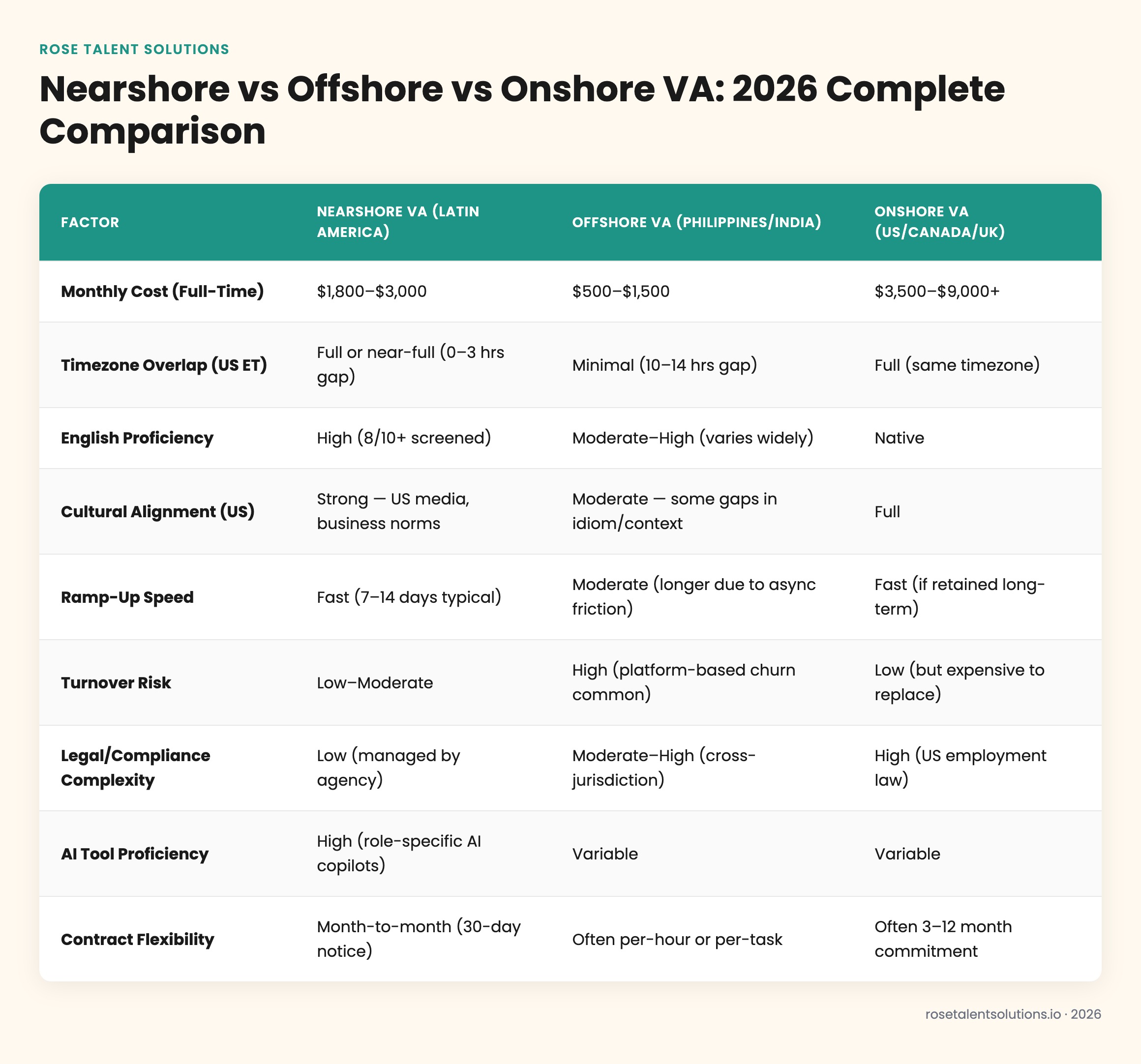
Nearshore vs Offshore vs Onshore VA: 2026 Side-by-Side Comparison Table
The table below scores each model across the dimensions that matter most for US, Canadian, and UK businesses hiring virtual staff in 2026. Use it as a quick reference — this is the core of any nearshore vs offshore vs onshore virtual assistant complete comparison — before diving into the nuances of your specific role type.
| Factor | Nearshore VA (Latin America) | Offshore VA (Philippines/India) | Onshore VA (US/Canada/UK) |
|---|---|---|---|
| Monthly Cost (Full-Time) | $1,800–$3,000 | $500–$1,500 | $3,500–$9,000+ |
| Timezone Overlap (US ET) | Full or near-full (0–3 hrs gap) | Minimal (10–14 hrs gap) | Full (same timezone) |
| English Proficiency | High (8/10+ screened) | Moderate–High (varies widely) | Native |
| Cultural Alignment (US) | Strong — US media, business norms | Moderate — some gaps in idiom/context | Full |
| Ramp-Up Speed | Fast (7–14 days typical) | Moderate (longer due to async friction) | Fast (if retained long-term) |
| Turnover Risk | Low–Moderate | High (platform-based churn common) | Low (but expensive to replace) |
| Legal/Compliance Complexity | Low (managed by agency) | Moderate–High (cross-jurisdiction) | High (US employment law) |
| AI Tool Proficiency | High (role-specific AI copilots) | Variable | Variable |
| Contract Flexibility | Month-to-month (30-day notice) | Often per-hour or per-task | Often 3–12 month commitment |
How AI-Equipped Nearshore VAs Are Changing the Productivity Equation in 2026
The VA market has shifted dramatically since 2023. AI copilots trained on specific software platforms have made a measurable difference in how fast new hires become productive. At Rose, every virtual team member is placed with a role-specific AI copilot trained on the software they'll actually use — AppFolio, Buildium, QuickBooks, and similar platforms. That's not a marketing claim; it's a structural advantage that compresses ramp time from weeks to days.
A McKinsey Global Institute report found that generative AI tools can boost knowledge worker productivity by 20–45% depending on role complexity (McKinsey, 2023). For virtual assistants handling repetitive-but-critical tasks — lease renewals, invoice coding, maintenance ticket triage — that multiplier is achievable from week one when the AI is already configured for their workflow.
This is where nearshore VAs have a structural edge over offshore in the onshore virtual assistant complete comparison. Because they're working the same hours as your team, they can use AI tools collaboratively — asking questions in real time, iterating on outputs with you in Slack or Teams, and escalating exceptions immediately rather than queueing them. The AI copilot advantage Rose builds into every placement is designed specifically for this real-time workflow. You can also explore role-specific placements for bookkeeping and accounting or property management coordination if you have a specific function in mind.

How to Choose Between Nearshore, Offshore, and Onshore in 2026: A Decision Framework
The right model depends on the role, your workflow, and your tolerance for coordination overhead. Here's a practical five-step framework used across hundreds of VA placements — the same logic that makes the nearshore vs offshore vs onshore virtual assistant complete comparison useful in practice, not just on paper.
Identify Real-Time Requirements
List every task your VA will own. If more than 30% require live client or tenant interaction during US business hours, offshore is structurally incompatible. Nearshore or onshore are your only real options.
Set Your True Budget (All-In)
Don't compare hourly rates — compare total monthly cost including platform fees, employer taxes, benefits, and management overhead. Nearshore managed placements often beat DIY offshore when full cost is counted.
Score English Proficiency Requirements
If your VA will write client-facing emails, handle phone calls, or join video calls, set a minimum proficiency standard (Rose's floor is 8/10). Ask any agency how they test and what the floor is.
Evaluate Flexibility vs. Commitment
Onshore hires are expensive to unwind. Offshore platform VAs churn unpredictably. Nearshore managed placements with month-to-month terms and no long-term contract give you the most flexibility at a predictable price.
Check the Replacement Policy
What happens if the placement isn't a fit? Rose replaces the team member at no additional cost — no restart fees, no new recruiting charges. That guarantee changes the risk calculation fundamentally.
If you want to see how specific nearshore agencies stack up before committing, the best nearshore virtual assistant companies for 2026 comparison covers the top providers with real criteria. And once you've made a decision, the 30-day nearshore VA onboarding guide will help you structure the first month so your new hire is fully productive by week three.
Nearshore VA Pros and Cons vs. Offshore and Onshore in 2026
No model is perfect. Here's an honest accounting of nearshore advantages and the real limitations to plan around — because understanding the tradeoffs is how you set your VA up to succeed rather than blaming the model when friction emerges.
Nearshore VA: Pros
- Full US business hour coverage — live collaboration, not async queues
- Strong English fluency with Latin American cultural alignment to US business norms
- Predictable flat-rate pricing — no per-task or per-hour surprises
- Fast ramp time with AI copilots pre-trained on your software stack
- Month-to-month terms with no long-term contract required
- Free replacement if the team member isn't a fit
Nearshore VA: Cons
- Higher monthly cost than offshore-only platforms ($500–$1,500/mo range)
- Smaller total talent pool than offshore markets like Philippines or India
- Requires a structured onboarding investment — nearshore isn't "set and forget"
According to Statista's global outsourcing market data (2024), the outsourcing industry exceeded $700 billion globally, with nearshore delivery growing at a faster clip than traditional offshore as real-time collaboration demands increased. The trend is structural, not a fad — US businesses are repricing the value of timezone alignment as remote-first operations mature.
Ready to move from comparison to action? The fastest path is to start your Rose placement — the process takes about 7 days from brief to first shift, with a flat $2,500/month rate, no long-term contract, and a free replacement guarantee if the fit isn't right.
The bottom line: for US businesses with client-facing operations, real-time workflows, or software-heavy roles, nearshore beats offshore on productivity and beats onshore on cost. The nearshore vs offshore vs onshore virtual assistant complete comparison isn't close when you count all the variables — timezone alignment, English fluency, AI-equipped ramp time, and pricing transparency all point in the same direction.