
What Is Pay for Performance Appointment Setting — and Why ERP SaaS Teams Want It in 2026?
Nearshore appointment setters are reshaping how ERP SaaS companies fill their sales pipelines in 2026. Before you sign with a pay-for-performance agency — or assume commission-only is always the smarter model — it's worth understanding exactly what you're buying and what you're giving up.
Pay for performance appointment setting is a sales development arrangement where the vendor is compensated only when a qualified meeting is booked and held — not for emails sent, calls logged, or sequences completed. For ERP SaaS companies, where average deal cycles run six to twelve months and a single enterprise logo can be worth $200,000 or more in ARR, the logic seems airtight: why pay for activity when you can pay for outcomes?
The appeal is obvious. You eliminate the fixed cost of a full-time SDR, shift risk to the vendor, and theoretically align incentives. But the model has structural flaws that matter specifically in the ERP space — flaws that a flat-rate nearshore VA model often sidesteps entirely. According to Gartner (2024), the average SDR ramp time in complex B2B software categories is now 4.2 months, meaning commission-only reps have a powerful incentive to book warm bodies rather than qualified enterprise buyers.
ERP SaaS is not a volume game. Buyers are CFOs, IT directors, and operations VPs evaluating platforms like NetSuite, Acumatica, Sage Intacct, or Microsoft Dynamics. Getting a low-intent contact to accept a calendar invite is not the same as getting a qualified buyer to show up ready to evaluate. That distinction is where pay-for-performance models quietly break down — and where a dedicated, trained nearshore SDR consistently wins.
How Pay-for-Performance Agencies Actually Price ERP SaaS Appointments in 2026
Most pay-for-performance appointment setting agencies charge between $300 and $800 per held, qualified meeting in the ERP SaaS category. At first glance, that sounds cheaper than a full-time SDR. Do the math over a month and it often isn't. If your team needs 10 qualified meetings per month to hit pipeline targets — a conservative number for a mid-market ERP team — you're looking at $3,000 to $8,000 per month, plus the hidden cost of defining, debating, and enforcing the "qualified" standard with a vendor whose incentives run opposite to yours.
Pay-for-performance agencies also tend to concentrate on the easiest verticals within your ICP, ignore the harder-to-reach accounts that might be your best logos, and rotate through messaging without telling you. You lose institutional knowledge every time they churn an internal rep. According to LinkedIn's State of Sales Report (2023), 58% of B2B buyers say the quality of their first conversation with a vendor meaningfully influences their likelihood to purchase — which means a rushed, incentive-warped discovery call does real damage to your brand.

Compare that pricing structure to a nearshore virtual SDR working 40 hours a week exclusively on your outbound motion. At $2,500 per month — Rose Talent Solutions' flat all-in rate — you get recruiting, vetting, payroll, HR, and ongoing management included. If that team member generates 12 held meetings in a month, your cost per meeting is $208. If they generate 8, it's $312. Either way, you're at or below the floor of what a pay-for-performance agency charges, and your SDR is exclusively focused on your ICP, your messaging, and your brand voice. For a deeper look at how this model stacks up across staffing categories, the nearshore vs. offshore vs. onshore VA comparison on the Rose blog breaks down total cost of ownership across all three models.
Nearshore vs. Pay-for-Performance vs. In-House SDR: 2026 Comparison for ERP SaaS
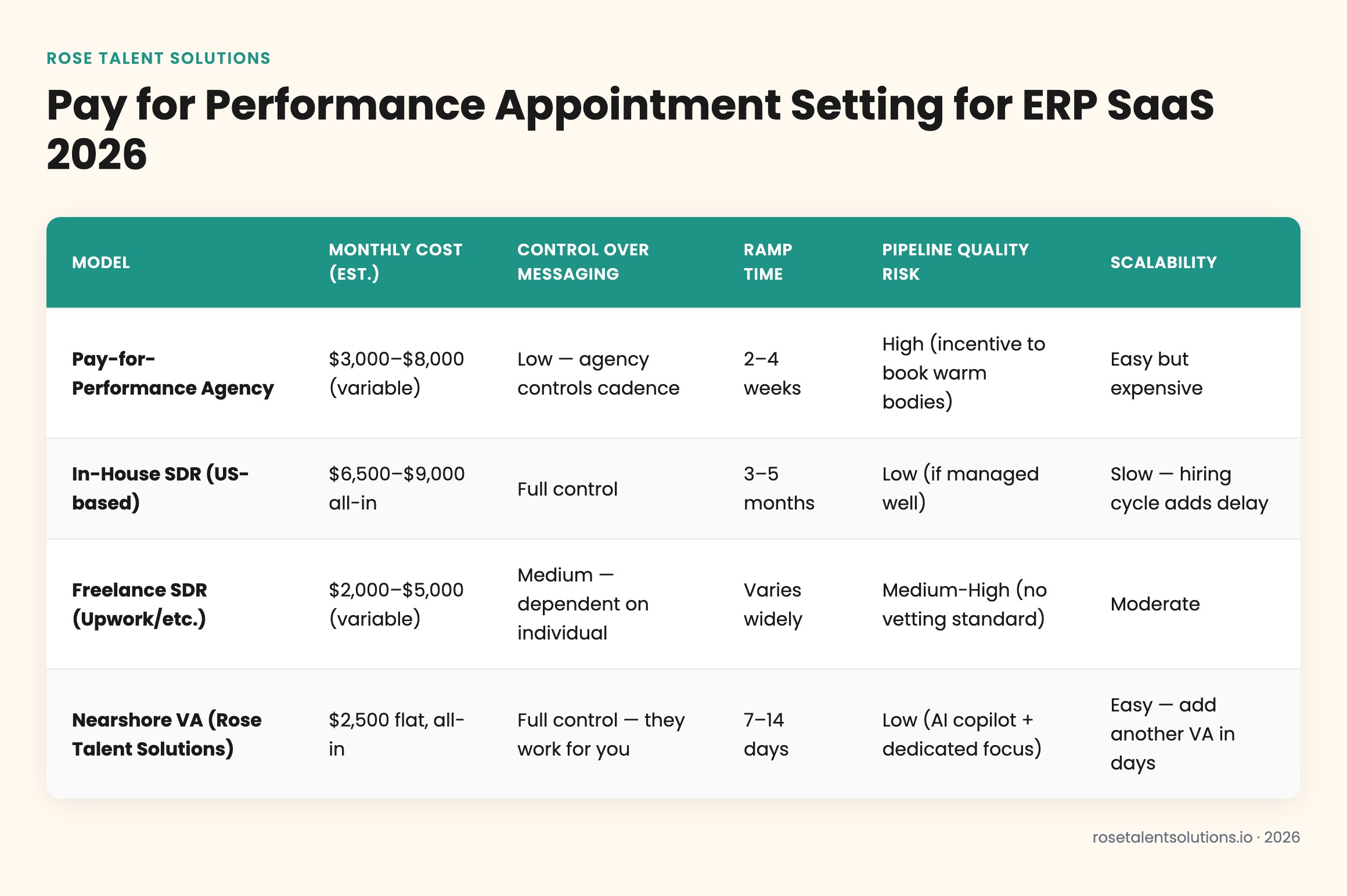
Choosing the right appointment setting model for ERP SaaS comes down to four variables: cost predictability, pipeline quality control, ramp time, and your willingness to manage the function. The table below gives you an honest side-by-side.
| Model | Monthly Cost (Est.) | Control Over Messaging | Ramp Time | Pipeline Quality Risk | Scalability |
|---|---|---|---|---|---|
| Pay-for-Performance Agency | $3,000–$8,000 (variable) | Low — agency controls cadence | 2–4 weeks | High (incentive to book warm bodies) | Easy but expensive |
| In-House SDR (US-based) | $6,500–$9,000 all-in | Full control | 3–5 months | Low (if managed well) | Slow — hiring cycle adds delay |
| Freelance SDR (Upwork/etc.) | $2,000–$5,000 (variable) | Medium — dependent on individual | Varies widely | Medium-High (no vetting standard) | Moderate |
| Nearshore VA (Rose Talent Solutions) | $2,500 flat, all-in | Full control — they work for you | 7–14 days | Low (AI copilot + dedicated focus) | Easy — add another VA in days |
"The highest-performing SDR teams we benchmark aren't the ones with the most aggressive commission structures — they're the ones where reps have deep product knowledge, consistent messaging, and enough time in role to understand buyer psychology." — Becc Holland, CEO at Flip the Script (2023)
The comparison table makes one thing clear: the pay-for-performance agency model wins on surface simplicity and loses on unit economics the moment you need consistent pipeline volume. For ERP SaaS teams running an ABM motion against a defined target account list, giving an outside agency control over your outbound messaging is a structural liability. If you're evaluating similar trade-offs for adjacent SaaS categories, the post on pay-for-performance appointment setting for SaaS hosting companies covers how the same dynamics play out in a different vertical.
How the Rose Nearshore VA Model Works for ERP SaaS SDR Roles in 2026
The Rose model is built for operators who want the cost efficiency of outsourcing without surrendering control of their pipeline. Every step is designed to get a qualified SDR running your ERP SaaS outbound in days, not months.
Role Scoping Call
Rose's team maps your ICP, target verticals (manufacturing, distribution, professional services), and existing tech stack — Salesforce, HubSpot, Apollo, Outreach, or any combination — before the search begins.
Candidate Vetting
Every candidate clears English proficiency at 8/10 or higher, passes a role-specific skills assessment, and is screened for prior B2B SaaS SDR or BDR experience. Rose handles all recruiting and pre-screening at no extra cost.
AI Copilot Activation
Your VA ships with a role-specific AI copilot trained on ERP SaaS objection handling, persona-based messaging, and your specific tools — so they ramp in days rather than months. Learn more about the AI advantage built into every Rose placement.
First Placement Within 7 Days
Your SDR starts working US business hours from Latin America — same timezone overlap as your sales team, no batch-and-reply lag. Day one looks like a new full-time hire, not a vendor handoff.
Ongoing Management & Replacement Guarantee
Rose handles payroll, HR, and performance management. If the team member isn't a fit, Rose replaces them at no additional cost — the only risk reversal you need.
According to SHRM (2023), replacing an employee costs between 50% and 200% of their annual salary. For a US-based SDR earning $70,000 per year, that's $35,000 to $140,000 in replacement cost if they churn in the first six months. The Rose replacement guarantee eliminates that risk entirely without requiring a long-term contract — month-to-month terms with 30 days written notice.

The hidden cost of pay-for-performance appointment setting isn't the per-meeting fee — it's the brand damage from unqualified meetings, the messaging drift you can't audit, and the pipeline volatility that makes revenue forecasting nearly impossible for ERP SaaS teams running 6–12 month deal cycles.
What Tasks Does a Nearshore ERP SaaS Appointment Setter Actually Own?
A common misconception is that a virtual SDR "just books meetings." In practice, a well-trained nearshore appointment setter running an ERP SaaS outbound motion owns a much broader scope — and that scope is exactly what makes the flat-rate model so defensible on a per-outcome basis.
Daily tasks typically include: building and enriching target account lists from tools like Apollo or ZoomInfo, writing and A/B testing cold email sequences, managing LinkedIn outreach and connection follow-ups, logging all activity in your CRM, handling objection replies in real time during US business hours, coordinating calendar scheduling with your AEs, and attending weekly pipeline reviews. According to McKinsey (2023), B2B buyers now complete an average of 57% of their purchase decision process before engaging a sales rep — which means your SDR's outbound messaging and discovery framing carry more weight than ever.
The AI copilot advantage is particularly relevant for ERP SaaS, where buyers ask technically dense questions about implementation timelines, integration with legacy systems, total cost of ownership, and change management. Rose's AI copilot trains each VA on role-specific knowledge — ERP product categories, common objections from manufacturing or distribution buyers, and the language of your specific platform — so they handle first-touch conversations with genuine credibility. This is fundamentally different from a generic pay-for-performance agency rep cycling through twelve clients simultaneously.
For cybersecurity SaaS teams evaluating the same model, the post on pay-for-performance appointment setting for cybersecurity startups covers how nearshore SDRs handle technically complex outbound in a similarly high-trust buyer environment. The playbook transfers cleanly to ERP.
Nearshore Flat-Rate SDR — Pros
- Full control over messaging, ICP targeting, and sequence design
- Predictable $2,500/mo cost — no per-meeting variable pricing
- Works US business hours from Latin America — real-time overlap with buyers
- AI copilot trained on ERP SaaS objections and your specific tools
- Builds institutional knowledge of your product and buyer personas over time
- Month-to-month — no long-term contract, 30 days written notice to cancel
Pay-for-Performance Agency — Cons
- $300–$800 per meeting creates unpredictable monthly spend
- Incentive to book warm bodies, not qualified buyers
- No visibility into outreach quality or messaging evolution
- Rep attention divided across multiple clients simultaneously
- No institutional knowledge — every rep churn resets your ICP context
- Brand risk from low-quality discovery calls with enterprise ERP buyers
If you're ready to replace variable agency spend with a dedicated, AI-equipped nearshore SDR, the fastest path is to start a conversation with the Rose team — placements typically happen within seven days of the scoping call. For teams that also need sales support infrastructure — CRM management, reporting, or pipeline operations — Rose's broader service catalog covers adjacent roles that complement a dedicated SDR function. And if you're evaluating the cost and control trade-offs across different staffing arrangements, the onshore vs. offshore virtual assistant breakdown gives you the full picture before you commit to any model.
According to the U.S. Bureau of Labor Statistics (2024), the median annual wage for wholesale and manufacturing sales reps — the closest proxy for enterprise SDRs — is $67,800, which translates to roughly $8,500 per month in fully loaded employer cost. A nearshore SDR at $2,500 flat delivers the same dedicated focus at less than 30% of that cost, with zero recruiting overhead and a built-in replacement guarantee.