
What Is Pay for Performance Appointment Setting — and Why Cybersecurity Startups Are Obsessed With It in 2026?
Nearshore sales development is reshaping how cybersecurity startups fill their pipelines in 2026. But before diving into alternatives, it's worth defining the model that's generating the most buzz. Pay for performance appointment setting is a sales outsourcing arrangement where a vendor books discovery calls or demos on your behalf, and you pay a fixed fee per completed meeting rather than a monthly retainer. No meeting, no invoice. The appeal is obvious — especially for a pre-Series A cybersecurity startup burning through runway.
The model sounds like pure upside. In practice, it carries serious structural risks that most vendor pitch decks don't mention. Understanding those risks — and knowing when a flat-rate dedicated SDR model beats pay-per-meeting on unit economics — is what this guide is about.
Pay for performance appointment setting defined: A vendor sources prospect lists, runs cold outreach (email, LinkedIn, phone), and charges a per-booked-meeting fee — typically ranging from $150 to $400 per completed call — only when a qualified prospect shows up. Quality standards for "qualified" vary wildly by vendor, which is where most disputes originate.
Cybersecurity is a uniquely difficult vertical for appointment setting. Buyers — CISOs, IT directors, VP Infrastructure — are among the most skeptical, most solicited prospects in all of B2B. According to Gartner's B2B Sales research (2024), the average B2B technology buyer now ignores 85% of outbound sales contacts. Getting a cybersecurity decision-maker on a 30-minute call requires technical credibility, not just a catchy subject line. That's a problem for most pay-per-meeting vendors who rotate generic SDRs across dozens of verticals.
How Pay-Per-Meeting Pricing Actually Works in 2026 — and Where the Math Breaks Down
Let's do the math that agency sales reps hope you won't do before signing. At $200 per completed meeting, booking 20 meetings in a month costs $4,000. At $300 per meeting, that's $6,000. Now factor in your close rate. For cybersecurity SaaS at the SMB level, a strong close rate from cold outbound is roughly 15–20%, per Sales Benchmark Index (2024). That means 20 meetings might yield 3–4 closed deals. If your ACV is $15,000, that's fine math. If your ACV is $5,000, you just burned half your CAC budget on one vendor.

The other hidden cost: pay-per-meeting vendors own the outreach infrastructure — the sequences, the prospect data, the reply history. When you part ways, you take nothing. A dedicated SDR builds your CRM, your sequences, your relationships. That institutional knowledge compounds over time. If you've ever researched how pay-for-performance SDR models compare across SaaS verticals, you'll see the same pattern: the per-unit model wins at very low volumes, loses badly at scale.
There's also the qualification problem. Pay-per-meeting vendors have a financial incentive to define "qualified" as loosely as possible. A meeting where a prospect shows up and says "I was just curious" still gets billed. The better vendors contractually define ICP criteria — company size, tech stack, budget authority, active pain — but enforcing those criteria in disputes is exhausting for a 10-person startup that has no legal bandwidth.
How Nearshore SDRs Outperform Pay-Per-Meeting Agencies for Cybersecurity Startups in 2026
The core argument for a dedicated nearshore SDR over a pay-per-meeting agency comes down to four factors: domain depth, timezone alignment, cost predictability, and institutional ownership. Let's take them in order.
Domain depth. A nearshore SDR you hire and train becomes fluent in your specific product, your ICP, your competitive differentiators, and your objection handling. They can speak credibly to a CISO about zero-trust architecture or endpoint detection response (EDR) coverage gaps because you've trained them to. A rotating agency SDR juggling six clients this month has none of that depth. Technical credibility is the unlock for cybersecurity outbound — a prospect who senses the caller doesn't understand the product hangs up in 90 seconds.
Timezone alignment. Latin America-based SDRs work US business hours natively. When your VP Sales wants to debrief a call at 9 AM Eastern, your nearshore SDR is at their desk. Offshore SDRs in Southeast Asia are wrapping their day — or haven't started it yet. This matters enormously for fast iteration on messaging, which is where cybersecurity outbound wins or dies. If you want a deeper look at how timezone gaps compound into real productivity losses, our breakdown of nearshore vs. offshore vs. onshore virtual staff covers this in full.
"In cybersecurity sales, the SDR is the first human representation of your brand to a CISO. If they sound scripted, generic, or technically shallow, you've burned that account — possibly forever. You don't get a second first impression with a CISO." — Morgan Ingram, Founder at AMP (Accelerate My Pipeline) (2024)
Cost predictability. At $2,500/month flat, you know exactly what sales development costs. No meeting volume surprises. No billing disputes over qualification standards. Budget forecasting for a seed-stage startup is hard enough without a variable-cost vendor introducing swings of $2,000–$4,000 month to month.
Comparing Your 2026 Options: Pay-Per-Meeting vs. Offshore vs. Nearshore SDRs
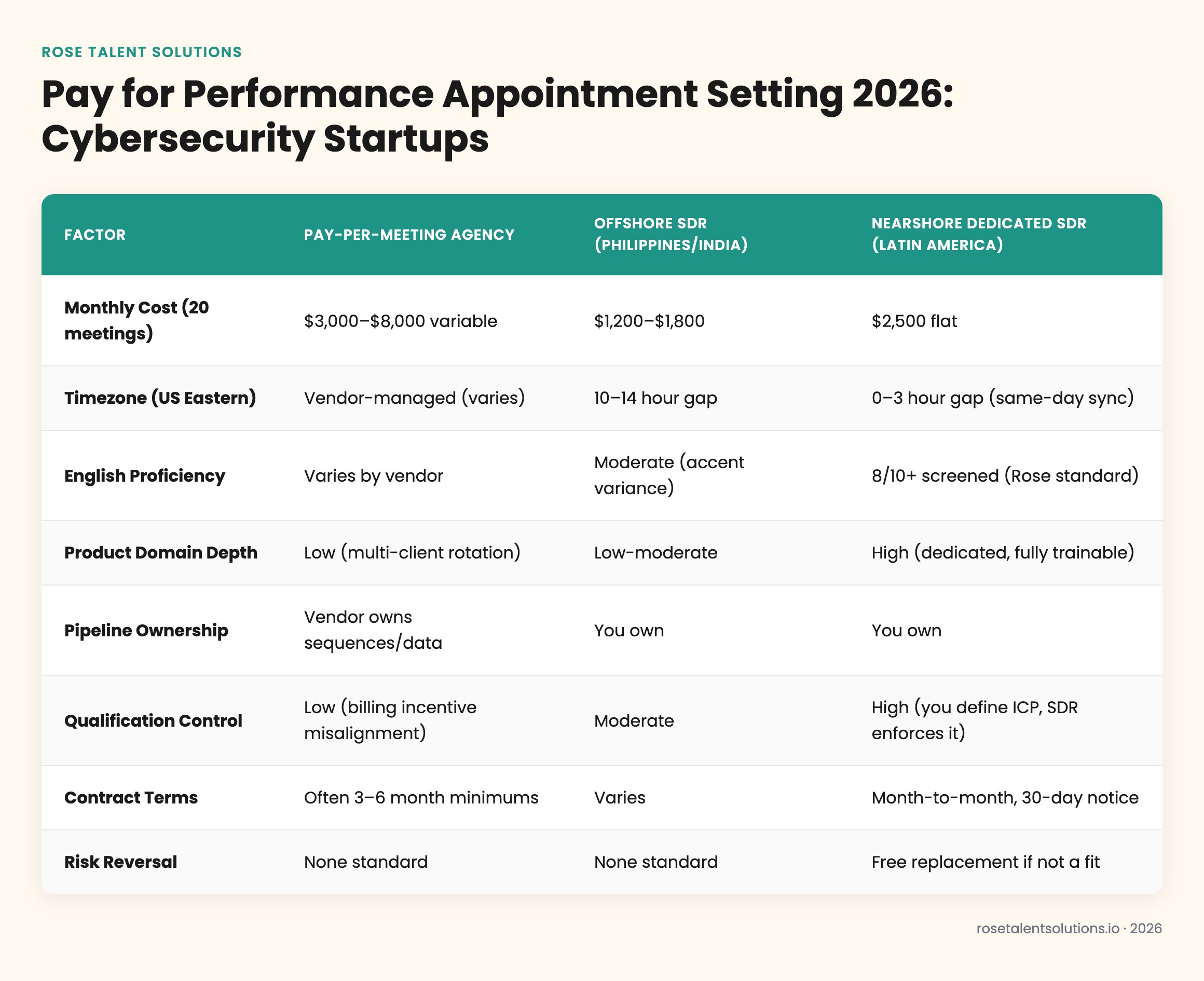
The table below compares the three most common appointment setting approaches cybersecurity startups evaluate. Use it to stress-test whichever model you're currently considering.
| Factor | Pay-Per-Meeting Agency | Offshore SDR (Philippines/India) | Nearshore Dedicated SDR (Latin America) |
|---|---|---|---|
| Monthly Cost (20 meetings) | $3,000–$8,000 variable | $1,200–$1,800 | $2,500 flat |
| Timezone (US Eastern) | Vendor-managed (varies) | 10–14 hour gap | 0–3 hour gap (same-day sync) |
| English Proficiency | Varies by vendor | Moderate (accent variance) | 8/10+ screened (Rose standard) |
| Product Domain Depth | Low (multi-client rotation) | Low-moderate | High (dedicated, fully trainable) |
| Pipeline Ownership | Vendor owns sequences/data | You own | You own |
| Qualification Control | Low (billing incentive misalignment) | Moderate | High (you define ICP, SDR enforces it) |
| Contract Terms | Often 3–6 month minimums | Varies | Month-to-month, 30-day notice |
| Risk Reversal | None standard | None standard | Free replacement if not a fit |
The offshore SDR option looks cheapest on paper, but the timezone math is brutal for cybersecurity outbound. CISOs and IT directors don't respond to 6 AM emails from someone who won't be online when they reply. Real-time follow-up within the same business day is what converts replies into booked calls. For a deeper look at why timezone alignment is the often-ignored dealbreaker, see our post on the real tradeoffs between onshore and offshore virtual staff.
The billing incentive structure of pay-per-meeting agencies is fundamentally misaligned with cybersecurity startups: vendors maximize meeting volume, you need meeting quality. A dedicated nearshore SDR's success metric is your pipeline — not their invoice.
How Rose Talent Solutions Places a Nearshore SDR for Your Cybersecurity Startup in 2026
If you decide a dedicated nearshore SDR beats the pay-per-meeting model for your stage and ACV, here's exactly how the Rose placement process works. According to SHRM's Talent Acquisition research (2024), the average time-to-fill for a specialized sales role in the US is 44 days. Rose's average first placement is 7 days — because the vetting, recruiting, payroll, and HR infrastructure is already built.

ICP + Role Scoping Call
Rose's team maps your ideal customer profile, your tech stack (CRM, sequencing tool, LinkedIn Sales Navigator), and the specific SDR competencies your cybersecurity niche requires — whether that's MSSP outreach, SMB IT buyers, or enterprise CISO targeting.
Pre-Vetted Candidate Match
Within days, Rose presents pre-screened Latin America-based SDR candidates who've cleared English proficiency screens (8/10+ floor), background checks, and role-specific assessments. You interview only the top matches.
Placement + AI Copilot Onboarding
Your SDR ships with a role-specific AI copilot trained on your CRM, sequencing platform, and cybersecurity vertical context — so they ramp in days, not months. Rose handles all payroll, HR compliance, and ongoing management.
Month-to-Month Flexibility
There is no long-term contract. If the SDR isn't a fit, Rose replaces them at no additional cost. Cancel with 30 days written notice at any point — Rose's model is built on retention through results, not contract lock-in.
The AI copilot advantage is worth emphasizing specifically for cybersecurity outbound. Rose's AI-powered team member model means your SDR has trained AI assistance for researching prospect tech stacks, personalizing outreach at scale, and surfacing buying signals — capabilities that most pay-per-meeting agencies charge extra for as "premium list enrichment." According to McKinsey's Growth & Sales research (2024), AI-assisted SDRs generate 50% more pipeline per rep than non-AI-assisted counterparts. That's not a marginal edge — it's a structural advantage compounding every month.
You can also explore how Rose structures appointment setting specifically for cybersecurity SaaS companies — including how to evaluate any vendor's ICP qualification standards before you sign.
Pros and Cons: Should a Cybersecurity Startup Use Pay-Per-Meeting or a Dedicated Nearshore SDR?
Neither model is universally superior. The right choice depends on your ACV, your stage, and how much pipeline ownership matters to you right now. Here's an honest breakdown.
Pay-Per-Meeting: When It Works
- You need pipeline immediately and have zero bandwidth to onboard a new hire
- Your ACV is high enough ($30K+) to absorb $200–$400 per meeting and still have healthy CAC ratios
- You're testing a new ICP segment and want market signal before committing to headcount
- Your product requires zero technical credibility to get a first meeting (rare in cybersecurity)
Pay-Per-Meeting: When It Fails
- Your ACV is under $15K — meeting costs destroy your CAC math at any meaningful volume
- You need domain-deep SDRs who can speak credibly to CISOs about your specific threat category
- You want to own your sequences, your CRM data, and your prospect relationships
- Qualification disputes drain your VP Sales's time and erode trust in the vendor fast
For most cybersecurity startups post-product-market fit with ACVs between $8,000 and $40,000, a flat-rate nearshore SDR at $2,500/month delivers better cost-per-meeting, better qualification control, and a pipeline asset that grows in value over time. According to the U.S. Bureau of Labor Statistics (2024), the fully-loaded cost of a US-based SDR (salary, benefits, payroll taxes, tools) exceeds $75,000 annually — that's 2.5× the cost of a dedicated nearshore SDR with the same business-hours availability and no recruiting overhead.
Ready to scope your cybersecurity SDR role? The fastest path is starting with a quick role scoping conversation — Rose's team will tell you within 24 hours whether a nearshore SDR placement makes sense for your stage, or whether a different sales support structure fits better.