
Nearshore sales development is rewriting the pipeline math for US and Canadian businesses in 2026. If you've been pricing out SDR talent and wondering why the numbers feel impossible — a $70,000+ base salary, benefits, tools, manager overhead, and a 3-month ramp before you see a single qualified meeting — you're not imagining it. This guide breaks down exactly what outsourced SDRs cost, where the hidden expenses live, and which model actually delivers ROI when you stack real benchmarks side by side.
Whether you're a SaaS founder, a B2B services operator, or a revenue leader trying to justify headcount to a board, the cost of your sales development function is one of the highest-leverage decisions you'll make this year. Getting it wrong by even one hire can cost you $80,000–$120,000 in fully-loaded annual expense for zero pipeline generated.
The Bureau of Labor Statistics (2024) puts median base pay for US sales development roles at roughly $52,000–$58,000 annually — but base is only part of the story. Layer in employer-side payroll taxes (~7.65%), health insurance (averaging $7,739/year per employee according to SHRM's 2024 Employee Benefits Survey), sales tools ($200–$500/month), and the management time required to ramp a new rep, and the real number climbs fast. Most operators who've done the math land between $85,000 and $105,000 per SDR per year before that person generates a single dollar of pipeline.
What Does an Outsourced SDR Actually Cost in 2026?
The outsourced SDR market in 2026 spans a wide range of price points, models, and geographies. Before comparing sticker prices, it's worth defining what you're actually buying in each model.
What is an outsourced SDR? An outsourced sales development representative is a full-time or part-time prospecting professional employed or managed by a third-party provider rather than directly on your payroll. They handle outbound prospecting, inbound lead qualification, cold outreach sequences, and meeting booking — the top-of-funnel work that feeds your account executives. The outsourcing provider handles recruiting, HR, payroll, and day-to-day management accountability.
Here's how the major models break down on cost in 2026:
| Model | Monthly Cost | Annual Cost | Time Zone Match (US) | English Proficiency | Ramp Time | Contract Terms |
|---|---|---|---|---|---|---|
| US In-House SDR | $7,000–$9,000 (fully loaded) | $85,000–$108,000 | ✅ Perfect | Native | 60–90 days | At-will employment; high turnover risk |
| Offshore SDR (Philippines / India) | $800–$1,800 | $9,600–$21,600 | ❌ 9–13 hr gap | Variable (5–7/10 avg) | 30–60 days | Often hourly; hidden mgmt costs |
| Nearshore SDR — Rose Talent (Latin America) | $2,500 flat | $30,000 | ✅ Same US hours | 8/10+ screened | 7–14 days | Month-to-month; no long-term contract |
| SDR Agency / Fractional | $4,000–$12,000 | $48,000–$144,000 | Varies | Varies | 30–45 days | 6–12 month minimums common |
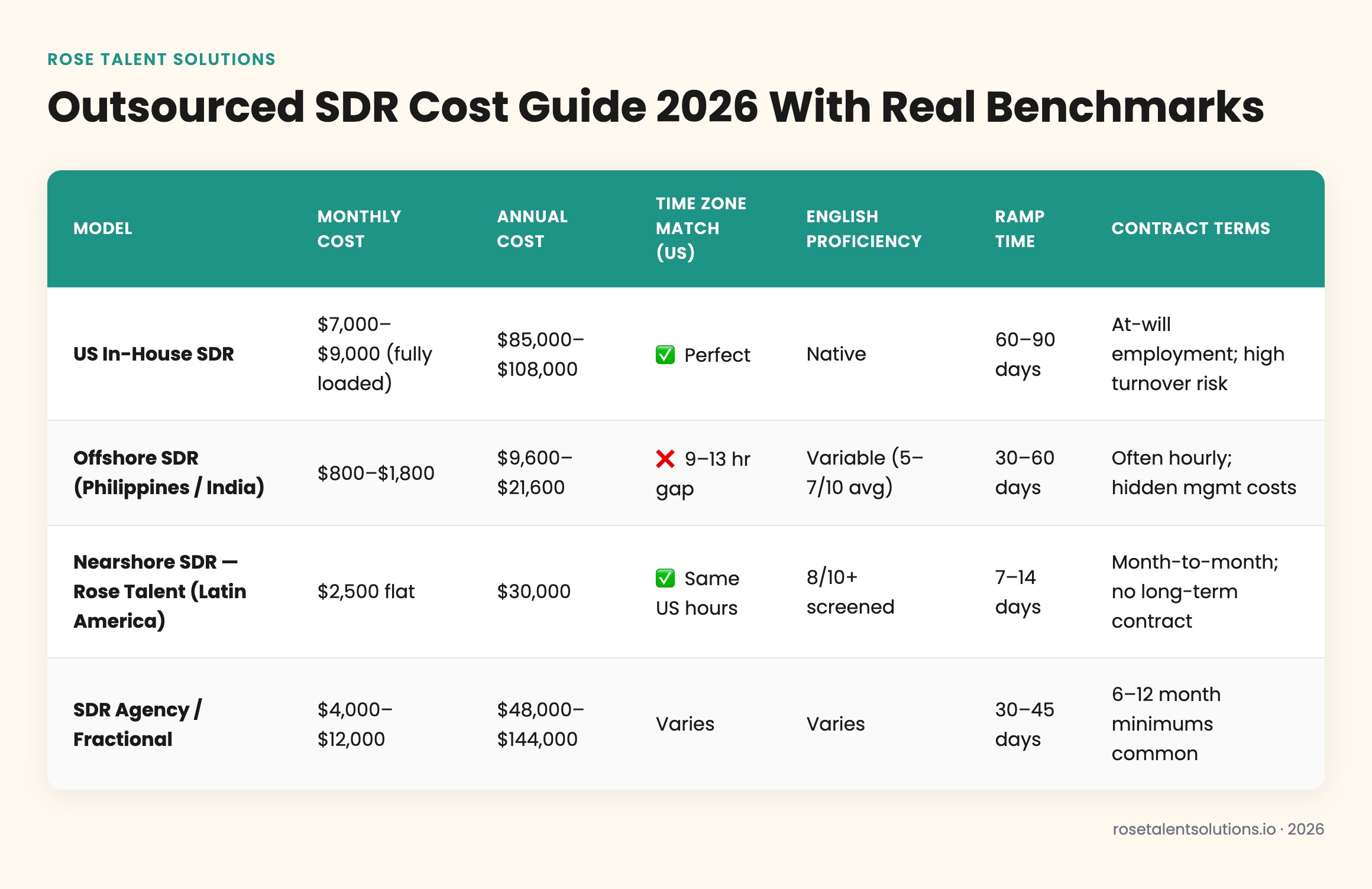
The nearshore model sits in a compelling middle lane: dramatically cheaper than a US hire, but without the timezone penalty and English quality gap that make pure offshore models frustrating for US B2B sales. If you want a deeper look at how these models compare on ROI beyond just cost, the outsourced vs. in-house SDR ROI comparison breaks down the full financial picture including quota attainment rates and ramp costs.
How Hidden Costs Distort the 2026 SDR Pricing Picture

Sticker price comparisons are almost always misleading in sales development. The real cost of an SDR model includes four layers that most buyers don't price in until they're already burned.
Layer 1 — Recruiting and replacement cost. The average US SDR tenure is 14 months, according to LinkedIn Talent Insights (2024). Every time an in-house SDR churns, you spend an estimated $5,000–$15,000 in recruiting fees, lost ramp time, and manager bandwidth. An outsourced model with a free replacement guarantee eliminates this exposure entirely.
Layer 2 — Tools and tech stack. A functional SDR runs on a CRM, a sequencer (Outreach, Apollo, Salesloft), a dialer, LinkedIn Sales Navigator, and intent data. Budget $400–$700/month per rep in tools alone. Many nearshore staffing models include software onboarding as part of the placement — Rose's AI copilot advantage means every placed SDR arrives pre-trained on your specific tech stack, not just handed a login on day one.
Layer 3 — Management overhead. In-house SDRs require real manager time: call reviews, coaching, pipeline audits, one-on-ones. Research from Gallup's State of the American Workplace (2023) finds that managers spend an average of 3–5 hours per week per direct report on performance management activities. For a VP of Sales managing two SDRs, that's up to 10 hours/week of senior-level time that has a real cost.
Layer 4 — Time zone friction. This one is subtle but punishing for outbound sales. Offshore SDRs operating on a 9–13 hour lag can't do real-time follow-up on inbound leads — and speed-to-lead is one of the single most important variables in B2B conversion. A Harvard Business Review analysis found that responding to a lead within one hour makes you nearly 7× more likely to qualify that lead than waiting even 2 hours. Nearshore SDRs in Latin America work your exact US business hours — this variable alone can justify the cost delta over offshore.
The hidden cost of offshore SDRs isn't the hourly rate — it's the 9–13 hour timezone gap that makes real-time follow-up impossible and inflates your cost-per-qualified-meeting by 2–3× compared to a nearshore model working US hours.
How Nearshore SDR Pricing Compares to Agency and Fractional Models in 2026
SDR agencies and fractional sales development firms occupy a different part of the market. Instead of staffing a dedicated rep to your team, they typically assign a team of 2–4 reps who split time across 3–6 clients simultaneously. The pitch is flexibility and speed. The reality, for most B2B companies with any degree of product complexity, is shallow product knowledge and diluted effort.
"Shared SDR models work well for simple transactional products. For anything with a sales cycle longer than 30 days or a technical buyer, you need someone who knows your product cold — and that only comes from a dedicated rep." — Becc Holland, Founder & CEO at Flip the Script (2023)
Agency retainers in 2026 typically run $4,000–$12,000/month and almost always require 6–12 month commitments. You're paying a premium for the agency's brand, their process IP, and the management layer — but you often don't control who's actually doing the work, and turnover inside agencies is high. According to SHRM's 2024 Benchmarking Report, sales roles see some of the highest voluntary turnover of any function, averaging 25–30% annually.
A flat-fee nearshore staffing model like Rose's $2,500/month gives you a dedicated, named team member who works only for you, 40 hours a week, on your CRM, learning your ICP — and if they're not a fit, they're replaced at no additional cost. No shared reps, no 12-month lock-in, no long-term contract.
For SaaS companies specifically, the dedicated nearshore SDR model tends to outperform agency models on cost-per-qualified-opportunity within the first 90 days. If you want a full walkthrough of how to vet and onboard an outsourced SDR specifically for a SaaS product, the guide on how to hire outsourced SDR services for SaaS covers qualification criteria, onboarding sequencing, and quota-setting frameworks in detail.

How to Calculate Your True 2026 SDR Cost Before You Hire
Before you sign anything — whether it's an employment offer, an agency retainer, or a staffing agreement — run this five-step cost model. It takes 20 minutes and will clarify which model actually pencils for your pipeline goals.
Calculate your all-in annual cost per model
For in-house: base + benefits + payroll tax + tools + recruiting amortized over 14-month average tenure. For outsourced: monthly flat fee × 12, plus any tool costs not included in the contract.
Estimate meetings booked per month per model
Benchmark: a focused, dedicated SDR in B2B SaaS averages 8–15 qualified meetings/month. Fractional or shared reps typically deliver 4–8 for your specific account. Factor timezone match into your estimate — real-time follow-up matters.
Calculate cost-per-meeting
Divide your all-in monthly cost by estimated monthly meetings. A $7,500/month fully-loaded US SDR booking 10 meetings = $750/meeting. A $2,500/month nearshore SDR booking 10 meetings = $250/meeting. That delta compounds fast.
Apply your pipeline conversion rate
Multiply meetings booked × your SQL-to-close rate × your average deal value to get expected pipeline per dollar spent. This is the number that matters to your CFO, not headcount cost.
Factor in ramp time and replacement risk
In-house hires take 60–90 days to ramp and churn at 25–30% annually. A nearshore placement with a free replacement guarantee and a 7–14 day placement window dramatically changes your risk-adjusted cost model.
If you want to go deeper on this ROI framework, including how to set quota expectations and benchmark performance by industry vertical, see the detailed breakdown on how much an outsourced sales development rep costs — it includes median cost-per-meeting data segmented by SDR model type.
Nearshore vs. Offshore SDRs in 2026: What the Data Actually Shows
The offshore vs. nearshore debate isn't really about cost anymore — it's about output quality relative to cost. Offshore (Philippines, India) SDRs can be hired for $800–$1,800/month. That's a real number. But the operational reality for US B2B sales development is harder to ignore.
Nearshore Latin American SDR (Pros)
- Works US business hours — real-time prospect engagement
- 8/10+ English proficiency, screened before placement
- Cultural familiarity with US B2B sales norms
- Same-day Slack/Teams collaboration with your AEs
- AI copilot pre-trained on your CRM and sequencing tools
Offshore SDR (Philippines/India) (Cons)
- 9–13 hour timezone gap kills speed-to-lead
- Variable English fluency — accent and idiom issues common in cold outreach
- Async-only collaboration; can't join live sales calls
- Hidden management overhead to bridge communication gaps
- Quality control requires dedicated US-side oversight
The data increasingly supports this distinction. A 2024 analysis by McKinsey's B2B Sales Practice found that B2B buyers expect same-day or faster responses to outbound engagement — a standard that timezone-lagged offshore reps structurally cannot meet during core US selling hours. For a comprehensive look at the competitive landscape of outsourced providers, the best outsourced SDR companies of 2026 ranking evaluates the top providers on cost, quality, contract terms, and geographic model.
Nearshore isn't just "cheaper offshore" — it's a fundamentally different operational model that preserves the real-time collaboration that makes sales development work. Rose's Latin American team members work your time zone, communicate in fluent English screened to an 8/10+ standard, and arrive equipped with role-specific AI tools trained on the software you already use. If you're ready to see what a dedicated nearshore SDR looks like for your pipeline, you can get started with a placement in as little as 7 days.