
Nearshore sales development is reshaping how US B2B companies build pipeline in 2026. Instead of paying $80,000–$100,000 per year for a junior in-house SDR — or rolling the dice on an offshore team that works while your prospects sleep — operators are turning to nearshore SDRs in Latin America who work your hours, speak fluent English, and cost a fraction of a domestic hire. This post breaks down what separates the best outsourced SDR companies in 2026 from the ones that burn your budget and your pipeline simultaneously.
What Is an Outsourced SDR — and Why Does the Model Matter in 2026?
An outsourced SDR (Sales Development Representative) is a dedicated outbound prospector hired through a third-party staffing or services firm rather than added to your internal payroll. Their job is to identify qualified leads, run multi-touch cold outreach sequences, book discovery calls, and hand warm opportunities to your closing team. The model matters enormously because not all outsourced SDRs are created equal — a shared-resource agency model where one rep juggles ten clients will never outperform a dedicated, embedded SDR who knows your ICP as well as your own team does.
In 2026, the distinction between "outsourced SDR" and "nearshore SDR" has become the central decision point for growing B2B companies. Providers based outside the Americas often compete on hourly rate alone, but timezone gaps, cultural nuance variance, and inconsistent English fluency create downstream costs that rarely show up in the initial proposal. According to SHRM's Talent Acquisition research (2024), mis-hires cost companies an average of 50–60% of the departing employee's annual salary — a stat that applies just as sharply to outsourced roles where poor fit means wasted ramp time and burned prospect lists.
If you are evaluating providers right now, our deeper guide on how to hire outsourced SDR services for SaaS companies walks through the exact vetting checklist Rose uses internally — including how to score a candidate's cold-call fluency before the first dial.
How Nearshore SDRs Outperform Distant Offshore Providers in 2026 — By the Numbers
The timezone argument is not abstract. A prospect who fills out a demo request form at 10am EST expects a callback within five minutes, not five hours. Lead Response Management research (2023) found that the odds of qualifying a lead drop by over 80% if the first call attempt happens more than five minutes after the inquiry. SDR teams operating 8–12 time zones away structurally cannot hit that window for US business-hours leads — regardless of where they are based.
Nearshore SDRs based in Colombia, Mexico, or Argentina work US Eastern or Central business hours natively. They are not adjusting their biological clocks to cover a shift — they are simply working their normal workday, which happens to be your workday. That alignment produces measurably faster lead response and higher connect rates, and it is the core reason nearshore Latin America has become the default model for US B2B companies under 200 employees.
The English fluency bar also matters more in SDR roles than in almost any other outsourced function. Unlike back-office tasks where written communication can be reviewed and edited before sending, cold calling is unscripted and real-time. Rose's published minimum is 8 out of 10 on English proficiency screens — a bar that filters out the majority of candidates who apply. If you want to understand the full ROI math before committing, the outsourced vs. in-house SDR hiring ROI comparison we published breaks down the fully-loaded cost of each model side by side.
How Do the Best Outsourced SDR Companies 2026 Compare? Full Breakdown
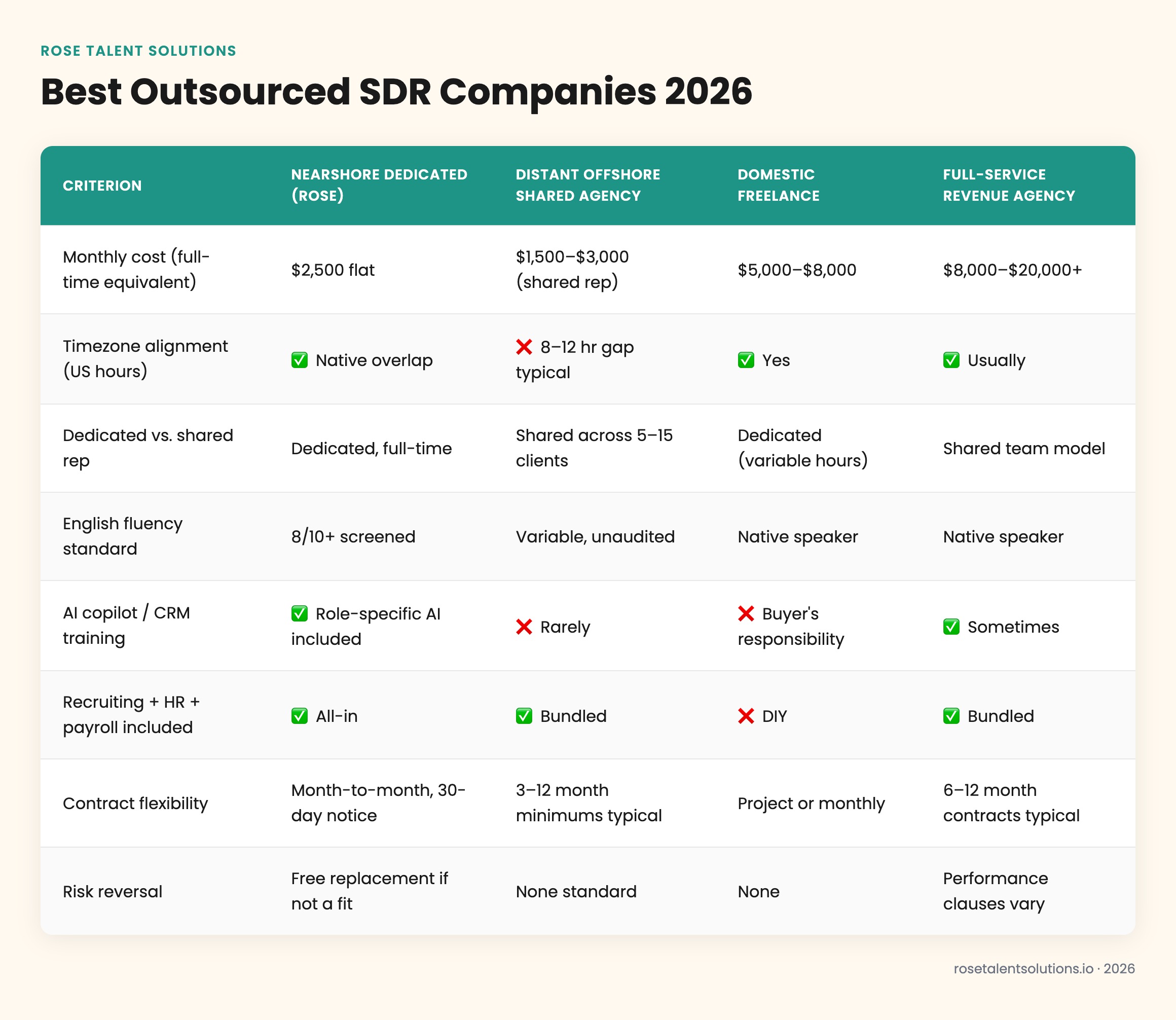
The market in 2026 contains four distinct model types: nearshore dedicated staffing (what Rose does), offshore agency/shared-rep models, domestic freelance SDR platforms, and full-service revenue agencies that bundle SDR + strategy + tooling at premium prices. Each has a legitimate use case — the table below cuts through the noise.
| Criterion | Nearshore Dedicated (Rose) | Distant Offshore Shared Agency | Domestic Freelance | Full-Service Revenue Agency |
|---|---|---|---|---|
| Monthly cost (full-time equivalent) | $2,500 flat | $1,500–$3,000 (shared rep) | $5,000–$8,000 | $8,000–$20,000+ |
| Timezone alignment (US hours) | ✅ Native overlap | ❌ 8–12 hr gap typical | ✅ Yes | ✅ Usually |
| Dedicated vs. shared rep | Dedicated, full-time | Shared across 5–15 clients | Dedicated (variable hours) | Shared team model |
| English fluency standard | 8/10+ screened | Variable, unaudited | Native speaker | Native speaker |
| AI copilot / CRM training | ✅ Role-specific AI included | ❌ Rarely | ❌ Buyer's responsibility | ✅ Sometimes |
| Recruiting + HR + payroll included | ✅ All-in | ✅ Bundled | ❌ DIY | ✅ Bundled |
| Contract flexibility | Month-to-month, 30-day notice | 3–12 month minimums typical | Project or monthly | 6–12 month contracts typical |
| Risk reversal | Free replacement if not a fit | None standard | None | Performance clauses vary |
"Most companies don't have an SDR problem — they have a hiring and enablement problem. The wrong rep with the wrong tools will fail in any timezone." — Trish Bertuzzi, Founder at The Bridge Group (2024)
What Does the AI Advantage Mean for Outsourced SDRs in 2026?
The single biggest shift in outsourced SDR services between 2023 and 2026 is AI integration at the individual rep level. In 2023, AI meant "we use Salesloft." In 2026, it means your SDR arrives with a role-specific AI copilot pre-trained on your tech stack — whether that's HubSpot, Salesforce, Apollo, Outreach, or a niche vertical CRM. The difference in ramp time is not incremental; it is structural.
AI-augmented SDRs can personalize outreach sequences at scale, surface intent signals from prospect behavior in real time, and draft follow-up copy that does not sound like a template. According to McKinsey's Sales & Marketing research (2024), companies that deploy AI tools in their sales development function see a 10–15% increase in lead conversion rates on average. That lift compounds across a full-time SDR's output over a 12-month period.
The hidden cost of a non-AI-augmented outsourced SDR in 2026 is not the salary — it's the 3–4 week ramp period that a pre-trained AI copilot eliminates. At $2,500/month, one lost month of productive output costs more than a full quarter of fees.
Every SDR placed through Rose ships with a role-specific AI copilot trained on the tools your team already uses. You can read more about how this works on the Rose AI advantage page — including which software stacks are currently supported and how the copilot is customized per placement.
For smaller B2B companies wondering whether outsourced SDR is even the right category — or whether a broader lead generation approach makes more sense — the post on the best B2B lead generation services for companies under 20 employees covers when to start with SDR, when to start with content, and when to do both simultaneously.
How Rose Talent Solutions Screens and Places SDRs in 2026
Process transparency is one of the clearest signals that separates serious nearshore staffing providers from glorified job boards. Here is exactly how Rose sources, screens, and places a dedicated SDR for your business.
Role scoping call (Day 1)
Rose's team maps your ICP, outreach channels, CRM stack, and quota expectations. The brief drives every subsequent filtering decision — this is not a generic intake form.
Candidate sourcing from Latin America talent network (Days 1–3)
Rose pulls from a pre-vetted network of SDR candidates across Colombia, Mexico, Argentina, and Chile — all with documented B2B outbound experience and prior English fluency scores.
Three-stage screening (Days 2–5)
Every candidate clears a live English fluency interview (8/10+ required), a role-play cold call scored against your ICP, and a background + reference check. Candidates who do not clear all three stages are not presented.
You interview your top two or three candidates (Days 5–6)
Rose presents a shortlist with scorecards. You run a final conversation and select. You are not rubber-stamping a pre-made decision — you choose.
Placement + AI copilot onboarding (Day 7)
Your SDR starts on day seven. Rose handles payroll, HR compliance, and ongoing performance management. The role-specific AI copilot is configured to your CRM and outreach sequences before the first dial.
According to the U.S. Bureau of Labor Statistics (2024), the median annual wage for a US-based inside sales representative exceeds $62,000 — and that figure excludes benefits, payroll taxes, recruiting fees, and management overhead. The fully-loaded cost of a domestic SDR hire typically lands between $90,000 and $110,000 per year. Rose's flat rate of $2,500 per month ($30,000 annually) includes recruiting, vetting, payroll, HR, and ongoing management — a difference of $60,000–$80,000 per year that flows directly back to your growth budget.
Nearshore Latin America vs. Distant Offshore SDR: Pros and Cons in 2026
Despite the clear timezone and fluency advantages of nearshore Latin America, distant offshore SDR services still hold a place in the market — primarily for companies where cost is the single overriding constraint and timezone misalignment is considered acceptable. Here is the honest breakdown.
Nearshore SDR (Latin America) — Pros
- Works US business hours natively — no shift adjustment
- English fluency screened to a measurable standard (8/10+ at Rose)
- Cultural context for US B2B buyer norms and objection patterns
- Timezone overlap enables real-time Slack, Zoom, and pipeline reviews
- AI copilot pre-trained on US CRM and sales engagement tools
- Month-to-month flexibility with no long-term contract
Distant Offshore SDR — Cons
- 8–12 hour timezone gap limits real-time prospect coverage
- English fluency varies significantly without a published screening bar
- Cultural nuance gaps can reduce cold-call connect and conversion rates
- Async communication slows pipeline reviews and coaching cycles
- Lead response speed structurally impaired for US business-hours inquiries
- Often requires longer contract minimums to offset provider setup costs
The conversation about which model fits your business is also a conversation about stage. Early-stage startups under 20 employees tend to benefit most from nearshore dedicated SDRs because they need pipeline velocity without the overhead of building an internal team. Our guide on the best nearshore SDR services for B2B startups specifically addresses the early-stage playbook — including how to onboard an outsourced SDR when you do not yet have a formal sales process documented.
According to Gallup's employee engagement research (2024), remote workers who operate in the same timezone as their team report 23% higher engagement scores than those with significant timezone misalignment — a finding that translates directly to outsourced SDR performance and retention. Engagement and retention matter in SDR roles because pipeline knowledge compounds over time; a rep who churns after three months takes your prospect relationship history with them.
If your business also needs support beyond sales development — bookkeeping, operations, or property management administration — Rose's bookkeeping and accounting staffing and property management VA services follow the same nearshore, dedicated, flat-rate model. Many Rose clients start with one SDR and expand to a two- or three-person nearshore team within six months.
Ready to scope your SDR placement? The process starts on the Rose get-started page — average time from first conversation to first dial is seven days, and if the placement is not the right fit, Rose replaces the team member at no additional cost.