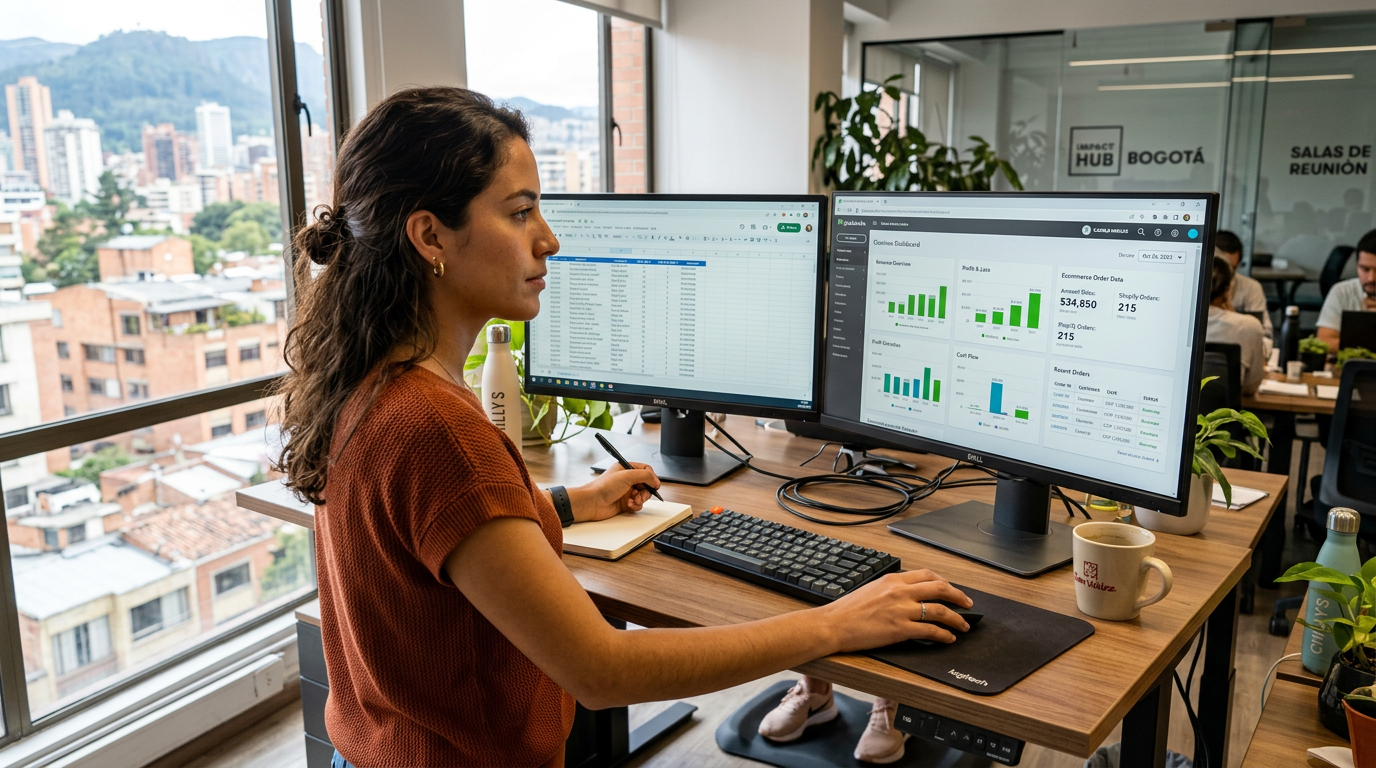
Nearshore outsourced accounting services are quietly becoming the default infrastructure layer for ecommerce brands that want real financial clarity without a $90,000 in-house hire. If you're running a Shopify store, an Amazon FBA operation, or a multi-channel DTC brand, your books are more complex than a typical small business — and most generalist bookkeepers aren't built for the volume, the platform integrations, or the sales tax exposure you're carrying. This guide breaks down exactly what to look for in 2026, what it costs, and how to know when you're ready to outsource.
That number is even higher for ecommerce founders, who often come from marketing, operations, or product backgrounds — not finance. When your monthly SKU count is in the hundreds and you're reconciling Stripe, PayPal, Shopify Payments, and Amazon Seller Central simultaneously, "winging it" stops being an option fast. The brands that scale past $1M in revenue reliably are the ones that get their financial infrastructure right early — and outsourcing is the fastest path there for most operators.
What Are Outsourced Accounting Services for Ecommerce Companies?
Outsourced accounting services for ecommerce companies means hiring a remote accounting professional — or a team — to handle your financial operations on an ongoing basis. This is not a one-time tax filing. It covers monthly bookkeeping, bank and payment processor reconciliations, cost of goods sold (COGS) tracking, inventory valuation, sales tax compliance, and financial reporting. The accountant works inside your existing tools — QuickBooks Online, Xero, A2X, Shopify, or whatever stack you're on — without you needing to set up a separate system.
The "outsourced" part simply means the person is not on your internal payroll as a W-2 employee. In 2026, the most effective version of this model is nearshore — meaning the accountant is based in Latin America, works your US business hours, communicates in fluent English, and integrates into your Slack or Teams like any other team member. This is meaningfully different from offshore outsourcing (Philippines, India) where timezone gaps and communication friction routinely slow down month-end closes and tax prep cycles. If you want to explore how this model works across ecommerce specifically, our deep-dive on outsourced accounting for ecommerce covers the fundamentals in detail.

Why 2026 Is the Inflection Point for Ecommerce Accounting Outsourcing
Three forces are colliding right now that make outsourcing your ecommerce accounting more urgent — and more accessible — than at any previous point. First, sales tax complexity has exploded since the South Dakota v. Wayfair Supreme Court decision in 2018 expanded economic nexus rules. By 2026, most states have enforcement mechanisms in place, and ecommerce brands selling across state lines without proper nexus tracking are sitting on real liability. According to the Tax Foundation (2024), 45 states plus D.C. now impose sales tax on remote sellers above defined thresholds — and the audit risk is not theoretical.
Second, the cost of a competent US-based in-house bookkeeper has climbed significantly. The U.S. Bureau of Labor Statistics (2024) puts the median annual wage for bookkeeping and accounting clerks at over $47,000 — and that's before benefits, payroll taxes, software seats, and management overhead. A senior ecommerce accountant with platform-specific expertise commands $70,000–$90,000+. Nearshore outsourcing at $2,500/month ($30,000/year, all-in) changes that math entirely.
Third, AI-augmented accounting tools have made nearshore professionals dramatically more productive. At Rose Talent Solutions, every team member ships with a role-specific AI copilot trained on their software stack — whether that's QuickBooks, Xero, A2X, or Shopify's native reporting. That means your outsourced accountant isn't just cheaper — they're faster and more accurate than many in-house hires who learned accounting software on the job without structured training.
"The biggest mistake ecommerce brands make is treating accounting as a once-a-quarter cleanup job. By the time you see the mess, you've already made three bad inventory decisions based on wrong numbers." — Liz Farr, CPA and Contributing Editor at Accounting Today (2024)
How Nearshore Compares to Other Outsourcing Models in 2026
Not all outsourced accounting is built the same. The table below breaks down the three primary models — onshore (US-based accounting firm or freelancer), offshore (Philippines or India-based), and nearshore (Latin America-based) — across the dimensions that matter most to ecommerce operators.
| Factor | Onshore (US Firm / Freelancer) | Offshore (Philippines / India) | Nearshore Latin America (Rose) |
|---|---|---|---|
| Typical Monthly Cost | $4,000–$10,000+ | $800–$1,800 | $2,500 flat |
| Timezone Overlap (US ET) | Full overlap | 0–2 hrs overlap | Full overlap (same hours) |
| English Proficiency | Native | Variable (5–8/10) | 8/10+ screened floor |
| Platform Expertise (Shopify, A2X, QBO) | Varies by firm | Varies widely | Role-specific AI copilot included |
| Dedicated vs. Shared Resource | Usually shared across clients | Often shared or task-based | Fully dedicated, 40 hrs/week |
| Contract Terms | Annual retainer common | Varies | Month-to-month, 30-day notice |
| Replacement if Not a Fit | Rarely offered | Rarely offered | Free replacement at no additional cost |
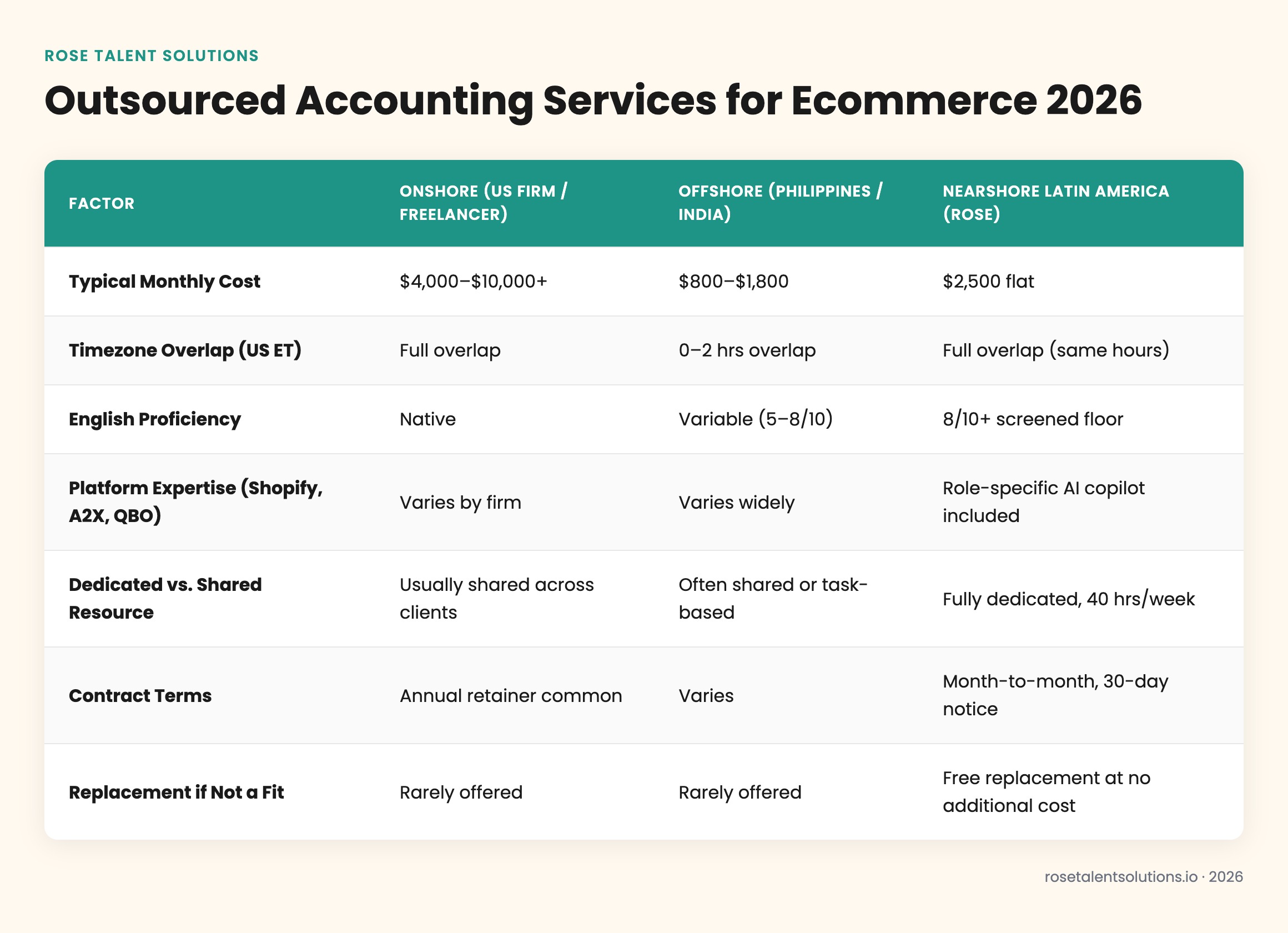
The offshore cost advantage looks compelling on paper, but the real-world friction compounds quickly. A 10–12 hour timezone gap means a single back-and-forth email thread about a reconciliation discrepancy takes two business days instead of two hours. Multiply that across a month-end close cycle and you're looking at a slower close, more errors sitting unreviewed, and a founder who can't get timely answers when it matters. For a detailed breakdown of how nearshore accounting works for SaaS and subscription businesses with similar complexity profiles, see our post on nearshoring accounting services for SaaS companies — many of the structural advantages are identical.
What Does an Outsourced Ecommerce Accountant Actually Do Day-to-Day?
This is the question most founders don't ask until after they've hired someone and discovered the scope doesn't match their expectations. A qualified outsourced ecommerce accountant handles a specific, repeatable set of functions. Here's what a typical engagement covers:
- Payment processor reconciliations — matching Shopify Payments, Stripe, PayPal, and Amazon payouts to your bank deposits daily or weekly
- COGS and inventory accounting — tracking cost of goods sold by SKU, managing landed cost calculations for imported inventory, and syncing with your 3PL or warehouse system
- Sales tax compliance support — monitoring nexus thresholds by state, preparing data for your tax software (TaxJar, Avalara, or manual filing), and flagging exposure
- Monthly P&L and cash flow reports — clean, founder-readable financials delivered within the first week of the following month
- Chart of accounts maintenance — keeping your books structured for both operational clarity and tax readiness
- Vendor and COGS bill entry — recording supplier invoices, freight costs, and duty payments accurately
- Year-end prep and CPA liaison — organizing your books so your CPA spends hours reviewing rather than days reconstructing
The biggest hidden cost in ecommerce accounting isn't bad bookkeeping — it's delayed bookkeeping. When your books are 60 days behind, every inventory reorder decision, every ad spend adjustment, and every cash flow projection is based on stale data. Nearshore accountants working your hours fix this structurally, not just operationally.
According to QuickBooks (2023), 64% of small business owners spend more than 41 hours per year on tax preparation alone — time that compounds when underlying books aren't clean. An outsourced ecommerce accountant eliminates most of that founder time by keeping the books current all year, so tax season becomes a review rather than an excavation. If you're evaluating whether Xero or QuickBooks is the better foundation for this setup, our breakdown of working with a Xero virtual bookkeeper walks through the platform-specific considerations in depth.

How to Get Started with Outsourced Ecommerce Accounting in 2026
The process of hiring a nearshore ecommerce accountant through Rose is deliberately simple. Most founders are matched and onboarded within a week. Here's how the sequence works:
Define Your Scope
Tell us your monthly transaction volume, which platforms you sell on (Shopify, Amazon, WooCommerce, etc.), your current software stack, and where your books currently stand. This takes 20 minutes on a discovery call.
We Match and Vet
Rose identifies candidates from our pre-vetted Latin America talent pool with direct ecommerce accounting experience. Every candidate passes our English proficiency screen (8/10+ floor) and a platform-specific skills assessment before you see them.
You Interview and Select
You meet 1–2 candidates and choose the one who fits your business and communication style. You're not obligated to accept — if none are the right fit, we keep searching.
Onboarding and AI Copilot Activation
Your accountant starts, and Rose activates their role-specific AI copilot trained on your software stack. Within the first week, they're inside your books, reconciling and building your reporting cadence.
Ongoing Management Included
Rose handles payroll, HR, and performance management. If the match isn't right at any point, we replace the team member at no additional cost — no long-term contract locks you in.
The flat rate of $2,500/month covers everything: recruiting, vetting, payroll, HR, the AI copilot, and ongoing support. There's no hidden markup per hour, no annual commitment — just month-to-month terms with 30 days written notice to cancel. You can start the process here with a brief intake form that takes under five minutes.
Why Nearshore Outsourcing Works for Ecommerce Accounting
- Full US business hours — real-time answers, same-day closes
- Platform-trained from day one (Shopify, A2X, QBO, Xero, Amazon Seller Central)
- Flat $2,500/month — no benefits, no payroll taxes, no overhead
- Dedicated 40-hour resource — not shared across 10 other clients
- Month-to-month flexibility — cancel with 30 days written notice
- Free replacement if the match isn't right
When Nearshore Outsourcing Isn't the Right Fit
- You need a licensed CPA to sign off on audited financials (outsourced bookkeepers prep the data; your CPA reviews it)
- Your transaction volume is below ~50/month — you may not need 40 hours yet
- You require in-person, on-site accounting presence for regulatory reasons
For brands that are still evaluating whether to outsource or build in-house, our post on when and how to outsource ecommerce accounting services lays out the decision framework by revenue stage. The short answer: if you're past $500K in annual revenue and reconciling more than three payment processors, the outsourced model almost always wins on cost, speed, and accuracy.
According to a McKinsey Global Institute report (2024), finance and accounting functions are among the highest-value targets for AI-augmented outsourcing — with automation potential in routine transaction processing exceeding 70%. That's exactly the leverage your nearshore accountant is already capturing with their AI copilot, delivering output that would have required a two-person team five years ago. You can explore the full scope of our bookkeeping and accounting services to see which engagement model fits your business stage.
According to SHRM's workforce cost research (2023), the total cost of employing a mid-level accounting professional in the US — including benefits, employer taxes, and overhead — runs 1.25–1.4× their base salary. On a $60,000 salary that's $75,000–$84,000 all-in, compared to $30,000/year for a dedicated nearshore accountant with the same platform expertise. That $45,000–$54,000 annual delta is capital you can redirect into inventory, paid acquisition, or product development.