Nearshore accounting talent is the most underused lever in SaaS finance right now. While most early-to-mid-stage SaaS companies are either overpaying a US-based accounting firm or understaffing their finance function entirely, a growing number of operators are quietly solving the problem by hiring full-time, software-trained accountants in Latin America — same timezone, same tools, fraction of the cost. This post breaks down exactly how nearshoring accounting services works for SaaS companies in 2026, what it costs, and whether it's the right move for your stage.
What Is Nearshoring Accounting Services for SaaS Companies?
Nearshoring accounting services means hiring finance staff based in Latin America — countries like Colombia, Mexico, Argentina, and Costa Rica — to handle your company's books, reporting, and financial operations. Unlike traditional offshore outsourcing, which typically places staff in India or the Philippines, nearshore hires work in time zones that overlap fully with US and Canadian business hours. For a SaaS company running Slack standups at 9am EST, that distinction is enormous.
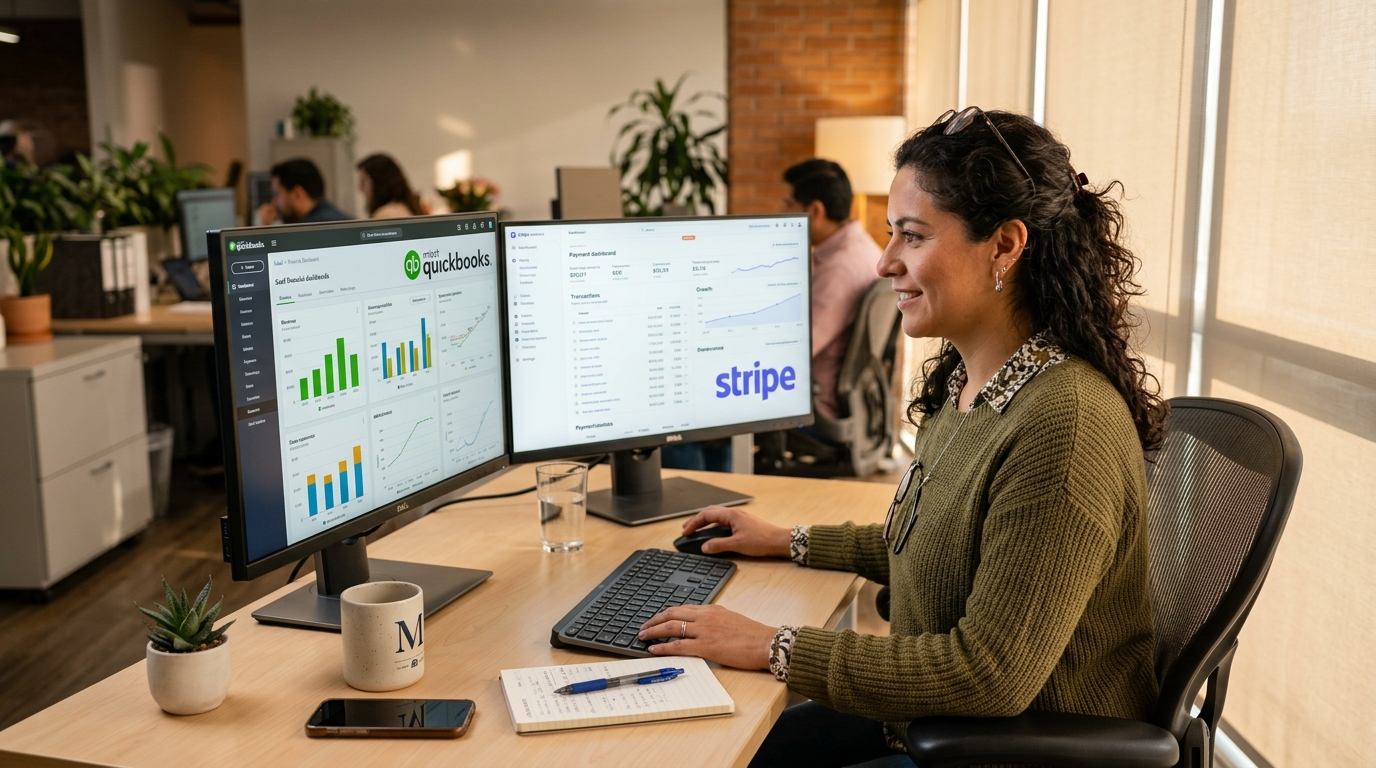
A nearshore accountant isn't a contractor you email deliverables to once a week. They are a dedicated, full-time team member embedded in your finance workflows — logging into your QuickBooks, reconciling Stripe payouts, tracking MRR and churn, and attending your month-end close calls live. The relationship looks and feels like an internal hire, at roughly 40–60% lower cost than the US equivalent role, according to U.S. Bureau of Labor Statistics Occupational Employment data (2024).
SaaS finance has a specific set of demands that generic bookkeeping services rarely meet: revenue recognition under ASC 606, deferred revenue schedules, subscription billing reconciliation, MRR/ARR reporting, and investor-ready financial packages. A nearshore accountant trained on the software your team already uses — QuickBooks Online, Stripe, Brex, Ramp, or Xero — closes that gap faster than a generalist ever could. Rose's AI copilot advantage means every team member ships with a role-specific AI assistant trained on your exact stack from day one.
How Nearshore Compares to Offshore and Onshore Accounting in 2026
The staffing decision for SaaS accounting usually comes down to three options: hire onshore (expensive, competitive market), hire offshore (cheap but operationally painful), or hire nearshore (the middle path most companies overlook). Here's how those three paths stack up on the metrics that actually matter for a SaaS finance function.
| Factor | Onshore (US/Canada) | Nearshore (Latin America) | Offshore (India/Philippines) |
|---|---|---|---|
| Monthly Cost (Full-Time) | $6,000–$10,000+ | $2,500 flat | $800–$1,800 |
| Timezone Overlap (US hours) | Full | Full (same or ±1–2 hrs) | Minimal (6–12 hr gap) |
| English Proficiency | Native | Fluent (8/10+ screened) | Varies widely |
| SaaS Software Familiarity | High | High (tool-trained) | Inconsistent |
| Avg. Ramp Time | 4–6 weeks | 1–2 weeks | 4–8 weeks |
| Cultural Alignment (US business) | Native | Strong | Moderate |
| Replacement Guarantee | No | Yes (Rose: no extra cost) | Rarely |
The offshore cost advantage evaporates fast once you account for the communication tax: re-explaining context, waiting overnight for simple corrections, and the coordination overhead that falls on your internal team. Nearshore closes the timezone gap entirely — your accountant is online when you are, asks the clarifying question in the same Slack thread, and doesn't batch problems until morning. Research from Gallup's State of the Global Workplace (2023) consistently shows that real-time collaboration drives higher engagement and output quality — a benefit nearshore teams capture that fully asynchronous offshore arrangements cannot.
If your team is already working in Xero, understanding how to structure a dedicated Xero virtual bookkeeper relationship is a useful frame for what a full nearshore engagement looks like in practice.

What SaaS Accounting Tasks Can a Nearshore Hire Actually Handle in 2026?
This is the question every SaaS founder asks — and the honest answer is: more than you think, if you hire correctly. A properly vetted, software-trained nearshore accountant can own the following workflows end-to-end without daily supervision from your side.
- Month-end close: Reconciling bank accounts, credit cards, Stripe payouts, and intercompany accounts against your general ledger
- Revenue recognition: Tracking deferred revenue schedules and applying ASC 606 treatment to SaaS subscription contracts
- MRR/ARR reporting: Building and maintaining subscription revenue waterfalls — new, expansion, contraction, churn — in your reporting tool of choice
- Accounts payable: Managing vendor invoices, approvals, and payment runs in Bill.com, Ramp, or Brex
- Payroll coordination: Working with Gusto, Rippling, or ADP to ensure payroll journal entries are coded correctly
- Investor reporting prep: Assembling the monthly or quarterly financial package — P&L, balance sheet, cash flow — with variance commentary
- Audit readiness: Organizing supporting documentation, reconciliation schedules, and GL detail for external auditors
According to SHRM's workforce research (2024), the average cost-per-hire for a finance professional in the United States has climbed to over $4,700, not counting the 4–6 week ramp time before they're independently productive. A nearshore accountant pre-trained on your stack is productive in the first week — a meaningful difference when you're racing to close books before a board meeting.
For teams already using QuickBooks Online, a nearshore hire pre-trained on the platform makes the biggest immediate impact on reconciliation speed and reporting accuracy. See how different QuickBooks virtual bookkeeper service models compare before deciding which structure fits your current finance maturity level.
"SaaS companies that delay building a real finance function — even remotely — consistently underestimate how much time founders spend on ad-hoc accounting tasks that should never touch the CEO's calendar." — Liran Zelkha, Co-Founder & CEO at Bench Accounting (2023)
The accounts payable function alone is a major time sink for lean SaaS teams. If vendor management and bill pay are eating your controller's bandwidth, exploring the best accounts payable virtual assistant services is a logical next step before committing to a full-scope nearshore engagement.
SaaS companies at Series A and beyond are often paying a Big 4 advisory firm $15,000–$25,000/month for work that a well-structured nearshore accounting team — at $2,500/month per head — can handle with the same accuracy and faster turnaround, because they're in your tools every day rather than parachuting in at month-end.
How Rose Talent Solutions Places Nearshore Accounting Staff for SaaS Teams
The placement process is designed to eliminate the biggest friction points SaaS founders hit when hiring finance staff: finding candidates who actually understand subscription businesses, vetting English fluency rigorously, and getting someone productive before the next close cycle. Here's how it works.
Role scoping call
Rose's team maps your current finance stack, close timeline, reporting requirements, and the specific tasks you need owned — not just assisted. This call takes 30 minutes and produces a written role spec.
Candidate matching
Rose screens from a pre-vetted Latin America talent pool, filtering for 8/10+ English proficiency, SaaS accounting experience, and tool familiarity (QuickBooks, Xero, Stripe, Bill.com). You receive 1–3 matched profiles within 5–7 business days.
Interview and selection
You interview candidates directly. Rose facilitates, but you make the call — so the hire feels like your team member, not a vendor's resource.
Onboarding with AI copilot
Every Rose team member ships with a role-specific AI copilot trained on your software stack. Day-one productivity is dramatically higher than a cold hire — your new accountant isn't learning QuickBooks, they're learning your QuickBooks.
Ongoing HR and management
Rose handles payroll, compliance, HR, and performance management. You manage the work; Rose manages the employment relationship. If the team member isn't a fit, Rose replaces them at no additional cost.
All engagements run month-to-month with no long-term contract required. Cancel with 30 days' written notice. The flat $2,500/month covers recruiting, vetting, payroll, HR, and ongoing management — nothing additional. Learn more about the full nearshore bookkeeping and accounting service or go straight to the getting started page to scope your role.

Is Nearshoring Accounting Right for Your SaaS Stage in 2026?
Not every SaaS company is ready to nearshore their accounting function — and getting the timing wrong in either direction is costly. Here's a direct breakdown of where it fits and where it doesn't.
Good fit for nearshore accounting
- Seed to Series B SaaS companies with $500K–$10M ARR and a lean finance team
- Teams where a founder or ops lead is currently doing books they shouldn't be touching
- Companies with a clear accounting tool stack (QuickBooks, Xero, Stripe, Brex)
- Businesses closing a funding round who need audit-ready financials fast
- CFOs or controllers who need execution bandwidth without adding a full US salary
May not be the right fit yet
- Pre-revenue companies with no real transaction volume (not enough work to justify full-time)
- Companies with no defined finance processes (the nearshore hire will amplify chaos, not fix it)
- Teams that need a strategic CFO function — nearshore excels at execution, not strategy
- Businesses with highly complex multi-entity international structures requiring on-site coordination
The sweet spot is a SaaS company that has real revenue moving through accounts, a working tool stack, and either a stretched controller or a founder doing books manually. According to McKinsey's research on automation and workforce transformation (2023), finance and accounting functions have among the highest potential for remote delegation of any business unit — particularly in companies where processes are already digitized. SaaS companies are almost by definition digitized, which makes them among the best candidates for nearshore accounting anywhere in the market.
Talent scarcity is a real driver here too. The accounting profession in the US is facing a structural supply problem: the AICPA reported (2023) that the number of CPA exam candidates has dropped 33% over the past decade, compressing supply at exactly the moment SaaS companies are scaling finance teams. Nearshoring isn't a compromise — for many teams, it's the only way to hire at all at a price that makes unit economics work.
Remote work adoption across finance functions has accelerated this shift further. Pew Research Center's analysis of remote work trends (2023) found that finance and business operations roles are among the occupations most frequently performed fully remotely — meaning the infrastructure, security norms, and management practices for remote finance teams are already well-established across most industries. Plugging a nearshore accountant into that existing remote-work operating model requires far less organizational change than it would have five years ago.
If your team is evaluating Xero as your primary GL and comparing service models, reviewing Xero virtual bookkeeper services compared side by side is a practical next step to understand exactly what a nearshore accountant can own versus what still needs internal oversight.
The bottom line: nearshoring accounting services for SaaS companies in 2026 is not a cost-cutting shortcut — it's a staffing strategy that gives growing companies access to full-time, software-trained finance talent at a price point that doesn't wreck their runway. The timezone overlap, the English fluency, the tool familiarity, and the flat all-in pricing are what separate nearshore from every other option on the table. Explore the full accounting and bookkeeping service Rose offers, or learn more about the AI copilot advantage that ships with every placement.