
Nearshore ecommerce accounting is quietly becoming the default for US and Canadian online brands that are tired of messy books, late reconciliations, and the sky-high cost of local CPAs doing work that doesn't require a CPA. If you run a Shopify, Amazon, or WooCommerce store, your accounting needs are specific: multi-channel revenue reconciliation, sales tax by state, COGS tracking across SKUs, and real-time cash flow visibility. Getting that done accurately — without blowing your margin — is what this guide is about.
The ecommerce accounting function is routinely under-resourced. Many store owners rely on a part-time local bookkeeper who has never seen A2X or Linnworks, or they try to DIY in QuickBooks until tax season turns into a crisis. According to QuickBooks / Intuit research (2023), 60% of small business owners feel they are not knowledgeable about accounting and finance. For ecommerce operators, that knowledge gap has real dollar consequences — in overpaid taxes, mis-categorized inventory costs, and cash flow surprises.
This post walks you through exactly how to outsource ecommerce accounting services the right way in 2026: what to look for, what it should cost, and why nearshore Latin American talent outperforms both onshore and offshore alternatives for this specific role.
What Does It Actually Mean to Outsource Ecommerce Accounting Services?
Outsourcing ecommerce accounting means delegating your store's financial record-keeping, reconciliation, reporting, and tax-prep support to a specialist who works outside your in-house team — but inside your normal business hours. The "ecommerce" qualifier matters: a generalist bookkeeper and an ecommerce bookkeeper are not the same thing. Ecommerce accounting involves platform fee splits (Shopify Payments vs. Stripe vs. PayPal), marketplace settlements (Amazon FBA disbursements every two weeks), inventory-based COGS, and multi-state sales tax obligations that did not exist for most small businesses before the South Dakota v. Wayfair Supreme Court ruling (2018).
A nearshore ecommerce accountant or bookkeeper is a professional based in Latin America — countries like Colombia, Mexico, Argentina, or Costa Rica — who works on US Eastern, Central, or Pacific time and communicates in fluent English. Unlike offshore providers in the Philippines or India, nearshore staff share significant time-zone overlap with US teams, meaning you get real-time communication, same-day turnarounds, and natural collaboration — not batched replies at 2 a.m. your time.
If you are already researching platforms for this work, it is worth understanding how QuickBooks virtual bookkeeper services compare when evaluating software-specific talent — the platform your bookkeeper knows cold will determine how fast they can deliver clean financials.

How Much Does It Cost to Outsource Ecommerce Accounting in 2026?
Pricing varies widely depending on the model you choose. A US-based CPA firm handling ecommerce bookkeeping typically charges $75–$150/hour, which translates to $6,000–$12,000/month for a full-time equivalent. Freelance platforms like Upwork can surface cheaper options, but quality control is on you — vetting, interviewing, managing, and replacing if things go wrong all consume founder time that has its own cost.
According to the U.S. Bureau of Labor Statistics (2024), the median annual wage for bookkeeping, accounting, and auditing clerks in the United States is $47,440 — or roughly $3,953/month before benefits, payroll taxes, equipment, and HR overhead. The true all-in cost of a US-based bookkeeping hire is typically 1.25–1.4× the base salary.
Rose Talent Solutions prices nearshore ecommerce accounting staff at a flat $2,500/month. That rate is all-in: recruiting, vetting, payroll, HR, and ongoing management are included. There are no per-hour overages and no long-term contract. If the team member turns out not to be the right fit, Rose replaces them at no additional cost. For most ecommerce brands, that is less than half the cost of a local hire — with better ecommerce-specific expertise and zero HR administrative burden on your side.
If your store uses Xero instead of QuickBooks, the cost structure is the same but the tool knowledge matters even more. See how Xero virtual bookkeeper services compare to understand what to screen for when the candidate pool claims platform fluency.
Nearshore vs. Offshore vs. Onshore: 2026 Comparison
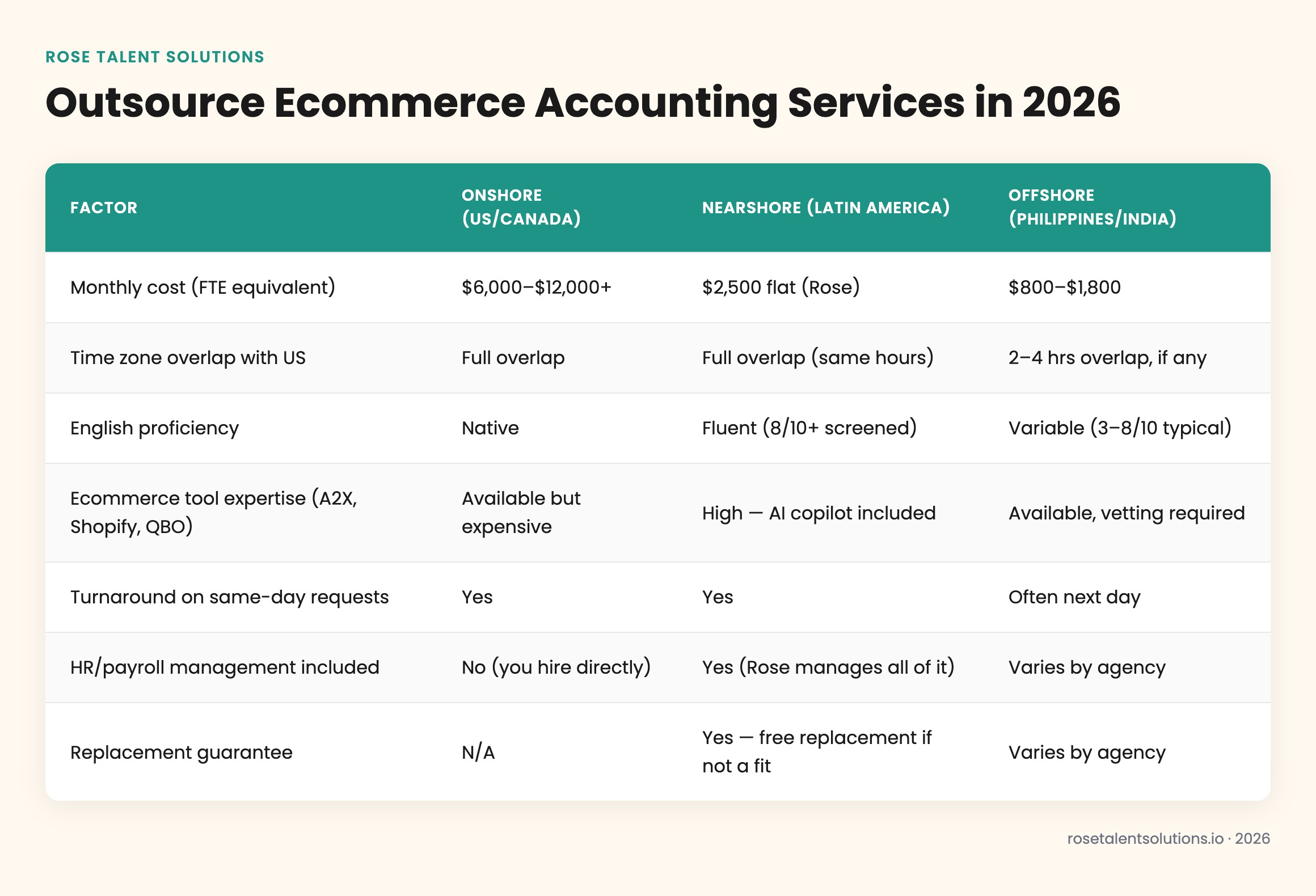
Not all outsourced accounting is equal. The three main models — onshore (US/Canada), nearshore (Latin America), and offshore (Philippines/India) — differ meaningfully on dimensions that directly affect ecommerce accounting quality. The biggest differentiators are not cost; they are time-zone coverage, communication fluency, and ecommerce software depth.
| Factor | Onshore (US/Canada) | Nearshore (Latin America) | Offshore (Philippines/India) |
|---|---|---|---|
| Monthly cost (FTE equivalent) | $6,000–$12,000+ | $2,500 flat (Rose) | $800–$1,800 |
| Time zone overlap with US | Full overlap | Full overlap (same hours) | 2–4 hrs overlap, if any |
| English proficiency | Native | Fluent (8/10+ screened) | Variable (3–8/10 typical) |
| Ecommerce tool expertise (A2X, Shopify, QBO) | Available but expensive | High — AI copilot included | Available, vetting required |
| Turnaround on same-day requests | Yes | Yes | Often next day |
| HR/payroll management included | No (you hire directly) | Yes (Rose manages all of it) | Varies by agency |
| Replacement guarantee | N/A | Yes — free replacement if not a fit | Varies by agency |
"Ecommerce accounting has become a specialized discipline. The volume of transactions, the proliferation of sales channels, and the complexity of sales tax nexus post-Wayfair mean that generalist bookkeepers are increasingly out of their depth with online retailers." — Kenji Kuramoto, Founder & CEO at Acuity (2023)
What Tasks Can You Actually Outsource to a Nearshore Ecommerce Accountant in 2026?
This is where many business owners undersell themselves. They assume outsourced accounting means basic data entry. In reality, a well-placed nearshore ecommerce accountant — especially one equipped with an AI copilot trained on their specific software stack — can own the entire financial operations layer of your store.
Every Rose Talent Solutions team member ships with a role-specific AI copilot trained on their primary software — whether that is QuickBooks Online, Xero, A2X, or Shopify. This means your nearshore accountant isn't just familiar with the tool; they're augmented by it. Reconciliations that took 3 hours manually can complete in under 45 minutes with AI-assisted workflows.
Here is a concrete list of tasks a nearshore ecommerce accountant handles day-to-day:
- Shopify, Amazon, Etsy, and WooCommerce revenue reconciliation
- A2X or similar settlement mapping to QuickBooks or Xero
- COGS tracking and inventory valuation (FIFO or weighted average)
- Multi-state sales tax reporting preparation (working alongside your CPA or TaxJar/Avalara)
- Accounts payable — supplier invoices, payment scheduling, vendor aging reports
- Monthly P&L and cash flow reporting
- Payroll entry and reconciliation
- Bank and credit card reconciliation across all accounts
- Year-end close support and CPA liaison
Accounts payable is often the first task ecommerce owners want to offload. If that is your starting point, the best accounts payable virtual assistant services breakdown covers exactly what to expect from a dedicated AP specialist versus a general bookkeeper — an important distinction as your supplier count grows.
According to McKinsey's State of AI in Operations (2023), companies that apply AI to finance and accounting functions report a 30–50% reduction in time spent on routine reconciliation tasks. Pairing a skilled nearshore bookkeeper with an AI copilot is precisely how Rose delivers that efficiency at a price point a $2M ecommerce brand can actually afford.
How to Outsource Ecommerce Accounting Services Without It Blowing Up
Most outsourcing failures are not talent failures — they are process failures. The store owner hands off "bookkeeping" without documenting what that means, the new hire does their best with incomplete context, and three months later the books are technically reconciled but useless for decision-making. Here is how to set it up so that does not happen.
Document Your Stack Before Day One
List every platform that touches money: your storefront(s), payment processors, fulfillment tools, and any automation middleware like Zapier or Make. Your bookkeeper needs a complete map of where transactions originate — not a verbal tour on day one.
Define Your Deliverables, Not Just Your Tasks
Instead of saying "keep the books clean," specify: reconciled accounts by the 5th of each month, P&L delivered by the 8th, weekly cash flow snapshot every Monday. Measurable outputs prevent ambiguity and make performance easy to evaluate.
Set Up Access and Controls on Day One
Add your bookkeeper as a limited-access user in QuickBooks, Xero, Shopify, and your bank. Use a password manager like 1Password for shared credentials. Never give unnecessary admin access — this is true for any hire, in-house or outsourced.
Establish a Weekly Sync
A 30-minute weekly check-in prevents small misunderstandings from becoming month-end disasters. Your nearshore bookkeeper works your time zone, so scheduling a 9 a.m. Tuesday call is no different than syncing with an in-house employee.
Review the First Month-End Together
Walk through the first P&L and reconciliation report side by side. This is where you catch categorization preferences, flag unusual accounts, and align on how you want your chart of accounts structured for ecommerce-specific reporting.
According to SHRM's Employee Job Satisfaction research (2023), clear role expectations and structured onboarding are among the top drivers of new-hire performance and retention — this applies equally to outsourced staff. The investment in a clean handoff pays for itself within the first 90 days.
You can explore the full bookkeeping and accounting services Rose offers, or head to the AI advantage page to see exactly how the role-specific AI copilots work before you make a decision.
Is Outsourcing Ecommerce Accounting Right for Your Store in 2026?
The honest answer is: it depends on your current stage. Below is a straightforward breakdown of where outsourcing ecommerce accounting creates the most value — and where it might be premature.
Strong Fit For
- Stores doing $500K+ in annual revenue with 200+ monthly transactions
- Multi-channel sellers (Shopify + Amazon + Wholesale) with complex reconciliation
- Founders spending more than 5 hours/week on financial admin
- Businesses that have outgrown a part-time local bookkeeper
- Brands preparing for fundraising, acquisition, or an audit that need clean GAAP-ready books
May Be Premature If
- You are pre-revenue or doing less than $10K/month — simpler DIY tools may suffice for now
- All transactions flow through a single platform with no inventory complexity
- You already have an in-house finance team with capacity and ecommerce expertise
According to Statista (2024), global ecommerce sales are projected to exceed $6.3 trillion in 2024 and continue growing through 2027. As the market grows, so does the financial complexity of running an online store — and the cost of messy books scales with revenue, not against it. A mis-categorized COGS line at $200K revenue is a rounding error; at $2M, it distorts every margin decision you make.
If you are at the stage where outsourcing makes sense, the fastest path to a placed and productive nearshore ecommerce accountant is the Rose Talent start page — where you describe the role and Rose handles recruiting, vetting, and placement, typically within a week. And if your store runs on Xero, it is worth reviewing what a dedicated Xero virtual bookkeeper brings to the table before your intake call, so you can brief the team on the exact software depth you need.
The single biggest mistake ecommerce operators make is waiting until their books are a disaster to outsource accounting. A nearshore bookkeeper placed in January, working clean books from day one, delivers far more value than the same person hired in October to untangle eight months of mis-categorized transactions before your CPA's deadline.