
Nearshore outsourced accounting is quietly becoming the default choice for ecommerce operators who are tired of doing their own books — or tired of paying US CPA rates for work that doesn't require a US CPA. If you're running a Shopify, Amazon, WooCommerce, or multi-channel store and your bookkeeping is still a monthly scramble, this guide is for you. We'll cover exactly what to outsource, what it should cost in 2026, and why the location of your accounting hire matters more than most operators realize.
What Is Outsourced Accounting for Ecommerce — and What Does It Actually Cover?
Outsourced accounting for ecommerce is the practice of delegating financial recordkeeping, reporting, and compliance tasks to an external professional or team rather than handling them in-house. For ecommerce specifically, this goes beyond basic bookkeeping — it includes tracking cost of goods sold (COGS) by SKU, reconciling payments across Stripe, PayPal, and Amazon Seller Central, managing multi-state sales tax obligations, and producing accurate profit-and-loss reports that reflect true inventory costs.
The distinction from general small-business bookkeeping is important. Ecommerce accounting involves platform-specific revenue recognition — Shopify payouts don't land in your bank the same day a sale happens, and Amazon remits a net figure that buries fees, refunds, and FBA costs inside a single deposit. A generalist bookkeeper often misclassifies these, which distorts your margins and creates tax headaches. An ecommerce-trained accountant knows the difference from day one.
If you want a deeper look at the specific platforms and software stacks that matter most, our guide on the best bookkeeping outsourcing options for ecommerce walks through the top providers and what each one is best suited for.
How Much Does Outsourced Ecommerce Accounting Cost in 2026?
Pricing for outsourced ecommerce accounting in 2026 ranges from about $300/month for a basic offshore bookkeeper to $8,000+/month for a US-based fractional controller. The sweet spot for most growing ecommerce brands — those doing $500K to $10M in annual revenue — is a full-time nearshore accounting VA at a flat monthly rate. Rose Talent Solutions prices this at $2,500/month, all-in: recruiting, vetting, payroll, HR, and ongoing management are included in that number.
That flat rate compares favorably to the fully-loaded cost of a US bookkeeper. According to the U.S. Bureau of Labor Statistics (2024), the median annual wage for bookkeeping and accounting clerks in the United States is $47,440 — roughly $3,953/month before you factor in payroll taxes, benefits, PTO, and recruiting costs. A fully-loaded US hire typically runs $55,000–$70,000/year. The math on nearshore is not close.
For more context on what the market actually charges, including hourly vs. flat-rate models, read our breakdown of how much outsourced bookkeeping costs for a small business — it covers the full pricing spectrum with real numbers.

Nearshore vs. Offshore vs. Onshore: Which Model Wins for Ecommerce Accounting in 2026?
Not all outsourced accounting is equal. The model you choose — nearshore, offshore, or onshore — determines your day-to-day experience more than the individual hire does. Timezone overlap, English fluency, and software familiarity are the three variables that separate a smooth working relationship from a constant communication tax.
| Factor | Onshore (US/Canada) | Offshore (Philippines/India) | Nearshore (Latin America) |
|---|---|---|---|
| Monthly cost (full-time) | $4,500–$8,000+ | $800–$1,500 | $2,500 flat |
| Timezone overlap with US | Full overlap | 0–4 hrs (async heavy) | Full overlap (same US hours) |
| English fluency | Native | Varies widely | Fluent (8/10+ screened) |
| US GAAP familiarity | High | Moderate | High (US-client trained) |
| Software readiness (QBO, Xero) | High | Moderate — varies by hire | High — AI copilot included |
| Recruiting overhead for you | High (you do it) | High (you vet, you manage) | None (Rose handles end-to-end) |
| Contract flexibility | Varies | Varies | Month-to-month, 30-day notice |
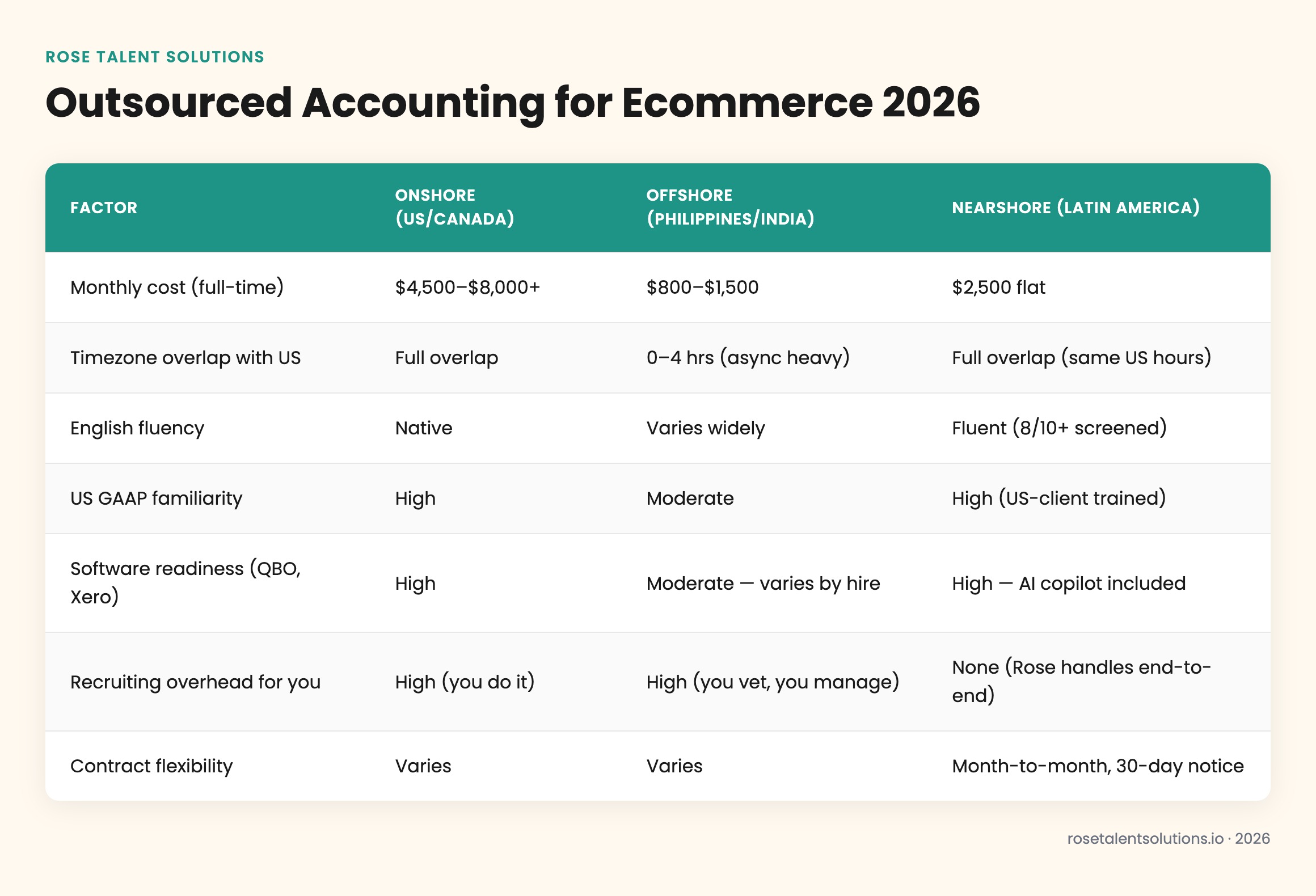
Rose Talent Solutions places accounting VAs based in Latin America who work your exact US business hours. There's no async lag, no overnight batch of answers. When your accountant is reviewing your Shopify payouts at 10am EST, you can message them and get a response before your next meeting. That real-time availability is the operational advantage that pricing charts don't capture. Every Rose team member also ships with a role-specific AI copilot trained on their core software stack — QuickBooks, Xero, A2X, and others — which compresses ramp time significantly.
"Ecommerce accounting has unique complexities — multi-channel revenue, inventory valuation, and sales tax nexus — that require bookkeepers who understand the platforms, not just debits and credits." — Kenji Kuramoto, Founder & CEO at Acuity (2023)
What Tasks Should You Actually Delegate to an Outsourced Ecommerce Accountant?
The most common mistake ecommerce founders make is outsourcing too little. They hand off bank reconciliations but keep doing their own revenue reporting, inventory adjustments, and sales tax filings. That's not outsourcing — that's just hiring someone to watch you do the hard parts. A well-scoped engagement should cover the full accounting cycle.
The three tasks that eat the most founder time in ecommerce accounting — multi-channel revenue reconciliation, sales tax filing across states, and COGS tracking by SKU — are also the three tasks a trained nearshore accountant can own completely from week one. Hand all three off, not just one.
Here's what a full-service outsourced ecommerce accountant typically handles on a recurring basis:
- Sales channel reconciliation — matching Shopify, Amazon, Etsy, and WooCommerce payouts to actual bank deposits, netting out fees and refunds correctly
- COGS tracking — updating cost of goods sold as inventory moves, especially critical for brands using 3PL fulfillment
- Accounts payable — managing supplier invoices and payment schedules
- Sales tax compliance — tracking nexus thresholds by state and filing returns via TaxJar or Avalara integrations
- Monthly close and P&L — producing clean financials by the 5th of every month so you can make real business decisions
- Inventory valuation — FIFO or weighted average cost calculations for accurate margin reporting
- Cash flow forecasting — flagging upcoming gaps before they become emergencies
According to SCORE (2023), small businesses that delegate bookkeeping save an average of 10+ hours per week of owner time. For an ecommerce founder, that recovered time goes directly into merchandising, marketing, and supplier relationships — the activities that actually compound revenue.
If your accountant uses QuickBooks Online, it's worth understanding the real cost structure of that tool in your workflow. Our post on QuickBooks bookkeeper cost breaks down what you should expect to pay and what's included in different engagement models.

How the Rose Talent Matching Process Works for Ecommerce Accounting Roles in 2026
Most founders who've tried hiring offshore accounting help on Upwork or Fiverr have a horror story. The person looked great on paper, the test task went fine, and then real-world performance was inconsistent. The core problem is that platformized hiring puts all the recruiting, vetting, and management work on you. Rose is structured to absorb that entire burden.
Intake call — 30 minutes
You describe your software stack, transaction volume, and specific pain points. Rose maps those to a candidate profile including required software certifications and English proficiency scores.
Candidate matching
Rose sources from its vetted Latin America network and presents matched candidates — typically within days. Every candidate has cleared the 8/10+ English screen and a role-specific skills assessment.
You interview and select
You meet the shortlist, ask the questions that matter to your operation, and choose. No guesswork — these candidates are already qualified before you talk to them.
Onboarding with AI copilot
Your new team member starts with a role-specific AI copilot trained on your software — QuickBooks, Xero, A2X, or others — which cuts ramp time and reduces early errors.
Ongoing management — handled by Rose
Payroll, HR, performance check-ins, and replacement coordination if needed are all managed by Rose. You manage the work; Rose manages the employment relationship.
The engagement runs month-to-month with a 30-day written notice to cancel — no long-term contract required. And if the team member turns out not to be a fit for your operation, Rose replaces them at no additional cost. That's the risk reversal: not a trial period, but a replacement guarantee that stays in place as long as you're a client.
You can learn more about the full service model — including what roles are available beyond accounting — on the Rose bookkeeping and accounting services page. If you're ready to scope a role, the fastest path is the get started page, which walks through the intake process in under five minutes.
How Ecommerce Accounting Software Shapes What Your VA Can Do
The tools your accountant uses determine the ceiling on what's possible. QuickBooks Online is the most common stack for US ecommerce brands under $5M in revenue. Xero is gaining ground, particularly with brands that sell internationally and need multi-currency support. A2X is the connector layer that most professional ecommerce accountants use to get clean, summarized journal entries out of Amazon and Shopify and into QBO or Xero — without it, you're manually categorizing hundreds of line items every month.
What software-trained VAs handle well
- Automated bank feed reconciliation in QuickBooks or Xero
- A2X settlement mapping for Amazon and Shopify payouts
- TaxJar or Avalara integration for sales tax filings
- Inventory sync with tools like Cin7, Skubana, or Linnworks
- Month-end close checklists with zero founder involvement
What still needs a US CPA or controller
- Annual tax return preparation and filing (Form 1120-S, Schedule C)
- R&D tax credit analysis or complex depreciation strategies
- Audit representation or IRS correspondence
- M&A due diligence or investor-ready GAAP financials
According to Intuit QuickBooks (2024), businesses that use a dedicated bookkeeper alongside accounting software are significantly more likely to have up-to-date financials at any given time compared to those relying on software alone. The software handles data processing; the human handles judgment calls — like whether a $4,200 Amazon remittance was categorized correctly or buried a $600 FBA storage fee.
If your business runs on Xero and you're weighing the VA model, our guide on working with a Xero virtual bookkeeper covers the specific skills and workflows to look for in that hire.
Sales tax compliance deserves specific attention here. The 2018 South Dakota v. Wayfair Supreme Court ruling eliminated the physical presence requirement for sales tax nexus, meaning any ecommerce business with sufficient sales volume in a state may owe sales tax there. According to the Tax Foundation (2024), 45 states plus the District of Columbia now have a sales tax — and most of them have economic nexus thresholds between $100,000 and $500,000 in annual sales. Managing that manually across multiple states is not a realistic founder task. It belongs on your accountant's plate.
Ecommerce accounting is also one of the clearest use cases for the AI copilot advantage that Rose builds into every placement. A QuickBooks-trained AI assistant catches categorization anomalies that a human would miss at speed — and flags them for review rather than letting them compound across a quarter. That's not a replacement for human judgment; it's the layer that makes human judgment faster and more reliable.
For benchmarking purposes: ecommerce brands doing $1M–$5M in revenue typically need 15–25 hours per month of dedicated accounting work. According to SHRM (2023), the average cost to recruit and onboard a new employee in the United States exceeds $4,700 — before salary. That recruiting overhead alone is something the Rose flat-rate model eliminates entirely. At $2,500/month with recruiting, payroll, and HR bundled in, the total cost of ownership is straightforwardly lower than building an in-house accounting function from scratch.
One nuance worth flagging: outsourced accounting is not the same as outsourced CFO services. A full-time accounting VA handles the operational layer — reconciliations, categorization, reporting, filings. Strategic decisions — pricing strategy, fundraising, unit economics modeling — still require senior financial leadership, either in-house or via a fractional CFO. The right nearshore hire clears the operational backlog so that strategic conversations are actually possible. Most founders can't think clearly about growth when they're manually reconciling Amazon remittances at 11pm.
According to Deloitte's Global Outsourcing Survey (2022), 70% of companies cite cost reduction as a primary driver for outsourcing — but a close second is access to capabilities not available in-house. For ecommerce businesses, that second reason is often the more important one: finding a bookkeeper who already knows A2X, already understands Amazon settlement reports, and already has a workflow for multi-state sales tax is genuinely difficult in a local hiring market. Nearshore staffing solves the capability problem and the cost problem simultaneously.