
What Is a Nearshore Virtual Assistant — and How Does It Differ from Offshore in 2026?
A nearshore virtual assistant is a remote professional based in a geographically proximate region — for US and Canadian businesses, that means Latin America. They work your business hours, operate inside a 0–3 hour time-zone window, and are screened specifically for English fluency. At Rose Talent Solutions, every nearshore VA must score 8/10 or higher on English proficiency screens before a single client ever sees their profile.
An offshore virtual assistant is based in a distant region with significant time-zone separation from North America — typically 10–14 hours offset from US Eastern time. Offshore models trade real-time availability for a lower headline hourly rate. Whether that trade-off is worth it depends entirely on what tasks you are delegating and how fast those tasks require a live human decision behind them.
These two models sit inside the broader outsourcing taxonomy. According to SHRM (2024), the three types of outsourcing are: onshore (same country), nearshore (adjacent region, similar time zone), and offshore (distant region, lower cost). Each solves a different problem. Onshore maximizes cultural alignment but maximizes cost. Offshore minimizes cost but maximizes coordination friction. Nearshore lands in the middle — and for most US businesses running time-sensitive workflows, that middle ground outperforms both extremes on total return.
Turnaround speed is often the invisible cost nobody puts in a spreadsheet. If your offshore VA batches overnight replies and your nearshore VA handles the same query live at 10am, the nearshore VA just prevented a tenant, customer, or lead from going cold — and that has measurable dollar value.
How Nearshore vs Offshore Virtual Assistant Salary and Pay Actually Compare in 2026
The sticker-rate conversation is almost always misleading. At the raw labor level, nearshore vs offshore virtual assistant salary comparisons show that nearshore VAs in Latin America average $10–$18/hour for business operations roles, while comparable offshore roles in lower-cost distant markets average $5–$9/hour, according to Bureau of Labor Statistics occupational wage data (2024). That spread looks decisive — until you add the real total cost of ownership.
Here is what the true nearshore vs offshore virtual assistant cost looks like when you add the variables most comparison articles ignore:
- Onboarding time: Offshore VAs in mismatched time zones require asynchronous onboarding spread over 2–4 weeks. Nearshore VAs in Latin America can complete live onboarding in 3–5 business days because you are both awake at the same time.
- Rework and error rate: Communication gaps generate rework. A McKinsey Global Institute (2023) analysis found that time-zone misalignment increases task rework rates by up to 27% in knowledge-work environments.
- Turnover cost: The average cost to replace a specialized VA — recruiting, vetting, retraining — runs $3,000–$5,000 per cycle, according to SHRM (2024). Nearshore Latin American markets show lower annual churn due to stronger labor-market stability in key cities.
- Management overhead: Someone on your team manages the offshore VA asynchronously. At a US manager's loaded hourly rate of $45–$65/hour, even 3 extra hours per week of oversight adds $585–$845/month to your real cost.
When you stack those four variables, the offshore model's $800–$1,200/month sticker-price advantage frequently disappears within 90 days for any role that requires live judgment calls — customer service, scheduling, bookkeeping reconciliation, or leasing coordination.

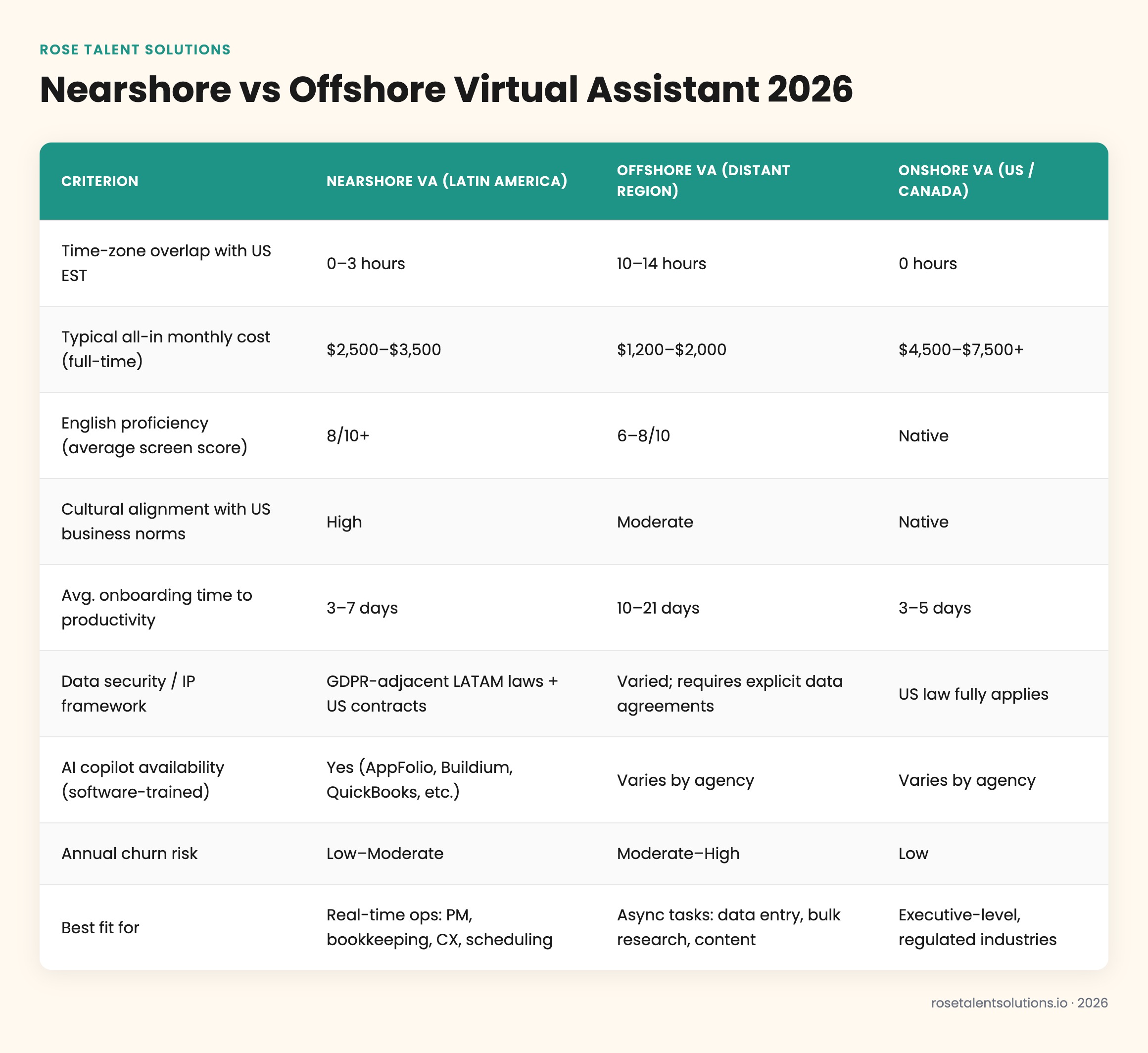
Nearshore vs Offshore Virtual Assistant: The 2026 Head-to-Head Comparison Table
Use this table as your decision baseline. Every criterion below has a direct impact on which model generates positive ROI for your business in 2026. Onshore is included for full context — most US businesses rule it out on cost alone, but it belongs in the frame.
| Criterion | Nearshore VA (Latin America) | Offshore VA (Distant region) | Onshore VA (US / Canada) |
|---|---|---|---|
| Time-zone overlap with US EST | 0–3 hours | 10–14 hours | 0 hours |
| Typical all-in monthly cost (full-time) | $2,500–$3,500 | $1,200–$2,000 | $4,500–$7,500+ |
| English proficiency (average screen score) | 8/10+ | 6–8/10 | Native |
| Cultural alignment with US business norms | High | Moderate | Native |
| Avg. onboarding time to productivity | 3–7 days | 10–21 days | 3–5 days |
| Data security / IP framework | GDPR-adjacent LATAM laws + US contracts | Varied; requires explicit data agreements | US law fully applies |
| AI copilot availability (software-trained) | Yes (AppFolio, Buildium, QuickBooks, etc.) | Varies by agency | Varies by agency |
| Annual churn risk | Low–Moderate | Moderate–High | Low |
| Best fit for | Real-time ops: PM, bookkeeping, CX, scheduling | Async tasks: data entry, bulk research, content | Executive-level, regulated industries |
What Are the Disadvantages of Nearshoring — and How Do You Mitigate Them?
Nearshoring is not perfect, and you should know exactly where the model has edges before you commit to it. What are the disadvantages of nearshoring? There are three legitimate ones worth naming directly.
1. Higher base cost than offshore. You pay a premium for time-zone alignment and English fluency. If your workflow is 100% asynchronous — think bulk data entry, overnight report generation, or image tagging — that premium may not generate enough ROI to justify it. In those cases, a well-managed offshore model is rational.
2. Smaller raw talent pool in ultra-specialized niches. Latin America has fewer specialized VAs than some distant offshore markets at absolute scale. In highly specific technical categories — certain niche programming stacks or medical transcription at volume — offshore still has depth advantages. For core business operations roles (property management, bookkeeping, customer experience), the Latin American talent pool is deep enough for virtually any SMB.
3. Country-specific labor law complexity. Employment law in Mexico, Colombia, Argentina, and Brazil varies significantly. Using a staffing partner who handles payroll and HR compliance in-country eliminates this risk entirely. At Rose Talent Solutions, payroll, HR, and compliance are included in the flat $2,500/month rate — you are never exposed to local labor law directly.
The hidden cost of offshore VAs is not the hourly rate — it is the 10–14 hour timezone gap that turns every real-time decision into a 24-hour delay. For any role that touches a customer, a tenant, or a transaction in motion, that delay has a measurable dollar cost that sticker-rate savings rarely cover.
On data security: Latin American countries increasingly operate under privacy frameworks modeled after GDPR. For US businesses, the practical standard is contractual — a well-drafted data processing agreement (DPA) with your VA or their employer covers IP protection, confidentiality, and data handling regardless of geography. Nearshore agencies operating under US-aligned contracts are easier to hold accountable given jurisdiction proximity, which is an underrated structural advantage.

How to Choose the Right Model: A 2026 Decision Framework
Instead of a generic pros/cons conclusion, here is a scoring rubric. Score your workflow on each axis and pick the model that matches your dominant pattern.
Choose nearshore if: your tasks require real-time judgment (tenant escalations, client calls, live bookkeeping reconciliation), your team communicates primarily by Slack or phone during US hours, your industry has compliance sensitivity that benefits from jurisdiction proximity, or you have had previous outsourcing experiments fail due to communication friction.
Choose offshore if: your workflow is genuinely asynchronous (overnight batch processing, bulk content, data scraping), your team has a dedicated ops manager to absorb coordination overhead, and the task type carries low penalty for a 24-hour turnaround window.
According to Gallup's State of the Global Workplace (2024), 51% of US workers cite schedule flexibility as a major factor in job retention — which makes the month-to-month nearshore model structurally aligned with how modern teams want to operate on both sides of the placement.
Nearshore VA — Strengths
- Real-time availability during US/Canada business hours
- 8/10+ English proficiency standard (Rose screen)
- Strong cultural alignment with North American business norms
- Faster onboarding — 3–7 days to full productivity
- Lower rework rates due to synchronous communication
- AI copilot trained on your specific software stack
Offshore VA — Strengths
- Lower base sticker rate ($5–$9/hr vs $10–$18/hr)
- Larger absolute talent pool in highly specialized technical niches
- Established async work culture and batch-processing workflows
- Suitable for 100% overnight or batch task pipelines
How the Rose Talent Solutions Nearshore Model Works — From Day One in 2026
Rose Talent Solutions places nearshore virtual assistants from Latin America for US, Canadian, and UK businesses at a flat $2,500/month — full-time, 40 hours per week, with recruiting, vetting, payroll, HR, and ongoing management all included. There is no long-term contract; you can cancel with 30 days written notice. If your placed team member is not the right fit, Rose replaces them at no additional cost.
Every Rose team member ships with a role-specific AI copilot trained on the software your business actually uses — AppFolio, Buildium, QuickBooks, and more. Your VA arrives knowing the tool, not learning it on your clock. According to Buildium's State of the Property Management Industry Report (2024), property management companies that leverage technology-integrated staffing reduce administrative task completion time by up to 35%.
Discovery Call
You describe your workflow, software stack, and must-have skills. Rose maps the role and confirms the right candidate profile within 24 hours.
Candidate Matching
Rose sources from its pre-vetted Latin American talent network, screens for English proficiency (8/10+ floor), software literacy, and role-specific experience — typically within 3–5 business days.
You Interview and Approve
You meet shortlisted candidates via video call. No one is placed without your explicit sign-off.
Onboarding and Go-Live
Your VA starts on your systems with their AI copilot already configured. Rose handles payroll, HR, and compliance from day one.
Ongoing Management and Support
Rose monitors performance and provides an HR backstop throughout the engagement. If the fit is not right at any point, a free replacement is initiated — no additional cost, no re-recruiting fee.
If you run a property management operation and need leasing coordinators, maintenance dispatchers, or tenant communication specialists, Rose places nearshore VAs from Latin America who are already fluent in the tools your PMs use daily. The same applies to bookkeeping and accounting roles — nearshore VAs trained on QuickBooks and AppFolio financial modules are available at the same flat monthly rate. For a deeper look at how AI augments every placement, see the AI advantage page.
Can you make $10k a month as a virtual assistant? At the senior specialist level — executive assistants with financial operations experience, bilingual property management coordinators, or specialized legal VAs — professionals in this space can reach $3,000–$5,000/month in total compensation through agencies. The $10k/month ceiling is achievable primarily for US-based, highly specialized VAs or those running their own multi-client practices, according to BLS occupational wage data (2024). For most nearshore Latin American VAs, the realistic earning range is $1,800–$4,500/month depending on role seniority and market.