
Why Nearshore Onboarding Is Different — and Why It Works
Nearshore virtual assistants — team members based in Latin America who work your US business hours — onboard faster than any other staffing model, but only if you follow a deliberate 30-day structure. The timezone alignment that makes nearshore staffing so effective also means your VA is reachable in real time, which changes how you train and delegate. You don't batch feedback overnight; you iterate the same morning. That compresses a typical 90-day ramp into 30 days when done correctly.
A nearshore VA is not a freelancer you ping occasionally. They are a full-time (40-hour-per-week) team member embedded in your operations, fluent in English, and already familiar with the software stack your business runs on. Understanding that distinction up front is what separates operators who extract massive value from their VA in month one from those who spend three months re-explaining the same tasks. If you are still weighing whether nearshore is the right model for your business, the nearshore vs offshore virtual assistant breakdown is worth reading before you move forward.
According to Gallup's State of the Global Workplace report (2023), unclear onboarding is one of the top drivers of early underperformance for remote workers. The fix is not more documentation — it is a structured, week-by-week transfer of context, access, and responsibility. The four-week framework below is what that looks like in practice.

Week 1 in 2026: Access, Context, and the First Live Tasks
The single most common onboarding mistake is withholding system access until the VA "proves themselves." That logic delays everything. On day one, grant access to every tool they will eventually use — your property management software, inbox, task manager, communication channels, and any shared drives. Restricted access in week one creates a false ramp: your VA looks slow because you haven't given them the road yet.
Every Rose Talent Solutions team member arrives with a role-specific AI copilot trained on their software stack — AppFolio, Buildium, QuickBooks, and others — so they're not starting from zero on the tools. That cuts the software ramp that normally eats two to three weeks of a traditional hire's onboarding. According to U.S. Bureau of Labor Statistics JOLTS data (2024), the average time-to-productivity for a new administrative hire is 8–12 weeks. A nearshore VA with pre-trained AI tools collapses that window dramatically.
In week one, your VA should shadow you live on every core workflow. Don't record a Loom and disappear. Join them on a live screen share while they process a maintenance request, respond to a leasing inquiry, or reconcile a transaction. Real-time observation in the first five days catches misunderstandings before they become habits. Schedule a 15-minute daily check-in at the same time every morning — this single practice is the highest-leverage thing you can do in week one.
"The fastest-ramping remote hires I've seen are the ones where the manager treats day one like an orientation, not a test. You have to give people context before you can hold them to outcomes." — Matt Mottola, Co-Author of The Human Cloud and Future of Work Analyst (2023)
How to Compare Nearshore, Offshore, and Onshore VAs for Onboarding Speed in 2026
Not all virtual assistant models onboard at the same pace. The table below compares the three main staffing models across the dimensions that matter most during a 30-day onboarding window. Timezone fit and English proficiency are the two variables that compress or extend your ramp time most aggressively.
| Factor | Nearshore VA (Latin America) | Offshore VA (Philippines/India) | Onshore VA (US-based) |
|---|---|---|---|
| Timezone overlap with US hours | Full overlap (same or ±1–2 hrs) | Minimal (6–12 hr gap) | Full overlap |
| English proficiency (typical floor) | 8/10+ (Rose standard) | Varies (5–8/10) | Native (10/10) |
| Average monthly cost (full-time) | ~$2,500 flat | $800–$1,800 | $4,500–$7,000+ |
| Typical time-to-productivity | 2–4 weeks | 6–10 weeks | 4–6 weeks |
| AI copilot / software pre-training | Yes (Rose-standard) | Rarely included | Rarely included |
| Real-time collaboration during US hours | Yes | No (async only) | Yes |
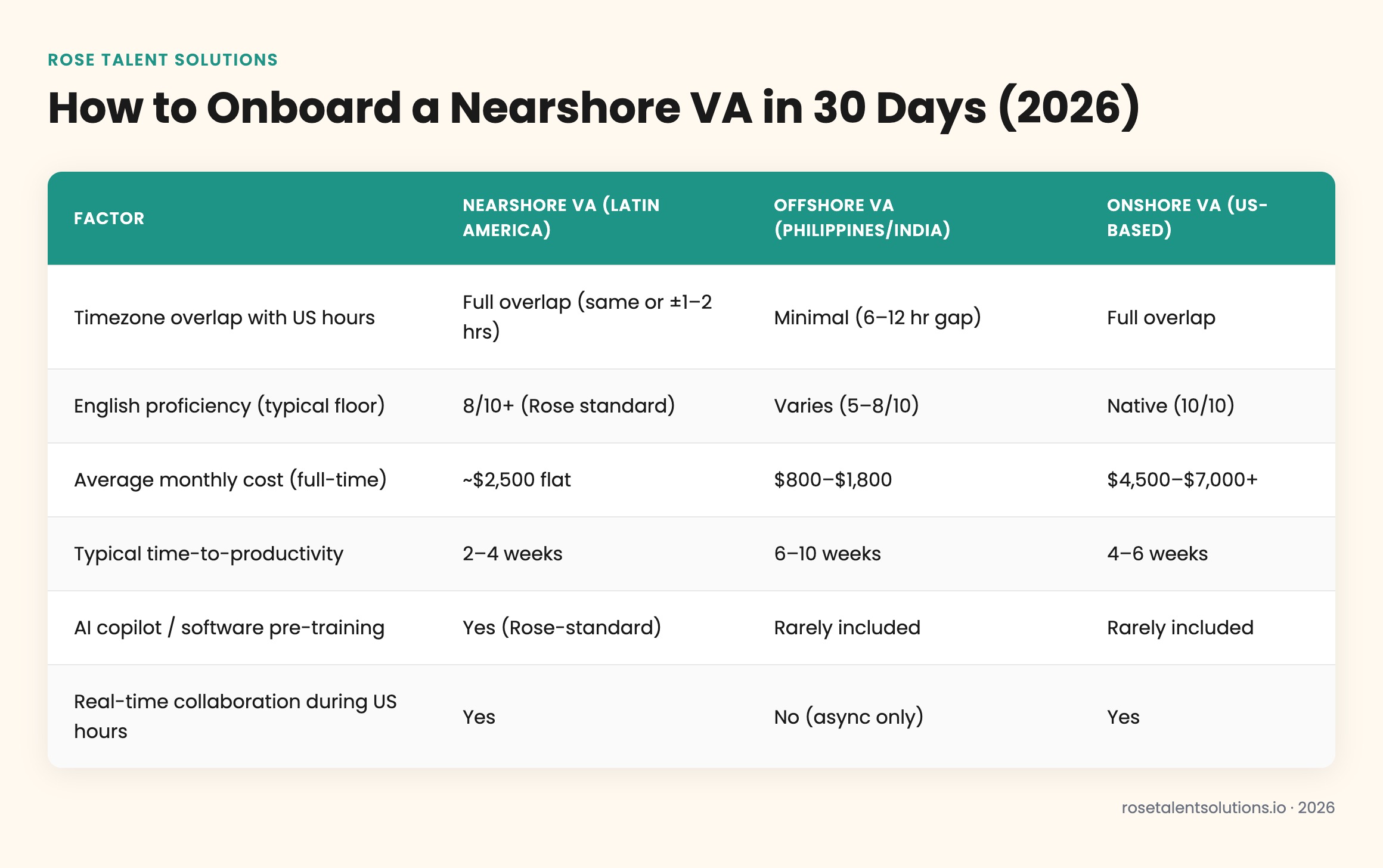
The offshore model's low sticker price evaporates when you factor in the timezone drag. Every back-and-forth that takes 20 minutes with a nearshore VA takes 24–48 hours with an offshore team member working opposite shifts. If you want to dig deeper into why that gap matters operationally, the full nearshore vs offshore comparison covers the cost math in detail.
Week 2–3: How Task Ownership Transfer Drives 30-Day Independence
By the start of week two, your VA should stop shadowing and start doing — with you watching. The psychological shift matters: they are now the primary actor, not the observer. Your job in week two is to let them attempt tasks independently, then debrief the output rather than pre-correcting every step. According to SHRM's onboarding research (2022), employees who are given autonomous ownership of tasks within their first two weeks show 34% higher 90-day retention than those kept in observation mode longer.
The handoff moment — when you stop pre-approving every output and start reviewing completed work — is the most important transition in 30-day onboarding. Most operators delay it out of caution. Delaying past day 14 is the #1 reason VAs are still "not ready" at day 60.
In week two, pick three repeatable tasks and hand them off completely. For a property management VA, that might be maintenance ticket logging, rent follow-up calls, and owner report preparation. For a bookkeeping or accounting VA, it might be transaction coding, bank reconciliation, and invoice processing. Define what "done" looks like with a simple checklist — not a 40-page SOP. A one-page task card with the expected output, the tool, and the deadline is all most high-performing nearshore VAs need.
Week three is about edge cases. Every workflow has exceptions — a tenant who responds unusually, a transaction that doesn't categorize cleanly, a vendor who calls instead of emailing. Walk through three to five real edge cases that happened in the last 90 days and show your VA exactly how you handled each one. This is the context that rarely makes it into written SOPs but determines whether a VA operates confidently or escalates everything.

According to McKinsey's research on new hire experience (2022), structured milestone check-ins at days 7, 14, and 30 reduce time-to-full-productivity by up to 25% compared to unstructured onboarding. Build those three check-ins into your calendar before your VA starts — not after.
How to Structure Week 4 for Full Independence by Day 30
Week four is the proof-of-concept week. Your VA should be running their full task list without daily check-ins from you. Shift your daily 15-minute call to a weekly 30-minute review. The conversation should change: instead of "how do I do this," it should be "here's what I completed, here's what I flagged, here's what I need a decision on." That shift in conversation format is the clearest signal that the 30-day onboarding has worked.
Day 1–2: Full System Access
Grant access to every tool on day one. No delayed permissions. Share login credentials, invite to communication channels, and walk through the software stack live on a screen share.
Days 3–7: Live Shadowing
Your VA observes every core workflow in real time. Use live screen shares, not pre-recorded videos. Run a 15-minute debrief at end of each day to surface questions before they compound.
Days 8–14: Supervised Doing
VA executes tasks while you observe. Debrief outputs rather than pre-correcting inputs. Transfer ownership of three core repeatable tasks by end of week two.
Days 15–21: Edge Case Training
Walk through five real exception scenarios from the last 90 days. Document VA's decisions for future reference. Reduce check-in frequency to every other day.
Days 22–30: Independent Execution
VA owns full task list independently. Shift to weekly review calls. Evaluate output quality, communication clarity, and proactive flagging. Assess readiness for scope expansion.
By day 30, you should have a clear picture of what your VA does exceptionally well and where they need more context. That assessment is what drives month two — not another round of onboarding, but deliberate scope expansion. Rose's pricing model makes this easy to plan around: at a flat $2,500 per month with no long-term contract, you're not locked into a six-month runway to justify the investment. And if the fit isn't right at day 30, Rose replaces the team member at no additional cost — that's the risk reversal built into the model. You can review how Rose stacks up against other providers in the best nearshore virtual assistant companies roundup to see how the replacement guarantee compares across the market.
The operators who get the most from this model don't just onboard well — they treat month one as the foundation for a multi-year working relationship. A VA who is fully independent by day 30 is ready to take on higher-leverage work in month two: owner communications, reporting analysis, vendor management, and more. If you're exploring whether nearshore staffing is the right fit for your stage of growth, nearshore staffing for startups and growing teams covers the operational fit criteria worth checking before you get started with your first placement.
What Goes Right in 30-Day Onboarding
- Full system access granted on day one — no permission delays
- Daily 15-minute check-ins in week one catch issues before they compound
- Task ownership transferred by day 14, not day 30
- Edge case walkthroughs replace 40-page SOPs
- Weekly review calls replace daily hand-holding by week four
What Derails 30-Day Onboarding
- Withholding access "until the VA proves themselves"
- Training via pre-recorded videos instead of live shadowing
- Keeping the VA in observation mode past day 10
- No defined "done" criteria for handed-off tasks
- Skipping the day 14 and day 30 milestone check-ins
The 30-day framework above isn't theoretical — it mirrors how top-performing operator clients structure their first month with a nearshore team member. According to Deloitte's Future of Work research (2023), companies that use structured 30-day onboarding frameworks for remote hires report 2× higher satisfaction scores at the 90-day mark compared to those using informal onboarding. Structure in month one is the highest-return investment you can make in any new hire relationship — and with a nearshore VA working your exact business hours, you have every tool you need to execute it properly.