
What Is a Nearshore Virtual Assistant — and Why Does the Label Matter in 2026?
Nearshore virtual assistants are remote professionals based in Latin America who work for US, Canadian, or UK businesses during standard North American business hours. Unlike offshore VAs sourced from the Philippines or India — who often work on opposite time zones — a nearshore hire in Bogotá, Mexico City, or Buenos Aires clocks in when your team does, answers your Slack messages in real time, and joins your 10am Zoom without anyone needing to set an alarm at 2am. That timezone alignment alone changes the entire collaboration dynamic, and it's the single biggest reason buyers who ask "how much does a nearshore virtual assistant cost in 2026" often find the answer surprisingly affordable relative to the output they get.
The distinction matters because buyers searching for VA pricing in 2026 are frequently quoted rates from offshore platforms and then surprised when real-world costs — time-zone friction, communication rework, turnover — push the true bill far higher than the headline rate. This guide breaks down what nearshore VAs actually cost, what drives those costs, and how to evaluate the numbers honestly.
According to the U.S. Bureau of Labor Statistics (2024), the median hourly wage for secretaries and administrative assistants in the United States sits at $22.93 — and that number doesn't touch benefits, payroll taxes, office space, or equipment. When you load those in, the fully-burdened cost routinely exceeds $40/hr for even a mid-level admin role. Nearshore staffing is not cheap — but it is dramatically cheaper than the domestic alternative on an apples-to-apples basis.
How Much Does a Nearshore Virtual Assistant Cost in 2026? The Three Pricing Models
There are three ways buyers pay for nearshore virtual assistants in 2026, and each has a different risk profile. Understanding the model behind the price tag matters more than the number itself.
1. Freelance / marketplace platforms — Sites like Workana, Upwork, and independent Latin America freelance networks list nearshore VAs in the $12–$30/hr range depending on skill level, English proficiency, and niche experience. You source, vet, onboard, manage, and replace them yourself. There is no HR backstop. If they quit or underperform, the search starts over at your expense. For a founder with time to spare, this can work. For a busy operator, the hidden management overhead typically exceeds any savings versus an agency. Our analysis of virtual assistant hiring ROI benchmarks shows that DIY hiring commonly costs 1.5–2× more in total time-adjusted dollars than the sticker price suggests.
2. Full-service nearshore staffing agency — A flat monthly fee covers recruiting, multi-stage vetting, payroll, HR compliance, benefits administration, ongoing performance management, and a replacement guarantee if the match isn't right. Rose Talent Solutions charges $2,500/month for a full-time (40 hrs/week) dedicated team member. That rate is all-in — no setup fees, no per-task markups, no long-term contract. If the team member isn't a fit, we replace them at no additional cost.
3. Hybrid staffing + software models — A newer category where agencies embed role-specific AI copilots trained on the exact platforms your VA will use — AppFolio, Buildium, QuickBooks, and similar tools. Rose's AI-advantage model ships every team member with a copilot pre-trained on their assigned software stack, which meaningfully compresses ramp time and reduces errors in the first 30 days.
Nearshore vs. Offshore vs. Onshore in 2026: How the Numbers Compare
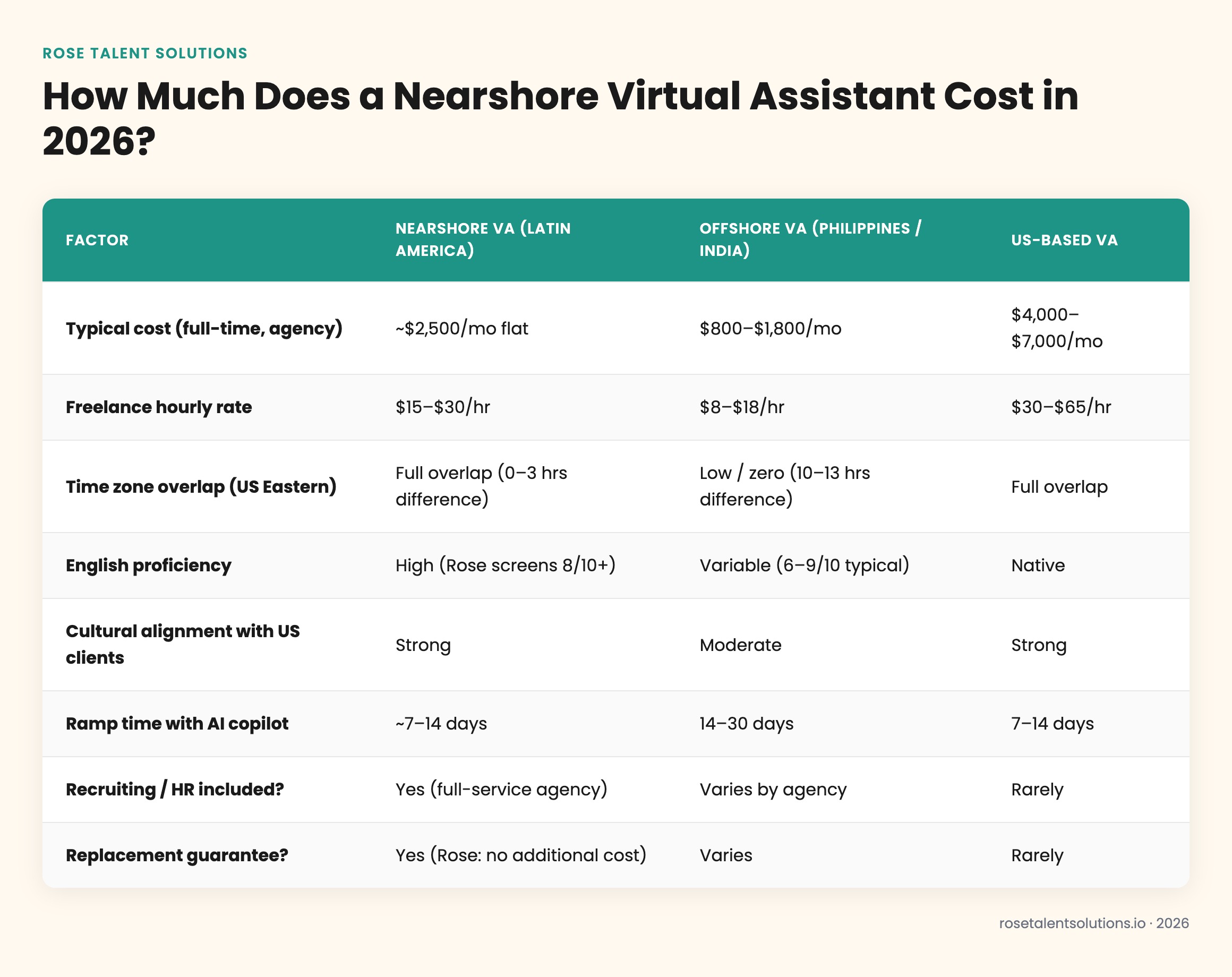
Pricing comparisons mean nothing without context. The table below puts nearshore, offshore, and US-based virtual assistant options side by side on the dimensions that actually affect your bottom line. If you want a deeper breakdown of the non-price differences, our post on nearshore vs. offshore virtual assistants covers the full picture.
| Factor | Nearshore VA (Latin America) | Offshore VA (Philippines / India) | US-Based VA |
|---|---|---|---|
| Typical cost (full-time, agency) | ~$2,500/mo flat | $800–$1,800/mo | $4,000–$7,000/mo |
| Freelance hourly rate | $15–$30/hr | $8–$18/hr | $30–$65/hr |
| Time zone overlap (US Eastern) | Full overlap (0–3 hrs difference) | Low / zero (10–13 hrs difference) | Full overlap |
| English proficiency | High (Rose screens 8/10+) | Variable (6–9/10 typical) | Native |
| Cultural alignment with US clients | Strong | Moderate | Strong |
| Ramp time with AI copilot | ~7–14 days | 14–30 days | 7–14 days |
| Recruiting / HR included? | Yes (full-service agency) | Varies by agency | Rarely |
| Replacement guarantee? | Yes (Rose: no additional cost) | Varies | Rarely |
What Drives Nearshore Virtual Assistant Cost Up or Down in 2026?
Not every nearshore VA costs the same, and even within a flat-rate agency model, understanding the cost drivers helps you evaluate whether you're getting value. According to SHRM's annual workforce benchmarking data (2024), total hiring and onboarding costs for a new employee average $4,700 in the US — a number that a flat-fee agency model essentially eliminates from your P&L.
Skill level and specialization. A general admin VA handling calendar management and inbox sorting costs less than a credentialed bookkeeper managing QuickBooks reconciliations or a property management VA handling AppFolio work orders, lease renewals, and maintenance coordination. Specialized roles command a premium because the vetting bar is higher and the candidate pool is smaller.
Software proficiency requirements. VAs who arrive pre-trained on specific platforms — AppFolio, Buildium, Yardi, QuickBooks — cost more to recruit and vet, but they ramp faster and produce fewer errors in the first 60 days. The AI copilot layer Rose bundles into every placement compresses this further, but it doesn't eliminate the underlying value of human software experience.
Language requirements. English-only roles are the most common. Bilingual Spanish-English roles — useful for US businesses with Spanish-speaking tenant bases or customer segments — are slightly harder to fill and may carry a modest premium depending on fluency level required.
Agency overhead model. Some agencies charge setup fees ($500–$2,000), monthly platform fees on top of the VA rate, or per-replacement fees. Rose charges a single flat $2,500/month with no setup fee and a free replacement if the match isn't right. When comparing agency quotes, always ask: what does "all-in" actually include?
"When you're evaluating virtual staffing costs, the question isn't what you pay per hour — it's what it costs you to get 40 productive hours of output. Those are very different numbers." — Liam Martin, Co-founder at Time Doctor and author of Running Remote (2023)
The real cost comparison isn't nearshore vs. offshore — it's nearshore vs. the fully-burdened cost of a domestic hire. When you factor in US salary, payroll taxes (~7.65% employer FICA), health insurance (average $7,911/year per employee per KFF's 2024 Employer Health Benefits Survey), PTO, equipment, and management time, a $45,000/year admin employee costs closer to $62,000–$70,000 fully loaded — or $5,200–$5,800/month. A $2,500/month nearshore VA delivers comparable output at less than half that cost.
How the $2,500/Month Model Breaks Down — and What It Actually Buys You in 2026
Flat-rate pricing sounds simple, but buyers often don't realize how many cost layers it absorbs. Here's what the $2,500/month includes when you place a full-time team member through Rose:
Sourcing and multi-stage vetting
Rose sources from a pre-screened Latin American talent pool, runs English proficiency screens (minimum 8/10), skills assessments, background checks, and structured interviews before you see a single candidate profile.
Placement and onboarding
Once you approve the match, the team member is onboarded with a role-specific AI copilot pre-trained on your software stack — AppFolio, Buildium, QuickBooks, or whichever tools your workflow runs on.
Ongoing HR, payroll, and compliance
Rose handles all Latin American payroll, contractor compliance, and HR administration. You never touch a foreign payroll system or worry about local labor law.
Performance management and replacement guarantee
If the team member isn't performing or isn't a fit for your team, Rose replaces them at no additional cost — no penalty, no search fee, no restart cost to you.
For businesses that need specialized financial support, Rose's bookkeeping and accounting VA service places professionals pre-vetted in QuickBooks, Xero, and related platforms — delivered inside the same $2,500/month flat-rate model. According to QuickBooks' small business research (2023), businesses that outsource bookkeeping save an average of 10 hours per week on financial administration — time that goes directly back to revenue-generating work.
Is a Nearshore Virtual Assistant Worth the Cost in 2026? How to Calculate Your ROI
Pricing only makes sense relative to value delivered. A $2,500/month nearshore virtual assistant who saves you 20 hours of your own time per week — at even a modest $100/hr valuation of your time — generates $8,000/month in recovered founder capacity. That's a 3.2× ROI before you count any output the VA produces directly.
The calculation shifts depending on what role you're filling. A leasing coordinator handling 50 inquiries per week through your property management platform generates direct revenue impact. A bookkeeper catching a $3,000 reconciliation error pays for multiple months of their own cost. The ROI math is almost always favorable — the question is whether you're filling the right role and setting the VA up to succeed.
If you're evaluating multiple agencies, our breakdown of the best nearshore virtual assistant companies in 2026 covers pricing structures, vetting standards, and replacement policies across the leading providers — useful context before you sign anything.
According to McKinsey's global workforce research (2024), companies that integrate remote talent with AI-assisted workflows report 20–35% higher output per worker compared to traditional hiring models. The AI copilot layer isn't marketing language — it measurably changes what a nearshore virtual assistant can produce in a standard 40-hour week.
Why nearshore VA cost makes sense in 2026
- 40–60% lower fully-burdened cost vs. US domestic hire
- Full US business hours overlap — no overnight lag
- Flat-rate agency model eliminates recruiting, HR, and payroll overhead
- AI copilot compresses ramp time to 7–14 days
- Month-to-month terms — no long-term contract risk
- Replacement guarantee removes placement risk entirely
When nearshore may not be the right fit
- Roles requiring physical on-site presence (not remote-compatible)
- Highly regulated roles requiring US licensure (CPA, attorney, licensed contractor)
- Ultra-niche technical roles with very small Latin American talent pools
- Teams not ready to manage a remote worker at all (no documented SOPs)
For startups specifically, the economics are even more compelling — lean teams can access specialized talent without committing to a full domestic salary. Our guide to the best nearshore staffing agencies for startups covers which models fit early-stage budgets and which are better suited to scaling operators.
Ready to run the numbers for your specific role? Start a placement with Rose and get a matched candidate profile within days — no long-term contract, and a free replacement if the match isn't right.