What Is a Nearshore Bookkeeper — and Why Does the Definition Matter in 2026?
Nearshore bookkeepers are full-time financial professionals based in Latin America — countries like Colombia, Mexico, Costa Rica, and Argentina — hired by US, Canadian, or UK businesses to handle day-to-day accounting tasks remotely. The word "nearshore" is doing real work in that sentence: unlike offshore providers based in the Philippines or India, nearshore bookkeepers sit in the same or adjacent time zones as your team, speak English at a business-fluent level, and operate on your schedule from 9 to 5. That distinction turns out to matter enormously when your books need a quick question answered before a Friday payroll run.
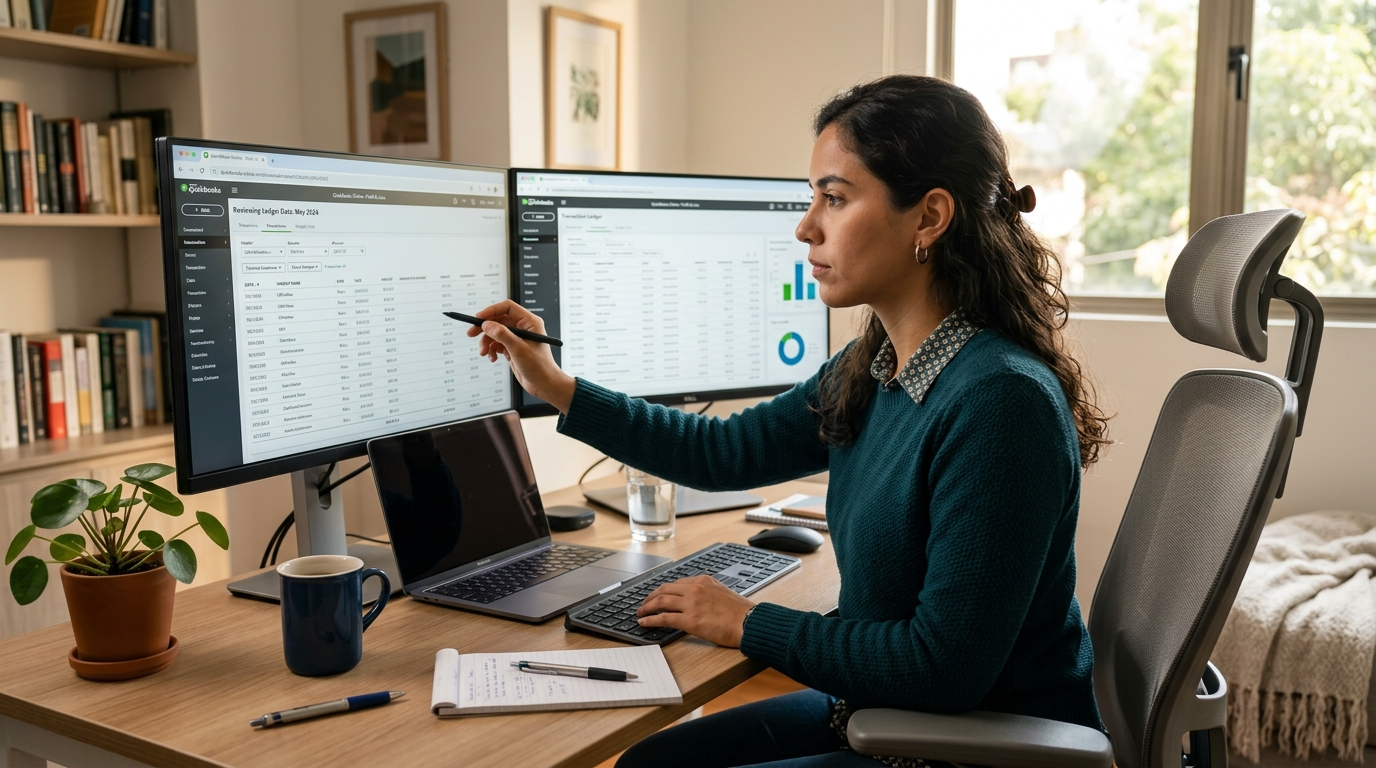
A nearshore bookkeeper typically handles accounts payable and receivable, bank reconciliations, monthly close, payroll processing, expense categorization, and financial reporting. They work inside the same software your team already uses — QuickBooks, Xero, FreshBooks, NetSuite — so there is no workflow translation layer to manage. If you want a deeper look at how that software integration works in practice, the Rose guide on nearshore accounting walks through the full scope of roles and tools involved.
The market has shifted fast. According to the U.S. Bureau of Labor Statistics (2024), the median annual wage for a bookkeeping clerk in the United States is $47,440 — and that figure excludes benefits, payroll taxes, and recruiting costs that routinely push the all-in cost past $65,000. Businesses looking to close that gap without sacrificing quality are increasingly turning to nearshore bookkeepers in Latin America.
How Nearshore Bookkeepers Compare to Offshore and Onshore Hires in 2026
The bookkeeping outsourcing market offers three broad choices: hire locally (onshore), hire from a distant low-cost region like the Philippines or India (offshore), or hire nearshore bookkeepers from Latin America. Each model has a different cost structure, communication profile, and operational fit. The table below maps the key differences so you can see at a glance where nearshore sits.
| Factor | Onshore (US-Based) | Offshore (Philippines / India) | Nearshore (Latin America) |
|---|---|---|---|
| Typical monthly cost (full-time) | $4,500–$7,000+ | $800–$1,500 | $2,000–$2,800 |
| Time zone alignment with US | ✅ Perfect | ❌ 10–14 hr gap | ✅ Same or ±1–2 hrs |
| English fluency (typical) | Native | Moderate–High | High (8/10+ screen) |
| Software ramp speed | Fast | Variable | Fast (AI-copilot trained) |
| Real-time collaboration | ✅ Yes | ❌ Batch/async only | ✅ Yes |
| Cultural alignment with US clients | High | Moderate | High |
| Long-term contract required? | Often yes (employment law) | Often yes (agency terms) | No long-term contract (Rose) |
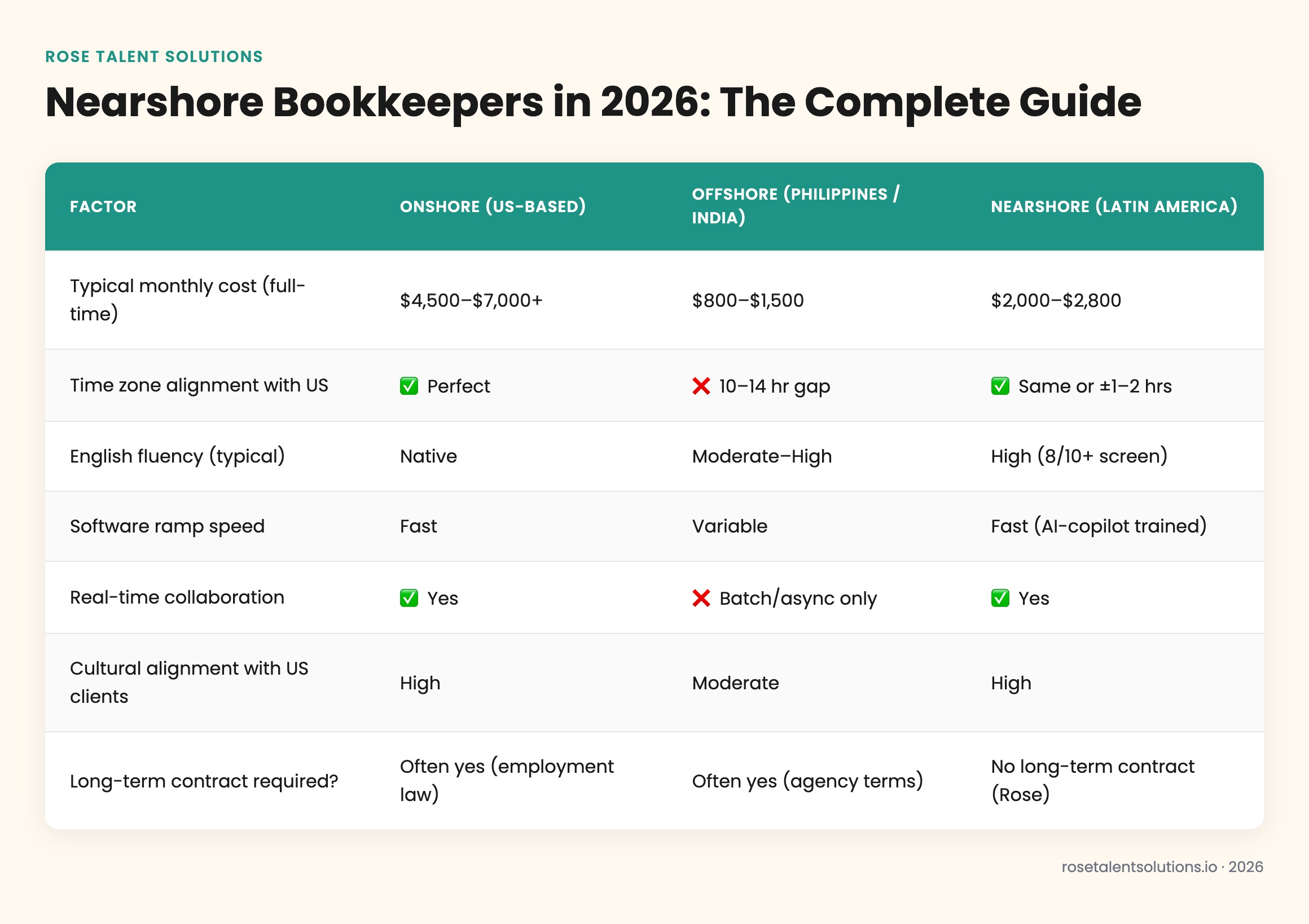
The offshore model's headline rate looks attractive until you account for the 10-to-14-hour time zone gap. When your controller needs a corrected invoice before a 3 p.m. client call, an async team halfway around the world cannot deliver that. Nearshore bookkeepers close the cost gap versus onshore hiring while preserving the real-time responsiveness that keeps your financial operations running cleanly.

What Tasks Do Nearshore Bookkeepers Handle in 2026?
A well-placed nearshore bookkeeper covers the full operational accounting layer of a small to mid-sized business. The tasks below are the most common scope items Rose team members manage from day one:
- Accounts payable processing — coding invoices, scheduling payments, managing vendor communications. For a detailed breakdown of the workflow, see the Rose post on how virtual bookkeepers handle accounts payable.
- Accounts receivable and collections — issuing invoices, tracking aging reports, following up on outstanding balances
- Bank and credit card reconciliation — monthly close reconciliation across all accounts
- Payroll support — processing pay runs, tracking PTO, coordinating with your payroll processor
- Expense categorization — coding transactions to the correct chart of accounts
- Financial reporting — preparing P&L, balance sheet, and cash flow statements for ownership review
- Software administration — managing your QuickBooks, Xero, or FreshBooks instance including user access and integrations
Software fluency is a non-negotiable screen at Rose. Every nearshore bookkeeper is evaluated on their working knowledge of the tools in your stack before placement. If your business runs on Xero, for example, the Rose post on hiring a Xero virtual bookkeeper explains exactly what to look for in a candidate and how to onboard them to your chart of accounts quickly.
The remote bookkeeping market has grown substantially. According to Statista (2024), the global finance and accounting outsourcing market is projected to exceed $60 billion by 2027, driven largely by small and mid-sized businesses in North America seeking cost-effective alternatives to full-time domestic hires. Nearshore bookkeepers capture a growing share of that demand because they combine cost savings with the real-time responsiveness clients need.
How the AI Copilot Advantage Changes Nearshore Bookkeeping in 2026
One of the more meaningful shifts in nearshore bookkeeper staffing over the past 18 months is the emergence of role-specific AI copilots. At Rose, every nearshore bookkeeper ships with an AI assistant trained on the specific software stack they'll work in — whether that's QuickBooks Online, Xero, FreshBooks, or a combination. This means the team member arrives on day one already fluent in your tool's logic, not learning it on your time.
According to McKinsey & Company (2023), generative AI has the potential to automate 60–70% of the time employees currently spend on documentation, data entry, and reporting tasks — exactly the repetitive workflows that dominate bookkeeping. A nearshore bookkeeper who operates with an AI copilot can process the same volume of transactions in significantly less time, which means more of their 40 hours per week goes toward analysis and exception handling rather than rote data entry.
The AI copilot isn't a gimmick — it's a force multiplier on an already-affordable hire. A nearshore bookkeeper at $2,500/month who handles 40% more transaction volume than an unaided hire at the same rate is effectively delivering a lower cost-per-transaction than almost any domestic alternative.
The AI advantage built into every Rose placement also reduces onboarding friction. Copilots trained on your specific software mean the nearshore bookkeeper needs fewer "how does this work" questions in the first two weeks — a pain point that slows almost every new remote hire relationship.

How Much Do Nearshore Bookkeepers Cost in 2026?
Pricing transparency is rare in the staffing world, which is one reason the Rose flat-rate model resonates with operators. At $2,500 per month, you get a full-time nearshore bookkeeper working 40 hours per week, with recruiting, vetting, payroll, HR, and ongoing management included. There are no hidden add-ons for replacement, no setup fees, and no long-term contract.
To put that in context: the U.S. Bureau of Labor Statistics (2024) median for a US bookkeeping clerk is $47,440 annually — roughly $3,953/month before you add employer FICA taxes (7.65%), health benefits, PTO, and recruiting costs. SHRM (2022) puts the average cost-per-hire at $4,683 for a single employee. The all-in cost of a US bookkeeper clears $70,000 annually at most small businesses. A nearshore bookkeeper at $30,000 per year all-in represents a savings of $40,000 or more annually on a single headcount.
It is also worth noting what the IRS requires of businesses that engage bookkeeping staff. According to the IRS, the distinction between an independent contractor and an employee affects employer tax obligations significantly — another reason many businesses prefer a fully managed nearshore bookkeeper model where classification, payroll, and compliance are handled entirely by the agency. For a granular breakdown of how QuickBooks-specific bookkeeping roles are priced across different hiring models, the Rose post on QuickBooks virtual bookkeeper cost in 2026 gives a detailed comparison across freelance, agency, and nearshore full-time models.
"Outsourcing bookkeeping is no longer just a cost play — it's a talent access play. The best bookkeepers at this price point are simply not available in the domestic market at this salary level." — Vinay Bhagat, Founder & CEO at TrustRadius (2023)
Rose's model also includes a free replacement guarantee: if the nearshore bookkeeper isn't a fit for any reason, Rose replaces them at no additional cost. There is no penalty for a poor match — the risk sits entirely with Rose, not with you.
How to Hire a Nearshore Bookkeeper: The Rose Process in 2026
The biggest friction point in hiring any remote nearshore bookkeeper is the gap between "I need someone" and "they're actually working in my books." Rose has compressed that window to roughly one week through a structured matching and onboarding process.
Intake call (Day 1)
Rose collects your software stack, transaction volume, reporting cadence, and any specialized needs — property accounting, e-commerce COGs, construction job costing, etc. This drives candidate matching, not generic sourcing.
Candidate matching (Days 2–4)
Rose's recruiting team surfaces 2–3 pre-vetted nearshore bookkeeper candidates from its active Latin America talent pool. Every candidate has already passed the English proficiency screen (8/10 minimum) and software skills assessment before you see their profile.
Your interview (Days 4–5)
You interview your top candidate — or candidates — and make the call. Rose handles the offer, contracting, and payroll setup entirely on the back end.
Onboarding and AI copilot activation (Days 5–7)
The nearshore bookkeeper gets access to your systems, and their role-specific AI copilot is activated for your software stack. Day one is productive, not orientation theater.
Ongoing management (Month 1+)
Rose manages HR, payroll, and performance on the back end. If something isn't working, you have a dedicated account point of contact — not a ticket queue.
If you're ready to move forward, the fastest path is the Rose start page, where you can book a 15-minute intake call and have a matched nearshore bookkeeper in front of you within the week.
Nearshore Bookkeepers vs. Offshore: The Real Trade-offs in 2026
The offshore model is not without merit — if your bookkeeping tasks are entirely asynchronous, batch-based, and low-complexity, a Manila-based team processing overnight can work. But most small and mid-sized US businesses don't actually operate that way. Vendors call. Banks send notices. The payroll processor has a question. Those moments require someone who is awake and available when your business day is running — and that is exactly what nearshore bookkeepers are built for.
According to Gallup's State of the Global Workplace (2023), communication responsiveness is the single most cited driver of remote-worker productivity ratings from managers. A nearshore bookkeeper who operates in your time window is structurally more productive in a collaborative environment, regardless of raw skill level.
Nearshore Bookkeepers — Pros
- Same business-hours availability as your team
- English fluency screened at 8/10+ minimum
- Cultural alignment with US business norms
- AI-copilot trained on your software stack
- No long-term contract commitment
- Free replacement if not a fit
Offshore Bookkeepers — Cons
- 10–14 hour time zone gap creates async-only workflows
- English fluency more variable; miscommunication risk higher
- Slower iteration on urgent financial tasks
- Often locked into 6–12 month agency contracts
- Less cultural familiarity with US GAAP norms and business cadence
- Ramp time longer without AI-assisted onboarding
Workforce data reinforces the nearshore bookkeeper value proposition. Pew Research Center (2023) reports that roughly one-third of US workers who can work remotely do so full-time — a structural shift that has normalized remote financial roles and made hiring a nearshore bookkeeper a mainstream business decision rather than an experiment. The question for most operators in 2026 is no longer whether remote bookkeeping works, but which geography delivers the best combination of cost, communication, and competency.
The bookkeeping and accounting services page at Rose gives a full overview of the roles available — from entry-level AR/AP clerks to senior nearshore bookkeepers who can own the full monthly close — so you can match the right seniority level to your actual business complexity before you ever get on a call.