
Nearshore accounting is one of the fastest-growing staffing decisions US small and mid-sized businesses are making in 2026. Instead of posting a local job that will take three months to fill — at a salary that might run $55,000–$75,000 per year — more operators are hiring full-time, English-fluent accounting professionals based in Latin America who work their exact US business hours. The result is real-time collaboration, clean books, and a cost structure that doesn't require a CFO salary to afford.
This guide covers exactly what nearshore accounting is, how it compares to offshore and onshore alternatives, what you should expect to pay, and how to find a team member who actually knows your software. If you've been thinking about outsourcing your accounting function but weren't sure where to start, this is the post to read first.
What Is Nearshore Accounting — and How Does It Work in 2026?
Nearshore accounting refers to the practice of hiring accounting professionals located in a geographically close region — typically Latin America for US-based businesses — rather than domestically or in a distant offshore location like the Philippines or India. The defining characteristics are time zone alignment (most of Latin America operates within 0–3 hours of US Eastern time), strong English fluency, and cultural familiarity with US business norms.
A nearshore accounting professional handles the same tasks as an in-house accountant: accounts payable and receivable, bank reconciliations, payroll support, financial reporting, and bookkeeping in platforms like QuickBooks, Xero, or FreshBooks. The key difference is that they're hired through a staffing partner who handles recruiting, vetting, payroll, and HR — so you get a fully managed team member without a full domestic employment overhead.
According to the U.S. Bureau of Labor Statistics (2024), the median annual wage for bookkeeping, accounting, and auditing clerks in the United States is $47,440 — and that figure doesn't include benefits, payroll taxes, or recruiting costs. A nearshore accounting professional at $2,500/month works out to $30,000 per year, all-in, with no additional overhead on your side.
How Nearshore Accounting Compares to Offshore and Onshore Hiring in 2026
The most common question operators ask is: "What's actually different about nearshore versus just hiring someone overseas?" The answer comes down to three practical factors — time zone, communication quality, and ramp speed. A team member 12 hours ahead of you in Manila or Bangalore requires asynchronous workflows by default. A team member in Bogotá or Mexico City picks up your Slack message at 10am and replies before lunch.

| Factor | Nearshore (Latin America) | Offshore (Philippines / India) | Onshore (US-based) |
|---|---|---|---|
| Monthly cost (full-time) | ~$2,500 all-in | ~$1,200–$1,800 | ~$4,500–$7,000+ |
| Time zone overlap | 0–3 hrs from US Eastern | 9–13 hrs from US Eastern | Same |
| English fluency | High (8/10+ screened) | Variable | Native |
| Cultural alignment | Strong US business familiarity | Moderate | Native |
| Ramp time | Fast (real-time collaboration) | Slower (async by necessity) | Fast, but costly to onboard |
| Contract flexibility | Month-to-month, 30-day notice | Varies | Typically 90-day notice or severance |
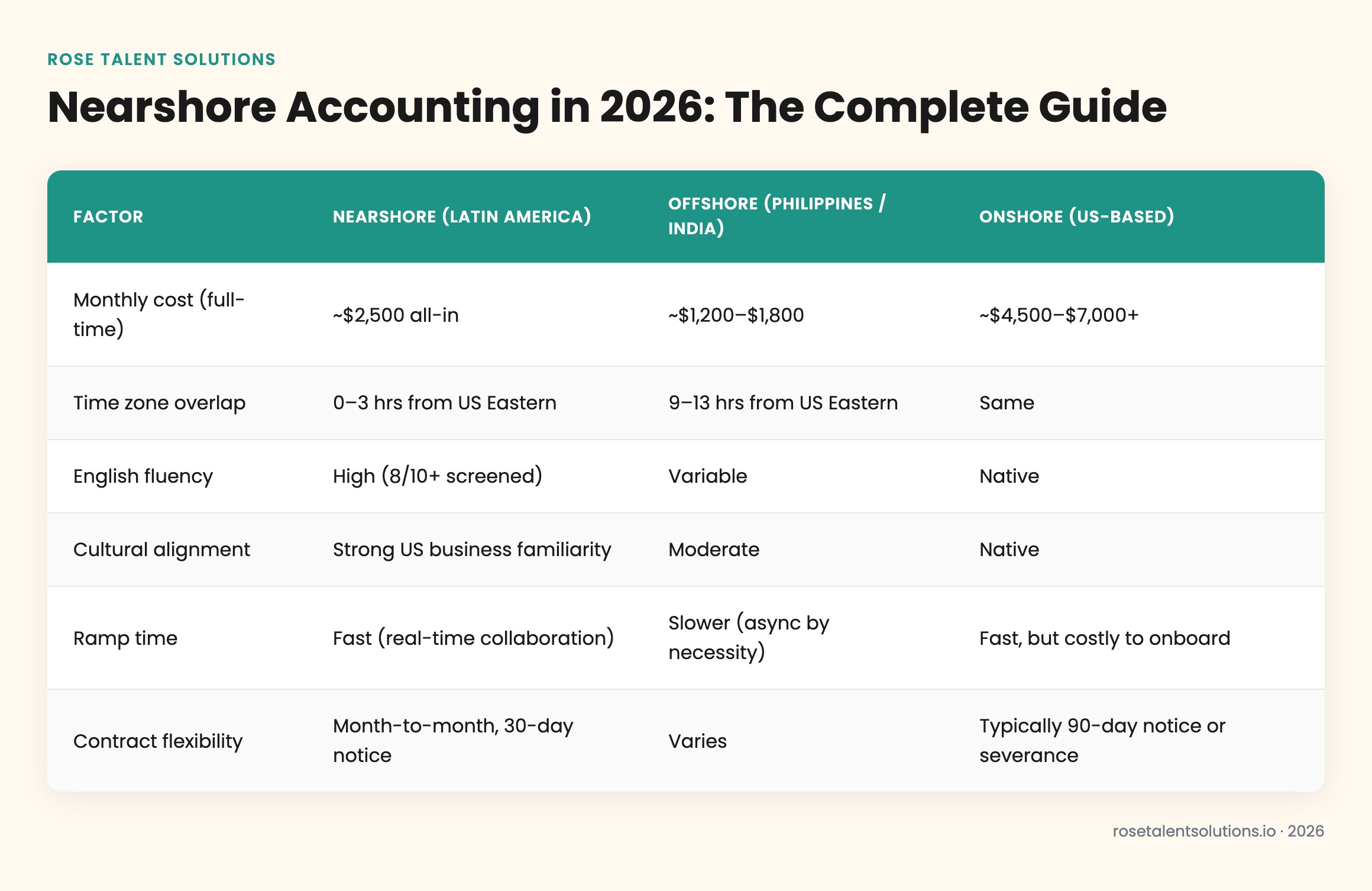
Offshore accounting is cheaper on paper, but the hidden costs are real. Delayed responses on reconciliation questions, errors that sit unresolved overnight, and the coordination overhead of managing someone working while you sleep all erode the apparent savings. According to McKinsey & Company (2022), proximity and cultural alignment are among the strongest predictors of successful outsourcing relationships — factors nearshore models are specifically built around.
If you're also evaluating what a dedicated bookkeeper might cost through various channels, our breakdown of QuickBooks virtual bookkeeper costs in 2026 is a useful companion read — it puts the pricing models side by side in plain language.
What Tasks Can a Nearshore Accounting Professional Handle?
One of the most common misconceptions about nearshore accounting is that it's limited to data entry or basic bookkeeping. In practice, a well-screened nearshore accountant can own significant portions of your finance function — especially when they're paired with the right software and given clear ownership of specific workflows.
Here's what a typical nearshore accounting professional handles day-to-day:
- Accounts payable and receivable — processing vendor invoices, tracking customer payments, and following up on overdue balances
- Bank and credit card reconciliation — matching transactions weekly or monthly in QuickBooks, Xero, or FreshBooks
- Payroll support — running payroll cycles, managing deductions, and coordinating with your payroll provider
- Financial reporting — generating P&L statements, balance sheets, and cash flow reports on a cadence you set
- Expense categorization — keeping your chart of accounts clean so your CPA doesn't spend tax season untangling twelve months of miscoded transactions
- Vendor and contractor management — tracking 1099-eligible payments, issuing POs, and maintaining vendor files
Every Rose Talent nearshore accounting professional also ships with a role-specific AI copilot trained on their exact software stack. If they're working in QuickBooks Online, their AI tools are trained on QuickBooks workflows, common reconciliation errors, and how to flag anomalies before they become problems. This isn't a generic AI assistant — it's a tool built around the specific job they're doing.
"The future of accounting work isn't replacing accountants with AI — it's accountants who use AI to do the work of three people with the accuracy of ten." — Intuit Chief Accountant Economist Miranda Jade Tompkins, QuickBooks Blog (2023)
According to Intuit QuickBooks (2023), accounting professionals who leverage AI tools complete reconciliation tasks up to 40% faster than those using manual processes alone — a material efficiency gain when you're managing high transaction volumes.
How Much Does Nearshore Accounting Cost in 2026?
Rose Talent Solutions prices nearshore accounting at a flat $2,500 per month. That covers everything: recruiting, vetting, onboarding, payroll processing, HR management, and ongoing performance oversight. You don't pay a separate recruiting fee. You don't manage a foreign payroll relationship. You don't negotiate benefits. The $2,500 is the number.
The $2,500/month flat rate includes recruiting, vetting, payroll, HR, and ongoing management — so the real comparison isn't $2,500 vs. a $47K salary. It's $2,500 vs. a $47K salary plus $8–12K in benefits, plus $3–6K in recruiting costs, plus your own time managing employment compliance.
There's no long-term contract. You can cancel with 30 days written notice. And if the team member isn't a fit for your business, Rose replaces them at no additional cost. That's the only risk reversal on offer — and it's the one that matters most in a staffing relationship.
For context, SHRM (2023) estimates the average cost to hire a single employee in the US — including recruiting, onboarding, and lost productivity — runs between $4,000 and $20,000 depending on the role. That's a one-time sunk cost before the person has done a single day of work. Nearshore accounting eliminates that exposure entirely.
If you're specifically evaluating Xero as your platform, it's worth reading about how a Xero virtual bookkeeper works in a nearshore model — the software-specific vetting process changes what you should expect on day one.

According to Statista (2024), the global business process outsourcing market is projected to reach $525 billion by 2030, with finance and accounting functions representing one of the fastest-growing segments. The trend is not speculative — it's structural.
How to Get Started with Nearshore Accounting Through Rose in 2026
The process of hiring a nearshore accounting professional through Rose is designed to move fast. Most clients have a placed team member within a week of their intake call. Here's how it works:
Intake & Role Scoping
You spend 30 minutes with the Rose team outlining your software stack, transaction volume, and the specific accounting tasks you need owned. This shapes the candidate profile so you're not reviewing résumés that don't fit.
Candidate Matching
Rose recruits, vets, and screens candidates against your profile — including English proficiency (minimum 8/10), software competency, and accounting credentials. You see only pre-vetted candidates.
Your Interview
You interview the top candidates directly. You make the hire decision — Rose handles the employment relationship, payroll, and HR compliance in the background.
Onboarding & AI Copilot Activation
Your new team member starts with a role-specific AI copilot pre-configured for your software. Rose manages the first-week check-in to resolve any early friction fast.
Ongoing Management
Rose handles performance oversight, payroll, HR, and replacement logistics if needed. You manage the work — Rose manages the employment relationship.
You can explore the full bookkeeping and accounting service page to see the specific roles Rose places, or go straight to the start page to book your intake call.
Is Nearshore Accounting Right for Your Business in 2026?
Nearshore accounting is the right fit for most US businesses that have outgrown DIY bookkeeping but aren't yet large enough to justify a full in-house accounting department. The sweet spot is typically businesses processing 200–2,000 transactions per month, running 1–50 employees, and currently spending significant owner or manager time on financial admin.
Nearshore Accounting Is a Strong Fit If…
- You want someone working your hours, not batching overnight
- You're already using QuickBooks, Xero, FreshBooks, or a similar cloud platform
- You need full-time capacity without a full-time domestic salary
- You want month-to-month flexibility without long-term contract exposure
- Your current bookkeeping is behind, inconsistent, or owned by someone who shouldn't be doing it
Nearshore Accounting May Not Be the Right Fit If…
- You need a licensed CPA for tax filing or audit work (nearshore accountants support CPAs — they don't replace them)
- Your accounting requires on-site presence for physical document handling
- You're processing under 50 transactions per month and a part-time local bookkeeper is genuinely sufficient
For businesses that also manage property portfolios, the nearshore model extends naturally to property management accounting — a topic covered in depth on the Rose property management staffing page. AppFolio and Buildium accounting workflows are among the most commonly requested skill sets for nearshore placements in that vertical.
If you want to understand how nearshore bookkeeping specifically differs from nearshore accounting (they overlap but aren't identical), the nearshore bookkeeper guide draws that line clearly — including which tasks fall into each category and when you need one versus the other.
According to Gallup (2023), businesses with highly engaged team members — including remote and distributed staff — outperform peers by 23% in profitability. The implication for nearshore staffing is straightforward: a well-matched, well-managed nearshore accountant isn't a compromise. It's a competitive advantage.
The real question in 2026 isn't whether nearshore accounting works — it's whether you can afford to keep running your books the way you're running them now. If reconciliations are late, reporting is inconsistent, or you're doing accounting work that should be owned by someone else, the math on a $2,500/month flat-rate solution tends to close itself.
For a detailed look at what comparable bookkeeping services cost across different hiring models, the QuickBooks bookkeeper cost guide breaks down the full range — from freelance platforms to managed staffing — so you can benchmark the numbers against your current spend.