
Nearshore virtual bookkeepers handle accounts payable the same way an in-house AP clerk does — except they cost a fraction of the price and never call in sick on a vendor payment day. If you run a US-based business and your AP process still lives in someone's inbox, a spreadsheet, or a shared drive nobody audits, you are one missed payment away from a late fee, a strained vendor relationship, or an audit flag. This guide breaks down exactly how a virtual bookkeeper manages accounts payable end-to-end, what software they use, and what to look for before you hire one in 2026.
What Does a Virtual Bookkeeper Actually Do in Accounts Payable?
Accounts payable is the complete workflow from the moment a vendor invoice arrives to the moment a payment clears and gets reconciled in your books. A virtual bookkeeper owns every step of that workflow. They are not just data-entry operators — a skilled AP bookkeeper is a control point who catches duplicate invoices, flags vendor discrepancies, enforces your approval thresholds, and keeps your cash-flow schedule predictable.
What is a nearshore virtual bookkeeper? A nearshore virtual bookkeeper is a full-time, remote finance professional based in Latin America — countries like Colombia, Mexico, or Argentina — who works your exact US, Canadian, or UK business hours. They hold English proficiency scores of 8/10 or higher, are trained on US GAAP conventions, and operate inside your cloud accounting software as if they were sitting two desks away. This is meaningfully different from generic offshore outsourcing, where a 10-hour timezone gap means your AP questions sit unanswered overnight.
The core AP tasks a virtual bookkeeper handles include: receiving and digitizing vendor invoices, three-way matching (purchase order → receipt → invoice), routing invoices through your approval workflow, scheduling ACH or check payments inside your payment terms window, reconciling vendor statements against your ledger, and filing documents for audit readiness. If you want to understand how this compares specifically to software-driven workflows, our deep-dive on the best accounts payable virtual assistant services covers the competitive landscape in detail.
How Virtual Bookkeepers Process Invoices in 2026 — Step by Step
The invoice-to-payment cycle has six distinct stages. A well-trained virtual bookkeeper handles all six without you touching a single PDF.
Invoice Capture
Invoices arrive by email, vendor portal, or EDI. The bookkeeper logs each one into your accounting platform (QuickBooks, Xero, NetSuite, or similar), assigns the correct GL code, and tags the vendor record.
Three-Way Match
The bookkeeper compares the invoice against the original purchase order and the receiving document. Discrepancies — wrong quantity, price variance, missing PO — are flagged to you before payment, not after.
Approval Routing
Invoices above your set threshold get routed to the appropriate approver via your approval workflow tool (Bill.com, ApprovalMax, or a simple email chain). The bookkeeper tracks and follows up on pending approvals so nothing stalls.
Payment Scheduling
Approved invoices are scheduled for payment within terms (Net 30, Net 60, etc.). The bookkeeper batches payments, prepares the payment run summary for your sign-off, and executes ACH or check disbursements.
Vendor Reconciliation
Each month, the bookkeeper reconciles vendor statements against your AP ledger, catches any missed credits or unapplied payments, and resolves disputes directly with vendors.
Audit-Ready Filing
Every invoice, approval email, and payment confirmation is filed in a structured folder system (Google Drive, SharePoint, or within your accounting platform) so your CPA can pull any document in under two minutes at year-end.
According to the U.S. Bureau of Labor Statistics (2024), the median annual wage for a bookkeeping clerk in the US is $47,440 — roughly $3,950 per month before benefits, payroll tax, and PTO. A nearshore virtual bookkeeper from Rose Talent Solutions runs $2,500/month flat, all-in, with recruiting, HR, and ongoing management included.
Which Software Do Virtual AP Bookkeepers Use in 2026?
Software fluency is what separates a useful AP bookkeeper from an expensive one. The tools your bookkeeper works in determine how fast invoices move, how accurate the GL is, and how quickly your CPA can close the month. The most common platforms Rose Talent bookkeepers are trained on include QuickBooks Online, Xero, NetSuite, Bill.com, Sage Intacct, FreshBooks, and Wave.
Every Rose Talent bookkeeper ships with a role-specific AI copilot trained on their primary software. That means a QuickBooks-focused AP bookkeeper has an AI layer that auto-suggests GL codes, flags invoice anomalies, and surfaces duplicate vendor entries before they hit the ledger. If you want to understand what that looks like in practice for a QuickBooks-specific hire, our post on QuickBooks virtual bookkeeper cost walks through the full pricing and capability breakdown. For Xero users, the Xero virtual bookkeeper guide covers the same ground inside that platform.
Software-trained bookkeepers close AP cycles significantly faster than platform-agnostic hires, because they don't spend the first 60 days learning where the buttons are. According to QuickBooks / Intuit research (2023), businesses that use dedicated bookkeeping support reduce month-end close time by an average of 3.5 days compared to owner-managed books.
"The biggest mistake small business owners make with accounts payable is treating it as a data-entry task rather than a cash-flow control function. A trained bookkeeper — remote or in-house — pays for themselves the first time they catch a duplicate invoice or negotiate an early-pay discount." — Rhonda Abrams, Author & Small Business Columnist, USA Today (2022)
Nearshore vs. Offshore vs. Onshore: How AP Bookkeeping Compares in 2026
Not all virtual bookkeepers are the same. Where they're located determines timezone overlap, communication speed, and how quickly your AP cycle actually moves. The table below compares your three main hiring options across the metrics that matter for accounts payable specifically.
| Factor | Nearshore (Latin America) | Offshore (Philippines / India) | Onshore (US-based VA) |
|---|---|---|---|
| Timezone overlap with US | Full overlap (same hours) | 0–3 hrs overlap; 8–12 hr lag | Full overlap |
| Typical monthly cost | ~$2,500 flat (all-in) | $800–$1,500 (agency); hidden fees common | $4,000–$6,500+ |
| English proficiency floor | 8/10+ screened | Varies widely; 5–7/10 common | Native speaker |
| AP invoice turnaround | Same business day | Next day (batched overnight) | Same business day |
| Software training on hire | Role-specific AI copilot included | Self-trained; variable quality | Self-trained; variable quality |
| HR/payroll overhead on you | None (agency handles all) | Partial (depends on arrangement) | High (W-2 or 1099 management) |
| Replacement if not a fit | Free replacement included | Varies by agency; often a fee | Full rehire cost (~$4–8K) |
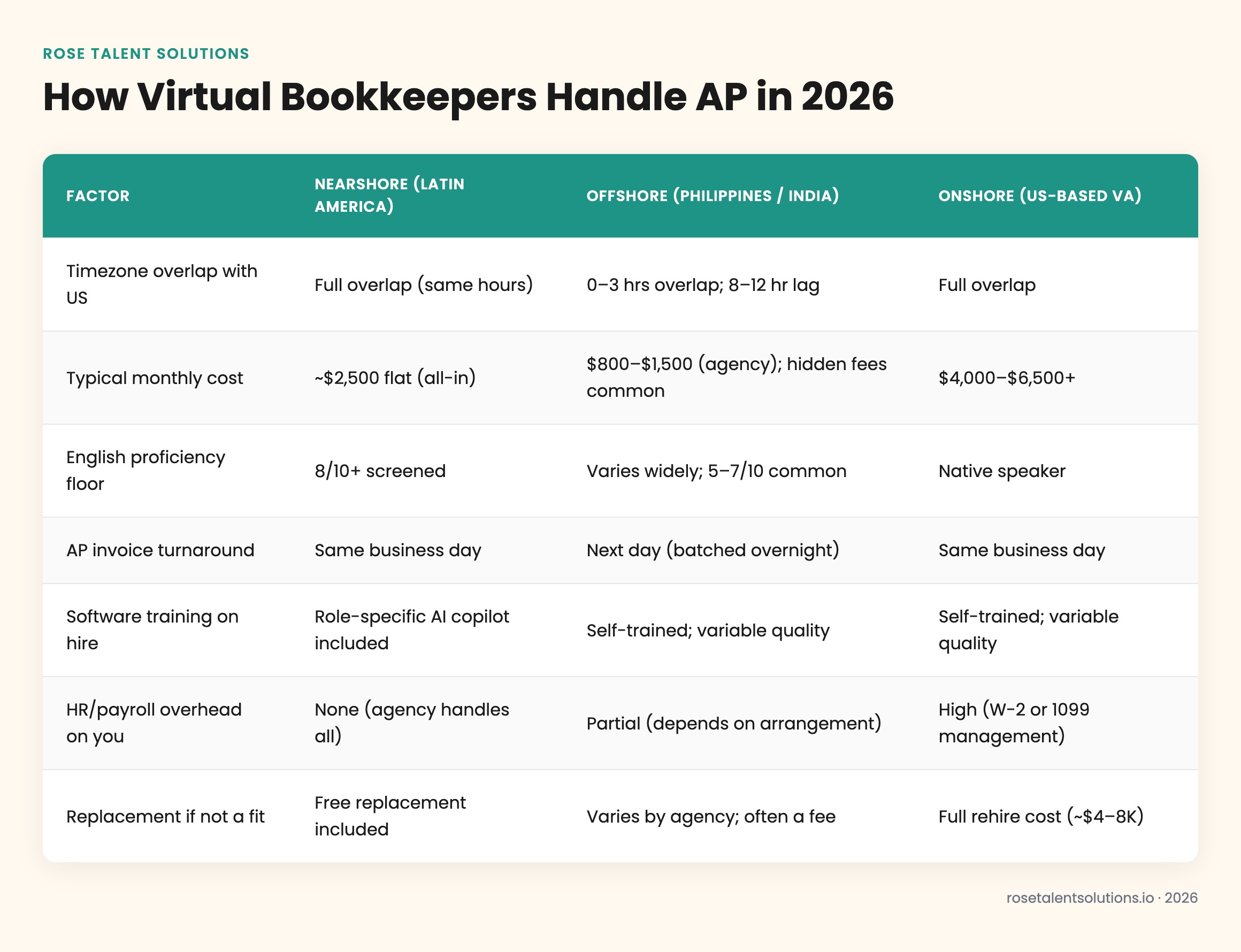
Table: Nearshore vs. offshore vs. onshore virtual bookkeeping for accounts payable — 2026 comparison across cost, timezone, and AP-specific performance factors.
How Rose Talent's AP Bookkeepers Protect You from Common 2026 Payment Risks
Accounts payable isn't just an administrative function — it's a risk surface. Duplicate payments, missed early-pay discounts, unapplied vendor credits, and fraud via fake invoice schemes all live inside a poorly managed AP process. According to the Association of Certified Fraud Examiners (ACFE) (2024), billing fraud and check tampering account for 39% of all small business fraud cases — and nearly all involve weak AP controls.
A virtual AP bookkeeper is not just a cost-reduction play. They are a fraud-prevention layer. Segregating invoice entry, approval, and payment execution across a trained bookkeeper and a single business owner sign-off removes the single-person control gap that fraudsters exploit most often.
Rose Talent bookkeepers are trained to implement a three-control AP framework: (1) no invoice enters the system without a valid vendor record, (2) no payment is scheduled without documented approval, and (3) no vendor banking change is processed without a direct verbal confirmation to the vendor on file. These aren't just best practices — they're the exact controls the IRS expects to see in your documentation if you're ever audited.
For businesses that need a dedicated bookkeeping and accounting virtual assistant, Rose places full-time team members who own your AP process end-to-end, not freelancers who juggle 12 clients and disappear at 2pm. And if you want to understand exactly what you'd pay at the $2,500/month rate for a full AP-capable hire, our 2026 QuickBooks virtual bookkeeper cost guide breaks down the full cost comparison against in-house hiring.
How to Evaluate a Virtual Bookkeeper's AP Readiness Before You Hire in 2026
Most businesses that have a bad experience with a virtual bookkeeper hired the wrong person, not the wrong model. Here is how to screen specifically for AP capability before anyone touches your vendor ledger.
Green Flags — Hire
- Can describe three-way matching without prompting
- Has hands-on experience in your specific software (QuickBooks, Xero, NetSuite)
- Understands the difference between cash-basis and accrual AP timing
- Can explain how they would handle a vendor dispute or a duplicate payment catch
- Asks about your approval thresholds and vendor master list in the first conversation
- Works your business hours — not batched overnight
Red Flags — Pass
- Vague about software experience ("I'm a quick learner")
- Cannot define three-way match or GL coding
- Located offshore with a 10-hour timezone gap — real-time AP questions will wait until tomorrow
- No process for vendor banking change verification (fraud risk)
- Freelancer model — no backup if they go dark during a payment run
- Agency cannot replace them without charging a new placement fee
According to SHRM (2024), the average cost of a bad hire in a finance role is 1.5–2× the annual salary of the position. For a $47K AP clerk, that's a $70–94K mistake when you factor in lost productivity, rework, and rehiring costs. Rose's model eliminates that risk with a free replacement if your team member isn't a fit — no additional cost, no long-term contract required.
If you're ready to hand off your AP cycle to a dedicated nearshore bookkeeper, you can start the placement process here — most clients have a candidate in front of them within seven business days.