
Nearshore backend developers are reshaping how US, Canadian, and UK businesses build and scale their engineering teams in 2026. Instead of posting a $180,000 salary role on LinkedIn and waiting three months, or rolling the dice on an offshore team eight time zones away, operators are hiring full-time Latin American backend engineers who show up at 9 a.m. EST, communicate without friction, and ship code the same week they start. This post breaks down exactly how that works, what it costs, and how to avoid the traps most hiring managers fall into.
What Is a Nearshore Backend Developer — and Why Does It Matter in 2026?
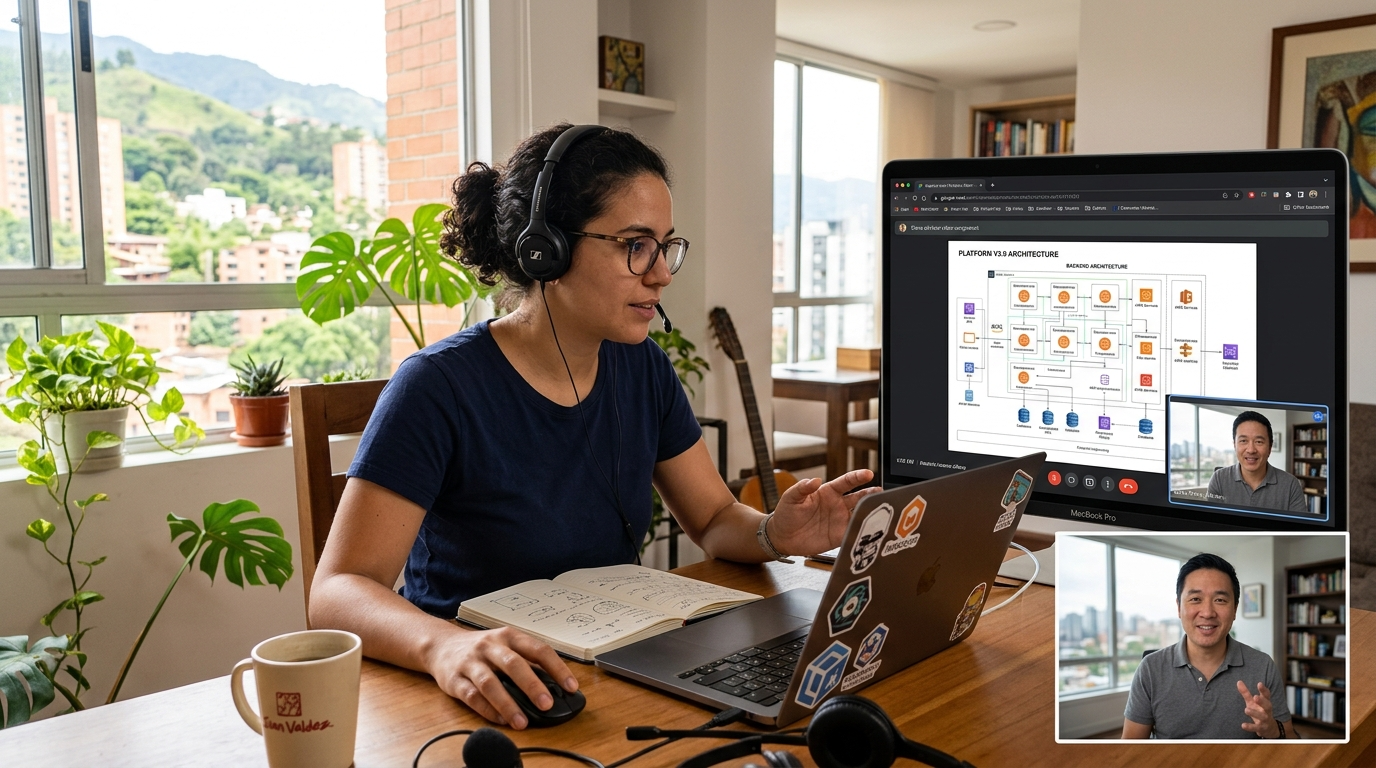
A nearshore backend developer is a software engineer based in Latin America — countries like Argentina, Colombia, Mexico, or Brazil — who works exclusively for your company during your business hours. The word "nearshore" distinguishes this model from offshore (Philippines, India, Eastern Europe) primarily because of timezone overlap: a nearshore developer in Bogotá is only one to two hours off from New York, meaning real-time standups, same-day code reviews, and no overnight ticket queues.
Backend development covers the server-side logic your product runs on: APIs, databases, authentication systems, cloud infrastructure, and data pipelines. A backend specialist hired nearshore handles Node.js microservices, Python data layers, PostgreSQL schemas, or AWS Lambda functions — the same work a US senior engineer does — at a compensation structure that reflects Latin American market rates, not San Francisco ones. The net result for your business is full-time focus, real collaboration, and a cost structure that keeps your runway intact.
According to the U.S. Bureau of Labor Statistics (2024), the median annual salary for a US-based software developer now exceeds $132,000 — before benefits, payroll tax, or recruiting fees. Nearshore backend developers through Rose Talent Solutions run $2,500 per month flat, all-in, with recruiting, vetting, HR, and ongoing management included.
How Nearshore Compares to Offshore and Onshore Backend Hiring in 2026
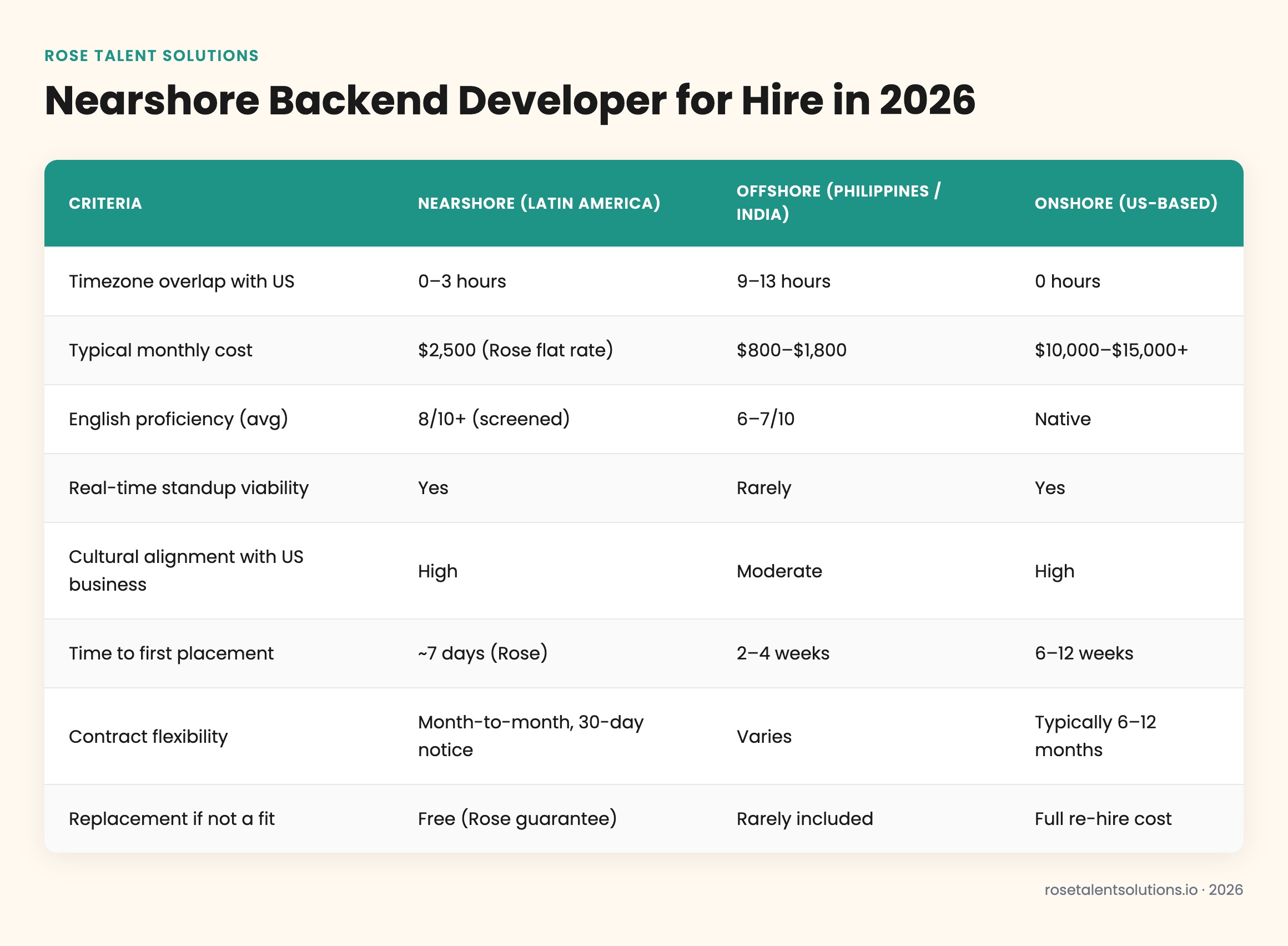
The debate between nearshore, offshore, and onshore hiring isn't philosophical — it's operational. The table below breaks down the real variables that determine whether your backend developer actually ships on time or becomes an expensive bottleneck.
| Criteria | Nearshore (Latin America) | Offshore (Philippines / India) | Onshore (US-based) |
|---|---|---|---|
| Timezone overlap with US | 0–3 hours | 9–13 hours | 0 hours |
| Typical monthly cost | $2,500 (Rose flat rate) | $800–$1,800 | $10,000–$15,000+ |
| English proficiency (avg) | 8/10+ (screened) | 6–7/10 | Native |
| Real-time standup viability | Yes | Rarely | Yes |
| Cultural alignment with US business | High | Moderate | High |
| Time to first placement | ~7 days (Rose) | 2–4 weeks | 6–12 weeks |
| Contract flexibility | Month-to-month, 30-day notice | Varies | Typically 6–12 months |
| Replacement if not a fit | Free (Rose guarantee) | Rarely included | Full re-hire cost |
The offshore price point looks attractive until you calculate the compounding async tax: every back-and-forth question that takes 30 seconds in a Slack huddle becomes a 24-hour ticket cycle when your developer is in Manila. A nearshore backend engineer in Medellín answers your CTO at 2 p.m. EST without either party staying up late. That's not a soft benefit — it measurably reduces sprint cycle time. A Gallup workplace engagement study (2023) found that employees who can collaborate in real time with their manager report 23% higher productivity outcomes — a finding that maps directly to the synchronous advantage nearshore engineers hold over async-only offshore teams.
What Stack Skills Can You Hire for Nearshore in 2026?
Latin America's developer talent pool has matured significantly. A decade ago, regional engineering education lagged US and European standards. Today, LATAM universities and bootcamps produce strong graduates across the full backend stack — and the best of them are bilingual, remote-native, and already experienced with US startup and enterprise workflows.
Rose's vetted backend engineers cover the languages and frameworks US companies actually need: Node.js, Python, Go, Ruby on Rails, Java Spring Boot, and PHP/Laravel. They're comfortable in AWS, GCP, and Azure environments, and many specialize in database architecture (PostgreSQL, MongoDB, Redis) or API design (REST, GraphQL). If you're specifically looking to hire a nearshore Node.js developer or need a dedicated nearshore Python developer, Rose matches you with pre-vetted engineers who've already passed technical screens in that specific stack.
Every Rose team member also ships with a role-specific AI copilot — trained on the tools your engineer will actually use. Whether that's GitHub Copilot workflows, Jira automation, or cloud cost optimization tooling, the AI advantage layer means your hire is productive from day one rather than week three. You can learn more about how that works at Rose's AI Advantage page.
"Latin America has become one of the most competitive developer markets in the world. The combination of US-aligned work culture, strong English adoption, and technical education investment has created a pipeline that didn't exist five years ago." — Ariel Camus, CEO at Microverse (2023)
According to Coursera's Global Skills Report (2023), Latin America ranks among the fastest-improving regions globally for technology skill development, with Brazil and Colombia leading in cloud computing and data science proficiency gains year-over-year. That's not a soft trend — it's a hiring signal that the engineering pipeline feeding nearshore teams is stronger now than at any point in the past decade.
How Rose Talent Solutions Matches and Onboards a Nearshore Backend Developer in 2026
The biggest objection companies have to hiring remote international engineers isn't the cost — it's the fear of a slow, painful process that leaves them holding a bad hire with no exit. Rose is built to remove that risk entirely. Here's the exact sequence from first call to productive developer on your team.
Intake call and role scoping
Rose's team gets specific about your stack, your sprint cadence, your team's communication style, and the hard technical requirements — so matching is precise, not approximate.
Candidate matching and technical vetting
Rose runs backend-specific technical screens, English proficiency assessments (8/10+ minimum), and cultural fit reviews before you see a single profile. You don't interview a dozen wrong fits.
Your interview and selection
You interview your top match — usually one or two candidates — and confirm the hire. Most clients go from intake call to confirmed offer within seven days.
Onboarding with AI copilot activation
Your new developer joins your Slack, your GitHub org, and your sprint board. Rose activates their role-specific AI copilot — pre-configured for your tooling — so day one productivity is immediate, not eventual.
Ongoing HR, payroll, and performance management
Rose handles all employer-side administration — payroll, compliance, HR issues, performance check-ins. You manage the work; Rose manages the employment relationship.
The entire model is month-to-month. You can cancel with 30 days written notice — no long-term contract required. If your developer isn't a fit for any reason, Rose replaces them at no additional cost. That's the only risk reversal you need.
The hidden cost of a bad backend hire isn't just the salary you paid — it's the three months of delayed features, the team morale hit, and the full recruiting cycle you now have to restart. Rose's free replacement guarantee eliminates that exposure entirely.
Why Argentine and Colombian Backend Developers Are Dominating 2026 Tech Hiring
Argentina in particular has emerged as a standout source of backend engineering talent. The country's strong public university system — the Universidad de Buenos Aires engineering program is consistently ranked in Latin America's top five — combined with a decade of remote-work normalization has produced a generation of developers who are technically rigorous, English-fluent, and experienced working with US product teams. If you want to go deeper on this specific talent market, Rose's guide on hiring an Argentine software developer covers the nuances in detail.
Colombia, Mexico, and Brazil round out Rose's primary talent markets. Each country has specific stack strengths: Colombian developers often specialize in cloud infrastructure and DevOps; Mexican engineers are heavily represented in enterprise Java and .NET ecosystems; Brazilian talent leads in data engineering and Python-based ML pipelines. When you're building a dedicated nearshore developer team rather than a single hire, mixing these talent pools gives you coverage across the full backend layer.

According to SHRM's Talent Acquisition Research (2024), the average US employer spends $4,700 and 42 days to fill a single technology role — before accounting for the first-year attrition risk. Nearshore hiring through Rose cuts that timeline to approximately seven days with a replacement guarantee that eliminates first-year attrition cost entirely.
How to Structure the Role Before You Hire a Nearshore Backend Developer
The companies that get the most out of a nearshore backend developer are the ones who treat the role like a senior internal hire — not a vendor or a ticket-taker. That means a real onboarding plan, access to your codebase from day one, inclusion in sprint planning, and a named internal point of contact (usually your CTO or a senior engineer) who reviews PRs in the first two weeks.
The developers Rose places are full-time and dedicated — 40 hours per week, exclusively on your work. They are not shared across multiple clients. This distinction matters because it determines whether your hire builds context about your system over time (a full-time embedded engineer does) or resets their context every time they context-switch between clients (a fractional or marketplace hire often does).
Nearshore Full-Time Embedded Developer
- Builds deep codebase context over weeks and months
- Attends standups, reviews, and planning in real time
- Treated as a team member — retention and loyalty follow
- Single point of accountability for backend output
- Flat monthly cost — no surprise invoices or scope creep
Freelance Marketplace / Hourly Contractor
- Context resets with every engagement gap
- Billing unpredictable — hourly overruns are common
- No HR or compliance coverage — you're exposed
- Loyalty goes to whoever pays next — churn is high
- No replacement guarantee if quality drops
If your backend needs span multiple disciplines — say, a Node.js API layer and a Python data pipeline — Rose can place two dedicated engineers or refer you to the full team-building process where you scope a multi-role engagement from the start. For companies that also need financial operations support alongside technical hires, Rose's bookkeeping and accounting staffing runs on the same flat-rate, no-long-term-contract model.
According to McKinsey's State of AI Report (2024), companies that embed AI-augmented engineers into their core product teams report 20–30% faster feature delivery compared to teams using traditional developer workflows. Rose's AI copilot layer is designed specifically to deliver that advantage from the moment your nearshore backend developer starts. And according to IDC's Future of Work research (2024), organizations that close the developer talent gap within 30 days of a vacancy opening are 2.4x more likely to hit their annual product roadmap targets — a benchmark nearshore hiring through Rose is built to meet.