
Why Nearshore Node.js Hiring Is the 2026 Standard for US Tech Teams
Nearshore Node.js development means hiring backend engineers based in Latin America — same or adjacent timezones to the US, English-fluent, and deeply integrated into your Slack, sprint cycles, and standups as if they were down the hall. It is not a compromise. For the majority of US product teams running Node.js microservices, REST APIs, or real-time WebSocket applications, nearshore has become the default hiring motion in 2026 — not a fallback when domestic hiring fails.
The numbers back this up. The global developer shortage is projected to reach 85 million unfilled tech roles by 2030, according to Korn Ferry (2023). Node.js roles sit at the epicenter of that gap — backend JavaScript engineers with production-grade experience in Express, NestJS, and event-driven architecture are among the most competed-for profiles in the market. Domestic hiring timelines for senior Node.js developers routinely stretch past 90 days, and when you do land someone, fully loaded cost easily exceeds $160,000 per year in most US metros.
Latin America has quietly become the most talent-dense nearshore region for JavaScript and Node.js specifically. Brazil alone produces over 500,000 STEM graduates per year, according to UNESCO (2023), and Argentina's software engineering community punches well above its weight globally — a topic we cover in depth in our guide on why companies hire Argentine software developers for backend-heavy roles. The engineering talent is there. The question is how you access it efficiently.
What "Nearshore Node.js Developer" Actually Means in 2026
A nearshore Node.js developer is a backend engineer based in a Latin American country — typically Mexico, Colombia, Argentina, Brazil, or Uruguay — who works your US business hours, communicates in English at a professional level, and specializes in the Node.js runtime ecosystem. The "nearshore" designation distinguishes them from offshore developers in India or the Philippines, who typically operate in a 9–13 hour time difference from US Eastern time. That timezone gap is not a minor inconvenience — it fundamentally changes how fast your team ships.
Nearshore engineers operate in UTC-3 to UTC-6, meaning a developer in Buenos Aires or Medellín is never more than 2 hours off US Eastern time. They attend your morning standups live. They push hotfixes in real time. They are on a Slack call with your CTO within minutes, not the next calendar day. That real-time collaboration loop is the structural advantage that no amount of async tooling fully replicates.
"The timezone issue is the silent killer of offshore engineering relationships. You lose a day on every single back-and-forth. That compounds into weeks of lost sprint velocity over a quarter." — Ariel Salmeron, VP of Engineering at a Series B SaaS company, quoted in Stack Overflow Blog (2022)
Rose Talent Solutions places nearshore Node.js developers who clear an 8/10+ English proficiency screen, pass a live technical assessment covering async/await patterns, RESTful API design, database integration (PostgreSQL, MongoDB), and basic DevOps literacy (Docker, CI/CD pipelines). If you want a broader view of how this process compares across stacks, our breakdown of how to hire a nearshore Python developer walks through the same vetting framework applied to a different language profile.
How Nearshore Compares to Offshore and Onshore Node.js Hiring in 2026
Before committing to any hiring model, you need apples-to-apples clarity on what each option actually costs and delivers. The table below cuts through the noise.
| Dimension | Nearshore (Latin America) | Offshore (India / Philippines) | Onshore (US) |
|---|---|---|---|
| Monthly Cost (Senior Node.js) | $2,500 flat (via Rose) | $1,200–$2,000 (agency) + hidden mgmt overhead | $13,000–$18,000 fully loaded |
| Timezone Overlap with US East | 6–8 hrs live overlap | 0–2 hrs live overlap | Full overlap |
| English Proficiency | 8/10+ screened | Varies widely; 5–7/10 typical | Native |
| Avg Time to First Placement | ~7 days | 2–4 weeks | 60–90 days |
| Contract Flexibility | Month-to-month, 30-day notice | 3–12 month minimums common | At-will but severance norms apply |
| Cultural Alignment to US Work Norms | High | Moderate | Native |
| AI Copilot Included | Yes (role-specific, via Rose) | Rarely | Depends on employer |
The offshore price looks attractive on a spreadsheet until you model the real cost: project management overhead to bridge the timezone gap, rework cycles caused by miscommunication, and the compounding delay on every async dependency. According to McKinsey's Developer Velocity research (2023), teams with high collaboration velocity ship features 4–5× faster than low-velocity peers — and timezone fragmentation is one of the top predictors of low velocity.

How Rose's Vetting Process Finds Production-Ready Node.js Developers
Most staffing agencies send you a resume and call it vetting. Rose's technical screening for Node.js developers goes several layers deeper, because a developer who has written Node.js on a personal project and one who has shipped a multi-tenant SaaS API under production load are categorically different hires.
The screening process covers five core dimensions: async JavaScript mastery (event loop, Promises, streams), API design (REST and optionally GraphQL), database integration (PostgreSQL, MongoDB, Redis caching patterns), security fundamentals (JWT auth, rate limiting, input validation), and deployment literacy (Docker containers, GitHub Actions, AWS/GCP basics). Candidates who pass all five proceed to a live pair-programming session. Only those who perform at a senior-equivalent level ship to clients.
Every Node.js developer placed through Rose also comes equipped with a role-specific AI copilot trained on the tools they'll actually use — whether that's your internal API documentation, your CI/CD pipeline patterns, or specific cloud infrastructure your team runs. This isn't a generic ChatGPT wrapper. It's a toolchain-aware assistant that cuts developer ramp time materially on day one.
The hidden cost of a slow Node.js hire isn't the recruiting fee — it's 60–90 days of engineering sprint capacity lost while your team waits, plus the 30-day ramp for an unvetted hire who can't yet ship independently. Nearshore placement through Rose compresses both windows to under two weeks total.
What Node.js Roles Are Best Suited to Nearshore in 2026?
Not every Node.js role maps equally well to a nearshore model. The highest-ROI placements share a few characteristics: the role is clearly scoped, requires real-time collaboration with a US team, benefits from timezone alignment, and doesn't require physical presence. Backend API development, microservices engineering, real-time application development (Socket.io, WebSockets), and BFF (backend-for-frontend) layer work are all strong fits.
The roles that are harder to fill nearshore are those requiring active US security clearances, on-site data center access, or highly regulated environments with specific domestic-only compliance requirements (some defense contracts, for instance). For the overwhelming majority of startup and scale-up Node.js work — product APIs, internal tooling, data pipeline integration, third-party service integrations — nearshore engineers perform identically to onshore peers, with a fraction of the cost and a faster hiring timeline.
If your engineering org spans multiple backend stacks, you can build a full nearshore backend team rather than placing individual contributors. Our guide on building a dedicated nearshore developer team covers how to structure multi-developer engagements, sprint coordination across Rose placements, and how teams typically look 90 days in.
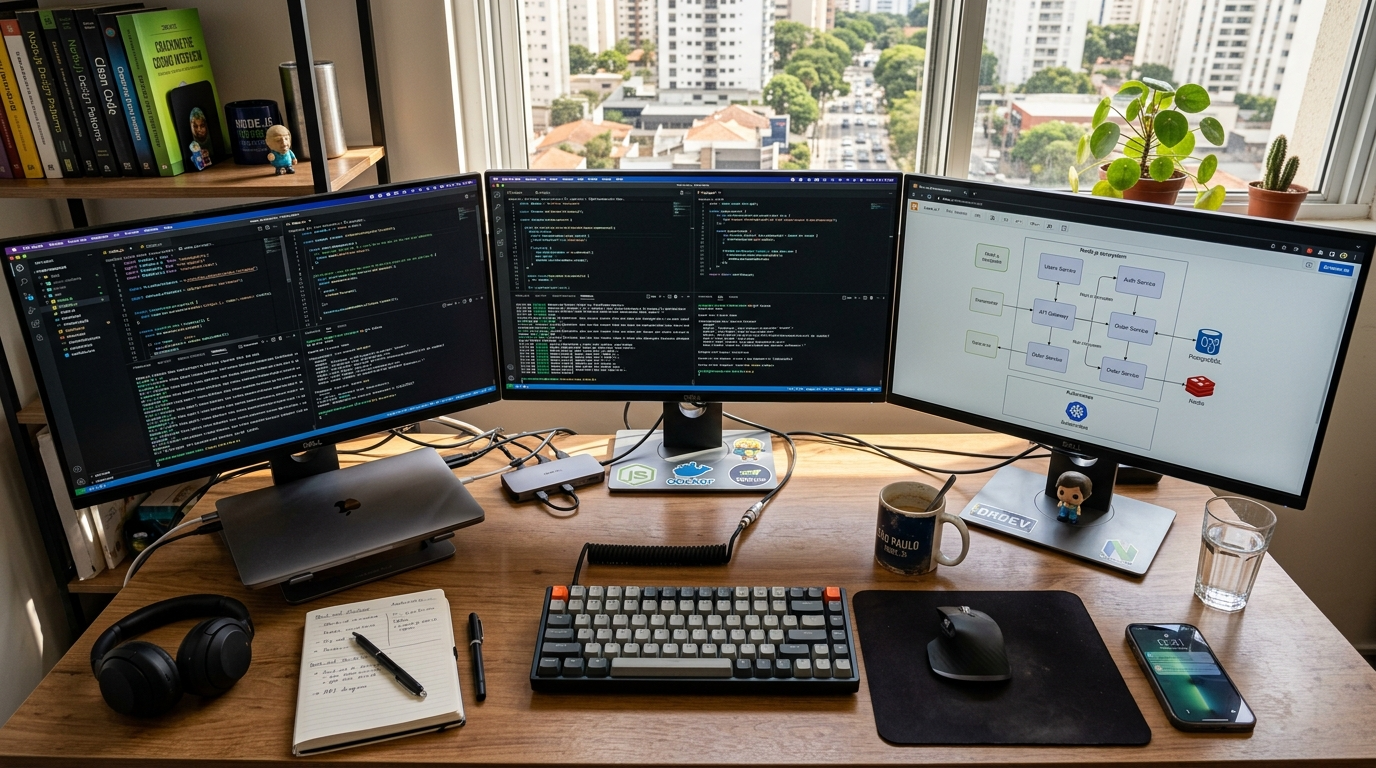
Brazil in particular has emerged as a Node.js talent hub worth understanding specifically. Brazilian developers have strong exposure to the Node.js ecosystem through a vibrant open-source community, major tech employers like Nubank and iFood who have normalized JavaScript at scale, and university curricula that have tracked JavaScript's rise for over a decade. If you want a Brazil-specific hiring lens, our post on how to hire a Brazilian software developer goes deep on what to expect from that talent market.
How the Rose Hiring Process Works — From Brief to First Commit
Speed matters in engineering hiring. Every week a Node.js role sits open is a week of sprint capacity your team doesn't have. Rose is designed to compress the timeline from decision to deployed developer to under two weeks for most roles.
Role Brief (Day 1)
You submit a role brief — stack specifics, seniority level, domain context (fintech, healthtech, SaaS, etc.), and team composition. Rose's technical team uses this to pull matched profiles from its pre-vetted Latin America candidate pool rather than starting a cold search.
Matched Profiles Delivered (Days 2–4)
You receive 2–3 shortlisted candidates who have already cleared the full Node.js technical screen and English proficiency assessment. Each profile includes a technical summary, assessment scores, and timezone/availability confirmation.
Your Interview (Days 4–6)
You run a final-round interview with your preferred candidate — cultural fit, technical depth on your specific use case, and team chemistry. Rose coordinates scheduling across timezones. Most clients make an offer same day.
Onboarded and Active (Day 7–10)
Rose handles contracting, payroll, HR setup, and NDA/IP agreements. Your developer gets access to their AI copilot and joins your first standup. You pay one flat $2,500/month — no recruiting invoice, no HR overhead, no separate payroll line item.
Ongoing Management
Rose continues as the employer of record. Performance issues, PTO coordination, equipment, and compliance are Rose's responsibility. If the developer isn't the right fit, Rose replaces them at no additional cost — no re-recruiting fee, no restart invoice.
According to SHRM (2023), the average cost of a bad technical hire is 50–200% of annual salary. For a senior Node.js engineer at $140,000/year, that is a $70,000–$280,000 mistake when you account for lost productivity, recruiting restart costs, and team disruption. Rose's replacement guarantee is the structural answer to that risk — not a marketing promise, a contractual mechanism built into how engagements work. You can explore how this applies across technical and operational roles on the Rose start page.
Nearshore Node.js: Strengths
- Real-time US timezone collaboration — 6–8 hrs live overlap daily
- English proficiency screened to 8/10+ before you see a profile
- Flat $2,500/month — recruiting, payroll, HR all included
- AI copilot trained on your toolchain ships with the developer
- Month-to-month terms — no long-term contract required
- Free replacement if the developer isn't the right fit
What to Plan For
- Requires a clear role brief — vague specs produce mis-matched candidates
- Physical on-site presence not possible (remote-only engagement)
- Niche ultra-specialized stacks (e.g., legacy COBOL integration) may have thinner candidate pools
The broader market data reinforces the nearshore direction. Remote developer roles now account for 58% of all software engineering job postings in the US, according to the Bureau of Labor Statistics (2024) — meaning the infrastructure, culture, and tooling to integrate remote engineers is already standard practice at most US tech companies. Nearshore is not a new operating model you need to build from scratch. It slots into what your team already does.