
Nearshore Python developers—based in Latin America and working US business hours—have become the default answer for US and Canadian tech teams that need senior-level backend talent without the $140,000+ fully-loaded salary of a domestic hire. If you've been burned by an 8-hour timezone gap with a distant offshore contractor, or sticker-shocked by a US engineering recruiter's fee, this guide is the practical alternative you've been looking for.
Python is now the most-used programming language in the world for the third year running, according to Stack Overflow's 2024 Developer Survey—which means the talent market for Python work is both deep in Latin America and fiercely competitive in the US. The arbitrage window is real, but only if you hire correctly. This guide walks you through what to look for, how to vet candidates, and how the nearshore model stacks up against every alternative in 2026.
What Is a Nearshore Python Developer—and Why Does It Matter in 2026?
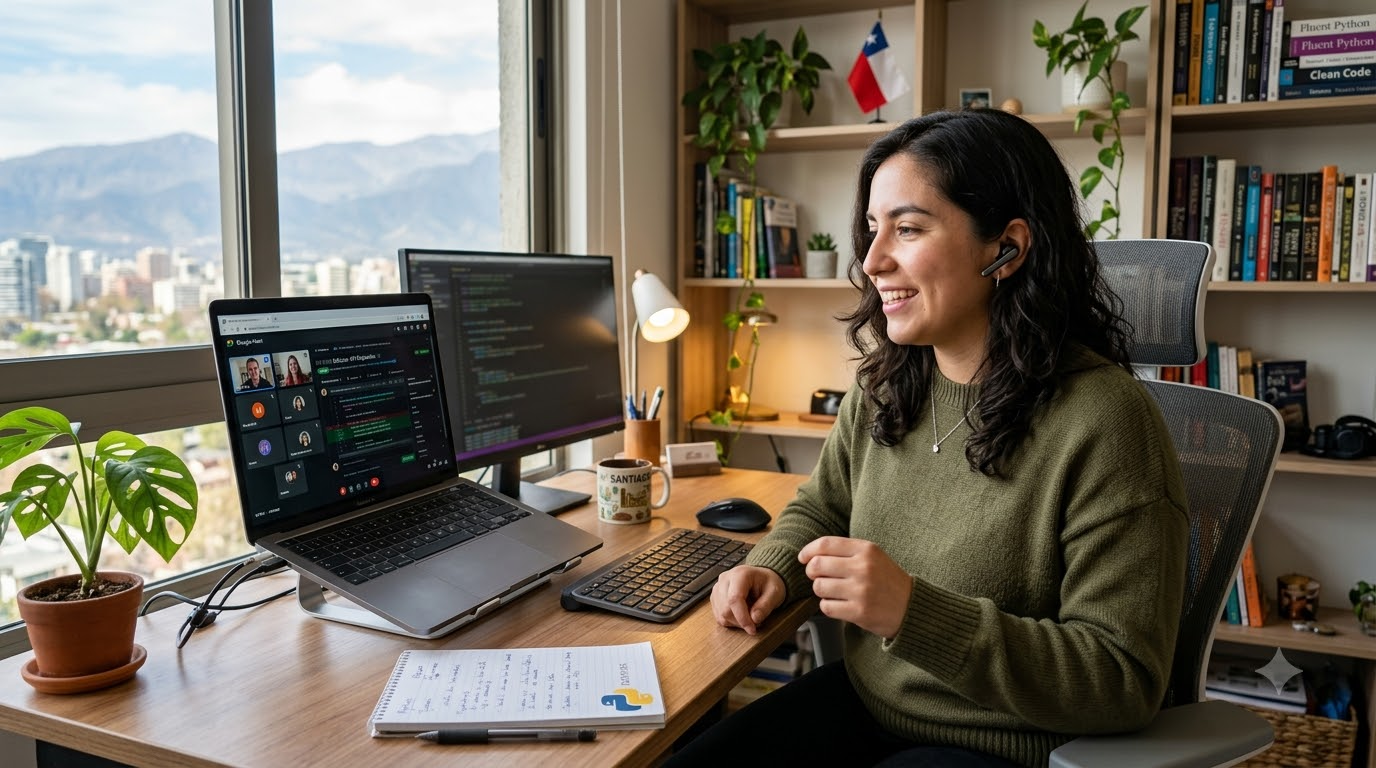
A nearshore Python developer is a software engineer based in a country geographically and culturally close to your own—typically Mexico, Colombia, Argentina, Brazil, or Costa Rica for US companies. "Nearshore" is distinct from "offshore" (which refers to regions such as Eastern Europe or parts of Asia) specifically because of timezone alignment: a developer in Medellín or Mexico City works the same 9-to-5 window as your team in Chicago or Austin, with zero or minimal offset.
This matters for Python work in particular because backend development is rarely a solo activity. Your Python developer will be in daily standups, reviewing pull requests with your senior engineers, and unblocking themselves on Slack. A developer operating many time zones away who goes dark at 2pm your time isn't really a team member—they're an asynchronous contractor. Nearshore closes that gap entirely.
How Nearshore Python Rates Compare to Onshore and Offshore in 2026
The cost math is the first thing every technical founder asks about—so let's be blunt. The median US software developer salary crossed $130,000 in 2024, according to the US Bureau of Labor Statistics, and that's before payroll taxes, benefits, equipment, or recruiter fees that typically run 15–20% of first-year salary. A fully-loaded senior Python developer in the US can easily cost $160,000–$180,000 per year when you add it all up.
Some hiring models advertise very low hourly rates, but the hidden costs pile up fast: asynchronous delays that double sprint cycles, high turnover from developers juggling multiple clients, and communication friction that senior US engineers end up spending real time managing. Latin American nearshore developers typically run $35–$55/hour on a direct-hire basis, but through a managed staffing model like Rose Talent Solutions, you get a flat $2,500/month that includes recruiting, vetting, payroll, HR, and ongoing management—no surprises on the invoice.
If you're evaluating multiple vendors, our breakdown of the best nearshore software development companies in 2026 covers what differentiators actually matter when comparing providers beyond the headline rate.
| Hiring Model | Typical Monthly Cost | Timezone Fit (US) | English Fluency | Avg. Ramp Time | Contract Flexibility |
|---|---|---|---|---|---|
| US Onshore (FTE) | $12,000–$15,000+ | ✅ Perfect | ✅ Native | 30–90 days | ❌ At-will + benefits overhead |
| Nearshore (Latin America) | $2,500 flat (Rose) | ✅ Same hours | ✅ 8/10+ screened | 3–7 days | ✅ No long-term contract |
| Offshore (distant time zones) | $800–$2,000 | ❌ 8–13 hr gap | ⚠️ Varies widely | 14–30 days | ⚠️ Often locked-in retainers |
| Freelance (Upwork/Toptal) | $3,500–$8,000 | ⚠️ Varies | ⚠️ Varies | 1–3 days | ✅ Flexible but no HR support |
What Skills Should You Demand When You Hire a Nearshore Python Developer?
Python is a broad language. A developer who's excellent at data pipelines may have never written a Django REST API—and vice versa. Before you post a role or brief a staffing partner, get specific about your stack. The four most common Python specializations US tech companies hire for nearshore are: backend web development (Django, FastAPI, Flask), data engineering (Pandas, PySpark, Airflow), machine learning / MLOps (scikit-learn, PyTorch, MLflow), and automation / scripting (Selenium, Playwright, Boto3 for AWS).
For backend and API work, insist on seeing pull request history—not just a portfolio site. A GitHub profile with consistent commit history, meaningful code comments, and real code review participation tells you far more than a resume bullet. For data engineering roles, ask candidates to walk through a pipeline they've built end-to-end: ingestion, transformation, scheduling, and monitoring. Vague answers here are a red flag.
"The best signal I've found for Latin American Python developers is whether they've contributed to open-source projects. It tells you they write code others will read, not just code that runs." — Gergely Orosz, Author of The Pragmatic Engineer and former engineering manager at Uber (2023)
Rose's AI copilot advantage means every developer we place ships with a role-specific AI assistant trained on their stack—whether that's FastAPI patterns, AWS Lambda deployments, or pandas data wrangling workflows. This isn't a chatbot bolted on. It's an actual productivity multiplier that lets a developer who knows your codebase get into flow state faster.
The single biggest mistake US tech teams make when hiring nearshore Python developers is treating the engagement like a freelance contract. The developers who compound value fastest are the ones treated as embedded team members—with access to your Jira board, your Slack channels, and your sprint planning calls from day one.
How Rose Talent Solutions Places Nearshore Python Developers: The 2026 Process
Most technical founders assume placing a vetted developer takes weeks of interviewing. Rose's process is built to compress that to under seven days—without cutting corners on vetting. Here's exactly how it works:
Role Intake Call (Day 1)
You walk us through your stack, team structure, and sprint cadence. We document the Python specialization you need—backend, data, ML, or automation—along with English fluency requirements and any domain knowledge (fintech, proptech, SaaS, etc.).
Candidate Sourcing & Screen (Days 1–4)
Our Latin America talent network surfaces pre-vetted Python developers who pass a technical screen, a live coding assessment, and an English proficiency interview scored to our published 8/10+ floor. You never see a candidate who hasn't passed all three gates.
Your Interview (Days 4–6)
You meet your shortlist—typically two to three candidates—in a 45-minute technical interview. Ask them to walk through your actual codebase or a realistic problem. This is your call, your standards.
Placement & Onboarding (Day 7)
Once you select your developer, Rose handles payroll, HR paperwork, and compliance on our end. Your developer shows up to your Monday standup with their AI copilot configured and ready to contribute.
Ongoing Management & Replacement Guarantee
If at any point the developer isn't the right fit, we replace them at no additional cost. Month-to-month terms mean you can cancel with 30 days written notice—no long-term contract, no penalty, no friction.
This structured approach is what separates a managed nearshore staffing partner from a raw freelance marketplace. Platforms like Upwork put the sourcing, screening, and management burden on you. Rose carries it. That's what the flat $2,500/month is paying for—not just a developer's time, but the entire infrastructure around keeping that developer productive and accountable.
If you're thinking about scaling beyond a single developer to a full pod, our guide to building a dedicated nearshore developer team covers how to structure multi-developer engagements for product squads and platform teams.
How to Evaluate Whether Nearshore Is the Right Model for Your Python Hiring in 2026
Nearshore staffing isn't the right answer for every situation. Here's an honest breakdown of when it works best—and where the model has limits.
Nearshore Python Hiring Works Best When…
- You need a developer embedded in daily standups and real-time Slack collaboration
- Your budget can't support a $130K+ US salary but you can't tolerate large timezone delays
- You want to scale up or down quickly without a long-term employment contract
- Your Python work touches customer-facing systems where turnaround speed matters
- You want recruiting, HR, and payroll off your plate entirely
Nearshore May Not Be Ideal If…
- Your project requires a Top 1% ML researcher with a niche academic background (use specialized academic networks instead)
- You have strict data residency laws requiring all computation on US soil (discuss compliance requirements upfront)
- Your team has no async documentation habits—nearshore works best with at least basic Confluence or Notion hygiene
The Latin American developer talent pool has grown significantly. According to Coursera's Global Skills Report 2024, Colombia, Mexico, and Brazil all rank in the top 20 globally for technology skill penetration, with Python and data science topping the list of most-completed professional certificates in all three countries. This is not a shallow talent pool—it's a deep, well-trained one with a growing share of developers who've worked on US product teams before.
For companies that also need financial operations support alongside their tech build, Rose's nearshore bookkeeping and accounting team can be staffed in parallel—useful for Series A and Series B startups running lean finance functions alongside product development.
When you're ready to move, the fastest path is to start your role intake with Rose—the call takes 30 minutes and your shortlist is typically ready within four business days. According to SHRM's 2024 Talent Acquisition Benchmarking Report, the average time-to-fill for a software developer role through traditional recruiting is 45 days. Rose's managed nearshore process cuts that to under one week for most Python roles.
The property management vertical is one area where Python automation developers have driven particularly measurable ROI for Rose clients—automating lease data extraction, maintenance ticket routing, and financial reporting that previously required manual entry across multiple platforms.
According to McKinsey's 2023 report on the economic potential of generative AI, software development is one of the top three functions where AI-augmented workers outperform non-augmented peers by the widest margin—making Rose's built-in AI copilot not a gimmick, but a direct productivity multiplier that compounds over the engagement. A nearshore Python developer from Latin America who ships with an AI assistant configured to your codebase conventions doesn't just cost less than a US hire—they can out-produce one in specific, measurable task categories within weeks.