
What Does "Nearshore" Mean for Bookkeeping in 2026?
Nearshore means hiring talent from a country in a similar or overlapping timezone to your own — specifically Latin America for US and Canadian businesses. A nearshore bookkeeper works your 9-to-5, speaks English fluently, and handles your books in real time. This is meaningfully different from offshore staffing, which typically means the Philippines or India — countries 11–14 hours ahead of US Eastern time.
For bookkeeping specifically, that timezone difference isn't a minor inconvenience. When your accountant flags a discrepancy at 2pm on a Tuesday, a nearshore bookkeeper can respond in the same working session. An offshore hire won't see that message until your next morning at the earliest — and that lag compounds across every reconciliation, every vendor call, every payroll question.
The nearshore staffing model has grown sharply as US businesses discovered that proximity and overlap matter more than raw cost savings when the work requires daily communication. According to SHRM's HR Benchmarking data (2024), the average US employer spends $4,700 in hard costs just to hire a single employee — before salary. Nearshore hiring sidesteps that entirely.
How Much Should You Pay a Bookkeeper in 2026? (US vs. Nearshore)
The honest answer depends entirely on what model you're using. US-based bookkeepers bill hourly for freelance work or command a salary for in-house roles. Nearshore bookkeepers through a staffing agency like Rose Talent Solutions' bookkeeping service are priced as a flat monthly rate — all-in, no surprises.
According to the US Bureau of Labor Statistics (2024), the median annual wage for bookkeeping, accounting, and auditing clerks in the United States is $47,440 — roughly $22.80/hr. But that's median. In high-cost metros, in-house bookkeepers earn $55,000–$70,000/year plus benefits. Freelance bookkeepers in platforms like Upwork or Bench typically charge $35–$75/hr depending on complexity.
At $2,500/month, a nearshore bookkeeper from Rose Talent Solutions comes out to roughly $14.42/hr for full-time work — with recruiting, vetting, payroll processing, HR management, and ongoing support included. You're not just buying labor. You're buying an operating system around the hire.

The 4 Types of Bookkeeping (And Which One You Actually Need)
Before hiring anyone — nearshore, freelance, or local — you need to know what type of bookkeeping your business actually needs. Most business owners conflate all four types and end up either over-hiring or under-hiring.
1. Single-entry bookkeeping is the simplest form: one line per transaction, like a checkbook register. Suited for solo freelancers or very small businesses with minimal transactions. No balance sheet produced.
2. Double-entry bookkeeping is the standard for any business with payroll, inventory, or investors. Every transaction hits two accounts (debit and credit). This is what QuickBooks and Xero are built around, and what almost every US business needs from day one.
3. Virtual/cloud bookkeeping isn't a separate accounting method — it describes where and how the work is done. Cloud-based books (QuickBooks Online, Xero, Wave) allow a nearshore bookkeeper to access your ledger in real time from Latin America with no friction.
4. Industry-specific bookkeeping refers to specialized chart-of-accounts setups and compliance requirements unique to your vertical. A restaurant tracks COGS and food waste differently than a contractor tracks job-costing. A nonprofit runs fund accounting. A property manager needs trust accounting compliance. Rose's property management virtual staff and bookkeeping team members are matched specifically by vertical, not just by general accounting skills.
Most small businesses think they need "a bookkeeper" when they actually need a double-entry cloud bookkeeper with specific software experience — QuickBooks Online, Xero, or a vertical platform like AppFolio or Buildium. Hiring generically is the single biggest reason the first hire doesn't work out.
Nearshore vs. Offshore vs. In-House vs. Freelance: 2026 Comparison
Business owners shopping for bookkeeping help in 2026 have four realistic models to choose from. Each has a different cost structure, risk profile, and daily experience. The table below breaks down what you're actually buying with each option.
| Model | Typical Cost | Timezone Overlap (US) | English Proficiency | Software Expertise | Flexibility |
|---|---|---|---|---|---|
| US In-House | $55K–$75K/yr + benefits | Full overlap | Native | Variable — you train them | Hard to exit (employment law) |
| US Freelance | $35–$75/hr | Full overlap | Native | Variable — you vet them | Easy to cancel, no dedicated hours |
| Offshore (Philippines/India) | $800–$1,500/mo | 11–14 hrs behind US East | Moderate (6–7/10 avg) | Variable, some platform gaps | Contract terms vary widely |
| Nearshore (Latin America) via Rose | $2,500/mo flat, all-in | Same hours (US EST/CST/PST) | 8/10+ screened floor | Role-specific AI copilot trained on your software | Month-to-month, 30-day notice, free replacement |
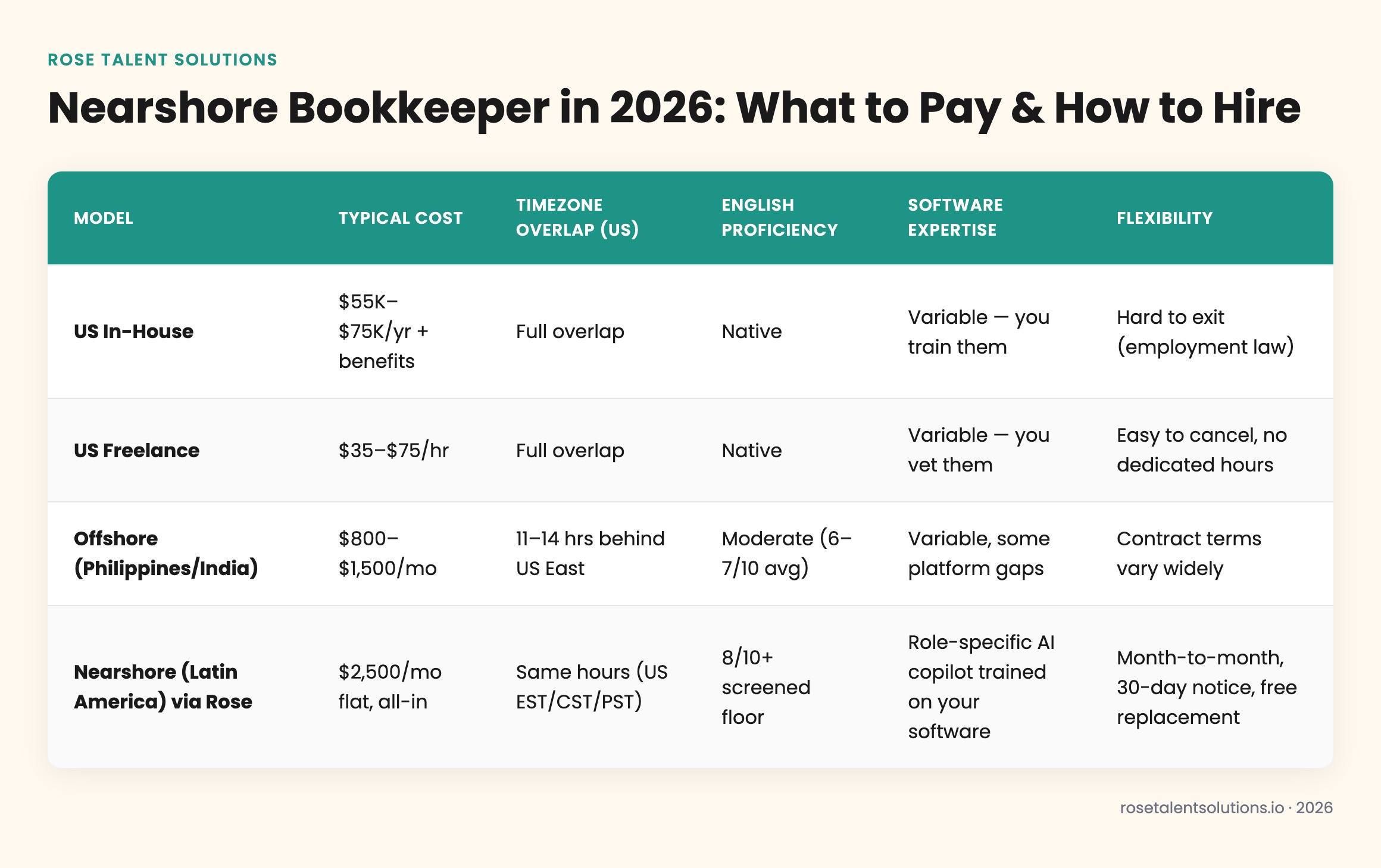
One detail worth calling out: Rose's AI advantage program pairs every placed bookkeeper with a role-specific AI copilot trained on their primary software stack — whether that's QuickBooks Online, Xero, AppFolio, or Buildium. That's not something a freelancer platform or a standard offshore agency offers. The ramp time difference is real.
How to Vet a Nearshore Bookkeeper Before You Hire (The Questions Nobody Tells You to Ask)
Regardless of which model you choose, vetting matters. A bookkeeper with the wrong software experience, poor English, or no industry exposure will cost you more in cleanup than they save. Here are the five things worth verifying before anyone touches your books.
1. Software fluency, not just familiarity. "I know QuickBooks" means nothing. Ask: "Walk me through how you handle a bank reconciliation when there are 12 uncleared transactions from last month." A skilled bookkeeper describes the workflow. A weak one describes the concept.
2. Industry exposure. Restaurant bookkeeping, contractor job-costing, property management trust accounting, and nonprofit fund accounting are four completely different disciplines. Ask specifically about your vertical. According to IRS guidance on business recordkeeping (2024), industry-specific records requirements differ substantially — a bookkeeper unfamiliar with your sector can create compliance problems you won't discover until tax season.
3. English communication under pressure. Book a live 20-minute call and give them a scenario: "A vendor calls and says our payment is 30 days late, but our records show it cleared. How do you handle that?" Communication quality under a realistic scenario is more predictive than a resume.
4. References from businesses at your scale. A bookkeeper who handled one-person freelance books isn't the same as one who's managed payroll, AP, and monthly closes for a 20-person company. Ask for references from similar-sized clients.
5. Red flags to disqualify immediately: Vague about which version of software they used, can't name the last account they reconciled, references aren't reachable, or no working knowledge of your state's payroll tax schedule.
Rose Talent Solutions runs all candidates through a multi-stage vetting process — including English proficiency screens with a published floor of 8/10 — before a candidate ever reaches a client. That's the structural difference between using a specialist nearshore staffing agency and hiring from a general freelance marketplace. Platforms like QX Accounting Services also operate in the remote accounting staffing space with an offshore India model, though their timezone overlap and English proficiency requirements differ from Rose's nearshore Latin America standard.

When Your Business Outgrows a Bookkeeper: 2026 Transition Signals
A bookkeeper records transactions, reconciles accounts, runs payroll, and produces reports. A CPA or controller interprets those reports, handles tax strategy, and makes forward-looking financial decisions. Many business owners keep a bookkeeper too long — or promote them mentally beyond their actual scope — and miss clear signals that a transition is needed.
Watch for these four transition signals:
- Revenue exceeds $1M/year. At this scale, tax strategy decisions — entity structure, retirement accounts, depreciation schedules — have material dollar impact. A bookkeeper can't make those calls.
- You're raising capital or seeking a business loan. Banks and investors require GAAP-compliant financials and an accountant or CPA to sign off on them. A bookkeeper produces the data; a CPA certifies it.
- Multi-state payroll or sales tax nexus. Once you hire employees or generate revenue in more than one state, compliance complexity escalates fast. This is CPA territory.
- You can't explain your own financials in a 5-minute conversation. If your books are accurate but you still don't understand your cash position or margin by product line, you need a fractional CFO or controller layer on top of bookkeeping — not a replacement, an addition.
The good news: a well-run nearshore bookkeeper setup makes the CPA transition easier, not harder. Clean, current books are the input every CPA wants. According to US Small Business Administration guidance on recordkeeping (2024), businesses with consistently maintained books pay significantly less in CPA fees because the cleanup work is already done.
Nearshore Bookkeeper: Best For
- Businesses needing full-time, dedicated bookkeeping at below-US cost
- Operators who want real-time communication in their own timezone
- Companies using QuickBooks Online, Xero, AppFolio, or Buildium
- Teams that want month-to-month flexibility without a long-term contract
- Owners who want recruiting, HR, and management handled for them
Nearshore Bookkeeper: Not Ideal If
- You need only 5–10 hours/week of bookkeeping (part-time freelance is cheaper)
- You require a licensed CPA signature on financial statements
- You want someone physically in your office for audit prep
- Your books are so simple a $20/mo app handles them automatically
How Rose Talent Solutions Places a Nearshore Bookkeeper in 7 Days
The staffing process at Rose is built for speed without cutting corners on fit. Most clients go from intake call to a placed, working bookkeeper in under seven business days.
Intake & Role Scoping
Rose maps your software stack, transaction volume, industry vertical, and communication preferences. This determines whether you need a general bookkeeper, an industry-specific one (e.g., property management trust accounting), or someone with controller-level AP/AR oversight experience.
Candidate Matching from Vetted Roster
Rose presents 1–3 pre-vetted candidates from Latin America who meet your role spec — all with 8/10+ English scores and verified software fluency. You review profiles and interview your top choice, typically within 2–3 business days.
AI Copilot Activation
Before day one, your bookkeeper's role-specific AI copilot is configured for your software stack. Whether that's QuickBooks Online, Xero, or a vertical platform, the AI accelerates ramp time on your specific chart of accounts and workflow.
Ongoing HR & Management — Handled
Rose manages payroll, compliance, performance check-ins, and HR for your bookkeeper. If the fit isn't right after placement, Rose replaces the team member at no additional cost. Month-to-month terms with 30 days' written notice to cancel — no long-term contract required.
For businesses already using Rose's bookkeeping and accounting virtual staff, the average time from signed agreement to a bookkeeper in your software tools is 5–7 business days. That's faster than posting a job on Indeed, reviewing applications, and scheduling first-round interviews for a local hire.