
Why Getting Outsourced SDR Onboarding Right in 2026 Matters More Than Ever
Nearshore SDRs can be generating qualified pipeline within their first month — but only if you structure onboarding intentionally. Most companies that struggle with outsourced sales development reps don't have a talent problem; they have a process problem. They hand over a contact list, point to a CRM, and expect results by week two. That approach fails whether you're working with an in-house hire or an external partner.
The stakes are real. According to SHRM (2023), the average cost of a bad sales hire runs 50–200% of annual salary — and SDR roles are among the highest-turnover positions in any revenue org. A botched 30-day ramp doesn't just cost you time; it costs you pipeline momentum, manager bandwidth, and often the rep themselves.
This guide walks you through a proven, week-by-week framework for how to onboard an outsourced SDR in 30 days — built specifically around the realities of working with nearshore talent on US business hours.
What Is a Nearshore Outsourced SDR — and How Does the Model Work in 2026?
A nearshore outsourced SDR is a full-time sales development representative based in Latin America who works your company's US business hours, communicates in fluent English, and operates as a dedicated extension of your revenue team — not a shared resource rotating across five other clients. The "nearshore" distinction matters: these reps work in overlapping time zones (typically GMT-3 to GMT-6), so your sales manager can run a morning standup, give real-time feedback on a call, and review sequences before lunch.
This is fundamentally different from an offshore SDR model where a rep in Manila or Bangalore is working while your team sleeps. If you're evaluating whether the outsourced model makes sense for your org at all, the outsourced vs. in-house SDR ROI comparison covers the full cost breakdown — but for this guide, we'll assume you've already made the decision to outsource and you need to make day 1 through day 30 count.
At Rose Talent Solutions, every nearshore SDR ships with a role-specific AI copilot trained on the tools in your stack — whether that's Salesforce, HubSpot, Apollo, Outreach, or Salesloft. That pre-trained context cuts the typical tool-ramp from 3–4 weeks down to 3–5 days in most cases. According to Salesforce's State of Sales report (2023), sales reps spend an average of 28% of their week on data entry and tool navigation — AI-assisted onboarding directly recaptures that time from the very first week.

How the 30-Day Outsourced SDR Onboarding Framework Works Week by Week
The best 30-day onboarding plans are structured around four distinct phases — each with a clear deliverable that signals whether the rep is ready to advance. Rushing any phase doesn't save time; it borrows problems and moves them into week five and six when they're much harder to correct. Here's the framework Rose Talent Solutions uses for every SDR placement.
Week 1: Foundation — ICP, Stack Access, and Company Context
Grant CRM access on day one, not day three. Walk the SDR through your ideal customer profile (ICP), your top 3 competitor differentiators, and your current best-performing sequence. End the week with a recorded role-play call reviewed by the hiring manager.
Week 2: Messaging and Tool Fluency
The SDR writes their first cold email sequence from scratch — you critique it. They shadow two to three live discovery calls. By Friday, they should be able to articulate your value proposition in under 30 seconds without notes.
Week 3: Live Prospecting with a Safety Net
The SDR begins outbound activity — targeting a reduced quota (typically 50–60% of full expectation). Your sales manager reviews all sent sequences on day 15 and provides written feedback. First booked meetings happen this week for most reps.
Week 4: Full Accountability and KPI Baseline
The SDR hits full activity targets: daily dials, emails sent, LinkedIn touches, and meetings booked. You record a KPI baseline this week that becomes the benchmark for month two performance reviews.
According to Gartner (2023), high-performing sales organizations are 2.2× more likely to have a structured, documented onboarding process than average performers. The companies that treat SDR onboarding as a repeatable system — not an improvised orientation — consistently hit quota faster and retain reps longer.
How Nearshore SDRs Compare to Offshore and In-House in 2026
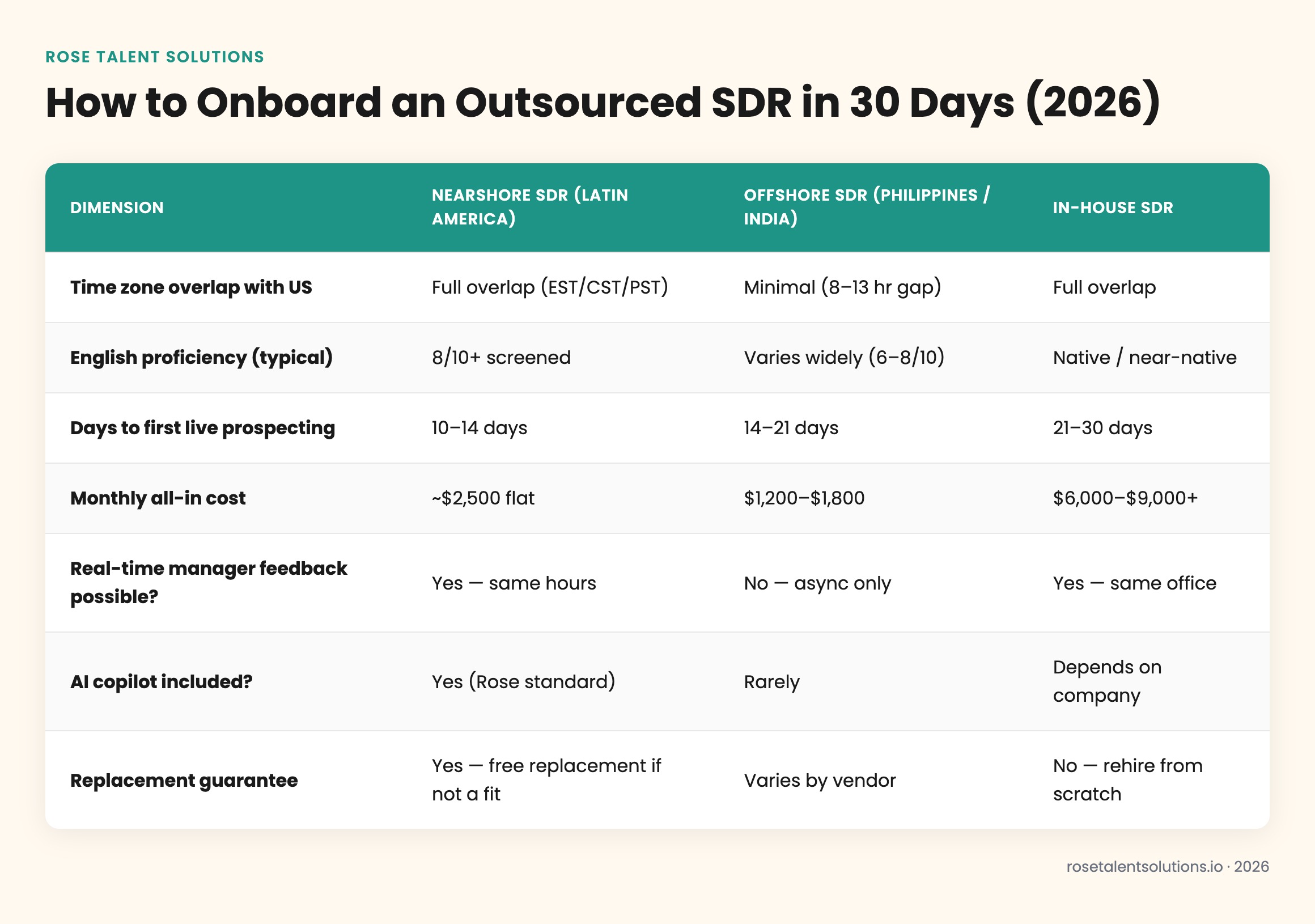
Not all outsourced SDR models onboard at the same speed. The table below compares the three most common hiring paths across the dimensions that matter most during a 30-day ramp. If you're still weighing your options, the guide on how to hire outsourced SDR services for SaaS companies goes deeper on vendor selection criteria.
| Dimension | Nearshore SDR (Latin America) | Offshore SDR (Philippines / India) | In-House SDR |
|---|---|---|---|
| Time zone overlap with US | Full overlap (EST/CST/PST) | Minimal (8–13 hr gap) | Full overlap |
| English proficiency (typical) | 8/10+ screened | Varies widely (6–8/10) | Native / near-native |
| Days to first live prospecting | 10–14 days | 14–21 days | 21–30 days |
| Monthly all-in cost | ~$2,500 flat | $1,200–$1,800 | $6,000–$9,000+ |
| Real-time manager feedback possible? | Yes — same hours | No — async only | Yes — same office |
| AI copilot included? | Yes (Rose standard) | Rarely | Depends on company |
| Replacement guarantee | Yes — free replacement if not a fit | Varies by vendor | No — rehire from scratch |
"The number one mistake I see sales leaders make with outsourced SDRs is treating them like a vendor relationship instead of a team member relationship. The ramp looks completely different when the manager shows up to day one with the same energy they'd bring for an internal hire." — Jacco van der Kooij, Founder at Winning by Design (2023)
How Cold Email Sequencing Fits Into 30-Day SDR Onboarding in 2026
Cold email is typically the highest-volume activity channel for an SDR in their first 30 days — and also the easiest to get wrong fast. Sequence quality in weeks two and three directly predicts whether your SDR hits their month-two meeting quota. A rep who ships poorly crafted emails in week two poisons deliverability, burns prospects, and builds bad habits that are hard to break later.
The right approach: have the SDR write their first sequence before they send a single email. Your sales manager reviews it against your top-performing historical sequences. Revise once. Send to a small batch (30–50 contacts). Analyze reply rates at day 10. Iterate before scaling. This loop — write, review, send small, analyze, iterate — is the same process our best-performing clients use, and it's covered in depth in the piece on how outsourced SDRs handle cold email at scale.
According to McKinsey (2023), personalized outreach sequences generate 5–8× higher reply rates than generic templated blasts — yet most SDRs default to templates because no one reviewed their first draft. Build the review checkpoint into your onboarding calendar on day 8, not as an afterthought.
LinkedIn data reinforces the same point: according to LinkedIn's State of Sales Report (2023), 89% of top-performing sales reps describe researching a prospect before outreach as "very important" — a habit that must be installed during onboarding, not after the first missed quota. The sequence review checkpoint on day 8 is where that habit gets built.
Your outsourced SDR's first cold email sequence is a training artifact, not just a sales tool. Treat it like a homework assignment you're grading — because the habits they build in week two are the habits they'll carry into month six.

How to Set KPIs and Accountability Checkpoints Without Micromanaging
One of the most common mistakes during outsourced SDR onboarding is swinging between two extremes: either zero accountability ("just figure it out") or over-monitoring that kills autonomy and morale. The sweet spot is structured checkpoints at predictable intervals with written KPI targets agreed upon before day one starts.
Here's what a healthy KPI ladder looks like across the 30-day ramp:
- Day 7: Role-play call scored on a 5-point rubric. Pass/fail gate before live prospecting begins.
- Day 14: First sequence reviewed. Open rate and reply rate benchmarked against your historical average.
- Day 21: Activity targets at 60% of full quota — dials, emails, LinkedIn outreach. First meeting booked expected.
- Day 30: Full activity targets active. KPI baseline set. Bi-weekly 1:1 cadence established for month two.
According to the U.S. Bureau of Labor Statistics (2023), sales representative roles have a median tenure of under three years — with the highest turnover concentrated in the first 90 days. Structured ramps with clear milestone checkpoints are one of the most evidence-backed retention interventions available to a sales leader. Build the checkpoints in before the SDR starts, not after the first miss.
Understanding the full cost picture also helps you calibrate expectations. The guide on outsourced SDR pricing and total cost breaks down what's included in flat-rate models versus hourly arrangements, so you know exactly what you're getting for $2,500/month.
What Works in 30-Day SDR Onboarding
- CRM access granted on day one
- Written ICP brief shared before the first meeting
- Sequence review checkpoint baked into the calendar
- Role-play gate before live prospecting begins
- Full-quota ramp starting day 22, not day 31
- Real-time manager availability during US hours
What Derails 30-Day SDR Onboarding
- Waiting until week two to grant tool access
- Skipping the ICP alignment session
- No sequence review — rep sends cold emails unsupervised
- Offshore model with 10+ hour time zone gap forcing async feedback
- No written KPI targets before day one
- Treating onboarding as orientation rather than a structured ramp
Rose Talent Solutions handles recruiting, vetting, payroll, HR, and ongoing management for every nearshore SDR placement — so your sales manager can focus entirely on the coaching and accountability steps above, not administrative logistics. Month-to-month terms with no long-term contract mean you can move fast, adjust quickly, and if the fit isn't right, we replace the team member at no additional cost. To see how the placement process works end-to-end, visit the get started page.